Report ID: 1459 |
Published Date: 29 Sep 2026 |
Report Format: |
Delivery Timeline: 48-72 Business Hours
Foot and Ankle Devices Market Outlook:
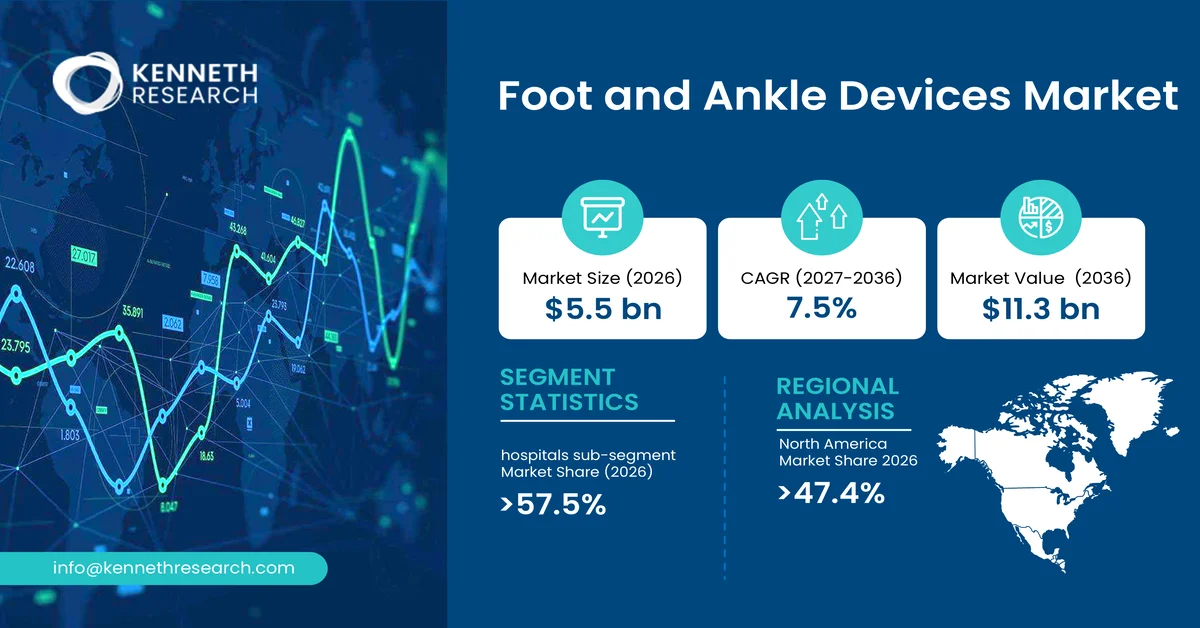
Foot and ankle devices market size was valued at USD 5.5 billion in 2026 and is projected to reach USD 11.3 billion by the end of 2036, rising at a CAGR of 7.5% during the forecast period, i.e., 2027–2036. In 2027, the industry size of the foot and ankle devices market is estimated at USD 5.9 billion.
A primary growth driver for the foot and ankle devices market is continued advancement in orthopedic device technology, including patient-specific instrumentation, fixation systems, and ankle arthroplasty solutions. Regulatory activity demonstrates ongoing development and commercialization of specialized devices designed to support surgical treatment of fractures, deformities, joint disorders, and complex reconstruction.
The foot and ankle devices market comprises medical devices used to diagnose, treat, stabilize, reconstruct, or replace structures of the foot and ankle. The market encompasses orthopedic implants and associated surgical devices, including fixation systems, plates, screws, prosthetic components, arthroplasty systems, and specialized instruments used during orthopedic procedures. U.S. Food and Drug Administration classifications identify ankle arthroplasty systems and their associated instrumentation as orthopedic medical devices intended to support implantation procedures.
Key characteristics of the market include application-specific device designs, diverse implant geometries and materials, and increasing use of specialized instrumentation to support anatomical alignment and surgical precision. Foot and ankle devices may be used for fracture fixation, bone fusion, osteotomy, reconstruction, joint replacement, and treatment of complex structural defects. FDA records also document dedicated foot fixation systems intended for fractures, fusions, and osteotomies.
Key Foot and Ankle Devices Market Insights Summary:
Key Takeaways: Market Trends & Insights
- Hospitals held the largest end-user share at 57.5% in 2026, supported by concentrated orthopedic specialists, operating-room infrastructure, diagnostic capabilities, implant inventories, and postoperative care
- The foot and ankle devices market was valued at USD 5.5 billion in 2026 and is projected to reach USD 11.3 billion by 2036, expanding at a 7.5% CAGR during 2027–2036
- North America accounted for the largest regional share at 47.4% in 2026, supported by established orthopedic healthcare infrastructure, specialized providers, advanced medical-device capabilities, and regulatory frameworks
Market Drivers
- Technological advancement in ankle arthroplasty and patient-specific devices
- Increasing demand for specialized orthopedic treatment
- Advancement in minimally invasive and precision-oriented orthopedic procedures
- Expansion of specialized fixation and reconstruction technologies
Challenges
- Regulatory and Clinical Evidence Requirements
- Procedure Complexity and Surgeon Training Requirements
Foot and Ankle Devices Market Overview & Supply Chain
Adoption of the foot and ankle devices market is increasing as healthcare systems address the clinical burden associated with fractures, degenerative conditions, deformities, trauma, and mobility-limiting musculoskeletal disorders. Technological progress in fixation systems, joint-replacement solutions, surgical instrumentation, and implant design is supporting more specialized treatment pathways and improving procedural options for orthopedic care.
The foot and ankle devices market value chain begins with specialized raw materials and component inputs, including medical-grade metals, polymers, ceramics, coatings, and precision-machined components. Material suppliers and component manufacturers provide inputs that must satisfy biocompatibility, mechanical-performance, traceability, and quality requirements. Device manufacturers then undertake product engineering, prototyping, machining, molding, surface treatment, assembly, sterilization, packaging, and quality assurance. Regulatory compliance is integrated throughout production because implants and associated instruments require authorization under applicable medical-device frameworks. Distribution typically moves through direct manufacturer sales, specialized orthopedic distributors, hospital procurement channels, and healthcare supply networks. End users include hospitals, ambulatory surgical facilities, orthopedic centers, and surgeons performing reconstructive, trauma, fusion, and joint-replacement procedures.
Foot and Ankle Devices Market - Growth Drivers & Challenges
Growth Drivers
- Technological Advancement in Ankle Arthroplasty and Patient-Specific Devices: Technological advancement in ankle arthroplasty and reconstruction is supporting adoption by expanding the range of surgical solutions available for complex foot and ankle conditions. Modern implants increasingly incorporate anatomical design principles, modular configurations, advanced fixation approaches, and patient-specific planning, enabling surgeons to address varied bone quality, deformity, instability, and revision requirements.
- Increasing Demand for Specialized Orthopedic Treatment: Growing demand for specialized orthopedic treatment is supporting the foot and ankle devices market as healthcare providers increasingly require solutions tailored to distinct anatomical and clinical conditions. Foot and ankle procedures encompass fracture fixation, fusion, reconstruction, deformity correction, and joint replacement, creating demand for differentiated implants and instruments rather than standardized orthopedic products.
Challenges
- Regulatory and Clinical Evidence Requirements: Foot and ankle device manufacturers face regulatory complexity because implants and surgical systems must satisfy jurisdiction-specific requirements covering safety, performance, manufacturing quality, labeling, and post-market surveillance. The root challenge is the need to demonstrate that increasingly sophisticated products provide appropriate clinical and technical performance while meeting different regulatory pathways across major healthcare markets.
- Procedure Complexity and Surgeon Training Requirements: The specialized anatomy of the foot and ankle creates a technical challenge because successful device utilization can depend on accurate implant selection, positioning, fixation, and surgical technique. The root cause is the anatomical variability and procedural complexity associated with fracture reconstruction, fusion, deformity correction, and ankle replacement. These factors can affect adoption when healthcare providers require experienced orthopedic specialists, appropriate instrumentation, operating-room capabilities, and structured training before introducing unfamiliar device platforms.
Foot and Ankle Devices Market Size and Forecast:
| Report Attribute | Details |
|---|---|
| Base Year |
2026 |
| Forecast Year |
2027-2036 |
| CAGR |
7.5% |
| Base Year Market Size (2026) |
USD 5.5 billion |
| Forecast Year Market Size (2036) |
USD 11.3 billion |
| Regional Scope |
|
Foot and Ankle Devices Market - Segment Analysis
End User Segment Analysis
In the end user segment, hospitals sub-segment is anticipated to capture the largest market share of 57.5% by the end of 2026.
Hospitals lead the end-user landscape because they concentrate orthopedic specialists, operating-room infrastructure, diagnostic capabilities, implant inventories, and postoperative care within an integrated clinical setting. Foot and ankle procedures frequently require coordinated surgical planning, specialized instrumentation, anesthesia, imaging, rehabilitation, and follow-up, making hospitals important purchasing and treatment centers. Demand is reinforced by the broad burden of musculoskeletal disorders and the increasing focus on fracture management and mobility restoration. The World Health Organization reported in 2023 that the number of people aged over 60 is expected to reach nearly 2.1 billion by 2050, highlighting a demographic shift associated with increasing healthcare needs among older populations.
Product Type Segment Analysis
The orthopedic implants and devices is projected to grow as the second-largest segment in the foot and ankle devices market due to four converging demand drivers.
Orthopedic implants and devices are projected to expand as demand increases for fixation, reconstruction, fusion, and joint-replacement procedures requiring specialized hardware. A key demand factor is the continuing clinical burden associated with injuries among older adults. Supply-side innovation is also broadening the segment: the FDA records recent clearances for dedicated ankle fusion cages and ankle fixation systems, demonstrating continued development of procedure-specific products. Increasing specialization, improved implant designs, and expanding procedural options should support adoption. Future growth is likely to depend on clinical evidence, surgeon familiarity, regulatory approvals, and manufacturers' ability to deliver anatomically targeted systems.
Our in-depth analysis of the Global foot and ankle devices market includes the following segments:
|
Segment |
Sub-segment |
|
Product Type |
|
|
Application |
|
|
End User |
|
Foot and Ankle Devices Market - Regional Analysis
North America Market Trends & Insights:
North America foot and ankle devices is projected to hold the largest revenue share of 47.4% by the end of 2026.
North America is the dominant regional market, supported by established orthopedic healthcare infrastructure, high procedural capacity, advanced medical-device manufacturing, and comparatively mature reimbursement and regulatory ecosystems. The region benefits from strong hospital networks, specialist orthopedic practices, established device-distribution channels, and sustained investment in surgical technologies.
The United States remains the key production, consumption, innovation, and investment center within North America, supported by manufacturers, specialized healthcare providers, research institutions, and regulatory capabilities.
Canada provides a complementary market characterized by public healthcare delivery and growing requirements associated with population aging. Together, both countries support regional demand through clinical infrastructure, specialist expertise, procurement systems, and device commercialization channels. Future regional development is likely to remain tied to orthopedic technology innovation, healthcare-capacity investment, regulatory developments, and adoption of increasingly specialized implants and surgical systems.
Asia Pacific Market Trends & Insights:
Asia Pacific presents substantial opportunities for the foot and ankle devices market as healthcare systems expand specialist orthopedic capacity, modernize hospital infrastructure, and strengthen domestic medical-device manufacturing. Demand is supported by improving access to surgical care, greater adoption of advanced orthopedic technologies, and investment in healthcare capabilities across major economies.
China is strengthening its medical-device ecosystem through regulatory modernization, manufacturing development, and initiatives supporting high-end medical-equipment innovation and clinical application. Its large healthcare system and established industrial base provide opportunities for both domestic and international device manufacturers.
India is developing a more integrated medical-device industry through the National Medical Devices Policy 2023, which emphasizes manufacturing infrastructure, regulatory streamlining, research and innovation, investment, and skilled workforce development. Together, China and India provide distinct opportunities across manufacturing, distribution, clinical adoption, and technology localization.
Foot and Ankle Devices Market Competitive Landscape
Here is a list of upstream, downstream, and key players operating in global foot and ankle devices market competitive ecosystem:
- Stryker Corporation (United States)
- Company Overview
- Business Strategy
- Key Product Offerings
- Financial Performance
- Key Performance Indicators
- Risk Analysis
- Recent Development
- Regional Presence
- SWOT Analysis
- Zimmer Biomet Holdings, Inc. (United States)
- CONMED Corporation (United States)
- Enovis Corporation (United States)
Recent Developments
- In January 2026, Zimmer Biomet Holdings, Inc. announced the commercial launch of the Brachiator™ Mini-Rail External Fixation System through its subsidiary Paragon 28. The platform is designed for precise, multi-planar correction, rapid construct assembly, and workflow efficiency for the correction of bone deformities and stabilization of fractures of the foot and ankle. It expands the company's external fixation portfolio into the forefoot and midfoot, featuring built-in in-plane and out-of-plane rotational control that enables surgeons to perform fine, multi-axis reduction even after pins are placed.
- In September 2025, Enovis Corporation debuted the Pecaplasty® “Wires First” System for percutaneous bunion surgery at the AOFAS 2025 annual meeting. The system is a second-generation platform building on the legacy of Novastep®, designed to help surgeons achieve reproducible outcomes through an intuitive technique. The “wires first” approach provides a simple and predictable modality for minimally invasive bunion correction.
Frequently Asked Question
In 2026, the foot and ankle devices market exceeded USD 5.5 billion.
The foot and ankle devices market is projected to reach USD 11.3 billion by the end of 2036, expanding at a CAGR of 7.5% over the forecast period (2027-2036).
The leading companies are not provided in the existing market intelligence data.
In the End User segment, the Hospitals sub-segment is anticipated to capture the largest market share of 57.5% in the future and exhibit lucrative growth opportunities during 2027-2036. This growth trajectory is largely attributed to the concentration of orthopedic specialists, operating-room infrastructure, diagnostic capabilities, implant inventories, and postoperative care within hospitals.
North America is projected to hold the largest market share of 47.4% by the end of 2026 and provide more business opportunities in the future. Continuous investment in advanced orthopedic healthcare infrastructure and specialized medical-device capabilities across the United States and Canada is supporting the region's market position.
Why Choose Kenneth Research ?
-
Insight with Impact : We don’t just gather data — we uncover stories, trends, and opportunities that fuel business growth.
-
Experts Who Get It : Our team speaks your industry’s language and knows what really matters to your customers and market.
-
Custom-Built for You : Forget one-size-fits-all. We craft research and consulting solutions as unique as your business vision.
-
Partners, Not Just Providers : We work with you, not for you — collaborating closely to turn insights into smart, strategic moves.
-
Results That Speak : Our work powers brands, startups, and industry leaders alike — with a track record of ideas that work in the real world.
Report ID: 1459 |
Published Date: 29 Sep 2026 |
Report Format: |
Delivery Timeline: 48-72 Business Hours

Copyright © 2025 Kenneth Research. All rights reserved. Terms of Use | Privacy Policy
