Report ID: 1209 |
Published Date: 01 Sep 2026 |
Report Format: |
Delivery Timeline: 48-72 Business Hours
Floating Offshore Wind Power Market Outlook:
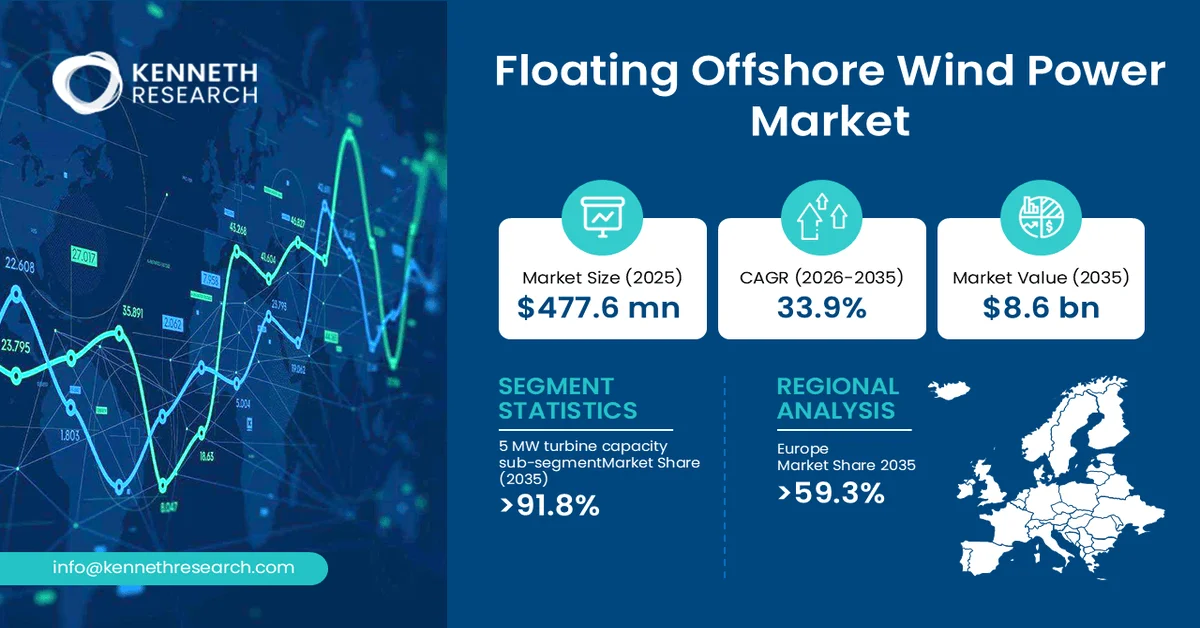
Floating Offshore Wind Power Market size was valued at USD 477.6 million in 2025 and is projected to reach USD 8.6 billion by the end of 2035, rising at a CAGR of 33.9% during the forecast period, i.e., 2026-2035. In 2026, the industry size of floating offshore wind power is estimated at USD 620.3 million.
The primary growth driver for the floating offshore wind power market is the ability to unlock high-quality offshore wind resources in deeper waters where conventional fixed-bottom foundations become impractical. This expands viable development areas, strengthens offshore renewable-energy potential, and supports decarbonisation strategies while creating opportunities for industrial-scale floating wind supply chains.
The floating offshore wind power market comprises the development, manufacturing, deployment, operation, and maintenance of wind-power systems installed offshore on floating foundations rather than structures fixed directly to the seabed. The technology combines conventional wind turbines with buoyant floating platforms, mooring systems, anchors, electrical infrastructure, and associated installation and servicing capabilities.
A defining characteristic is the ability to position wind turbines in deeper marine environments where seabed-fixed foundations are technically or economically less suitable. Floating configurations can therefore broaden the geographic area available for offshore wind development and provide access to stronger or more consistent offshore wind resources. Common platform concepts include semi-submersible structures, spar buoys, tension-leg platforms, and other buoyancy-based configurations.
Key Floating Offshore Wind Power Market Insights Summary:
Key Takeaways: Market Trends & Insights
- Floating Offshore Wind Power Market is projected to reach USD 8.6 billion by 2035, expanding at a CAGR of 33.9% during 2026-2035
- Above 5 MW turbine capacity is projected to remain the leading turbine capacity segment, accounting for 91.8% market share by 2035
- Europe is projected to dominate the floating offshore wind power market with a 59.3% market share by 2035
- Deep Water is identified as the fastest-growing analysis segment as developers target deeper marine areas where fixed-bottom foundations face technical constraints
- North America represents a significant secondary opportunity, with the United States and Canada advancing floating wind development through offshore infrastructure, regulatory frameworks, engineering capabilities, and supply-chain initiatives
Market Drivers
- Expansion into deep-water wind resources
- Industrialisation of floating wind technology
- Government-led offshore wind deployment and supply-chain development
- Advances in floating platform, mooring, transmission, and installation technologies
Challenges
- Insufficient port and installation infrastructure
- Technology standardisation and integration complexity
Floating Offshore Wind Power Market Overview & Supply Chain
Adoption of floating offshore wind is increasing as developers seek to access deeper-water wind resources that cannot be efficiently served by conventional fixed-bottom foundations. The technology is particularly relevant to countries with constrained shallow-water availability, while its development is also strengthening the industrial links between offshore engineering, shipbuilding, turbine manufacturing, ports, subsea infrastructure, and renewable-energy generation. Regulatory support, decarbonisation objectives, energy-security priorities, and technological advances in floating foundations are encouraging governments and industry participants to establish new deployment pathways. The European Commission identifies floating wind as an emerging offshore-wind segment capable of expanding deployment into deeper waters and reports that the EU had 18.9 GW of cumulative offshore wind capacity across 11 countries.
The floating offshore wind power market value chain begins with raw materials and specialised inputs, including steel or concrete for floating platforms, composites, electrical equipment, mooring lines, anchors, cables, and turbine components. Engineering and manufacturing participants then design and fabricate floaters, turbines, substations, mooring systems, and balance-of-plant equipment, with integration frequently requiring specialised yards and port infrastructure. Distribution is primarily project-based, involving marine logistics providers, heavy-lift and installation contractors, vessel operators, cable suppliers, and offshore construction specialists. Project developers and utilities coordinate procurement, financing, permitting, grid connection, construction, and long-term operations. End users are primarily electricity generators, utilities, energy companies, and grid-connected power systems seeking offshore renewable generation.
Floating Offshore Wind Power Market: Growth Drivers & Challenges
Growth Drivers:
- Expansion into deep-water wind resources: Floating foundations enable offshore wind developers to move beyond seabed conditions suitable for fixed-bottom turbines, materially expanding the geographic scope of offshore renewable generation. This capability is particularly important in markets where deep coastal waters limit conventional offshore-wind development. The U.S. Department of Energy states that about two-thirds of U.S. offshore wind energy potential is located in waters too deep for today’s fixed-bottom foundations, directly highlighting the resource-access advantage of floating technology. This creates a strong pathway for project development along deeper-water coastlines and supports demand for floating platforms, mooring systems, dynamic cables, specialised vessels, and offshore engineering services.
- Industrialisation of floating wind technology: Industrialisation is increasingly shifting floating offshore wind from project-specific engineering toward more repeatable manufacturing and deployment models. Improvements in platform design, turbine integration, mooring arrangements, port handling, installation techniques, and digital monitoring can reduce engineering complexity and improve project execution. Standardisation also creates opportunities for shipyards, fabrication facilities, ports, component manufacturers, and offshore-service providers to adapt existing capabilities to floating wind. As developers gain experience across demonstration and commercial projects, suppliers can build specialised production processes and develop more predictable procurement structures. This industrial learning can improve bankability and support larger project configurations over time.
Challenges:
- Insufficient port and installation infrastructure: A fundamental restraint is the limited availability of ports capable of handling the fabrication, assembly, integration, maintenance, and deployment requirements of large floating structures. The root cause is a mismatch between existing maritime infrastructure and the physical logistics of floating wind, compounded by uncertainty over project timing that can discourage early port investment. This creates bottlenecks across project development because inadequate quayside space, lifting capability, channel access, and fabrication capacity can constrain where projects are assembled and how efficiently components are moved offshore. Commercially, developers may face higher logistics complexity, longer project schedules, and greater dependence on specialised facilities.
- Technology standardisation and integration complexity: Floating offshore wind remains constrained by the difficulty of integrating multiple interdependent technologies into commercially repeatable project architectures. Platform configuration, turbine selection, mooring and anchoring systems, dynamic cables, controls, and power-delivery infrastructure must operate as an integrated system under demanding marine conditions. The root cause is that floating wind has not yet converged around a universally established design and manufacturing model, making project engineering highly site-specific. This can increase technical due-diligence requirements, complicate procurement, and make suppliers cautious about committing to dedicated production capacity before technology pathways become clearer. Developers may consequently face greater integration and execution risk when moving from demonstration projects to commercial arrays.
Floating Offshore Wind Power Market Size and Forecast:
| Report Attribute | Details |
|---|---|
| Base Year |
2025 |
| Forecast Period |
2026-2035 |
| CAGR |
33.9% |
| Base Year Market Size (2025) |
USD 477.6 million |
| Forecast Year Market Size (2035) |
USD 8.6 bllion |
| Regional Scope |
|
Floating Offshore Wind Power Market Segmentation Analysis:
Turbine Capacity Segment Analysis
In the turbine capacity segment, the above 5 MW turbine capacity sub-segment is anticipated to capture the largest market share of 91.8% by the end of 2035.
The above 5 MW turbine capacity segment dominates because floating offshore wind projects increasingly favour high-capacity turbines that can generate more electricity from each floating unit while reducing the number of turbines, foundations, mooring connections, and associated balance-of-system components required for a project. Larger turbines are particularly attractive offshore, where installation, maintenance, and marine logistics are costly and where higher output per unit can improve project configuration efficiency. The U.S. Department of Energy reported that the average offshore wind turbine capacity installed in 2021 was 7.4 MW, demonstrating that offshore deployment had already moved beyond the lower-capacity range. This technology trajectory supports continued adoption of larger turbine configurations in floating projects.
Water Depth Segment Analysis
The deep water is projected to grow as the second-largest segment in the floating offshore wind power market due to four converging demand drivers.
The deep water sub-segment is projected to grow as offshore wind developers increasingly target marine areas where conventional fixed-bottom foundations become technically constrained. Deeper-water locations can provide access to stronger wind resources while substantially expanding the pool of developable offshore sites, particularly in countries with limited shallow-water areas. Government policy is also moving toward technologies capable of exploiting these locations. Adoption is consequently shifting toward integrated floating systems capable of operating farther offshore, while suppliers are developing platform, anchoring, cable, and installation technologies suited to deeper environments.
Our in-depth analysis of the global floating offshore wind power market includes the following segments:
|
Segment |
Sub-segment |
|
Axis |
|
|
Water Depth |
|
|
Turbine Capacity |
|
Floating Offshore Wind Power Market Regional Insights:
Europe Market Trends & Insights:
Europe floating offshore wind power market is projected to hold the largest revenue share of 59.3% by the end of 2035.
The region benefits from established turbine and component manufacturing, specialised ports, offshore construction expertise, and experienced utilities and project developers. Regulatory support remains a major catalyst: the European Commission reported that EU Member States agreed in 2024 on an ambition of approximately 88 GW of offshore renewable generation capacity by the end of the decade, reinforcing long-term investment visibility for the sector.
The UK represents a strategically important European market because of its mature offshore-wind industry, established seabed leasing framework, CfD mechanism, specialised supply chain, and explicit policy support for floating technology. Its combination of deep-water resource potential and industrial offshore expertise positions it as a key commercialisation centre for floating wind.
France is developing floating offshore wind as a means of expanding offshore generation into deeper Mediterranean and Atlantic waters. Government-backed planning, pilot development, port capabilities, and industrial participation are creating a foundation for larger-scale deployment, while floating technology provides an avenue to access sites unsuitable for conventional fixed-bottom projects.
North America Market Trends & Insights:
North America is emerging as an important floating offshore wind market as governments and developers seek to unlock deeper-water resources, strengthen domestic clean-energy supply chains, and expand offshore generation near major coastal demand centres. Industrial activity is increasingly centred on port redevelopment, floating-platform engineering, transmission planning, environmental assessment, and workforce development. In the United States, federal agencies are coordinating leasing, technology development, transmission planning, and supply-chain initiatives through the Floating Offshore Wind Shot, while state-level programmes are supporting regional project ecosystems.
The U.S. is positioned as the region's principal commercialisation market, particularly along the Pacific Coast, where deep waters favour floating foundations. Federal leasing activity and investment in ports, vessels, transmission, research, and domestic manufacturing are building the infrastructure required for future projects.
Canada is developing an enabling framework for offshore wind, with Atlantic provinces at the centre of early activity. Federal and provincial authorities are advancing regional assessments, offshore renewable-energy legislation, transmission studies, marine-data programmes, and community engagement. These initiatives create opportunities for Atlantic Canada's ports, marine-services companies, utilities, engineering firms, and clean-energy developers.
Leading Companies Operating in the Global Floating Offshore Wind Power Market:
Here is a list of upstream, downstream, and key players operating in the global floating offshore wind power market competitive ecosystem:
- GE Vernova (United States) Company Overview
- Business Strategy
- Key Product Offerings
- Financial Performance
- Key Performance Indicators
- Risk Analysis
- Recent Development
- Regional Presence
- SWOT Analysis
- Siemens Gamesa Renewable Energy (Spain)
- Vestas Wind Systems A/S (Denmark)
- Mingyang Smart Energy Group Co., Ltd. (China)
- Xinjiang Goldwind Science & Technology Co., Ltd. (China)
- Envision Energy (China)
Recent Developments
- In October 2025, Xinjiang Goldwind Science & Technology successfully installed the GWH252-16-F floating wind turbine in Beihai, Guangxi, setting new world records for the largest single-unit capacity and rotor diameter among installed floating offshore wind turbines. The turbine is expected to generate 44.65 million kilowatt-hours annually, meeting the power needs of more than 24,000 households.
- In November 2025, Mingyang Smart Energy Group partnered with Buhawind Energy Northern Luzon Corp. to conduct a joint feasibility study for a planned 2GW offshore wind project in Ilocos Norte, Philippines. The collaboration will evaluate Mingyang's offshore wind turbine technologies for local wind conditions and prepare cost estimates for the development.
Frequently Asked Question
In 2026, the floating offshore wind power market exceeded USD 620.3 million.
The floating offshore wind power market is projected to reach USD 8.6 billion by the end of 2035, expanding at a CAGR of 33.9% over the forecast period (2026-2035).
The major players in the market are GE Vernova, Siemens Gamesa Renewable Energy, Vestas Wind Systems A/S, Mingyang Smart Energy Group Co., Ltd., Xinjiang Goldwind Science & Technology Co., Ltd., Envision Energy, and others.
In the Turbine Capacity segment, the Above 5 MW Turbine Capacity sub-segment is anticipated to capture the largest market share of 91.8% in the future and exhibit lucrative growth opportunities during 2026-2035. This growth trajectory is largely attributed to the higher electricity generation potential of larger turbines, which can improve project configuration efficiency in offshore environments.
Europe is projected to hold the largest market share of 59.3% by the end of 2035 and provide more business opportunities in the future. Continuous investments and strong offshore-wind policy support in the United Kingdom and France are fostering the region's dominance.
Why Choose Kenneth Research ?
-
Insight with Impact : We don’t just gather data — we uncover stories, trends, and opportunities that fuel business growth.
-
Experts Who Get It : Our team speaks your industry’s language and knows what really matters to your customers and market.
-
Custom-Built for You : Forget one-size-fits-all. We craft research and consulting solutions as unique as your business vision.
-
Partners, Not Just Providers : We work with you, not for you — collaborating closely to turn insights into smart, strategic moves.
-
Results That Speak : Our work powers brands, startups, and industry leaders alike — with a track record of ideas that work in the real world.
Report ID: 1209 |
Published Date: 01 Sep 2026 |
Report Format: |
Delivery Timeline: 48-72 Business Hours

Copyright © 2025 Kenneth Research. All rights reserved. Terms of Use | Privacy Policy
