Report ID: 1247 |
Published Date: 14 Sep 2026 |
Report Format: |
Delivery Timeline: 48-72 Business Hours
Floating LNG Power Plant Market Outlook:
Floating LNG Power Plant Market size was valued at USD 671.4 million in 2026 and is projected to reach USD 913.4 million by the end of 2036, rising at a CAGR of 3.1% during the forecast period, i.e., 2027–2036. In 2027, the industry size of the Global floating LNG power plant market is estimated at USD 693.9 million.
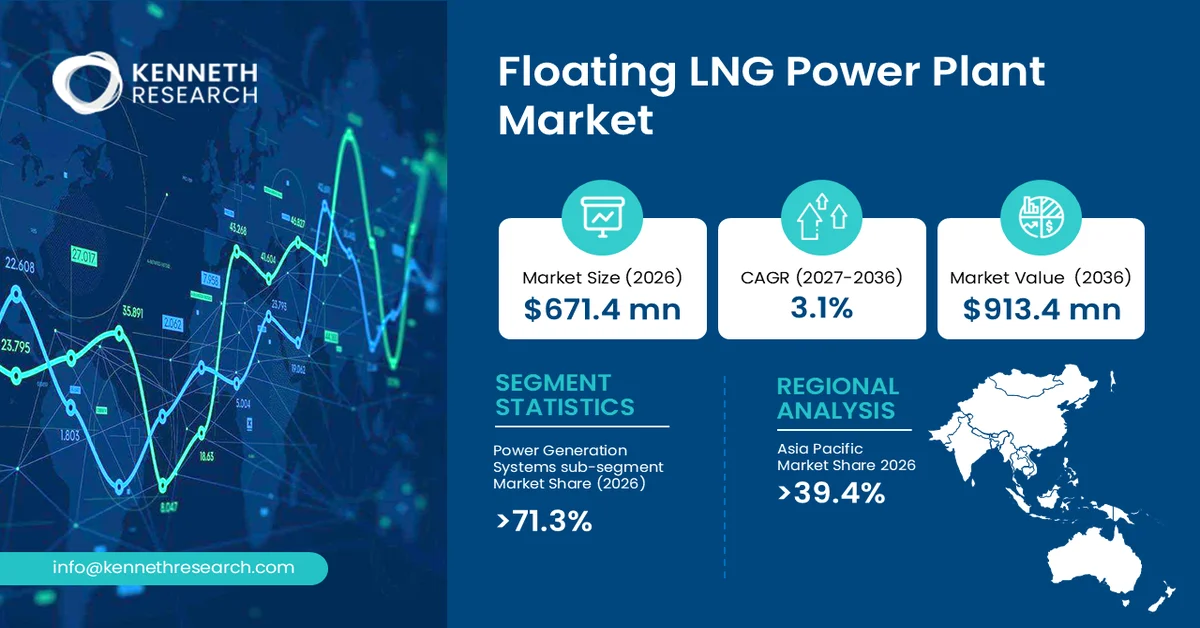
The primary growth driver is rising demand for flexible electricity infrastructure in markets seeking secure access to natural gas. Floating LNG power plants combine LNG-based fuel supply, onboard or connected power-generation equipment, and marine mobility, enabling electricity generation where conventional land-based fuel infrastructure is constrained or costly to develop.
The floating LNG power plant market comprises floating or marine-based energy systems that use liquefied natural gas (LNG) as a fuel source to generate electricity for coastal, offshore, island, remote, or infrastructure-constrained markets. These systems integrate LNG receiving, storage or handling capabilities with power-generation equipment and associated electrical, marine, control, and utility systems, depending on project configuration.
A defining characteristic is their floating architecture, which allows generation capacity and associated fuel infrastructure to be deployed on vessels, barges, or other marine platforms rather than being entirely constructed onshore. This configuration can support modular deployment, relocation, and integration with existing or newly developed electricity infrastructure.
Key Floating LNG Power Plant Market Insights Summary:
Key Takeaways: Market Trends & Insights
- 671.4 million market value in 2026 with the floating LNG power plant market projected to reach 913.4 million by 2036
- 3.1% CAGR expected for the floating LNG power plant market during 2027–2036
- Power Generation Systems leads the Component segment with a 71.3% market share in 2026
- Power Ship represents the second and fastest analysis segment within the Plant Type category
- Asia Pacific dominates with a 39.4% market share in 2026 supported by opportunities across China and Japan
Market Drivers
- Expansion of global electricity demand and the need for additional dispatchable generation capacity
- Growing demand for flexible and rapidly deployable power infrastructure
- Expansion of LNG import terminals, marine fuel logistics, and regasification infrastructure
- Increasing electrification of industrial, commercial, and remote energy-intensive operations
Challenges
- Complex Offshore Permitting and Multi-Agency Approvals
- LNG Supply Dependence and Infrastructure Integration
Floating LNG Power Plant Market Overview & Supply Chain
Adoption of floating LNG power plants is increasing as energy systems seek dispatchable generation that can be deployed without the extensive land-based infrastructure associated with conventional power projects. Their floating configuration can integrate LNG handling and power-generation equipment, making the model relevant to coastal markets, islands, remote industrial zones, and locations where pipeline access or rapid infrastructure deployment is challenging. Technological advances in gas turbines, marine engineering, LNG regasification, control systems, and modular power-generation packages are strengthening deployment flexibility. The energy-sector relevance is reinforced by continued reliance on natural gas for electricity: the U.S. Energy Information Administration reports that natural gas accounted for about 43% of total U.S. utility-scale electricity generation in 2023.
The value chain begins with upstream natural-gas producers and LNG suppliers that provide the fuel feedstock, alongside manufacturers supplying steel, cryogenic equipment, turbines, generators, pumps, valves, electrical systems, and marine components. Engineering, procurement, and construction companies then integrate these inputs into floating power platforms, combining LNG storage or receiving systems, regasification equipment, generation units, electrical infrastructure, and marine systems. Specialized shipyards and fabrication facilities support vessel or barge construction, conversion, module integration, and commissioning. Distribution involves LNG shipping, marine logistics, terminal operators, fuel suppliers, and transmission or grid infrastructure providers.
Floating LNG Power Plant Market - Growth Drivers & Challenges
Growth Drivers
- Accelerating Global Electricity Demand and Gas-Fired Generation: Rising electricity consumption is strengthening demand for flexible generation technologies that can be deployed close to constrained grids and coastal load centers. Floating LNG power plants benefit because they combine marine deployment with gas-fired generation, allowing developers to add dispatchable capacity without constructing an entirely land-based fuel and power complex. Future project development is likely to emphasize rapid deployment, fuel flexibility, integration with existing grids, and the ability to serve geographically constrained electricity markets.
- Growing Need for Flexible and Rapidly Deployable Power Infrastructure: The increasing need to strengthen electricity security is creating opportunities for floating generation solutions that can be deployed without the lengthy land acquisition, pipeline construction, and conventional plant-development processes associated with some onshore projects. Floating LNG power plants can consolidate power-generation and marine infrastructure into relocatable or purpose-built platforms, making them particularly relevant for islands, coastal economies, remote industrial developments, and regions experiencing temporary or structural generation shortages. Their modular configuration can also support phased capacity additions and potentially allow assets to be redeployed as electricity requirements change.
Challenges
- Complex Offshore Permitting and Multi-Agency Approvals: Floating LNG power projects face complex approval pathways because they combine LNG handling, marine infrastructure, power generation, subsea connections, and offshore operations within a single development. The root cause is overlapping jurisdiction among energy, maritime, environmental, pipeline, and local authorities. For developers, this can extend project-development schedules, increase engineering requirements, and create additional stakeholder-management obligations before construction can begin. The commercial impact is particularly significant for projects requiring subsea pipelines, marine berths, transmission connections, or environmentally sensitive offshore locations, where design changes during permitting can increase development costs.
- LNG Supply Dependence and Infrastructure Integration: Floating LNG power plants remain dependent on reliable LNG procurement, marine transportation, storage or regasification arrangements, and connection to electricity infrastructure. The root cause is the integrated nature of the operating model: disruption in any part of the LNG-to-power chain can affect generation availability. Projects therefore require coordinated fuel contracting, shipping logistics, terminal operations, power-generation equipment, and grid or industrial connections. Commercially, this creates exposure to fuel-supply negotiations, marine logistics constraints, infrastructure compatibility requirements, and long-term contractual commitments.
Floating LNG Power Plant Market Size and Forecast:
| Report Attribute | Details |
|---|---|
| Base Year |
2026 |
| Forecast Year |
2027-2036 |
| CAGR |
3.1% |
| Base Year Market Size (2025) |
USD 671.4 million |
| Forecast Year Market Size (2035) |
USD 913.4 million |
| Regional Scope |
|
Floating LNG Power Plant Market - Segment Analysis
Component Segment Analysis
In the component segment, Power Generation Systems sub-segment is anticipated to capture the largest market share of 71.3% by the end of 2026.
Power Generation Systems dominates the component segment because electricity generation is the core revenue-generating function of floating LNG power plants and determines the platform’s usable output, reliability, and operational flexibility. Current demand is supported by the need for dispatchable generation that can complement intermittent renewable resources and provide dependable electricity to coastal, island, remote, and infrastructure-constrained markets. Adoption trends favor gas-fired generation technologies capable of rapid operational response, while floating configurations allow generation equipment to be integrated with marine LNG infrastructure and deployed without constructing an entirely land-based power complex. On the supply side, established turbine, generator, control-system, and marine-engineering capabilities enable suppliers to package generation equipment into modular floating solutions.
Plant Type Segment Insights
The Power Ship is projected to grow as the second-largest segment in the floating LNG power plant market due to four converging demand drivers.
Power Ship, within the plant type segment, is projected to grow as utilities, governments, and industrial users seek mobile or relocatable generation capacity that can be connected to electricity systems without developing a fully land-based power plant. Demand is supported by electricity shortages, coastal and island power requirements, emergency capacity needs, and the expansion of LNG-based generation infrastructure. Adoption is also benefiting from the ability of power ships to integrate generation equipment with marine fuel logistics and deploy capacity where grid infrastructure is limited. Supply-side conditions are improving as LNG availability and marine infrastructure expand. The U.S. Energy Information Administration reported that U.S. LNG exports reached 11.9 billion cubic feet per day in 2024, while exports to Asia increased from the previous year, supporting broader international LNG availability.
Our in-depth analysis of the floating LNG power plant market includes the following segments:
|
Segment |
Sub-segment |
|
Plant Type |
|
|
Power Output |
|
|
Component |
|
Floating LNG Power Plant Market - Regional Analysis
Asia Pacific Market Trends & Insights:
Asia Pacific floating LNG power plant market is projected to hold the largest revenue share of 39.4% by the end of 2026.
Its leadership reflects the region’s combination of expanding electricity requirements, substantial LNG import activity, coastal industrialization, and continued investment in power infrastructure. China, Japan, and other Asian economies have established LNG receiving and marine infrastructure that can support floating generation projects, while island and coastal markets create additional applications for marine-based power capacity.
China represents a major demand center because of its large electricity system, expanding natural-gas consumption, and extensive coastal LNG infrastructure.
Japan remains strategically important because of its established LNG import network and dependence on thermal generation for electricity security.
North America Market Trends & Insights:
North America presents a favorable environment for floating LNG power solutions because of its established natural-gas ecosystem, extensive LNG infrastructure, strong industrial base, and growing focus on electricity-system reliability. The region’s demand profile is supported by power-intensive manufacturing, data centers, resource development, coastal industrial activity, and the need for flexible generation capacity.
The United States is positioned as the region’s principal opportunity because its large gas-production base, established LNG terminals, extensive electricity network, and industrial demand provide multiple potential applications for floating generation. Offshore and coastal projects can also benefit from existing marine energy expertise and LNG logistics.
Canada offers complementary opportunities through its expanding LNG infrastructure and emphasis on reliable electricity development. Government support for Cedar LNG demonstrates institutional backing for floating LNG infrastructure, while Canada’s Clean Electricity Strategy is encouraging investment in grid expansion, modernization, and reliable generation.
Floating LNG Power Plant Market Competitive Landscape
Here is a list of upstream, downstream, and key players operating in the floating LNG power plant market competitive ecosystem:
- Karpowership (Turkey)
- Company Overview
- Business Strategy
- Key Product Offerings
- Financial Performance
- Key Performance Indicators
- Risk Analysis
- Recent Development
- Regional Presence
- SWOT Analysis
- Siemens Energy AG (Germany)
- Wärtsilä Corporation (Finland)
- Kawasaki Heavy Industries, Ltd. (Japan)
Recent Developments
- In July 2026, Karpowership began construction on four new Sea Lion-class floating power plants at the HSG Sungdong shipyard in South Korea. Each 300 MW vessel features three combined-cycle gas turbines for improved fuel efficiency and a shallow 4.5-meter draft, enabling operations in ports that cannot accommodate larger units. The vessels are expected to be delivered between January and May 2028, expanding the company's fleet to 49 floating plants with over 8,000 MW installed capacity.
- In September 2025, Siemens Energy signed a strategic MoU with Wison New Energies to co-develop optimized configurations of Siemens Energy's SGT-750 gas turbine and motor compressor packages for Wison's FLNG and FPSO projects. The partnership aims to standardize technical and commercial processes to reduce project lead times.
Frequently Asked Question
In 2026, the floating LNG power plant market was valued at USD 671.4 million.
The floating LNG power plant market is projected to reach USD 913.4 million by the end of 2036, expanding at a CAGR of 3.1% over the forecast period (2027–2036).
The major players in the market are Karpowership, Siemens Energy AG, Wärtsilä Corporation, Kawasaki Heavy Industries, Ltd., and others.
In the Component segment, the Power Generation Systems sub-segment is anticipated to capture the largest market share of 71.3% in the future and exhibit lucrative growth opportunities during 2027–2036. This growth trajectory is largely attributed to increasing demand for dispatchable electricity generation capacity.
Asia Pacific is projected to hold the largest market share of 39.4% by the end of 2026 and provide more business opportunities in the future. Continuous investments in LNG infrastructure and power-generation capacity across China and Japan are fostering the region's dominance.
Why Choose Kenneth Research ?
-
Insight with Impact : We don’t just gather data — we uncover stories, trends, and opportunities that fuel business growth.
-
Experts Who Get It : Our team speaks your industry’s language and knows what really matters to your customers and market.
-
Custom-Built for You : Forget one-size-fits-all. We craft research and consulting solutions as unique as your business vision.
-
Partners, Not Just Providers : We work with you, not for you — collaborating closely to turn insights into smart, strategic moves.
-
Results That Speak : Our work powers brands, startups, and industry leaders alike — with a track record of ideas that work in the real world.
Report ID: 1247 |
Published Date: 14 Sep 2026 |
Report Format: |
Delivery Timeline: 48-72 Business Hours

Copyright © 2025 Kenneth Research. All rights reserved. Terms of Use | Privacy Policy
