Report ID: 1278 |
Published Date: 14 Sep 2026 |
Report Format: |
Delivery Timeline: 48-72 Business Hours
Event Camera Market Outlook:
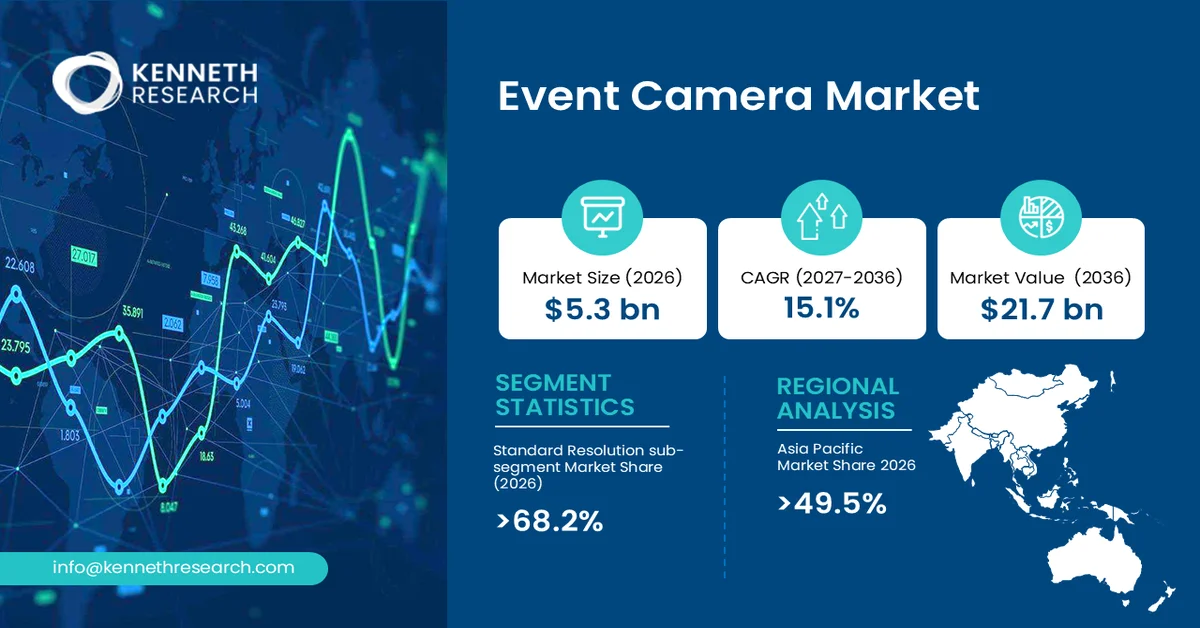
Event Camera Market size was valued at USD 5.3 billion in 2026 and is projected to reach USD 21.7 billion by the end of 2036, rising at a CAGR of 15.1% during the forecast period, i.e., 2027–2036. In 2027, the industry size of the event camera is estimated at USD 6.1 billion.
The primary growth driver for the event camera market is the growing requirement for low-latency, power-efficient machine vision in applications where conventional frame-based imaging can be limiting. Government-backed development programs highlight event-based sensing for autonomous detection and other demanding real-time applications, supporting broader industrial adoption of neuromorphic vision technologies.
The event camera market comprises imaging systems built around neuromorphic vision sensors that detect changes in scene illumination rather than continuously recording complete image frames. Unlike conventional cameras, an event camera operates asynchronously at the pixel level: individual pixels respond when a change in incident light crosses a defined threshold and generate event information associated with the location and direction of that change. This produces a stream of visual events instead of conventional frame-by-frame imagery.
Key characteristics include event-driven sensing, sparse data generation, rapid response to changing scenes, and the ability to concentrate sensing activity on areas undergoing visual change. These characteristics make the technology particularly relevant where continuous image acquisition can create unnecessary data or processing requirements.
Key Event Camera Market Insights Summary:
Key Takeaways: Market Trends & Insights
- The event camera market is valued at USD 5.3 billion in 2026, highlighting a substantial commercial opportunity for event-based imaging technologies
- The market is projected to reach USD 21.7 billion by 2036, reflecting a CAGR of 15.1% during 2027–2036
- Standard Resolution leads the Resolution segment with a 68.2% market share in 2026, supported by demand for practical and processing-efficient machine vision
- Event-based Vision Sensors (EVS) represent the fastest-growing analysis segment, driven by demand for low-latency and energy-efficient visual perception
- Asia Pacific dominates the global market with a 49.5% market share in 2026, supported by strong electronics manufacturing, semiconductor capabilities, robotics, and industrial automation across China and Japan
Market Drivers
- Ultra-low-latency machine vision
- Energy-efficient edge intelligence
- Increasing integration of event-based sensing with autonomous robotics
- Growing adoption of neuromorphic computing architectures
Challenges
- Immature software and algorithm ecosystem
- Inconsistent performance characterization and interoperability
Event Camera Market Overview & Supply Chain
Adoption of event cameras is increasing as industries seek sensing technologies capable of supporting real-time machine perception under rapidly changing visual conditions. Event-based imaging is particularly relevant to robotics, autonomous systems, industrial inspection, intelligent transportation, and other applications where conventional frame-based cameras can create unnecessary data and processing demands. The technology’s asynchronous sensing architecture can support responsive perception while concentrating data generation on changes within a scene.
The event camera market value chain begins with specialized inputs including semiconductor materials, photodiode and pixel-array components, optical elements, wafer-processing technologies, packaging materials, and embedded processing hardware. Sensor manufacturers integrate these inputs into event-based vision sensors and camera modules, combining pixel architectures with readout circuits, interfaces, optics, and supporting electronics. System developers subsequently incorporate cameras with processors, algorithms, software, and application-specific platforms for machine perception. Distribution occurs through direct industrial sales, specialist component channels, system integrators, and technology partners. End users include robotics manufacturers, automotive and mobility companies, industrial automation providers, aerospace and defense organizations, research institutions, and advanced imaging developers.
Event Camera Market - Growth Drivers & Challenges
Growth Drivers
- Demand for Ultra-Low-Latency Machine Vision: Event cameras are gaining traction because they can capture rapid changes in a scene with substantially lower latency than conventional frame-based imaging. This capability is particularly valuable for autonomous mobility, robotics, industrial automation, and high-speed inspection, where delayed visual information can reduce system responsiveness. The growth mechanism is strengthened as event-based sensors are paired with increasingly capable neural-network architectures, enabling real-time interpretation directly from asynchronous visual data.
- Expansion of Energy-Efficient Edge Intelligence: The growing deployment of artificial intelligence at the edge is creating demand for sensing technologies that can limit unnecessary data generation and reduce the processing burden placed on embedded computing platforms. Event cameras support this transition by transmitting information primarily when changes occur, rather than continuously producing complete image frames. This architecture can complement edge processors in robotics, autonomous machines, industrial monitoring, and portable systems where computing resources, thermal management, and power availability influence system design. The growth mechanism therefore extends beyond the camera itself: sensor manufacturers, processor developers, algorithm providers, and system integrators can jointly develop compact perception platforms around event-driven data.
Challenges
- Immature Software and Algorithm Ecosystem: The asynchronous output of event cameras creates a structural barrier for organizations built around conventional frame-based computer vision. Existing algorithms, development workflows, and machine-learning pipelines generally expect synchronized image frames, whereas event cameras generate streams of time-stamped changes that require specialized processing and data representations. This increases integration effort, engineering requirements, validation complexity, and deployment risk for industrial users. The International Telecommunication Union identifies differences in signal acquisition, coding, transmission, and analysis as fundamental characteristics requiring dedicated event-based system requirements, while noting that conventional vision algorithms cannot simply be applied.
- Inconsistent Performance Characterization and Interoperability: A second restraint is the difficulty of evaluating and integrating event cameras consistently across vendors and system architectures. Performance characteristics can depend on sensor configuration, illumination, and operating conditions, making direct comparison difficult when specifications are not measured using common procedures. NIST research specifically identifies the absence of sufficiently defined and reproducible pixel-latency measurement practices as a deployment challenge. At the system level, asynchronous data streams also create integration requirements involving acquisition, coding, transmission, synchronization, and analysis. These issues can complicate procurement decisions, system validation, multi-sensor integration, and qualification for industrial applications.
Event Camera Market Size and Forecast:
| Report Attribute | Details |
|---|---|
| Base Year |
2026 |
| Forecast Year |
2027-2036 |
| CAGR |
15.1% |
| Base Year Market Size (2026) |
USD 5.3 billion |
| Forecast Year Market Size (2036) |
USD 21.7 billion |
| Regional Scope |
|
Event Camera Market - Segment Analysis
Resolution Segment Analysis
In the resolution segment, Standard Resolution sub-segment is anticipated to capture the largest market share of 68.2% by the end of 2026.
Standard Resolution dominates the event camera market because it provides a practical balance between image detail, processing requirements, system cost, and integration complexity for mainstream machine-vision deployments. Demand is supported by industrial inspection, robotics, logistics automation, surveillance, and embedded perception, where applications generally require reliable spatial information without the computational burden associated with higher-resolution sensing. The U.S. Census Bureau reported that 3.9% of businesses used artificial intelligence to produce goods or services during October 23–November 5, 2023, with machine vision identified among the AI applications covered by its survey. This indicates an expanding industrial environment in which vision-enabled automation can support demand for commercially practical camera architectures.
Type Segment Insights
The Event-based Vision Sensors (EVS) is projected to grow as the second-largest segment in the event camera market due to four converging demand drivers.
Event-based Vision Sensors (EVS) are projected to grow rapidly because they provide asynchronous, change-driven visual information that is well suited to dynamic machine-perception environments. Demand is being stimulated by robotics, autonomous systems, industrial automation, and applications requiring low-latency sensing. The European Commission’s research agenda explicitly identifies event-based cameras as an enabling technology for more efficient and resilient machine intelligence, while its robotics initiatives emphasize the expanding role of autonomous systems across manufacturing, logistics, healthcare, agriculture, and transport. On the supply side, sensor developers are increasingly combining event-driven pixel architectures with neuromorphic processors, specialized algorithms, and edge-computing platforms.
Our in-depth analysis of the event camera market includes the following segments:
|
Segment |
Sub-segment |
|
Type |
|
|
Resolution |
|
|
Application |
|
Event Camera Market - Regional Analysis
Asia Pacific Market Trends & Insights:
Asia Pacific event camera market is projected to hold the largest revenue share of 49.5% by the end of 2026.
Asia Pacific remains the dominant regional market for event cameras, supported by its deep electronics manufacturing ecosystem, expanding automation base, strong semiconductor capabilities, and sustained investment in advanced sensing technologies. The region benefits from both production and consumption: manufacturers can access established semiconductor, imaging, robotics, and electronics supply chains, while industrial users increasingly deploy machine vision across manufacturing, mobility, logistics, and automation.
China represents a particularly important country market because its electronics manufacturing capacity, industrial automation ecosystem, and semiconductor expansion provide multiple channels for event-camera adoption.
Japan complements this position through advanced semiconductor, automotive, robotics, and precision-manufacturing capabilities. Government policy is also reinforcing Japan’s technology supply base: METI has identified next-generation semiconductors as strategically important and is supporting domestic development and manufacturing capacity. Together, China and Japan strengthen Asia Pacific’s position across production, application development, investment, and technology commercialization, while continued public-sector support should sustain regional momentum.
North America Market Trends & Insights:
North America represents an important secondary market for event cameras, supported by advanced manufacturing, robotics, autonomous systems, aerospace and defense applications, and continued investment in artificial intelligence-enabled industrial technologies. Demand is reinforced by manufacturers seeking faster machine perception, real-time monitoring, and more adaptable automation. U.S. government initiatives are strengthening this environment: NIST’s Manufacturing USA program is designed to accelerate the transition of emerging technologies into scalable domestic manufacturing capabilities while improving supply-chain resilience and industrial competitiveness.
The United States is the region’s principal technology and adoption center, with government-backed programs emphasizing AI-enabled manufacturing, robotics, measurement science, and autonomous systems. NIST’s advanced-manufacturing agenda specifically targets real-time monitoring, intelligent robots, and integration of emerging technologies into manufacturing operations, creating favorable conditions for event-camera applications.
Canada offers complementary opportunities through its national AI strategy, which identifies manufacturing and robotics as priorities for addressing labor constraints and improving industrial competitiveness. Its strategy also highlights autonomous systems and intelligent logistics, broadening potential applications for event-based vision across transportation, manufacturing, and resource-intensive industries.
Event Camera Market Competitive Landscape
Here is a list of upstream, downstream, and key players operating in the event camera competitive ecosystem:
- Sony Corporation (Japan)
- Company Overview
- Business Strategy
- Key Product Offerings
- Financial Performance
- Key Performance Indicators
- Risk Analysis
- Recent Development
- Regional Presence
- SWOT Analysis
- CenturyArks Co., Ltd. (Japan)
- OMNIVISION (United States)
- IMAGO Technologies GmbH (Germany)
- LUCID Vision Labs Inc. (Canada)
Recent Developments
- In July 2026, Sony filed a patent for a novel event camera tracking system designed to solve a fundamental problem in high-speed photography: keeping fast-moving objects locked perfectly in frame. Instead of waiting for a full image to be captured and processed before reacting, the system uses an event camera as a high-speed feedback sensor. The near-instant motion data from the sensor physically steers a small mirror and adjusts a lens, allowing the camera to track subjects with microsecond-level reaction times, a significant leap over conventional autofocus systems that rely on full-frame capture.
- In December 2025, CenturyArks hosted Japan's first full-scale seminar on the "present and future" of event-based vision cameras in Tokyo. The seminar, titled "Powered by SilkyEvCam®," aimed to provide a comprehensive, hands-on learning experience about the company's SilkyEvCam® neuromorphic camera, which features ultra-high-speed sensing with a minimum temporal resolution of 1 µsec and a wide dynamic range exceeding 120 dB. The event featured leading experts from academia and industry sharing insights on event camera research and real-world application cases.
Frequently Asked Question
In 2026, the event camera market exceeded USD 5.3 billion.
The event camera market is projected to reach USD 21.7 billion by the end of 2036, expanding at a CAGR of 15.1% over the forecast period (2027-2036).
The major players in the market are Sony Corporation, CenturyArks Co., Ltd., OMNIVISION, IMAGO Technologies GmbH, LUCID Vision Labs Inc., and others.
In the Resolution segment, the Standard Resolution sub-segment is anticipated to capture the largest market share of 68.2% in the future and exhibit lucrative growth opportunities during 2027-2036. This growth trajectory is largely attributed to demand for practical, processing-efficient machine vision across industrial automation and robotics.
Asia Pacific is projected to hold the largest market share of 49.5% by the end of 2026 and provide more business opportunities in the future. Continuous investments in electronics manufacturing, semiconductor capabilities, robotics, and industrial automation across China and Japan are fostering the region's dominance.
Why Choose Kenneth Research ?
-
Insight with Impact : We don’t just gather data — we uncover stories, trends, and opportunities that fuel business growth.
-
Experts Who Get It : Our team speaks your industry’s language and knows what really matters to your customers and market.
-
Custom-Built for You : Forget one-size-fits-all. We craft research and consulting solutions as unique as your business vision.
-
Partners, Not Just Providers : We work with you, not for you — collaborating closely to turn insights into smart, strategic moves.
-
Results That Speak : Our work powers brands, startups, and industry leaders alike — with a track record of ideas that work in the real world.
Report ID: 1278 |
Published Date: 14 Sep 2026 |
Report Format: |
Delivery Timeline: 48-72 Business Hours

Copyright © 2025 Kenneth Research. All rights reserved. Terms of Use | Privacy Policy
