Report ID: 1215 |
Published Date: 14 Sep 2026 |
Report Format: |
Delivery Timeline: 48-72 Business Hours
EV Semiconductor Market Outlook:
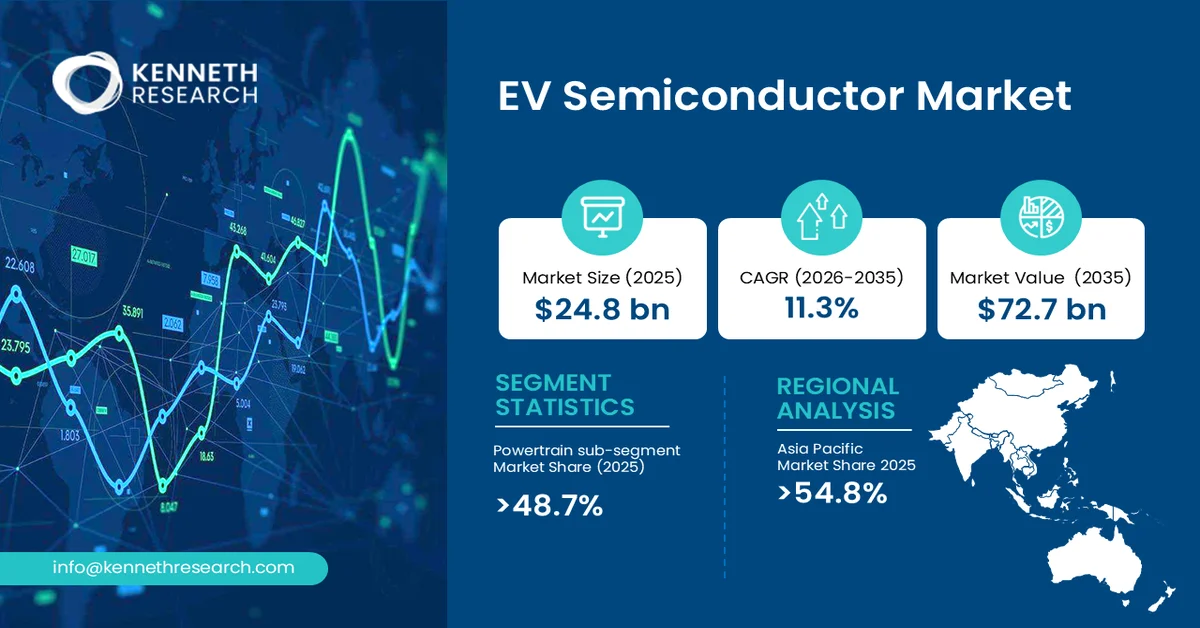
EV Semiconductor Market size was valued at USD 24.8 billion in 2025 and is projected to reach USD 72.7 billion by the end of 2035, rising at a CAGR of 11.3% during the forecast period, i.e., 2026–2035. In 2026, the industry size of EV semiconductors is estimated at USD 27.7 billion.
The primary growth driver is accelerating electric-vehicle adoption, which increases demand for semiconductor-intensive electric powertrains, battery-management systems, inverters, onboard chargers, and vehicle-control electronics. Global electric-car sales exceeded 17 million in 2024, demonstrating expanding vehicle electrification and strengthening the underlying requirement for semiconductor content across EV architectures.
The EV semiconductor market comprises semiconductor devices, integrated circuits, and related electronic components designed for use in electric vehicles and their associated electrical and electronic systems. The market covers components supporting vehicle propulsion, power conversion, battery management, charging, sensing, connectivity, control, and other electronically controlled functions.
A defining characteristic is the market’s close integration with the vehicle’s electrified architecture. Semiconductor technologies enable the conversion, regulation, switching, monitoring, and control of electrical energy between the battery, electric motor, charging system, and auxiliary vehicle systems. Power electronics are particularly important because they manage electrical energy and control motor speed and torque; major components include inverters, DC/DC converters, and chargers.
Key EV Semiconductor Market Insights Summary:
Key Takeaways: Market Trends & Insights
- EV Semiconductor Market reached USD 24.8 billion in 2025
- EV Semiconductor Market is projected to reach USD 72.7 billion by 2035 at a CAGR of 11.3% during 2026–2035
- Powertrain was the largest Application segment with a 48.7% market share in 2025
- Power semiconductor devices are projected to be the fastest-growing Device Type segment
- Asia Pacific was the dominant region with a 54.8% market share in 2025, led by China and Japan
Market Drivers
- Accelerating global EV adoption
- Expansion of silicon carbide and wide-bandgap power electronics
- Increasing electronic content and functional integration in EV architectures
- Growth of fast-charging and high-voltage vehicle electrical systems
Challenges
- Supply-chain concentration and automotive semiconductor qualification complexity
- High manufacturing complexity and cost of advanced power semiconductor devices
EV Semiconductor Market Overview & Supply Chain
Electric-vehicle adoption is increasing globally as automakers expand electrified model portfolios, battery technology improves, charging infrastructure develops, and governments pursue transport decarbonization. The shift materially increases the strategic importance of semiconductors because EV architectures depend on electronic systems for power conversion, propulsion control, battery management, charging, sensing, and vehicle connectivity. The industrial relevance is reinforced by the scale of EV manufacturing: the International Energy Agency reports that 17.3 million electric cars were produced worldwide in 2024.
The EV semiconductor value chain begins with raw-material and input suppliers providing silicon, silicon carbide, gallium-based materials, specialty chemicals, wafers, substrates, metals, and semiconductor-grade processing inputs. Semiconductor manufacturers then transform these inputs through wafer fabrication, device formation, packaging, testing, and quality qualification. Specialized power-device producers and integrated-device manufacturers supply components to automotive semiconductor integrators and Tier-1 suppliers, which incorporate them into inverters, battery-management systems, onboard chargers, converters, electronic control units, and other vehicle subsystems. Distribution occurs through direct OEM relationships, authorized distributors, and specialized component channels. End users include passenger-EV, commercial-EV, and specialty-vehicle manufacturers, alongside charging-equipment and mobility-system providers.
EV Semiconductor Market: Growth Drivers & Challenges
Growth Drivers:
- Silicon carbide and wide-bandgap power electronics adoption: The transition from conventional silicon devices toward silicon carbide (SiC) and other wide-bandgap technologies is strengthening semiconductor demand within EV powertrains. These devices can operate at higher voltages and temperatures while improving electrical efficiency, making them increasingly relevant to traction inverters, onboard chargers, and DC-to-DC converters. The mechanism of growth is therefore twofold: EV manufacturers require more capable power devices as vehicle electrical architectures become more demanding, while semiconductor suppliers invest in higher-value materials, wafers, packaging, and device manufacturing. Government-backed investment is also reinforcing domestic capacity.
- Increasing electronic complexity of ev architectures: EV platforms are becoming progressively more dependent on sophisticated electronic systems, creating broader semiconductor requirements beyond the core traction inverter. Battery-management systems continuously monitor and control battery operation, while charging systems, DC-DC conversion, thermal management, sensing, communications, and electronic control functions require dedicated semiconductor content. As automakers improve vehicle performance and integrate more software-defined functionality, semiconductor requirements increasingly span power, analog, mixed-signal, sensing, connectivity, and control applications. This creates opportunities across the device-type spectrum and encourages suppliers to develop smaller, more efficient, thermally robust, and highly integrated components. The resulting architectural shift also increases the strategic importance of semiconductor qualification, reliability, packaging, and automotive-grade manufacturing.
Challenges:
- Supply-chain concentration and qualification complexity: A major restraint is the structural concentration of semiconductor manufacturing and specialized inputs across geographically dispersed supply networks. EV components must meet stringent automotive reliability and safety requirements, so replacing an established semiconductor source is not equivalent to substituting a conventional electronic component; new devices and manufacturing sources require qualification and validation within vehicle platforms. This creates switching costs, lengthens procurement decisions, and limits manufacturers’ ability to respond rapidly to disruptions. The commercial impact extends from semiconductor producers to automotive OEMs, where supply interruptions can affect production continuity, inventory strategies, and supplier relationships. The issue is particularly relevant for mature-node and specialty devices used extensively in automotive electronics. Government policy increasingly targets this vulnerability through domestic manufacturing programs.
- High manufacturing complexity and cost of advanced power devices: Advanced power semiconductors, particularly silicon-carbide devices, face manufacturing constraints that can limit cost competitiveness and commercial scalability. Producing high-quality wafers and converting them into reliable automotive-grade devices requires specialized materials, process control, equipment, packaging expertise, and extensive quality assurance. These requirements raise production complexity and can make next-generation devices less economically attractive when vehicle manufacturers remain sensitive to component costs. The challenge also affects suppliers’ ability to scale capacity efficiently: immature manufacturing processes and limited high-capacity facilities can constrain expansion even when automotive demand is strengthening. Commercially, manufacturers must balance investment in advanced fabrication and packaging against customers’ requirements for competitive system costs and dependable supply.
EV Semiconductor Market Size and Forecast:
| Report Attribute | Details |
|---|---|
| Base Year |
2025 |
| Forecast Year |
2026-2035 |
| CAGR |
11.3% |
| Base Year Market Size (2025) |
USD 24.8 billion |
| Forecast Year Market Size (2035) |
USD 72.7 billion |
| Regional Scope |
|
EV Semiconductor Market Segmentation Analysis:
Application Segment Analysis
In the application segment, the Powertrain sub-segment is anticipated to capture the largest market share of 48.7% by the end of 2025.
The powertrain segment dominates the EV semiconductor market because it represents the core electrical pathway responsible for converting stored battery energy into controlled vehicle motion. Demand is being reinforced by continued EV adoption, increasing drivetrain efficiency requirements, higher operating voltages, and growing use of advanced power electronics in traction inverters, converters, and motor-control systems. From an adoption perspective, automakers are increasingly optimizing integrated electric-drive architectures around efficiency, reliability, thermal performance, and packaging. On the supply side, semiconductor manufacturers are developing silicon-carbide, gallium-nitride, and advanced silicon solutions specifically for demanding power-conversion applications. The U.S. Department of Energy identifies inverters, DC/DC converters, and onboard chargers as central power-electronics components in electric-drive vehicles.
Device Type Segment Analysis
The Power semiconductor devices is projected to grow as the second-largest segment in the EV Semiconductor market due to four converging demand drivers.
Power semiconductor devices are projected to grow rapidly because EV electrical architectures increasingly require efficient, high-voltage switching and power conversion. Current demand is driven by traction inverters, onboard chargers, DC-to-DC converters, and increasingly higher-voltage battery systems. The U.S. Department of Energy identifies silicon carbide (SiC) as an important emerging power-semiconductor material and notes that the EV market is its primary demand driver, particularly for inverters and charging systems. Adoption is moving beyond conventional silicon as automakers seek greater efficiency, reduced thermal losses, faster charging, and improved vehicle range. Supply-side investment is responding accordingly: the DOE states that high-quality SiC wafers are currently under-supplied and that demand is expected to increase alongside EV sales. This is encouraging semiconductor manufacturers to expand wafer, device, packaging, and module capabilities.
Our in-depth analysis of the global EV semiconductor market includes the following segments:
|
Segment |
Sub-segment |
|
Application |
|
|
Device Type |
|
|
Technology |
|
|
Propulsion Type |
|
|
Material |
|
|
Installation Type |
|
|
Shape |
|
|
Price Range |
|
|
End User |
|
EV Semiconductor Market Regional Insights:
Asia Pacific Market Trends & Insights:
Asia Pacific EV semiconductor market is projected to hold the largest revenue share of 54.8% by the end of 2025.
Asia Pacific remains the dominant regional market for EV semiconductors, supported by a deeply established automotive manufacturing base, extensive electronics production capabilities, expanding EV adoption, and sustained investment in semiconductor and power-electronics infrastructure.
China remains the region’s largest country-level opportunity because its integrated automotive, battery, electronics, and semiconductor ecosystems facilitate high-volume deployment and localized supply development. Government industrial policy also supports domestic technology capabilities and supply-chain resilience.
Japan represents a complementary strength: its mature automotive industry, semiconductor know-how, precision manufacturing capabilities, and strong supplier relationships support demand for highly reliable automotive-grade devices. Together, China’s manufacturing scale and Japan’s technology-intensive industrial base create a broad regional platform for EV semiconductor development. Future regional growth should be supported by higher vehicle electrification, greater semiconductor content per vehicle, expansion of high-voltage architectures, and continued investment in localized power-electronics and semiconductor supply chains.
North America Market Trends & Insights:
North America is an important EV semiconductor market because growing vehicle electrification is stimulating demand for power electronics, battery-management systems, charging technologies, and automotive control semiconductors. The region combines a large automotive manufacturing base with expanding domestic investment in EV and component supply chains. Government initiatives are increasingly focused on strengthening local manufacturing, improving supply-chain resilience, and accelerating advanced vehicle technologies. In the United States, the Department of Energy supports research into wide-bandgap semiconductors, advanced packaging, thermal management, and integrated power-electronics systems, reinforcing the technology base required for next-generation EVs.
The United States represents the region’s primary industrial hub, supported by established automakers, semiconductor research capabilities, national laboratories, and federal programs targeting domestic manufacturing. DOE financing is also supporting domestic SiC wafer production specifically for EV power electronics, strengthening the upstream supply base.
Canada offers complementary opportunities through its automotive manufacturing ecosystem, critical-mineral resources, clean-technology policy, and integration with North American vehicle supply chains. Federal measures targeting EV assembly and battery production can encourage broader localization of electrified-vehicle components and create downstream opportunities for semiconductor suppliers serving Canadian and integrated continental production networks.
Leading Companies Operating in the Global EV Semiconductor Market:
Here is a list of upstream, downstream, and key players operating in the global EV semiconductor market competitive ecosystem:
- Infineon Technologies AG (Germany)
- Company Overview
- Business Strategy
- Key Product Offerings
- Financial Performance
- Key Performance Indicators
- Risk Analysis
- Recent Development
- Regional Presence
- SWOT Analysis
- NXP Semiconductors N.V. (Netherlands)
- Texas Instruments Incorporated (United States)
- Renesas Electronics Corporation (Japan)
- ON Semiconductor (onsemi) (United States)
- Wolfspeed, Inc. (United States)
Recent Developments
- In May 2025, Infineon was selected to supply silicon carbide (SiC) and silicon power modules from its HybridPACK Drive G2 family for traction inverters in Rivian's R2 platform, with supply expected to start in 2026. Infineon will also supply AURIX TC3x microcontrollers and power management ICs for the platform.
- In July 2025, Texas Instruments received the prestigious "Operational Excellence" award at the Volkswagen Group Award 2025, recognizing its resilient semiconductor supply strategies and forward-looking investments. TI supplies Volkswagen with analog and embedded processing products for next-generation automotive systems, including microcontrollers, processors, and power management devices.
Frequently Asked Question
In 2025, the EV semiconductor market exceeded USD 24.8 billion.
The EV semiconductor market is projected to reach USD 72.7 billion by the end of 2035, expanding at a CAGR of 11.3% over the forecast period (2026-2035).
The major players in the market are Infineon Technologies AG, NXP Semiconductors N.V., Texas Instruments Incorporated, Renesas Electronics Corporation, ON Semiconductor (onsemi), Wolfspeed, Inc., and others.
In the Application segment, the Powertrain sub-segment is anticipated to capture the largest market share of 48.7% in the future and exhibit lucrative growth opportunities during 2026-2035. This growth trajectory is largely attributed to increasing demand for traction inverters, converters, and other power-electronics systems supporting EV propulsion.
Asia Pacific is projected to hold the largest market share of 54.8% by the end of 2035 and provide more business opportunities in the future. Continuous investments in EV manufacturing, semiconductor capabilities, and power-electronics supply chains across China and Japan are fostering the region's dominance.
Why Choose Kenneth Research ?
-
Insight with Impact : We don’t just gather data — we uncover stories, trends, and opportunities that fuel business growth.
-
Experts Who Get It : Our team speaks your industry’s language and knows what really matters to your customers and market.
-
Custom-Built for You : Forget one-size-fits-all. We craft research and consulting solutions as unique as your business vision.
-
Partners, Not Just Providers : We work with you, not for you — collaborating closely to turn insights into smart, strategic moves.
-
Results That Speak : Our work powers brands, startups, and industry leaders alike — with a track record of ideas that work in the real world.
Report ID: 1215 |
Published Date: 14 Sep 2026 |
Report Format: |
Delivery Timeline: 48-72 Business Hours

Copyright © 2025 Kenneth Research. All rights reserved. Terms of Use | Privacy Policy
