Report ID: 1197 |
Published Date: 27 Aug 2026 |
Report Format: |
Delivery Timeline: 48-72 Business Hours
Europe Welding Equipment Market Outlook:
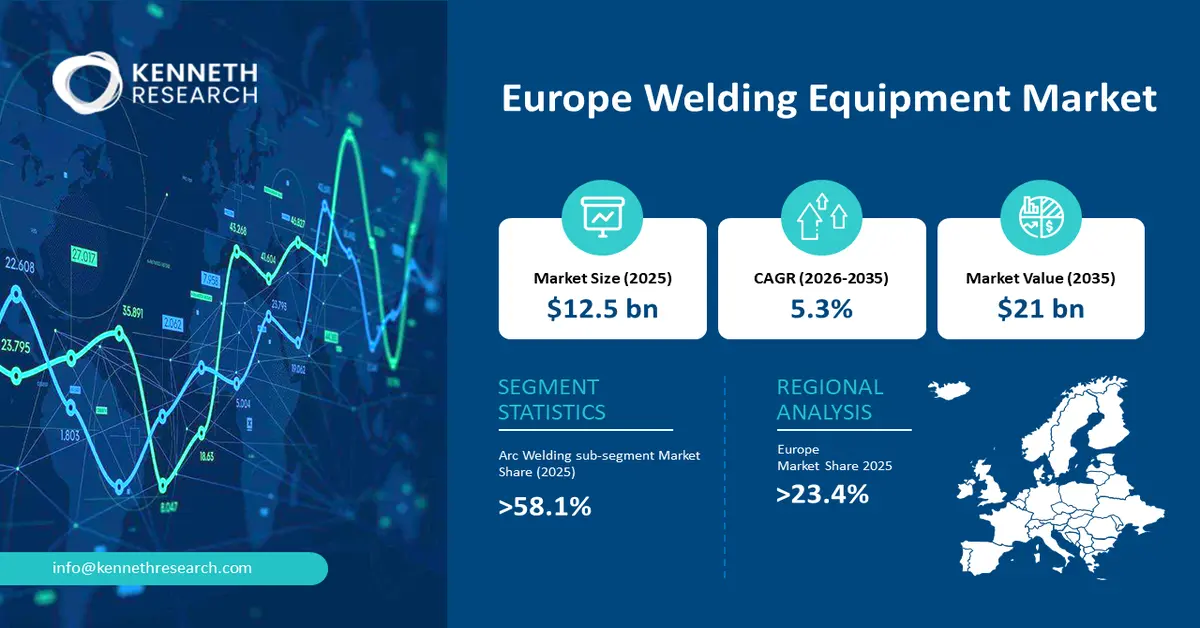
Europe Welding Equipment Market size was valued at USD 12.5 billion in 2025 and is projected to reach USD 21 billion by the end of 2035, rising at a CAGR of 5.3% during the forecast period, i.e., 2026-2035. In 2026, the industry size of the Europe welding equipment is estimated at USD 13.2 billion.
The growing adoption of automated and energy-efficient welding technologies is a primary growth driver for the Europe welding equipment market. Manufacturers are upgrading welding operations to improve productivity, weld consistency, energy performance, and process control while meeting increasingly stringent industrial requirements.
The Europe welding equipment market comprises equipment and systems used to join metals and other compatible materials through controlled heat, pressure, or a combination of both. It encompasses welding power sources, welding machines, process-specific equipment, control systems, and associated equipment used across industrial and commercial fabrication environments. Major processes include arc welding, resistance welding, gas welding, and other specialized joining techniques.
Key characteristics include controllable power output, process precision, thermal management, durability, portability, and compatibility with manual, semi-automatic, and automated production environments. Modern equipment increasingly incorporates electronic controls, digital monitoring, automated parameter adjustment, and energy-efficiency features to improve weld quality and production consistency.
Key Europe Welding Equipment Market Insights Summary:
Key Takeaways: Market Trends & Insights
- Europe Welding Equipment Market projected to grow from USD 12.5 billion in 2025 to USD 21 billion by 2035 at a 5.3% CAGR.
- Europe accounted for the largest regional share at 23.4% in 2025, supported by advanced manufacturing infrastructure, industrial modernization, and strong welding demand across Germany and France.
- Arc Welding is expected to remain the leading Process segment with a 58.1% market share in 2025, supported by its broad application across automotive, machinery, construction, and heavy engineering.
- Semi-Automatic welding systems are positioned for continued adoption as manufacturers seek a balance between operator flexibility, process consistency, productivity, and the gradual transition toward higher automation.
Market Drivers
- Accelerating industrial automation and smart manufacturing.
- Growing need for energy-efficient welding processes.
- Increasing integration of robotic welding systems into European production facilities.
- Rising demand for digitally controlled and process-monitoring-enabled welding equipment.
Challenges
- Shortage of skilled welding professionals
- High energy and input costs
Europe Welding Equipment Market Overview & Supply Chain
Welding equipment adoption is increasing as European manufacturers modernize production, improve energy performance, and integrate more efficient joining technologies into industrial operations. Automotive, machinery, metal fabrication, infrastructure, and heavy engineering applications increasingly require equipment capable of delivering consistent weld quality while controlling energy consumption and supporting resource efficiency. The European Commission's welding-equipment ecodesign framework identifies energy consumption and resource efficiency as significant environmental considerations and establishes requirements for welding equipment placed on the EU market.
The Europe welding equipment market value chain begins with raw-material and component suppliers providing electrical components, power semiconductors, transformers, cables, control boards, cooling systems, metal housings, welding torches, and other precision parts. Equipment manufacturers integrate these inputs into welding power sources, machines, control systems, and process-specific equipment, followed by calibration, performance testing, safety validation, and quality assurance.
Europe Welding Equipment Market: Growth Drivers & Challenges
Growth Drivers:
- Accelerating industrial automation and smart manufacturing: The integration of robotics, digital controls, and connected production systems is increasing demand for welding equipment capable of operating within automated manufacturing environments. European manufacturers are adopting advanced production technologies to improve weld consistency, productivity, process monitoring, and operational flexibility. The European Commission identifies advanced manufacturing as the integration of robotics, automation, AI, and data-driven technologies into modern production systems, specifically noting robotic automation for precision welding in automotive assembly.
- Growing need for energy-efficient welding processes: Energy efficiency is becoming an increasingly important purchasing consideration for European manufacturers as they seek to control operating costs and improve the environmental performance of production facilities. Welding equipment is being upgraded with more efficient power electronics, improved process controls, and technologies that reduce unnecessary energy consumption during welding operations. The European regulatory framework has specifically addressed the energy performance and resource efficiency of electrical welding equipment, encouraging manufacturers to improve equipment design and operational efficiency.
Challenges:
- Shortage of skilled welding professionals: The shortage of qualified welders and related metalworking professionals is a major constraint on the European welding equipment market. Manufacturing companies increasingly require workers capable of operating sophisticated welding systems, interpreting digital process information, and maintaining automated equipment, while the available skilled workforce is under pressure from demographic changes and evolving technical requirements. Cedefop identifies welders and flame cutters among occupations experiencing severe shortages in Europe and notes that technological change is simultaneously altering the skills required across metal manufacturing.
- High energy and input costs: Elevated energy and material costs can constrain investment in welding equipment, particularly among energy-intensive fabrication and manufacturing operations. Welding equipment purchases are capital-intensive decisions, and manufacturers must evaluate not only acquisition costs but also electricity consumption, maintenance requirements, consumables, and overall lifecycle economics. The European Commission has highlighted how energy-price volatility can negatively affect European manufacturing capacity and emphasized the importance of energy efficiency and resilient industrial supply chains.
Europe Welding Equipment Market Size and Forecast:
| Report Attribute | Details |
|---|---|
| Base Year |
2025 |
| Forecast Period |
2026-2035 |
| CAGR |
5.3% |
| Base Year Market Size (2025) |
USD 12.5 billion |
| Forecast Year Market Size (2035) |
USD 21 billion |
| Regional Scope |
|
Europe Welding Equipment Market Segmentation Analysis:
Process Segment Analysis
In the Process segment, the Arc Welding sub-segment is anticipated to capture the largest market share of 58.1% by the end of 2025. Its leading position is supported by broad applicability across automotive manufacturing, machinery production, construction, heavy engineering, shipbuilding, and metal fabrication. Arc welding equipment offers flexibility across different material thicknesses and production environments, ranging from manual fabrication to highly automated industrial welding cells. The European Commission identifies robotic automation as an important advanced-manufacturing application, including precision welding in automotive assembly.
Demand is also supported by Europe's transition toward automated manufacturing and the need to address skilled-labor constraints. The European Labour Authority identifies welders and flame cutters among the most widespread shortage occupations in Europe, encouraging manufacturers to consider automation and more productive welding processes
Automation Level Segment Analysis
The Semi-Automatic segment under the Automation Level category is projected to grow as European manufacturers seek a balance between manual flexibility and automated productivity. Semi-automatic welding systems allow operators to retain process control while benefiting from controlled wire feeding, power regulation, and more consistent welding parameters. This makes them particularly suitable for fabrication environments with varied component geometries, medium production volumes, and frequent product changes. The European manufacturing base provides a substantial application environment for such equipment. Eurostat reported that Germany generated 26% of the EU’s total value of sold industrial production in 2024, highlighting the scale of industrial activity within a major European manufacturing market.
Semi-automatic systems also offer a practical pathway toward greater automation without the capital and integration requirements associated with fully robotic cells. Equipment manufacturers are increasingly incorporating digital controls, programmable parameters, improved power electronics, and process-monitoring functions into these systems.
Our in-depth analysis of the Europe welding equipment market includes the following segments:
|
Segment |
Sub-segment |
|
By Process |
|
|
By Automation Level |
|
|
End User |
|
Europe Welding Equipment Market Regional Insights:
European Market Trends & Insights:
Europe accounted for 23.4% of the Europe welding equipment market in 2025, maintaining its leading position due to its established industrial base, advanced manufacturing ecosystem, and strong concentration of automotive, machinery, metal fabrication, energy, and heavy-engineering activities. The region is also supported by ongoing industrial modernization and reindustrialization initiatives that encourage investment in production technologies and equipment. Eurostat reported that industrial production in the EU increased 0.2% in March 2024 compared with the previous month, reflecting continued manufacturing activity across the region.
Germany is a major European manufacturing center with strong automotive, machinery, engineering, and metalworking industries. Its sophisticated industrial ecosystem supports demand for advanced arc-welding, automated welding, and digitally controlled equipment.
France is also strengthening its industrial base through reindustrialization initiatives. France's Directorate General for Enterprise reported 89 net significant factory openings and expansions in 2024, demonstrating continued industrial investment and capacity development.
North America Market Trends & Insights:
North America represents an important market for welding equipment, supported by its established manufacturing base, extensive metal fabrication activity, automotive production, aerospace manufacturing, infrastructure development, and growing adoption of automated production technologies. The region also has a mature ecosystem of welding-equipment manufacturers, distributors, integrators, and industrial users, creating a strong replacement and modernization market.
In the U.S., demand is supported by automotive, machinery, construction, energy, and general manufacturing applications. The country's large installed manufacturing base also creates opportunities for equipment upgrades, automation, and replacement of aging welding systems.
Canada benefits from its integrated manufacturing relationship with the U.S., with automotive, machinery, energy, construction, and metal fabrication representing important applications.
Leading Companies Operating in the Europe Welding Equipment Market:
Here is a list of upstream, downstream, and key players operating in the global Europe welding equipment market competitive ecosystem:
- Lincoln Electric(United States)
- Company Overview
- Business Strategy
- Key Product Offerings
- Financial Performance
- Key Performance Indicators
- Risk Analysis
- Recent Development
- Regional Presence
- SWOT Analysis
- ESAB(United States)
- Fronius(Austria)
- Kemppi(Finland)
Recent Developments
- May 2026: Lincoln Electric introduced the AlumaFab Aluminum MIG Welding System, expanding its welding-equipment portfolio with a system designed specifically for aluminum welding applications.
- June 2026: ESAB released ESAB Next LP17, its latest quarterly update covering new welding equipment and the InduSuite digital platform.
Frequently Asked Question
In 2025, the Europe welding equipment market exceeded USD 12.5 billion.
The Europe welding equipment market is projected to reach USD 21 billion by the end of 2035, expanding at a CAGR of 5.3% over the forecast period (2026–2035).
The major players in the market are Lincoln Electric, ESAB, Fronius, Kemppi, voestalpine Böhler Welding, Carl Cloos Schweisstechnik, and TRUMPF, and others.
In the process segment, the arc welding sub-segment is anticipated to capture the largest market share of 58.1% in the future and exhibit lucrative growth opportunities during 2026–2035.
Europe is projected to hold the largest market share of 23.4% by the end of 2025 and provide more business opportunities in the future.
Why Choose Kenneth Research ?
-
Insight with Impact : We don’t just gather data — we uncover stories, trends, and opportunities that fuel business growth.
-
Experts Who Get It : Our team speaks your industry’s language and knows what really matters to your customers and market.
-
Custom-Built for You : Forget one-size-fits-all. We craft research and consulting solutions as unique as your business vision.
-
Partners, Not Just Providers : We work with you, not for you — collaborating closely to turn insights into smart, strategic moves.
-
Results That Speak : Our work powers brands, startups, and industry leaders alike — with a track record of ideas that work in the real world.
Report ID: 1197 |
Published Date: 27 Aug 2026 |
Report Format: |
Delivery Timeline: 48-72 Business Hours

Copyright © 2025 Kenneth Research. All rights reserved. Terms of Use | Privacy Policy
