Report ID: 1344 |
Published Date: 10 Sep 2026 |
Report Format: |
Delivery Timeline: 48-72 Business Hours
Enterprise Network Equipment Market Outlook:
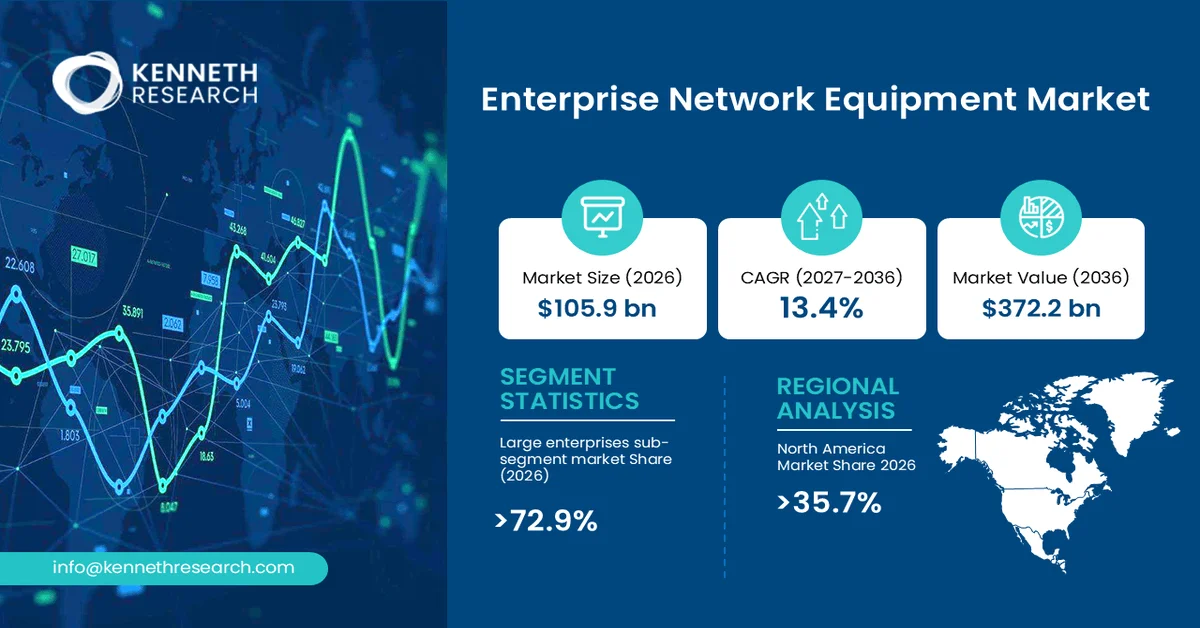
Enterprise Network Equipment Market size was valued at USD 105.9 billion in 2026 and is projected to reach USD 372.2 billion by the end of 2036, rising at a CAGR of 13.4% during the forecast period, i.e., 2027-2036. In 2027, the industry size of the enterprise network equipment is estimated at USD 120 billion.
The primary growth driver is accelerating enterprise digitalization, particularly the integration of cloud computing, data-intensive applications, connected devices, and distributed work environments. These trends require organizations to modernize connectivity infrastructure, improve network capacity, strengthen security, and support reliable access to applications and data across increasingly complex enterprise environments.
The enterprise network equipment market comprises hardware products and associated network infrastructure used by organizations to establish, manage, secure, and optimize communications across enterprise environments. The market encompasses equipment such as switches, routers, wireless networking equipment, access points, gateways, and related infrastructure supporting data transmission between users, devices, applications, servers, and external networks.
Key characteristics include high-performance connectivity, scalability, network management, interoperability, security capabilities, reliability, and support for distributed computing environments. Enterprise networking increasingly operates as part of a broader digital technology ecosystem in which connectivity enables cloud computing, Internet of Things applications, artificial intelligence, big-data analytics, and other digital technologies. The OECD identifies connectivity as a critical foundation for cloud computing and IoT adoption, while emphasizing the interdependence among major digital technologies.
Key Enterprise Network Equipment Market Insights Summary:
Key Takeaways: Market Trends & Insights
- Enterprise network equipment market is valued at USD 105.9 billion in 2026 and is projected to reach USD 372.2 billion by 2036
- The market is expected to expand at a CAGR of 13.4% during 2027–2036, supported by cloud adoption, enterprise digitalization, cybersecurity requirements, and distributed IT environments
- Large Enterprises represent the leading Enterprise Size segment with a 72.9% market share in 2026, supported by extensive connectivity requirements and complex IT infrastructure
- On-Premises is projected to grow as enterprises prioritize control, security, regulatory compliance, operational continuity, and predictable network performance
- North America leads the global market with a 35.7% market share in 2026, supported by strong technology ecosystems, cloud infrastructure, cybersecurity investment, and digital transformation across the United States and Canada
Market Drivers
- Cloud and hybrid IT infrastructure expansion
- Increasing network security and zero-trust adoption
- Growth of distributed and remote enterprise operations
- Expansion of connected devices and industrial digitalization
Challenges
- Semiconductor supply chain vulnerability
- Regulatory and security compliance complexity
Enterprise Network Equipment Market Overview & Supply Chain
Adoption of enterprise network equipment is increasing globally as organizations digitize business processes, expand connected operations, support distributed workforces, and deploy data-intensive applications. Modern enterprise environments require dependable connectivity across offices, campuses, data centers, cloud resources, industrial facilities, and connected devices. Network infrastructure therefore remains a foundational layer for digital transformation, enabling secure data exchange, application access, collaboration, and operational continuity.
The value chain of the enterprise network equipment market begins with raw materials and technology inputs, including semiconductors, printed circuit boards, optical components, metals, plastics, power components, and specialized software. Component manufacturers and technology suppliers provide these inputs to network equipment producers, which design, assemble, configure, test, and integrate switches, routers, wireless equipment, gateways, and related infrastructure. Manufacturers typically combine proprietary hardware, firmware, operating systems, security capabilities, and network-management functionality to create enterprise-ready solutions. Distribution then moves through direct sales, distributors, value-added resellers, system integrators, and technology service providers. End users include enterprises across commercial, industrial, public-sector, healthcare, financial, energy, telecommunications, and manufacturing environments.
Enterprise Network Equipment Market: Growth Drivers & Challenges
Growth Drivers:
- Cloud and hybrid IT infrastructure expansion: The rapid adoption of cloud and hybrid IT environments is driving demand for enterprise network equipment because organizations need dependable connectivity between users, branch offices, private infrastructure, public cloud platforms, and distributed applications. Cloud migration increases traffic complexity and creates requirements for scalable switching, routing, wireless access, traffic management, and secure connectivity. Eurostat reported that 45.2% of EU enterprises purchased cloud computing services in 2023, confirming continued enterprise migration toward externally hosted computing resources.
- Increasing network security and zero-trust adoption: The growing complexity of enterprise IT environments is strengthening demand for network equipment with integrated security capabilities. Organizations increasingly connect employees, devices, applications, cloud resources, branch locations, and external partners, making conventional perimeter-based approaches less suitable for modern operating models. This encourages investment in networking infrastructure that supports segmentation, identity-aware access, secure connectivity, policy enforcement, monitoring, and centralized management.
Challenges:
- Semiconductor supply chain vulnerability: Enterprise network equipment depends heavily on advanced semiconductors, making manufacturers exposed to disruptions in chip production, raw-material availability, geopolitical tensions, and concentrated manufacturing capacity. The root cause is a highly interconnected semiconductor ecosystem in which critical production stages and specialized suppliers are distributed across regions. The U.S. Government Accountability Office has identified geographic concentration and supply-chain chokepoints as persistent semiconductor risks. For network equipment manufacturers, disruptions can affect component availability, production scheduling, inventory requirements, product launches, and delivery commitments.
- Regulatory and security compliance complexity: Increasing security requirements and restrictions on telecommunications equipment create another structural restraint by raising the complexity and cost of enterprise network procurement and deployment. Governments are placing greater emphasis on supply-chain transparency, trusted equipment, cybersecurity, and potential foreign-source risks. Recent GAO findings indicate that limited visibility into telecommunications equipment supply chains can make it difficult for agencies to determine the provenance of components and identify potentially covered equipment.
Enterprise Network Equipment Market Size and Forecast:
| Report Attribute | Details |
|---|---|
| Base Year |
2026 |
| Forecast Period |
2027-2036 |
| CAGR |
13.4% |
| Base Year Market Size (2026) |
USD 105.9 billion |
| Forecast Year Market Size (2036) |
USD 372.2 billion |
| Regional Scope |
|
Enterprise Network Equipment Market Segmentation Analysis:
Enterprise Size Segment Analysis
In the enterprise size segment, large enterprises sub-segment is anticipated to capture the largest market share of 72.9% by the end of 2026.
Large enterprises dominate the enterprise-size segment because their extensive operational footprints, complex IT environments, and higher requirements for secure, reliable connectivity create sustained demand for sophisticated network infrastructure. These organizations typically operate multiple offices, campuses, data centers, production facilities, and distributed work environments, requiring substantial switching, routing, wireless, security, and network-management capabilities. Digital transformation is also more deeply embedded in large organizations, increasing the need for infrastructure that can support cloud applications, connected devices, data-intensive workloads, and remote access. Eurostat reported that 91.9% of large EU enterprises provided employees with remote access to email, documents, and business applications in 2024, highlighting the extensive connectivity requirements of this enterprise class.
Deployment Model System Segment Analysis
The on-premises is projected to grow as the second-largest segment in the enterprise network equipment market due to four converging demand drivers.
The on-premises segment is projected to grow as enterprises retain direct control over critical infrastructure where data security, regulatory compliance, operational continuity, latency, and customization are strategic priorities. Organizations handling sensitive information or running mission-critical applications may prefer infrastructure deployed within their own facilities to maintain greater control over network architecture, access policies, data flows, and system performance. On the supply side, vendors continue providing scalable switching, routing, wireless, security, and management solutions suited to controlled enterprise environments. Future demand should increasingly reflect hybrid architectures, with on-premises infrastructure remaining important for workloads requiring control, resilience, or specialized performance.
Our in-depth analysis of the Global enterprise network equipment market includes the following segments:
|
Segment |
Sub-segment |
|
Type |
|
|
Deployment Mode |
|
|
Enterprise Size |
|
|
End-User Vertical |
|
Enterprise Network Equipment Market Regional Insights:
North America Market Trends & Insights:
North America enterprise network equipment market is projected to hold the largest revenue share of 35.7% by the end of 2026.
North America holds the dominant regional position, with the market-share value specified in the input. Regional leadership is supported by a mature enterprise technology ecosystem, extensive data-center infrastructure, high levels of digitalization, and sustained investment in cloud, cybersecurity, artificial intelligence, and advanced communications infrastructure.
The United States remains the principal regional technology hub, with extensive enterprise infrastructure requirements spanning corporate networks, data centers, cloud environments, industrial facilities, and public-sector operations. Its established vendor ecosystem and continuing investment in digital infrastructure reinforce equipment demand.
Canada represents an important complementary market, where businesses are expanding their use of cloud computing, artificial intelligence, connected technologies, and digital services. Together, the two countries provide a strong combination of technology adoption, enterprise investment, infrastructure modernization, and regulatory attention to cybersecurity and digital resilience, supporting North America's continued leadership in enterprise networking.
Asia Pacific Market Trends & Insights:
Asia Pacific is positioned for continued demand for enterprise network equipment as businesses accelerate digital transformation, cloud adoption, industrial automation, artificial intelligence deployment, and connected operations.
China represents a major regional demand center, supported by industrial digitalization, cloud and computing infrastructure development, data infrastructure initiatives, and the integration of networking with manufacturing and emerging technologies. Government policy also emphasizes interoperability, network capacity, and coordination between computing and communications infrastructure, supporting long-term equipment modernization.
Japan offers a complementary opportunity through its focus on resilient digital infrastructure, secure communications, distributed data-center development, and digital transformation across industries. Its government has highlighted the importance of communications networks and data centers for sectors including healthcare, education, transportation, and agriculture. Together, China and Japan provide strong opportunities for vendors offering scalable, secure, resilient, and management-intensive enterprise networking solutions.
Leading Companies Operating in the Global Enterprise Network Equipment Market:
Here is a list of upstream, downstream, and key players operating in the global enterprise network equipment market competitive ecosystem:
- Cisco Systems, Inc. (United States)
- Company Overview
- Business Strategy
- Key Product Offerings
- Financial Performance
- Key Performance Indicators
- Risk Analysis
- Recent Development
- Regional Presence
- SWOT Analysis
- Hewlett Packard Enterprise (HPE) (United States)
- Juniper Networks, Inc. (United States)
- Arista Networks, Inc. (United States)
- Extreme Networks, Inc. (United States)
Recent Developments
- In June 2026, Hewlett Packard Enterprise used its Discover conference to outline its AI networking strategy following the $14 billion acquisition of Juniper Networks, positioning networking as the control plane for AI infrastructure. HPE introduced new Juniper-based QFX switches for AI workloads, integrated Aruba switches with Juniper's Mist AIOps, and expanded GreenLake with agent lifecycle governance and self-driving network capabilities.
- In June 2026, Arista Networks announced the 7060XE7 Series, a 1.6 Terabit switching portfolio for rack-scale AI fabrics. The new switches, featuring Ethernet 1.6T ports, support liquid cooling with up to 60% lower interconnect power consumption via Linear Pluggable Optics. Meta, Microsoft, and Oracle have endorsed the platform for their next-generation AI clusters.
Frequently Asked Question
In 2026, the enterprise network equipment market exceeded USD 105.9 billion.
The enterprise network equipment market is projected to reach USD 372.2 billion by the end of 2036, expanding at a CAGR of 13.4% over the forecast period (2027-2036).
The major players in the market are Cisco Systems, Inc., Hewlett Packard Enterprise (HPE), Juniper Networks, Inc., Arista Networks, Inc., Extreme Networks, Inc., and others.
In the enterprise size segment, the large enterprises sub-segment is anticipated to capture the largest market share of 72.9% in 2026 and exhibit lucrative growth opportunities during 2027-2036. This growth trajectory is largely attributed to extensive enterprise digitalization and complex connectivity requirements.
North America is projected to hold the largest market share of 35.7% in 2026 and provide more business opportunities in the future. Continuous investments in cloud infrastructure, cybersecurity, data centers, and digital transformation across the United States and Canada are fostering the region's dominance.
Why Choose Kenneth Research ?
-
Insight with Impact : We don’t just gather data — we uncover stories, trends, and opportunities that fuel business growth.
-
Experts Who Get It : Our team speaks your industry’s language and knows what really matters to your customers and market.
-
Custom-Built for You : Forget one-size-fits-all. We craft research and consulting solutions as unique as your business vision.
-
Partners, Not Just Providers : We work with you, not for you — collaborating closely to turn insights into smart, strategic moves.
-
Results That Speak : Our work powers brands, startups, and industry leaders alike — with a track record of ideas that work in the real world.
Report ID: 1344 |
Published Date: 10 Sep 2026 |
Report Format: |
Delivery Timeline: 48-72 Business Hours

Copyright © 2025 Kenneth Research. All rights reserved. Terms of Use | Privacy Policy
