Report ID: 1251 |
Published Date: 01 Sep 2026 |
Report Format: |
Delivery Timeline: 48-72 Business Hours
Energy Retrofit Systems Market Outlook:
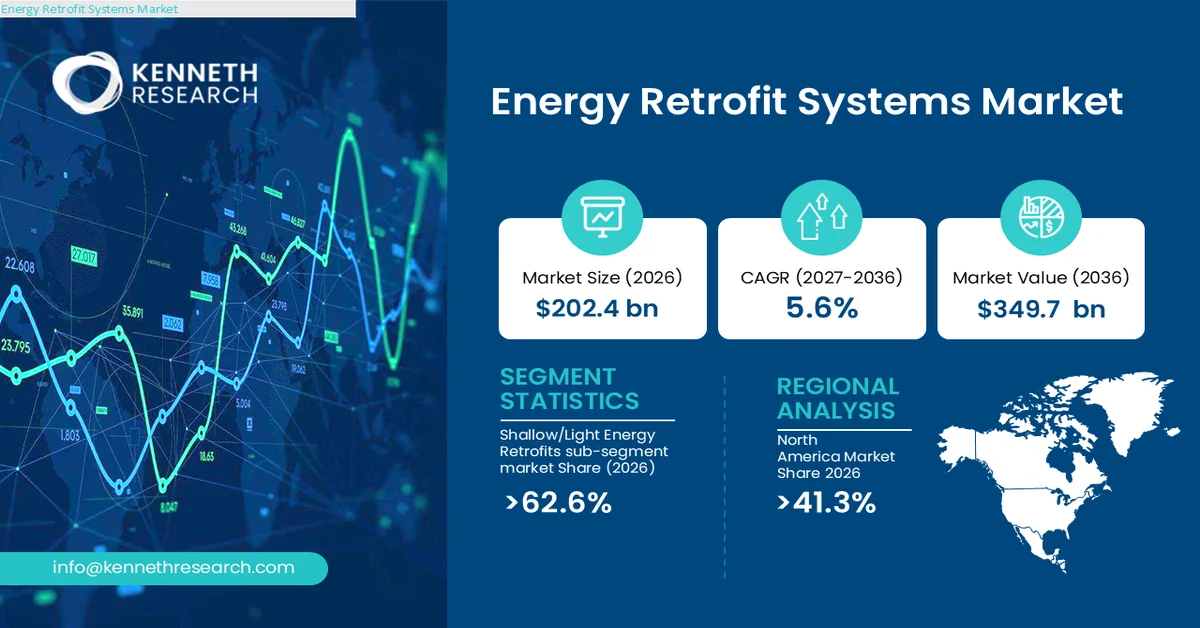
Energy Retrofit Systems Market size was valued at USD 202.4 Billion in 2026 and is projected to reach USD 349.7 Billion by the end of 2036, rising at a CAGR of 5.6% during the forecast period, i.e., 2027–2036. In 2027, the industry size of the global energy retrofit systems is estimated at USD 214.1 Billion.
The primary growth driver for the energy retrofit systems market is rising pressure to improve the energy performance of existing buildings through renovation policies, efficiency requirements, and cost-reduction initiatives. The European Commission reports that roughly 75% of EU buildings have poor energy performance, strengthening demand for energy renovation solutions.
The energy retrofit systems market comprises technologies, equipment, materials, controls, and integrated solutions used to improve the energy performance of existing buildings. These systems are deployed during renovation or refurbishment activities to reduce energy demand, improve operational efficiency, enhance occupant comfort, and support building decarbonization objectives.
Key characteristics include the integration of building-envelope improvements, heating, ventilation and air-conditioning upgrades, efficient lighting, renewable-energy systems, energy-management technologies, smart controls, and other efficiency measures. Retrofit projects can range from targeted upgrades addressing individual systems to coordinated interventions across multiple building components.
Key Energy Retrofit Systems Market Insights Summary:
Key Takeaways: Market Trends & Insights
- Shallow/Light Energy Retrofits accounted for 62.6% market share in 2026, making it the leading sub-segment within the Retrofit Depth category
- North America dominated the energy retrofit systems market with a 41.3% market share in 2026, supported by strong retrofit activity across the United States and Canada
- The energy retrofit systems market is projected to increase from USD 202.4 Billion in 2026 to USD 349.7 Billion by 2036
- The market is expected to expand at a CAGR of 5.6% during 2027–2036, reflecting sustained demand for building modernization, energy efficiency, and retrofit technologies
- The Building Envelope segment is identified as the second and fastest-growing analysis segment within the Product category, supported by demand for insulation, windows, air sealing, and integrated envelope improvements
Market Drivers
- Government support for advanced retrofit technologies
- Aging building infrastructure and demand for performance upgrades
- Building electrification and integration of smart energy-management systems
- Stronger energy-efficiency regulations and building-performance requirements
Challenges
- High upfront investment and financing complexity
- Shortage of specialized retrofit skills
Energy Retrofit Systems Market Overview & Supply Chain
Global adoption of energy retrofit systems is increasing as building owners, governments, and facility operators seek to improve energy performance, reduce operating costs, strengthen resilience, and comply with increasingly stringent efficiency and decarbonization policies. Technological advances in heat pumps, building controls, insulation, efficient HVAC equipment, digital energy management, and integrated retrofit solutions are expanding the range of economically viable interventions for existing buildings.
The energy retrofit systems market value chain begins with raw materials and component inputs, including insulation materials, glass, metals, polymers, electrical components, sensors, control hardware, and equipment used in HVAC, heating, cooling, lighting, and renewable-energy systems. Manufacturers transform these inputs into retrofit products, assemblies, equipment, and integrated building systems, with engineering and software capabilities increasingly incorporated into the offering. Distribution occurs through manufacturers, specialized distributors, contractors, wholesalers, energy-service providers, and project integrators, depending on system complexity and procurement structure. Installation and commissioning typically involve construction firms, mechanical and electrical contractors, energy consultants, architects, and engineering specialists. End users include commercial property owners, residential building owners, industrial facilities, public-sector organizations, institutional buildings, and facility managers.
Energy Retrofit Systems Market: Growth Drivers & Challenges
Growth Drivers
- Government support for advanced retrofit technologies: Government funding and demonstration programs are accelerating adoption by reducing the technical and financial barriers associated with upgrading existing buildings. Public support helps manufacturers, technology developers, contractors, and building owners validate emerging solutions across insulation, HVAC, electrification, controls, and integrated retrofit applications. In August 2023, the U.S. Department of Energy announced $46 million for 29 projects across 15 states to advance building technologies and retrofit practices, including solutions intended to improve efficiency, electrification, demand flexibility, and operating costs.
- Aging building infrastructure and demand for performance upgrades: Aging building infrastructure is creating sustained demand for retrofit solutions as owners seek to improve the performance of existing assets without undertaking complete reconstruction. Older envelopes, mechanical systems, lighting installations, controls, and heating and cooling equipment can constrain operational efficiency and increase maintenance requirements. Retrofit systems provide a modular pathway for addressing these weaknesses while preserving the underlying building structure and extending asset functionality. The growth mechanism is strengthened by the increasing availability of integrated solutions that combine envelope improvements with efficient equipment, electrification, automation, and energy-management capabilities.
Challenges
- High upfront investment and financing complexity: The retrofit market faces a structural financing barrier because many projects require substantial capital before energy savings are realized. Building owners must evaluate equipment replacement, envelope improvements, controls, electrical upgrades, and installation costs as an integrated investment, while returns can vary according to building condition, energy prices, occupancy, and operating practices. This complexity can delay investment decisions, particularly where owners have competing capital priorities or where tenants receive the utility savings but owners fund the improvements.
- Shortage of specialized retrofit skills: Energy retrofit projects require coordinated expertise across building diagnostics, insulation, HVAC, heat pumps, electrical systems, controls, commissioning, and energy auditing. The challenge is not simply a general construction-labor shortage; it is the availability of workers with the specific technical capabilities needed to install and integrate increasingly sophisticated efficiency technologies. This constraint can increase project lead times, raise installation costs, limit contractor capacity, and create execution risks for building owners. It can also make complex retrofit packages harder to scale consistently across regions because project quality depends heavily on local installation and commissioning capabilities.
Energy Retrofit Systems Market Size and Forecast:
| Report Attribute | Details |
|---|---|
| Base Year |
2026 |
| Forecast Period |
2027-2036 |
| CAGR |
5.6% |
| Base Year Market Size (2026) |
USD 202.4 Billion |
| Forecast Year Market Size (2036) |
USD 349.7 Billion |
| Regional Scope |
|
Energy Retrofit Systems Market Segmentation Analysis:
Retrofit Depth Segment Analysis
In the retrofit depth segment, Shallow/Light Energy Retrofits sub-segment is anticipated to capture the largest market share of 62.6% by the end of 2026.
Shallow/Light Energy Retrofits dominate the energy retrofit systems market because they offer building owners a lower-disruption pathway to improve performance without undertaking extensive structural modifications. Demand is supported by aging building stock, operating-cost reduction priorities, and the need to address individual efficiency weaknesses such as insulation, air sealing, lighting, controls, and equipment upgrades. DOE programs are also emphasizing faster, more affordable retrofit approaches, supporting broader implementation. Going forward, shallow retrofits should remain an important entry point for owners seeking immediate performance improvements, while successful projects can create a pathway toward progressively deeper building upgrades.
Product Segment Analysis
The Building Envelope is projected to grow as the second-largest segment in energy retrofit systems market due to four converging demand drivers.
Building Envelope is projected to grow rapidly within the energy retrofit systems market because envelope improvements directly address heat transfer, air leakage, insulation deficiencies, and inefficient windows while creating a foundation for subsequent electrification and HVAC optimization. Demand is being reinforced by building owners seeking lower operating costs and improved occupant comfort, alongside public programs that encourage insulation, air sealing, window upgrades, and other enclosure improvements. Adoption is also shifting toward less disruptive retrofit formats, including panelized systems, advanced insulation, automated surveying, and secondary glazing. Supply-side innovation is increasingly focused on faster installation, lower labor requirements, and scalable retrofit packages. Future growth should therefore benefit from integrated envelope solutions that reduce disruption while supporting building electrification and deeper energy-performance upgrades.
Our in-depth analysis of the energy retrofit systems market includes the following segments:
|
Segment |
Sub-segment |
|
Product |
|
|
Application |
|
|
Retrofit Depth |
|
Energy Retrofit Systems Market Regional Insights:
North America Trends & Insights:
North America energy retrofit systems market is projected to hold the largest revenue share of 41.3% by the end of 2026.
Regional leadership reflects a mature building-services ecosystem, substantial installed building stock, strong technology commercialization capabilities, and active public-sector support for energy-efficiency investment. The United States remains the principal demand and innovation center, with federal programs supporting advanced retrofit technologies, building electrification, envelope improvements, and energy-management solutions.
The United States represents the region’s principal commercial engine, supported by federal funding, technology development, state-level efficiency programs, and a large base of existing residential and commercial buildings requiring modernization.
Canada offers a complementary growth market, with government-backed retrofit financing and efficiency initiatives encouraging upgrades to existing properties. Together, the two countries provide manufacturers, energy-service companies, contractors, utilities, and technology providers with a broad platform for scaling retrofit solutions.
Europe Market Trends & Insights:
Europe represents a structurally attractive market for energy retrofit systems because building decarbonization, energy security, and operating-cost reduction are closely integrated into regional policy. The revised Energy Performance of Buildings Directive is accelerating renovation activity by requiring national renovation plans, strengthening minimum performance requirements for non-residential buildings, and establishing pathways for improving residential building performance.
Germany is a major industrial market, supported by established construction, engineering, HVAC, building-material, and energy-service capabilities. Its Federal Funding for Efficient Buildings program supports energy-efficient renovation across residential and non-residential properties, creating opportunities for technology suppliers, contractors, and project developers.
France combines strong policy support with an established renovation ecosystem. MaPrimeRénov’ provides financial assistance for energy renovation, while the government has expanded pathways covering both individual measures and comprehensive renovations. This creates opportunities for manufacturers and service providers offering insulation, heating, ventilation, and integrated retrofit solutions.
Energy Retrofit Systems Market Competitive Landscape
Here is a list of upstream, downstream, and key players operating in the global energy retrofit systems competitive ecosystem:
- Johnson Controls International plc (United States)
- Company Overview
- Business Strategy
- Key Product Offerings
- Financial Performance
- Key Performance Indicators
- Risk Analysis
- Recent Development
- Regional Presence
- SWOT Analysis
- Schneider Electric SE (France)
- Emerson Electric Co. (United States)
- Ameresco, Inc. (United States)
- AECOM (United States)
Recent Developments
- In September 2025, Johnson Controls partnered with Concordia University to retrofit the 59-year-old Guy-De Maisonneuve Building, targeting a 50% reduction in energy consumption through air-sourced heat pumps, heat recovery, and occupancy controls, with a 10-year performance guarantee.
- In October 2025, Schneider Electric launched EcoStruxure Building Operation 7.0, a next-generation building management software enabling up to 20% faster implementation through integrated automation, real-time occupancy-based HVAC and lighting control, and multi-factor cybersecurity authentication.
Frequently Asked Question
In 2026, the energy retrofit systems market exceeded USD 202.4 Billion.
The energy retrofit systems market is projected to reach USD 349.7 Billion by the end of 2036, expanding at a CAGR of 5.6% over the forecast period (2027-2036).
The major players in the market are Johnson Controls International plc, Schneider Electric SE, Emerson Electric Co., Ameresco, Inc., AECOM, and others.
In the Retrofit Depth segment, the Shallow/Light Energy Retrofits sub-segment is anticipated to capture the largest market share of 62.6% in the future and exhibit lucrative growth opportunities during 2027-2036. This growth trajectory is largely attributed to demand for lower-disruption building upgrades and energy-performance improvements.
North America is projected to hold the largest market share of 41.3% by the end of 2036 and provide more business opportunities in the future. Continuous investments and retrofit initiatives across the United States and Canada are fostering the region's dominance.
Why Choose Kenneth Research ?
-
Insight with Impact : We don’t just gather data — we uncover stories, trends, and opportunities that fuel business growth.
-
Experts Who Get It : Our team speaks your industry’s language and knows what really matters to your customers and market.
-
Custom-Built for You : Forget one-size-fits-all. We craft research and consulting solutions as unique as your business vision.
-
Partners, Not Just Providers : We work with you, not for you — collaborating closely to turn insights into smart, strategic moves.
-
Results That Speak : Our work powers brands, startups, and industry leaders alike — with a track record of ideas that work in the real world.
Report ID: 1251 |
Published Date: 01 Sep 2026 |
Report Format: |
Delivery Timeline: 48-72 Business Hours

Copyright © 2025 Kenneth Research. All rights reserved. Terms of Use | Privacy Policy
