Report ID: 1356 |
Published Date: 28 Sep 2026 |
Report Format: |
Delivery Timeline: 48-72 Business Hours
Electron Beam Machining Market Outlook:
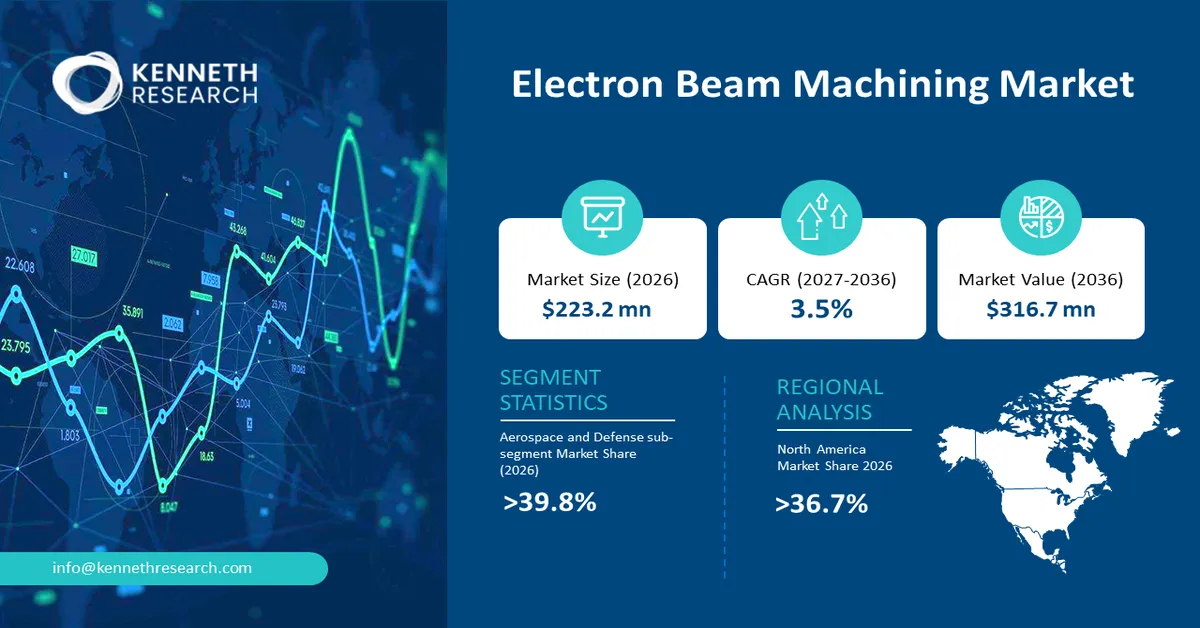
Electron Beam Machining Market size was valued at USD 223.2 million in 2026 and is projected to reach USD 316.7 million by the end of 2036, rising at a CAGR of 3.5% during the forecast period, i.e., 2027-2036. In 2027, the industry size of the global electron beam machining is estimated at USD 232.4 million.
Growing demand for high-precision manufacturing in aerospace and defense is a primary growth driver for the electron beam machining market. Electron beam-based processing enables controlled material removal and fabrication of intricate components, supporting manufacturers that require dimensional accuracy, repeatability, specialized materials processing, and reliable production capabilities for demanding engineering applications.
Electron beam machining is an advanced, nontraditional manufacturing process that uses a focused, high-energy electron beam to remove or modify material from a workpiece with highly controlled energy input. The process operates in a vacuum environment and can produce localized heating, melting, and vaporization, making it suitable for precision machining of electrically conductive materials and intricate component features.
Key characteristics include concentrated energy delivery, localized material processing, programmable beam control, and the ability to produce fine holes, narrow cuts, slots, and complex geometries. Process parameters can be adjusted to control the interaction between the electron beam and workpiece, supporting precision-oriented manufacturing requirements. NASA technical documentation describes electron-beam processes as relevant to advanced manufacturing and aerospace component development, including applications requiring controlled electron-beam deposition and precision processing.
Key Electron Beam Machining Market Insights Summary:
Key Takeaways: Market Trends & Insights
- Global electron beam machining market stood at USD 223.2 million in 2026
- Market value is projected to reach USD 316.7 million by 2036, reflecting a CAGR of 3.5% during 2027-2036
- Aerospace and Defense led the End-Use Industry segment with a 39.8% market share in 2026
- The 10 to 30 kW power-rating segment is projected to be the fastest-growing analysis segment
- North America dominated the market with a 36.7% market share in 2026, supported by the United States and Canada
Market Drivers
- Rising demand for advanced aerospace and defense component manufacturing
- Advancements in process automation and precision manufacturing
- Increasing use of difficult-to-machine and high-performance materials
- Growing adoption of digitally integrated and specialized manufacturing technologies
Challenges
- High capital intensity and vacuum-system complexity
- Workpiece size constraints and limited production flexibility
Electron Beam Machining Market Overview & Supply Chain
Adoption of the electron beam machining market is increasing as manufacturers pursue tighter process control, complex geometries, specialized-material processing, and digitally controlled production for high-value components. The technology is particularly relevant to aerospace and defense, where precision manufacturing, repeatability, material performance, and component integrity are critical. Its broader industrial relevance is reinforced by the expansion of advanced manufacturing programs and supply-chain capabilities across high-performance industries.
The electron beam machining market value chain begins with specialized input materials, including electrically conductive metals, alloys, tooling materials, vacuum-system components, electron-emission components, control electronics, and precision measurement equipment. Upstream suppliers provide certified materials and critical machine subsystems to equipment manufacturers and machining-system integrators. Production encompasses electron beam equipment design, beam-generation systems, vacuum chambers, motion-control platforms, software, process development, machine integration, and component machining. Distribution occurs through direct sales, specialized industrial equipment suppliers, technology integrators, and service providers. End users include aerospace and defense manufacturers, medical-device producers, automotive companies, electronics manufacturers, energy equipment producers, research institutions, and precision engineering organizations.
Electron Beam Machining Market: Growth Drivers & Challenges
Growth Drivers:
- Increasing demand for advanced aerospace and space manufacturing: The growing need for high-performance aerospace and space components is strengthening adoption of electron beam technologies. These processes provide concentrated energy delivery and precise control, enabling manufacturers to produce or modify complex metallic structures while addressing demanding requirements for material integrity and dimensional control. Government-backed development is also accelerating technology maturation. NASA reported that its collaboration with COSM was developing an electron beam gun incorporating in-situ imaging, metrology, and closed-loop controls to improve manufacturing reliability.
- Advancements in process automation and precision manufacturing: Advances in automation, beam control, sensing, and computer-integrated manufacturing are creating stronger conditions for electron beam machining adoption. Modern production environments increasingly require repeatable processing of sophisticated geometries while minimizing manual intervention and improving process consistency. Electron beam systems can integrate programmable controls with sophisticated motion platforms, monitoring technologies, and digital manufacturing workflows, enabling manufacturers to refine process parameters and improve production repeatability.
Challenges:
- High capital intensity and vacuum-system complexity: The capital-intensive configuration of electron beam machining equipment is a significant restraint on adoption, particularly for manufacturers evaluating the technology against conventional machining systems. Specialized electron guns, beam-focusing optics, high-voltage systems, vacuum chambers, motion controls, and associated safety infrastructure increase acquisition and installation complexity. The vacuum requirement also introduces operational considerations because chambers must be evacuated and maintained at suitable conditions before processing.
- Workpiece size constraints and limited production flexibility: The requirement to process components inside a vacuum chamber creates an inherent constraint on workpiece dimensions and production configuration. Large or irregularly shaped components can require specialized chamber designs, customized fixturing, or alternative processing arrangements, increasing engineering complexity and potentially restricting the range of applications that can be handled economically. Electron beam machining is consequently better aligned with precision features and specialized components than with broad, high-volume material-removal operations.
Electron Beam Machining Market Size and Forecast:
| Report Attribute | Details |
|---|---|
| Base Year |
2026 |
| Forecast Period |
2027-2036 |
| CAGR |
3.5% |
| Base Year Market Size (2026) |
USD 223.2 million |
| Forecast Year Market Size (2036) |
USD 316.7 million |
| Regional Scope |
|
Electron Beam Machining Market Segmentation Analysis:
End-Use Industry Segment Analysis
In the end-use industry segment, aerospace and defense sub-segment is anticipated to capture the largest market share of 39.8% by the end of 2026.
The aerospace and defense segment dominates the electron beam machining market because aircraft, propulsion, space, and defense components require highly controlled manufacturing of complex metallic parts, precision features, and difficult-to-machine materials. Electron beam machining is well suited to these requirements because its concentrated energy enables localized processing while supporting dimensional control and intricate geometries. Demand is reinforced by continued aerospace production, fleet expansion, defense modernization, and increasing investment in advanced aircraft and space systems. On the supply side, specialized machining providers and aerospace manufacturers are expanding capabilities around advanced manufacturing, inspection, automation, and digitally controlled production. The U.S. Department of Commerce reports an estimated 253,100 workers in aircraft manufacturing in mid-2024, demonstrating the substantial production ecosystem that supports demand for specialized manufacturing technologies.
Power Rating Segment Analysis
The 10 to 30 KW is projected to grow as the second-largest segment in the electron beam machining market due to four converging demand drivers.
The 10 to 30 kW power-rating segment is projected to grow as manufacturers seek electron-beam systems capable of delivering greater processing capacity while maintaining precise energy control. This power range is particularly relevant to demanding metal-processing applications where higher beam power can support deeper penetration, faster material interaction, and productivity improvements. Adoption is being reinforced by the convergence of electron-beam processing with automated motion control, in-process monitoring, and advanced manufacturing workflows. Government-backed research also demonstrates the practical use of this power range: a publicly accessible NASA technical publication describes an electron-beam manufacturing system equipped with a 15 kW electron gun, supporting automated deposition and online surface measurement.
Our in-depth analysis of the electron beam machining market includes the following segments:
|
Segment |
Sub-segment |
|
Process Type |
|
|
Power Rating |
|
|
Material |
|
|
End-Use Industry |
|
Electron Beam Machining Market Regional Insights:
North America Market Trends & Insights:
North America electron beam machining market is projected to hold the largest revenue share of 36.7% by the end of 2026.
North America maintains its position as the dominant region for the electron beam machining market, supported by a mature aerospace and defense manufacturing base, advanced precision-engineering capabilities, established research infrastructure, and sustained investment in advanced manufacturing technologies.
The United States provides the largest industrial ecosystem, with extensive aerospace manufacturing, defense production, research programs, and specialized machining capabilities. Regulatory and government-backed technology initiatives further support investment in advanced production methods and domestic manufacturing capacity.
Canada complements the regional ecosystem through a highly developed aerospace manufacturing base and established supplier networks. This industrial base supports demand for precision manufacturing technologies and strengthens North America's broader supply-chain capabilities. Going forward, regional adoption is expected to benefit from aerospace production expansion, defense modernization, reshoring initiatives, and continued investment in digitally enabled manufacturing.
Asia Pacific Market Trends & Insights:
Asia Pacific represents an important growth region for the electron beam machining market, supported by expanding aerospace, automotive, electronics, semiconductor, energy, and precision-engineering activities.
China is positioned as a major regional opportunity because of its extensive manufacturing ecosystem and accelerating development of commercial aerospace, advanced equipment, integrated circuits, and strategic industries. Beijing’s commercial-aerospace action plan specifically promotes advanced manufacturing capabilities and industrial clustering, supporting potential applications for precision electron-beam processing.
Japan offers complementary opportunities through its established precision-manufacturing base, aerospace ambitions, machine-parts sector, and government support for advanced manufacturing technologies. Its Space Strategy Fund also provides multiyear support for private-sector space technology development, strengthening the potential demand environment for sophisticated manufacturing processes.
Leading Companies Operating in the Electron Beam Machining Market:
Here is a list of upstream, downstream, and key players operating in electron beam machining market competitive ecosystem:
- pro-beam Group (Germany)
- Company Overview
- Business Strategy
- Key Product Offerings
- Financial Performance
- Key Performance Indicators
- Risk Analysis
- Recent Development
- Regional Presence
- SWOT Analysis
- Bodycote plc (United Kingdom)
- Sciaky, Inc. (United States)
- Cambridge Vacuum Engineering (United Kingdom)
- Focus GmbH (Germany)
- Joining Technologies, Inc. (United States)
Recent Developments
- In April 2026, Cambridge Vacuum Engineering appointed Nic Vincent as its new Global Sales & Marketing Director for Ebflow technology. Vincent, who brings over 25 years of experience from Olympus Corporation and Teledyne Technologies, will lead the commercial strategy to accelerate the adoption of the company's local vacuum electron beam welding technology across heavy engineering sectors globally, including nuclear and renewable energy infrastructure projects.
- In July 2026, Bodycote plc announced a multi-million-euro investment programme to expand thermal processing capacity across its European facilities. The programme includes new Hot Isostatic Pressing (HIP) equipment, with over €20 million invested at its Magny-Cours facility in France and additional HIP vessels installed at its Haag-Winden site in Germany. The investments are aimed at supporting growing demand from aerospace and defence customers.
Frequently Asked Question
In 2026, the electron beam machining market exceeded USD 223.2 million.
The electron beam machining market is projected to reach USD 316.7 million by the end of 2036, expanding at a CAGR of 3.5% over the forecast period (2027-2036).
The major players in the market are pro-beam Group, Bodycote plc, Sciaky, Inc., Cambridge Vacuum Engineering, Focus GmbH, Joining Technologies, Inc., and others.
In the End-Use Industry segment, the Aerospace and Defense sub-segment is anticipated to capture the largest market share of 39.8% in the future and exhibit lucrative growth opportunities during 2027-2036. This growth trajectory is largely attributed to growing demand for high-precision manufacturing in aerospace and defense applications.
North America is projected to hold the largest market share of 36.7% by the end of 2026 and provide more business opportunities in the future. Continuous investments in aerospace and defense manufacturing, advanced precision engineering, and specialized manufacturing capabilities across the United States and Canada are fostering the region's dominance.
Why Choose Kenneth Research ?
-
Insight with Impact : We don’t just gather data — we uncover stories, trends, and opportunities that fuel business growth.
-
Experts Who Get It : Our team speaks your industry’s language and knows what really matters to your customers and market.
-
Custom-Built for You : Forget one-size-fits-all. We craft research and consulting solutions as unique as your business vision.
-
Partners, Not Just Providers : We work with you, not for you — collaborating closely to turn insights into smart, strategic moves.
-
Results That Speak : Our work powers brands, startups, and industry leaders alike — with a track record of ideas that work in the real world.
Report ID: 1356 |
Published Date: 28 Sep 2026 |
Report Format: |
Delivery Timeline: 48-72 Business Hours

Copyright © 2025 Kenneth Research. All rights reserved. Terms of Use | Privacy Policy
