Report ID: 1259 |
Published Date: 01 Sep 2026 |
Report Format: |
Delivery Timeline: 48-72 Business Hours
Electric Vehicle Sensor Market Outlook:
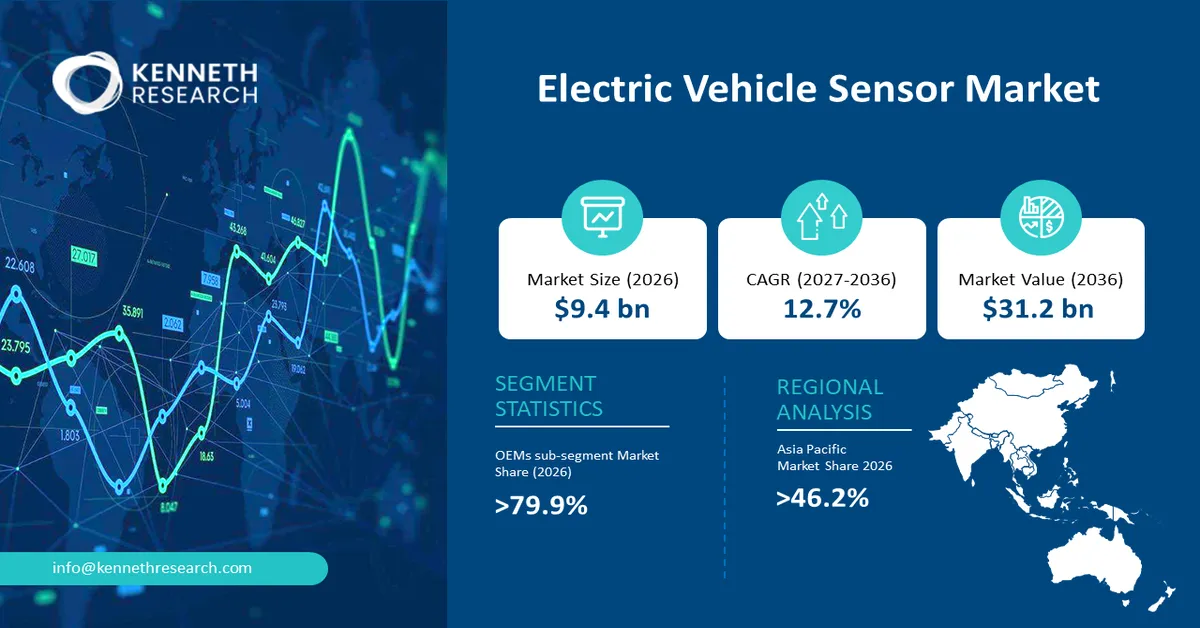
Electric Vehicle Sensor Market size was valued at USD 9.4 billion in 2026 and is projected to reach USD 31.2 billion by the end of 2036, rising at a CAGR of 12.7% during the forecast period, i.e., 2027-2036. In 2027, the industry size of the electric vehicle sensor is estimated at USD 10.6 billion.
The primary growth driver for the electric vehicle sensor market is accelerating EV adoption, increasing demand for sensors supporting battery monitoring, thermal management, powertrain control, safety, and vehicle intelligence. The IEA reports that electric car sales reached nearly 14 million in 2023, reinforcing expanding sensor requirements across electrified vehicle platforms.
The electric vehicle sensor market comprises sensors and sensing systems integrated into electric vehicles to measure, monitor, and communicate physical and electrical conditions across vehicle subsystems. These products detect parameters such as temperature, pressure, voltage, current, position, speed, acceleration, torque, proximity, and occupancy, converting real-world conditions into signals used by electronic control units and vehicle software.
Key characteristics include application-specific sensing, high accuracy, fast response, durability, electromagnetic compatibility, compact packaging, and integration with vehicle control architectures. Sensor technologies may include temperature, pressure, magnetic, inertial, optical, current, voltage, and position sensing, depending on the vehicle function and system design.
Key Electric Vehicle Sensor Market Insights Summary:
Key Takeaways: Market Trends & Insights
- Electric vehicle sensor market reached USD 9.4 Billion in 2026
- The market is projected to reach USD 31.2 Billion by 2036 at a CAGR of 12.7%
- OEMs dominated the Sales Channel segment with a 79.9% market share in 2026
- Battery Electric Vehicles are projected to remain the fastest-growing propulsion segment as BEV adoption expands globally
- Asia Pacific led the market with a 46.2% share in 2026, supported by strong EV manufacturing and electronics supply chains
Market Drivers
- Expansion of global electric vehicle deployment
- Increasing sensor content from advanced vehicle electronics
- Electrification-driven battery monitoring and thermal-management requirements
- Advancement of autonomous driving, ADAS, and vehicle safety systems
Challenges
- Semiconductor and component supply-chain vulnerability
- Increasing functional safety and cybersecurity requirements
Electric Vehicle Sensor Market Overview & Supply Chain
Global adoption of electric vehicles is accelerating as automakers, governments, energy providers, and technology suppliers respond to decarbonization objectives, evolving emissions policies, improving vehicle economics, and advances in battery and electronic systems. This transition is increasing the strategic importance of sensors, which support battery monitoring, thermal management, powertrain control, safety systems, driver assistance, and vehicle efficiency.
The electric vehicle sensor industry value chain begins with raw-material and component inputs, including semiconductor materials, silicon-based devices, conductive metals, magnetic materials, ceramics, polymers, and specialty electronic components. Sensor manufacturers convert these inputs into sensing elements, integrated modules, and packaged devices designed for temperature, pressure, position, current, voltage, speed, acceleration, proximity, and other vehicle functions. Tier-1 automotive suppliers and specialized electronics manufacturers then integrate sensors into battery-management systems, electric powertrains, thermal-management assemblies, braking systems, safety systems, and electronic control architectures. Distribution occurs through direct OEM procurement, automotive Tier-1 suppliers, component distributors, and established electronics supply networks.
Electric Vehicle Sensor Market: Growth Drivers & Challenges
Growth Drivers:
- Expansion of global electric vehicle deployment: The expansion of electric vehicle deployment is a primary demand catalyst for vehicle sensors because every increase in electrified vehicle production creates additional requirements for accurate monitoring and control across batteries, electric motors, thermal systems, charging interfaces, braking systems, and safety electronics. Sensors enable real-time measurement of temperature, current, voltage, pressure, position, speed, and other operating conditions, allowing electronic control units to optimize performance while protecting high-value components.
- Increasing sensor content from advanced vehicle electronics: The growing sophistication of electric vehicle electronic architectures is increasing the number and functional importance of sensors installed throughout the vehicle. EV platforms depend heavily on electronic control systems to coordinate propulsion, battery operation, thermal management, charging, braking, steering, and safety functions. As manufacturers pursue greater driving efficiency, faster charging, improved battery durability, and enhanced vehicle intelligence, sensing requirements become more precise and increasingly interconnected. This trend is also encouraging the migration from individual discrete sensors toward integrated sensing modules capable of supplying multiple measurements to centralized or zonal vehicle-control architectures.
Challenges:
- Semiconductor and component supply-chain vulnerability: The electric vehicle sensor market remains exposed to disruptions across the semiconductor and electronic-component supply chain. Sensor production depends on specialized chips, wafers, packaging technologies, precision materials, and manufacturing capacity that cannot always be substituted quickly. The root cause is structural concentration across parts of the semiconductor ecosystem, combined with long qualification cycles for automotive components. The U.S. Government Accountability Office has identified raw-material bottlenecks and geographic concentration of semiconductor manufacturing as underlying supply-chain risks. For sensor suppliers, disruptions can delay production, increase procurement costs, and complicate delivery commitments to automotive OEMs and Tier-1 suppliers.
- Increasing functional safety and cybersecurity requirements: Greater integration of sensors into safety-critical vehicle functions raises the technical and commercial burden of achieving dependable performance throughout the product lifecycle. EVs increasingly rely on interconnected electronic systems, meaning sensor faults, incorrect data, compromised interfaces, or weaknesses in supporting semiconductor components can affect downstream control functions. The National Highway Traffic Safety Administration highlights cybersecurity as an important consideration for vehicles incorporating advanced driver-assistance technologies, electronics, sensors, and computer systems. For sensor manufacturers, this creates requirements for stronger validation, fault detection, secure development processes, traceability, and collaboration with vehicle-system integrators. These requirements can lengthen development and qualification cycles and increase engineering costs, particularly for smaller suppliers.
Electric Vehicle Sensor Market Size and Forecast:
| Report Attribute | Details |
|---|---|
| Base Year |
2026 |
| Forecast Period |
2027-2036 |
| CAGR |
12.7% |
| Base Year Market Size (2026) |
USD 9.4 billion |
| Forecast Year Market Size (2036) |
USD 31.2 billion |
| Regional Scope |
|
Electric Vehicle Sensor Market Segmentation Analysis:
Sales Channel Segment Analysis
In the sales channel segment, OEM sub-segment is anticipated to capture the largest market share of 79.9% by the end of 2026.
OEMs dominate the electric vehicle sensor market because sensors are increasingly embedded directly into vehicle architectures during original equipment manufacturing, where battery management, electric powertrain control, thermal regulation, braking, safety, and driver-assistance functions must be engineered as integrated systems. Demand is reinforced by automakers expanding electrified model portfolios and increasing electronic content per vehicle. China provides a strong indication of OEM-side demand: the National Bureau of Statistics of China reported that 13.168 million new energy vehicles were produced in 2024, representing a 38.7% increase from the previous year. This expanding production base supports direct procurement relationships between vehicle manufacturers, Tier-1 suppliers, and sensor producers. On the supply side, OEM programs favor suppliers capable of meeting stringent automotive qualification, reliability, traceability, and integration requirements, which creates barriers to entry but strengthens established vendor relationships.
Propulsion Segment Analysis
The Battery Electric Vehicles (BEVs) is projected to grow as the second-largest segment in the electric vehicle sensor market due to four converging demand drivers.
Battery Electric Vehicles (BEVs) are positioned for strong growth within the propulsion segment because their fully electric architecture requires extensive electronic monitoring across battery packs, electric motors, thermal-management systems, charging interfaces, braking, and vehicle-control functions. This creates sustained demand for current, voltage, temperature, pressure, position, speed, and other sensors that enable efficient and safe operation. Adoption is also supported by broader availability of BEV models, expanding charging ecosystems, and automakers increasingly designing dedicated electric platforms rather than adapting internal-combustion architectures. On the supply side, deeper collaboration among OEMs, Tier-1 suppliers, semiconductor manufacturers, and battery-system developers supports technology refinement. Future BEV platform standardization and greater electronic integration should further increase sensor content and reinforce demand for advanced sensing technologies.
Our in-depth analysis of the electric vehicle sensor market includes the following segments:
|
Segment |
Sub-segment |
|
Product Type |
|
|
Propulsion |
|
|
Sales Channel |
|
Electric Vehicle Sensor Market Regional Insights:
Asia Pacific Market Trends & Insights:
Asia Pacific electric vehicle sensor market is projected to hold the largest revenue share of 46.2% by the end of 2026.
It is supported by its extensive automotive manufacturing base, high EV adoption, established electronics and semiconductor supply chains, and substantial investment in electrification. China is the principal production and consumption hub, while Japan contributes advanced automotive engineering and sensor technologies. Regulatory initiatives promoting vehicle electrification, expanding charging infrastructure, and industrial policies supporting new-energy manufacturing further strengthen the regional ecosystem.
China combines large-scale EV production, domestic consumption, battery manufacturing, and extensive component localization, creating a broad customer base for sensor suppliers.
Japan remains strategically important through its sophisticated automotive manufacturing ecosystem, established electronics industry, and emphasis on high-reliability vehicle technologies. Together, these markets support both volume-oriented and technologically advanced sensor demand. Continued electrification, localized component development, and increasing electronic integration should sustain Asia Pacific’s leadership over the forecast period.
North America Market Trends & Insights:
North America represents an important secondary market for electric vehicle sensors, supported by expanding EV manufacturing, battery production, charging infrastructure, and investments in localized automotive supply chains. Demand is strengthened by automakers transitioning existing production facilities toward electrified platforms and by growing requirements for sophisticated battery-management, thermal-management, powertrain, safety, and driver-assistance sensing systems.
The United States is the principal North American hub, combining a large automotive manufacturing base with substantial investment in domestic EV and battery production. Its market offers opportunities across passenger vehicles, commercial fleets, battery systems, and charging-related electronics.
Canada complements this ecosystem through its automotive manufacturing footprint, critical-mineral resources, and battery-supply-chain development. Government policy is encouraging collaboration between manufacturers, technology companies, and resource producers, strengthening the region’s integrated EV ecosystem. Together, the two countries provide a diversified customer and manufacturing base for sensor suppliers.
Leading Companies Operating in the Global Electric Vehicle Sensor Market:
Here is a list of upstream, downstream, and key players operating in the electric vehicle sensor market competitive ecosystem:
- Robert Bosch GmbH (Germany)
- Company Overview
- Business Strategy
- Key Product Offerings
- Financial Performance
- Key Performance Indicators
- Risk Analysis
- Recent Development
- Regional Presence
- SWOT Analysis
- Infineon Technologies AG (Germany)
- STMicroelectronics N.V. (Switzerland)
- Sensata Technologies, Inc. (United States)
- TE Connectivity plc (Switzerland)
Recent Developments
- In March 2025, Sensata Technologies launched the SIM200 Insulation Monitoring Device (IMD), designed to enhance safety in high-voltage EV systems. The device provides continuous active monitoring for unearthed DC systems using a patented signal injection algorithm with "Always-On" monitoring capabilities, even when the system is turned off. It monitors total stored capacitance—critical for next-generation megawatt charging applications—and is available for systems from 60V up to 1500V with UL 2231-2 recognition.
- In October 2025, TE Connectivity introduced a new family of E-Motor Temperature Sensors for automotive and industrial applications, available in PT-type and NTC thermistor designs sealed and protected by fluoroplastics material. The sensors provide critical thermal feedback for electric vehicles and battery energy storage systems, featuring insulation resistance ≥100MΩ, dielectric strength of 3000VAC, and a temperature range of -40°C to +200°C.
Frequently Asked Question
In 2026, the electric vehicle sensor market exceeded USD 9.4 billion.
The electric vehicle sensor market is projected to reach USD 31.2 billion by the end of 2036, expanding at a CAGR of 12.7% over the forecast period (2027-2036).
The major players in the market are Robert Bosch GmbH, Infineon Technologies AG, STMicroelectronics N.V., Sensata Technologies, Inc., TE Connectivity plc, and others.
In the Sales Channel segment, the OEM sub-segment is anticipated to capture the largest market share of 79.9% in the future and exhibit lucrative growth opportunities during 2027-2036. This growth trajectory is largely attributed to increasing sensor integration across battery management, electric powertrain control, thermal regulation, braking, safety, and driver-assistance systems.
Asia Pacific is projected to hold the largest market share of 46.2% by the end of 2026 and provide more business opportunities in the future. Extensive EV production, strong electronics and semiconductor supply chains, and continuous investments in electrification across China and Japan are fostering the region's dominance.
Why Choose Kenneth Research ?
-
Insight with Impact : We don’t just gather data — we uncover stories, trends, and opportunities that fuel business growth.
-
Experts Who Get It : Our team speaks your industry’s language and knows what really matters to your customers and market.
-
Custom-Built for You : Forget one-size-fits-all. We craft research and consulting solutions as unique as your business vision.
-
Partners, Not Just Providers : We work with you, not for you — collaborating closely to turn insights into smart, strategic moves.
-
Results That Speak : Our work powers brands, startups, and industry leaders alike — with a track record of ideas that work in the real world.
Report ID: 1259 |
Published Date: 01 Sep 2026 |
Report Format: |
Delivery Timeline: 48-72 Business Hours

Copyright © 2025 Kenneth Research. All rights reserved. Terms of Use | Privacy Policy
