Report ID: 1456 |
Published Date: 29 Sep 2026 |
Report Format: |
Delivery Timeline: 48-72 Business Hours
Electric Vehicle Battery Coolant Market Outlook:
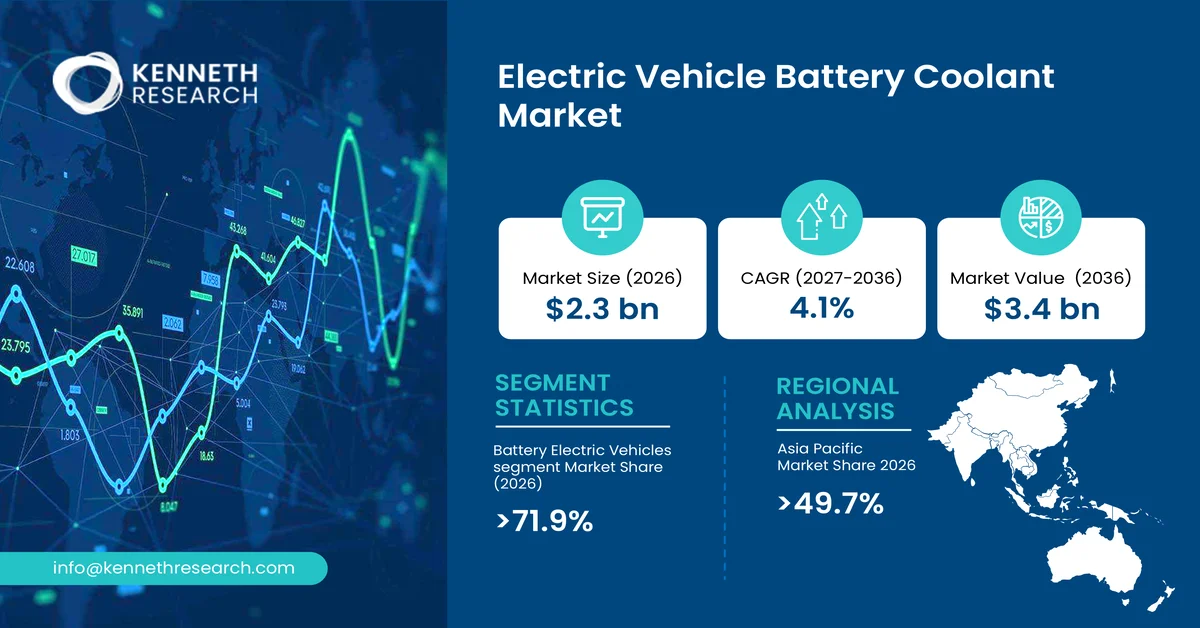
Electric vehicle battery coolant market size was valued at USD 2.3 billion in 2026 and is projected to reach USD 3.4 billion by the end of 2036, rising at a CAGR of 4.1% during the forecast period, i.e., 2027–2036. In 2027, the industry size of the electric vehicle battery coolant market is estimated at USD 2.4 billion.
The primary growth driver for the electric vehicle battery coolant market is the increasing deployment of high-performance electric vehicles, which require efficient thermal management to maintain battery operating conditions, improve durability, support charging performance, and enhance overall vehicle reliability across diverse operating environments.
The electric vehicle battery coolant market refers to the industry supplying specialized thermal-management fluids designed to regulate and dissipate heat generated by electric vehicle battery systems. These coolants are formulated to transfer heat efficiently while maintaining compatibility with battery packs, cooling components, electrical systems, and associated materials.
Key characteristics include high thermal stability, electrical safety, material compatibility, corrosion resistance, and reliable performance across varying temperature conditions. Depending on battery architecture and cooling configuration, coolants can support indirect or direct thermal-management systems and are selected according to battery chemistry, vehicle design, operating conditions, and manufacturer requirements.
Key Electric Vehicle Battery Coolant Market Insights Summary:
Key Takeaways: Market Trends & Insights
- Electric Vehicle Battery Coolant Market is projected to grow from USD 2.3 billion in 2026 to USD 3.4 billion by 2036 at a 4.1% CAGR.
- Asia-Pacific accounted for the largest regional share at 49.7% in 2026, supported by strong electric vehicle production, battery manufacturing capabilities, and expanding electrification across Japan and China.
- Battery Electric Vehicles will remain the leading vehicle type segment with a 71.9% market share in 2026, supported by the expanding deployment of fully electric powertrains and growing requirements for dedicated battery thermal management.
- Lithium-Ion Batteries represent a key battery type segment, supported by their extensive use across electric vehicle platforms and the continuing need for efficient thermal-management solutions compatible with diverse lithium-ion battery architectures.
Market Drivers
- Expansion of electric vehicle battery deployment
- Increasing thermal-management requirements for advanced battery systems
- Development of faster-charging electric vehicle platforms
- Growing integration of battery, power electronics, and vehicle thermal-management systems
Challenges
- Formulation Complexity and Material Compatibility
- High Automotive Qualification Requirements
Electric Vehicle Battery Coolant Market: Market Overview & Supply Chain
The electric vehicle battery coolant market is gaining importance as electric mobility expands and battery systems become increasingly central to vehicle performance, safety, and efficiency. Thermal management is particularly relevant because battery cells generate heat during charging and operation, requiring controlled temperature conditions to support reliable performance and durability. The expansion of EV battery manufacturing is therefore creating corresponding demand for specialized cooling fluids compatible with battery packs and thermal-management architectures.
The value chain of the electric vehicle battery coolant market begins with chemical and specialty-material suppliers providing base fluids, additives, corrosion inhibitors, and other formulation components. Coolant manufacturers then blend and formulate these inputs to achieve thermal-transfer efficiency, electrical compatibility, chemical stability, and protection against material degradation. Production may involve formulation, filtration, quality testing, packaging, and compliance verification according to automotive and battery-system requirements.
Electric Vehicle Battery Coolant Market: Growth Drivers & Challenges
Growth Drivers
- Expansion of Electric Vehicle Battery Deployment: The continued expansion of electric vehicle battery deployment is strengthening demand for advanced thermal-management solutions, including specialized battery coolants. As battery systems become more widely deployed across passenger vehicles and commercial applications, manufacturers require reliable methods to control heat generated during charging, acceleration, and sustained operation. Effective coolant systems help maintain appropriate thermal conditions, support battery longevity, and improve the reliability of vehicle thermal-management architectures.
- Increasing Thermal-Management Requirements for Advanced Battery Systems: The increasing complexity of electric vehicle battery architectures is creating stronger requirements for precisely engineered thermal-management systems. Higher-performance vehicles, faster charging capabilities, compact battery-pack configurations, and sophisticated power-management systems can increase the importance of maintaining controlled operating temperatures. This encourages automotive and battery manufacturers to evaluate coolant characteristics such as thermal conductivity, viscosity, dielectric behavior, chemical stability, and compatibility with seals, metals, polymers, and battery components.
Challenges
- Formulation Complexity and Material Compatibility: Battery coolant formulations must balance heat-transfer performance with compatibility across multiple materials used in battery packs and thermal-management circuits. Inappropriate chemical characteristics can contribute to corrosion, degradation of seals or polymers, contamination, or reduced system reliability. As battery and cooling architectures evolve, coolant manufacturers must conduct extensive compatibility and durability validation for different vehicle platforms. This raises formulation, testing, qualification, and engineering requirements.
- High Automotive Qualification Requirements: Entry into automotive coolant supply chains can be constrained by rigorous qualification processes and close integration between fluid suppliers, battery manufacturers, thermal-management-system developers, and vehicle OEMs. A coolant cannot be evaluated solely on its thermal characteristics because its interaction with the complete cooling circuit and battery environment must also be considered. Qualification requirements can increase development costs and lengthen commercialization timelines, particularly for smaller specialty-chemical suppliers.
Electric Vehicle Battery Coolant Market Size and Forecast:
| Report Attribute | Details |
|---|---|
| Base Year |
2026 |
| Forecast Year |
2027-2036 |
| CAGR |
4.1% |
| Base Year Market Size (2026) |
USD 2.3 billion |
| Forecast Year Market Size (2036) |
USD 3.4 billion |
| Regional Scope |
|
Electric Vehicle Battery Coolant Market: Segment Analysis
Battery Electric Vehicles Segment Analysis
Battery Electric Vehicles are the leading segment of the electric vehicle battery coolant market, accounting for 71.9% in 2026 under the Vehicle Type segment.
Their dominance is supported by the expanding deployment of fully electric powertrains, where the battery pack is the primary energy-storage system and requires dedicated thermal-management capabilities. Battery cooling is increasingly important as manufacturers pursue greater driving range, faster charging, higher power output, and more compact battery-pack architectures.
From the supply side, coolant producers are developing formulations compatible with increasingly sophisticated battery and thermal-management systems. Automotive OEMs and battery manufacturers are also placing greater emphasis on fluid compatibility, heat-transfer performance, electrical safety, and long-term stability.
Battery Type Segment Analysis
Lithium-Ion Batteries represent the second segment of the electric vehicle battery coolant market under the Battery Type category. Their continued use across electric vehicle platforms supports sustained demand for compatible thermal-management fluids because battery temperature control is integral to maintaining operational stability, charging performance, and component durability. Lithium-ion technology also encompasses multiple chemistries and pack configurations, creating varied requirements for coolant compatibility, heat-transfer performance, electrical properties, and material protection.
From the supply side, battery producers and automotive manufacturers are increasingly integrating thermal management into battery-pack engineering, encouraging closer collaboration with specialty-fluid suppliers.
Our in-depth analysis of the global electric vehicle battery coolant market includes the following segments:
|
Segment |
Sub-segment |
|
Battery Type |
|
|
By Coolant |
|
|
Vehicle Type |
|
Electric Vehicle Battery Coolant Market: Regional Analysis
Asia-Pacific Market Trends & Insights:
Asia-Pacific is the dominant region in the electric vehicle battery coolant market, accounting for 49.7% in 2026.
The region’s leadership is supported by its extensive electric vehicle manufacturing ecosystem, large battery-production base, expanding charging infrastructure, and continued investment in vehicle electrification. These factors create a substantial requirement for battery thermal-management technologies and specialized coolant formulations.
Japan maintains an established automotive and technology ecosystem, with government policy supporting broader electrification. Government measures include purchase support for clean-energy vehicles, encouraging manufacturers and suppliers to develop technologies compatible with evolving electrified powertrains.
China represents a major production and consumption center for electric and new-energy vehicles in Asia-Pacific. Its large automotive manufacturing base, battery supply chain, charging infrastructure, and policy support reinforce demand for thermal-management technologies. Government-backed industrial policies have also emphasized strengthening the automotive supply chain and expanding charging infrastructure, supporting continued integration of thermal-management solutions into electric vehicle platforms.
North America Market Trends & Insights:
North America represents an important demand center for the electric vehicle battery coolant market, supported by expanding electric vehicle adoption, battery manufacturing investments, charging infrastructure development, and government-led transportation electrification initiatives. The region’s automotive industry is increasingly integrating battery thermal-management systems into vehicle platforms, creating opportunities for specialized coolant suppliers.
The U.S. remains a major market for electric mobility and associated battery technologies. The U.S. Department of Energy reported that more than 1.4 million electric vehicles were sold in 2023, while federal programs have supported expansion of the country's charging network and domestic clean-vehicle manufacturing ecosystem. This industrial base creates opportunities for coolant manufacturers supplying automotive OEMs, battery producers, and thermal-management-system developers.
Canada is strengthening its electric mobility ecosystem through vehicle electrification policies, battery manufacturing investments, and charging infrastructure deployment.
Electric Vehicle Battery Coolant Market: Competitive Landscape
Here is a list of upstream, downstream, and key players operating in the global electric vehicle battery coolant market competitive ecosystem:
- BASF (Germany)
- Company Overview
- Business Strategy
- Key Product Offerings
- Financial Performance
- Key Performance Indicators
- Risk Analysis
- Recent Development
- Regional Presence
- SWOT Analysis
- Shell (United Kingdom)
- Castrol (United Kingdom)
- Arteco (Belgium)
- FUCHS (Germany)
Recent Developments
- September 2025 — BASF launched its GLYSANTIN ELECTRIFIED low-electrical-conductivity coolant portfolio for electric vehicles. The company stated that the new coolants comply with China's GB 29743.2-2025 standard and are produced at its Pudong site in Shanghai. The products are designed to reduce fluid decomposition and hydrogen generation while improving battery-system protection.
- July 2025 — Castrol announced a technical partnership with Zenvo Automotive for the Aurora hybrid hypercar. The partnership includes Castrol ON EV Thermal Fluid for battery cooling, alongside other Castrol fluids for the vehicle's hybrid powertrain.
Frequently Asked Question
In 2026, the electric vehicle battery coolant market exceeded USD 2.3 billion.
The electric vehicle battery coolant market is projected to reach USD 3.4 billion by the end of 2036, expanding at a CAGR of 4.1% over the forecast period (2027-2036).
The major players in the market are BASF, Shell, Castrol, Arteco, FUCHS, and others.
In the vehicle type segment, the battery electric vehicles sub-segment is anticipated to capture the largest market share of 71.9% in the future and exhibit lucrative growth opportunities during 2027-2036.
Asia-Pacific is projected to hold the largest market share of 49.7% by the end of 2026 and provide more business opportunities in the future.
Why Choose Kenneth Research ?
-
Insight with Impact : We don’t just gather data — we uncover stories, trends, and opportunities that fuel business growth.
-
Experts Who Get It : Our team speaks your industry’s language and knows what really matters to your customers and market.
-
Custom-Built for You : Forget one-size-fits-all. We craft research and consulting solutions as unique as your business vision.
-
Partners, Not Just Providers : We work with you, not for you — collaborating closely to turn insights into smart, strategic moves.
-
Results That Speak : Our work powers brands, startups, and industry leaders alike — with a track record of ideas that work in the real world.
Report ID: 1456 |
Published Date: 29 Sep 2026 |
Report Format: |
Delivery Timeline: 48-72 Business Hours

Copyright © 2025 Kenneth Research. All rights reserved. Terms of Use | Privacy Policy
