Report ID: 1216 |
Published Date: 31 Aug 2026 |
Report Format: |
Delivery Timeline: 48-72 Business Hours
Edge Computing Market Outlook:
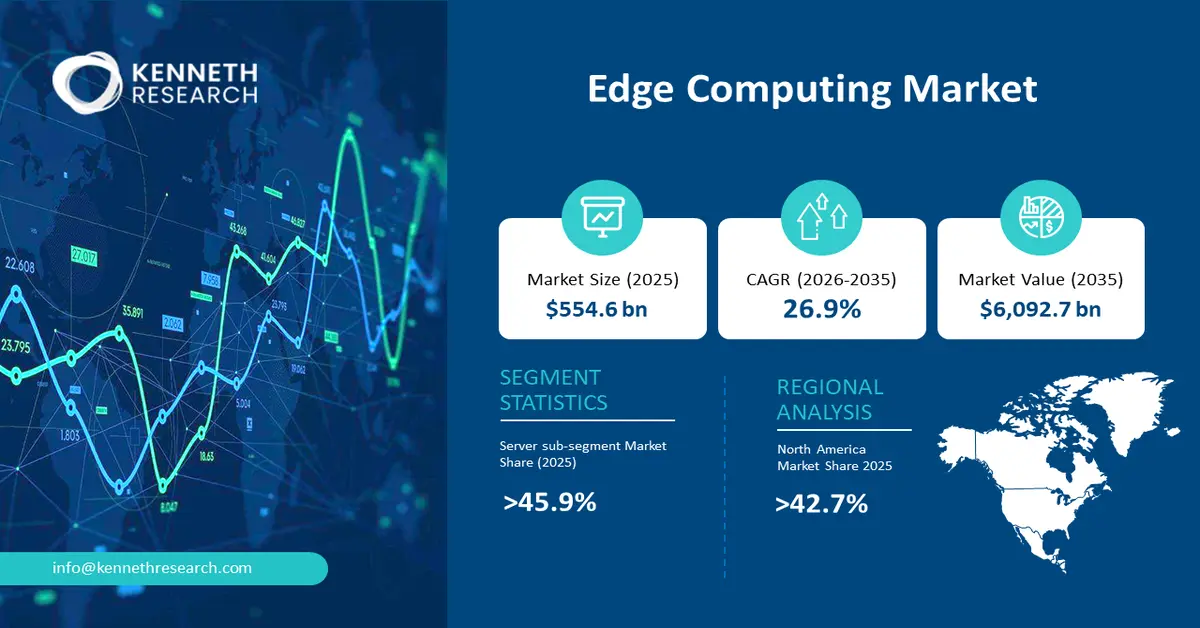
Edge Computing Market size was valued at USD 554.6 billion in 2025 and is projected to reach USD 6,092.7 billion by the end of 2035, rising at a CAGR of 26.9% during the forecast period, i.e., 2026-2035. In 2026, the industry size of edge computing is estimated at USD 710.2 billion.
The primary growth driver for the edge computing market is the increasing need to process data closer to where it is generated. Distributed computing enables organizations to reduce dependence on centralized processing, support responsive applications, strengthen operational decision-making, and accommodate data-intensive workloads across industrial, enterprise, and connected-device environments.
The edge computing market encompasses technologies, infrastructure, platforms, and services that place computing resources and application processing capabilities closer to data-generation points rather than relying exclusively on centralized cloud or data-center environments. NIST characterizes edge computing as a decentralized computing infrastructure in which computing resources and application services can be distributed along the communication path between data sources and the cloud. This architecture can operate across device-to-cloud environments and support processing, analysis, and action at the edge.
Key characteristics include distributed processing, proximity to data sources, localized analytics, connectivity with cloud environments, and the ability to execute workloads across geographically dispersed computing resources. Edge architectures can incorporate devices, gateways, servers, network infrastructure, and application services, depending on operational requirements.
Key Edge Computing Market Insights Summary:
Key Takeaways: Market Trends & Insights
- Edge computing market reached USD 554.6 billion in 2025 and is projected to reach USD 6,092.7 billion by 2035
- The market is forecast to expand at a CAGR of 26.9% during 2026-2035
- Server dominated the Component segment with a 45.9% market share in 2025
- Industrial Internet of Things (IIoT) is positioned as the second and fastest-growing segment, supported by demand for localized processing in industrial environments
- North America led the global market with a 42.7% market share in 2025, supported by strong technology infrastructure and adoption across the United States and Canada
Market Drivers
- Expansion of AI-enabled distributed processing
- Increasing industrial digitalization and real-time automation
- Growth of connected-device and IoT deployments
- Rising demand for localized analytics, operational resilience, and data sovereignty
Challenges
- Cybersecurity exposure across distributed infrastructure
- Resource constraints and operational complexity at the edge
Edge Computing Market Overview & Supply Chain
Global adoption of edge computing is increasing as enterprises and public-sector organizations seek faster data processing, localized intelligence, resilient connectivity, and greater control over distributed workloads. The technology is increasingly relevant to manufacturing, telecommunications, transportation, healthcare, energy, and connected infrastructure because these environments generate substantial volumes of data that benefit from processing closer to the point of generation. Its industrial importance is reinforced by the growing digitalization of energy and physical infrastructure. Edge deployment can complement centralized resources by distributing selected processing and analytics workloads across locations closer to connected assets and users.
The edge computing market value chain begins with semiconductor components, processors, memory, storage, networking equipment, sensors, embedded systems, power-management components, and other hardware inputs supplied by specialized technology manufacturers. These inputs feed the production of edge servers, gateways, ruggedized computing systems, networking equipment, and integrated edge appliances. Software providers then add operating systems, virtualization, containerization, orchestration, analytics, cybersecurity, device-management, and application layers. System integrators and technology service providers combine hardware and software into deployable edge environments tailored to specific operational requirements. Distribution occurs through direct enterprise sales, technology distributors, telecommunications operators, cloud-service channels, and specialized integrators. End users include manufacturers, telecom operators, healthcare organizations, utilities, transportation companies, retailers, government agencies, and other enterprises requiring localized computing.
Edge Computing Market: Growth Drivers & Challenges
Growth Drivers:
- Expansion of ai-enabled distributed processing: The accelerating deployment of artificial intelligence is strengthening demand for edge computing because many AI workloads require data to be processed close to connected assets, machines, and users. Edge infrastructure can support localized inference, real-time monitoring, machine vision, predictive maintenance, and automated decision-making while reducing dependence on continuous transmission to centralized environments. This is particularly relevant to manufacturing, logistics, telecommunications, healthcare, and critical infrastructure, where operational responsiveness is important. U.S. Census Bureau research found that AI use by firms increased from 3.7% in September 2023 to 5.4% in February 2024, with further growth expected by early fall 2024. The expanding business use of AI strengthens the addressable workload base for edge architectures, particularly where latency, data locality, and operational continuity influence deployment decisions.
- Increasing industrial digitalization and real-time automation: Industrial digitalization is creating a strong structural demand driver for edge computing as manufacturers connect machinery, sensors, control systems, and production processes. These environments generate operational data that often requires immediate interpretation rather than delayed processing through remote infrastructure. Edge architectures enable localized analytics and control, supporting applications such as machine-condition monitoring, quality inspection, process optimization, and predictive maintenance. Their value increases when production systems require continuous availability or rapid responses to changing operating conditions. NIST research highlights the importance of advanced manufacturing systems that can obtain, store, and interpret large volumes of data while improving flexible and competitive production. As factories adopt increasingly connected production environments, computing resources are expected to move closer to equipment and operational endpoints.
Challenges:
- Expanded cybersecurity exposure across distributed infrastructure: The decentralized architecture of edge computing increases the difficulty of maintaining a consistent security posture because computing resources, applications, and data are distributed across numerous locations and device types. Unlike centralized data centers, edge environments can include remotely deployed servers, gateways, industrial equipment, and endpoints operating under different physical and administrative conditions. This creates additional opportunities for unauthorized access, device compromise, configuration weaknesses, and data exposure. NIST specifically identifies increased attack surfaces in cloud and edge-computing environments, while emphasizing the need for layered platform protection. Commercially, organizations must therefore allocate resources to identity management, secure hardware, encryption, monitoring, patching, and physical protection across dispersed infrastructure.
- Resource constraints and operational complexity at the edge: Edge environments must operate across heterogeneous infrastructure with varying computing, storage, networking, and power capabilities. Resource limitations become particularly restrictive when organizations attempt to deploy sophisticated analytics or AI workloads outside centralized data centers. NIST identifies resource constraints, communication limitations, privacy requirements, heterogeneous data distributions, and security vulnerabilities as fundamental challenges for edge learning. The resulting operational burden extends beyond hardware selection: enterprises must coordinate software deployment, workload orchestration, device lifecycle management, connectivity, monitoring, and updates across geographically dispersed locations. This can complicate integration with existing IT and operational-technology systems and make standardized deployment difficult. Commercial implications include higher engineering requirements, longer implementation timelines, and greater dependence on specialized integrators.
Edge Computing Market Size and Forecast:
| Report Attribute | Details |
|---|---|
| Base Year |
2025 |
| Forecast Period |
2026-2035 |
| CAGR |
26.9% |
| Base Year Market Size (2025) |
USD 554.6 billion |
| Forecast Year Market Size (2035) |
USD 6,092.7 billion |
| Regional Scope |
|
Edge Computing Market Segmentation Analysis:
Component Segment Analysis
In the component segment, the server sub-segment is anticipated to capture the largest market share of 45.9% by the end of 2025.
The server segment dominates the edge computing market because edge deployments require localized compute capacity to execute workloads near data-generation points. Demand is being reinforced by AI inference, industrial automation, real-time analytics, video processing, and connected-device applications, all of which require dependable processing resources at distributed locations. Servers provide the computational foundation for these workloads while supporting integration with storage, networking, virtualization, and orchestration layers. The supply side is also evolving toward higher-performance processors, accelerated computing, compact form factors, and energy-efficient architectures suitable for constrained edge environments. The International Energy Agency identifies servers as the principal electricity-consuming component within modern data centres, accounting for around 60% of electricity demand on average, underscoring their central role in computing infrastructure.
Application Segment Analysis
The industrial internet of things (IIoT) is projected to grow as the second-largest segment in the edge computing market due to four converging demand drivers.
The Industrial Internet of Things (IIoT) segment is projected to grow rapidly as manufacturers increasingly connect machinery, sensors, control systems, and production assets to improve operational visibility and enable real-time decision-making. IIoT generates continuous streams of operational data, creating a strong requirement for localized computing that can analyze information close to industrial equipment while supporting low-latency control, predictive maintenance, quality monitoring, and automation. Supply-side development is supporting this trajectory through industrial gateways, edge servers, sensors, connectivity technologies, and software platforms designed for heterogeneous factory environments. NIST identifies IIoT as a foundation for smart manufacturing and highlights distributed edge computing as an important element for factory automation.
Our in-depth analysis of the global edge computing market includes the following segments:
|
Segment |
Sub-segment |
|
Component |
|
|
Organization Size |
|
|
Deployment |
|
|
Industry Vertical |
|
|
Application |
|
Edge Computing Market Regional Insights:
North America Market Trends & Insights:
North America edge computing market is projected to hold the largest revenue share of 42.7% by the end of 2025.
The region benefits from a large installed base of cloud, data-center, networking, and industrial technology infrastructure, creating favorable conditions for organizations to deploy computing resources closer to operational endpoints. Regulatory attention toward cybersecurity, data governance, critical infrastructure resilience, and artificial intelligence further supports investment in localized computing architectures. Within the input framework, North America holds the leading regional position, while the United States and Canada represent the principal country markets. Regional technology adoption is also visible in Canadian business activity: Statistics Canada reported that 26% of Canadian businesses used Internet-connected smart devices or Internet of Things technologies in 2023, supporting the expanding connected-device environment that can generate demand for edge processing.
The United States leads regional deployment through its extensive technology ecosystem, large enterprise base, telecommunications infrastructure, advanced manufacturing capabilities, and significant investment in AI and distributed digital infrastructure. Demand spans industrial automation, healthcare, telecommunications, defense, transportation, retail, and energy.
Canada provides a complementary growth market, supported by expanding business digitalization and IoT adoption across industrial and commercial applications. Its technology ecosystem also benefits from proximity to the broader North American supply and innovation network.
Europe Market Trends & Insights:
Europe is emerging as a strategically important environment for edge computing because its industrial base, connected infrastructure, and emphasis on digital sovereignty create sustained demand for distributed processing. Edge architectures are increasingly relevant to manufacturing, automotive, energy, mobility, healthcare, and other data-intensive sectors where localized processing can support responsiveness, resilience, and data governance. Government initiatives are reinforcing this trajectory. The European Commission is promoting a cloud-edge-IoT continuum through Horizon Europe, the Digital Europe Programme, data-space initiatives, interoperability measures, and industrial digitalization policies.
Germany represents a key European market because of its advanced manufacturing ecosystem and strong industrial automation base. Edge deployment can support connected factories, automotive production, industrial analytics, and intelligent infrastructure, while Germany’s participation in the European cloud-edge industrial ecosystem reinforces investment opportunities.
France combines strong telecommunications capabilities, industrial digitalization initiatives, and government support for strategic cloud and edge technologies.
Leading Companies Operating in the Global Edge Computing Market:
Here is a list of upstream, downstream, and key players operating in the global edge computing market competitive ecosystem:
- Hewlett Packard Enterprise (HPE) (United States)
- Company Overview
- Business Strategy
- Key Product Offerings
- Financial Performance
- Key Performance Indicators
- Risk Analysis
- Recent Development
- Regional Presence
- SWOT Analysis
- Amazon Web Services (AWS) (United States)
- Intel Corporation (United States)
- NVIDIA Corporation (United States)
- IBM Corporation (United States)
- ZEDEDA, Inc. (United States)
Recent Developments
- In April 2025, AWS announced general availability of second-generation AWS Outposts racks with support for the latest x86-powered EC2 instances, simplified network scaling, and accelerated networking instances designed specifically for ultra-low latency and high-throughput on-premises workloads.
- In November 2025, Intel and Cisco announced the industry's first integrated platform for distributed AI workloads powered by Intel® Xeon® 6 system-on-chip. Cisco Unified Edge brings compute, networking, storage and security closer to data generated at the edge for real-time AI inferencing and agentic workloads.
Frequently Asked Question
In 2025, the edge computing market exceeded USD 554.6 billion.
The edge computing market is projected to reach USD 6,092.7 billion by the end of 2035, expanding at a CAGR of 26.9% over the forecast period (2026-2035).
The major players in the market are Hewlett Packard Enterprise (HPE), Amazon Web Services (AWS), Intel Corporation, NVIDIA Corporation, IBM Corporation, ZEDEDA, Inc., and others.
In the component segment, the server sub-segment is anticipated to capture the largest market share of 45.9% in the future and exhibit lucrative growth opportunities during 2026-2035. This growth trajectory is largely attributed to increasing demand for localized computing capacity to support AI inference, industrial automation, and real-time analytics.
North America is projected to hold the largest market share of 42.7% by the end of 2025 and provide more business opportunities in the future. Continuous investments in digital infrastructure, AI, telecommunications, industrial automation, and connected technologies across the United States and Canada are fostering the region's dominance.
Why Choose Kenneth Research ?
-
Insight with Impact : We don’t just gather data — we uncover stories, trends, and opportunities that fuel business growth.
-
Experts Who Get It : Our team speaks your industry’s language and knows what really matters to your customers and market.
-
Custom-Built for You : Forget one-size-fits-all. We craft research and consulting solutions as unique as your business vision.
-
Partners, Not Just Providers : We work with you, not for you — collaborating closely to turn insights into smart, strategic moves.
-
Results That Speak : Our work powers brands, startups, and industry leaders alike — with a track record of ideas that work in the real world.
Report ID: 1216 |
Published Date: 31 Aug 2026 |
Report Format: |
Delivery Timeline: 48-72 Business Hours

Copyright © 2025 Kenneth Research. All rights reserved. Terms of Use | Privacy Policy
