Report ID: 1218 |
Published Date: 28 Sep 2026 |
Report Format: |
Delivery Timeline: 48-72 Business Hours
Earth Observation Satellite Market Outlook:
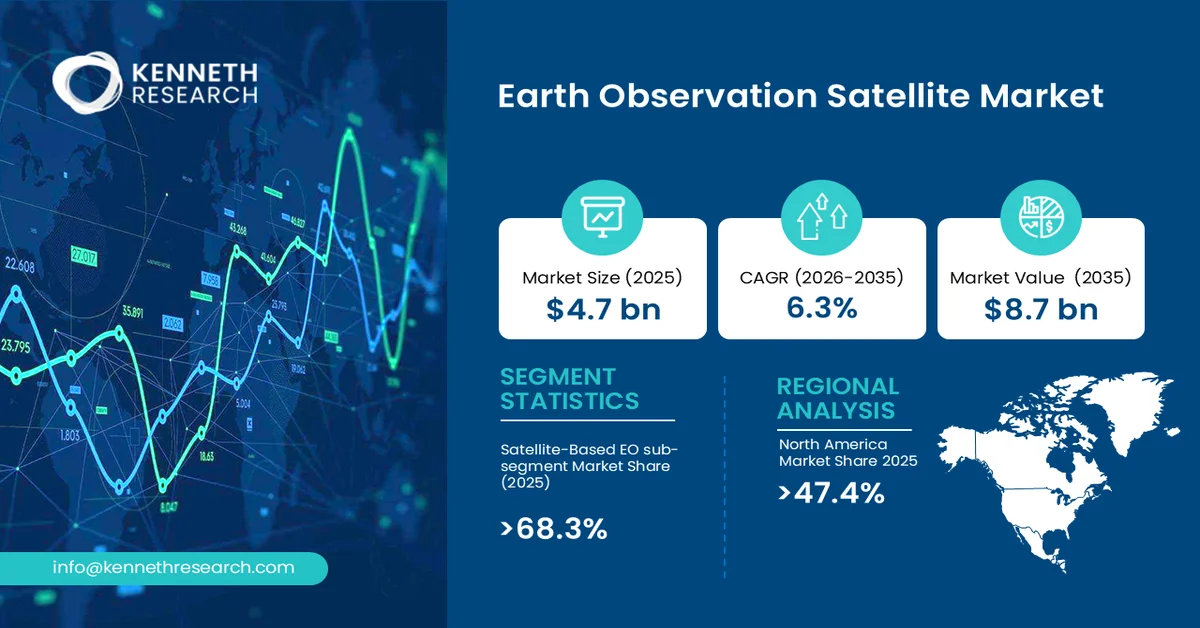
Earth Observation Satellite Market size was valued at USD 4.7 billion in 2025 and is projected to reach USD 8.7 billion by the end of 2035, rising at a CAGR of 6.3% during the forecast period, i.e., 2026–2035. In 2026, the industry size of earth observation satellites is estimated at USD 5.0 billion.
Rising demand for timely, high-resolution Earth intelligence is the primary growth driver. NASA’s 2022 Satellite Needs Working Group assessment identified 115 high-priority satellite-data needs across Earth science, reflecting expanding institutional requirements for more frequent and higher-resolution observations. These needs strengthen demand for EO satellites, data products, analytics, and operational services.
The earth observation satellite market comprises satellites, payloads, supporting ground infrastructure, data services, and associated solutions used to collect, transmit, process, and distribute information about Earth’s land, oceans, atmosphere, ice, and human-built environments. These systems employ optical, multispectral, hyperspectral, synthetic-aperture radar, thermal, microwave, and other sensing technologies, enabling observations across different spatial, spectral, and temporal scales.
A defining characteristic is the integration of space-based sensing with ground stations, data-processing platforms, analytics, and application-specific services. Satellites may operate in different orbital regimes and support both government and commercial missions, with capabilities spanning environmental monitoring, agriculture, forestry, mapping, disaster management, infrastructure assessment, maritime surveillance, climate research, and security.
Key Earth Observation Satellite Market Insights Summary:
Key Takeaways: Market Trends & Insights
- Earth Observation Satellite Market is valued at USD 4.7 billion in 2025 and is projected to reach USD 8.7 billion by 2035, expanding at a CAGR of 6.3% during 2026–2035
- Satellite-Based EO dominates the Platform segment with a 68.3% market share in 2025, supported by broad-area monitoring, repeatable observations, and expanding downstream applications
- Low Earth Orbit (LEO) is projected to be the fastest-growing orbital segment, driven by high-resolution sensing, frequent observation cycles, and increasing constellation deployment
- North America leads the global market with a 47.4% market share in 2025, supported by established EO infrastructure and strong capabilities across the United States and Canada
- Asia Pacific represents a significant secondary growth region, with China and Japan strengthening satellite capabilities, Earth observation applications, and government-supported space programmes
Market Drivers
- Advanced satellite sensor and payload capabilities
- Expansion of high-frequency Earth monitoring capabilities
- Increasing integration of EO data into operational decision-making
- Growing use of satellite intelligence for environmental and resource management
Challenges
- Orbital congestion and space-debris management
- Difficult commercialisation of EO data and services
Earth Observation Satellite Market Overview & Supply Chain
Global adoption of Earth Observation Satellite technologies is increasing as governments and industries require persistent, geographically extensive intelligence for environmental monitoring, agriculture, infrastructure, emergency response, transport, health, and resource management. Improvements in sensor capabilities, satellite connectivity, data processing, and analytics are increasing the operational value of remotely sensed information. Regulatory and policy requirements for environmental monitoring and evidence-based planning further reinforce adoption. The European Commission identifies Earth Observation as supporting applications spanning urban management, agriculture, forestry, fisheries, health, civil protection, infrastructure, transport, and mobility.
The Earth Observation Satellite value chain begins with raw materials and specialized inputs, including semiconductor components, optical and radar sensor materials, structural materials, propulsion components, power systems, onboard computing hardware, and communications equipment. Satellite manufacturers and system integrators combine these inputs into spacecraft, payloads, and associated ground infrastructure, while launch providers deliver completed systems into operational orbits. The downstream layer encompasses satellite operators, ground-station providers, data distributors, cloud infrastructure companies, geospatial platforms, and analytics providers that process raw observations into usable information products. Distribution occurs through direct commercial agreements, government data programmes, digital platforms, application programming interfaces, and specialized data marketplaces. End users include government agencies, defense and security organizations, scientific institutions, agriculture and energy companies, infrastructure operators, insurers, environmental organizations, and other commercial users.
Earth Observation Satellite Market: Growth Drivers & Challenges
Growth Drivers:
- Expansion of high-frequency earth monitoring capabilities: The expansion of satellite constellations and improved sensor performance is increasing the frequency, continuity, and practical usability of Earth observation data. A major government-backed example is NASA and USGS’s Landsat 9 mission, launched in 2021, which strengthened the continuity of land-surface monitoring and expanded the operational capacity of the Landsat programme. NASA states that Landsat 9 can provide more than 700 Earth scenes per day, supporting applications including deforestation monitoring, water-quality assessment, and crop-condition reporting. This capability encourages government agencies, researchers, resource managers, and commercial users to incorporate satellite-derived intelligence into recurring workflows rather than relying solely on periodic surveys or field observations.
- Increasing integration of eo data into operational decision-making: Earth observation is moving beyond specialist scientific use toward routine operational intelligence across agriculture, infrastructure, environmental management, insurance, energy, transportation, and public administration. The growth mechanism is increasingly based on converting satellite observations into actionable information through cloud computing, geospatial analytics, artificial intelligence, and automated monitoring workflows. This reduces the technical burden on end users and makes remotely sensed information more accessible to organizations that previously lacked dedicated satellite-analysis capabilities. Commercial and public-sector users can increasingly combine EO information with ground sensors, geographic information systems, weather information, and enterprise data to improve planning and risk assessment.
Challenges:
- Orbital Congestion and Space-Debris Management: The rapid deployment of satellites into commercially valuable orbital regimes is creating a more constrained operating environment for Earth observation missions. The root cause is the accumulation of active spacecraft, defunct satellites, rocket bodies, and fragmentation debris, combined with uneven compliance with end-of-life disposal practices. This increases collision-avoidance requirements, complicates mission planning, and can impose additional operational burdens on satellite operators. For EO providers, greater orbital congestion can affect constellation design, launch planning, satellite lifetime management, and insurance considerations. It can also increase the complexity of coordinating spacecraft movements with other operators.
- Difficult Commercialisation of EO Data and Services: A persistent restraint is the difficulty of converting technically capable EO systems into commercially scalable offerings. The root cause is not simply satellite availability; it also involves inconsistent customer awareness, uncertainty around business cases, and challenges in demonstrating sufficient economic value for individual applications. ESA identifies limited awareness among non-space companies, price sensitivity, and insufficient quality, availability, and reliability of EO products as barriers to broader customer adoption. These conditions can lengthen sales cycles, increase customer-acquisition costs, and make recurring revenue less predictable for downstream providers. They also create pressure on companies to invest in analytics, workflow integration, and sector-specific solutions rather than relying on imagery sales alone.
Earth Observation Satellite Market Size and Forecast:
| Report Attribute | Details |
|---|---|
| Base Year |
2025 |
| Forecast Year |
2026-2035 |
| CAGR |
6.3% |
| Base Year Market Size (2025) |
USD 4.7 billion |
| Forecast Year Market Size (2035) |
USD 8.7 billion |
| Regional Scope |
|
Earth Observation Satellite Market Segmentation Analysis:
Platform Segment Analysis
In the platform segment, the Satellite-Based EO sub-segment is anticipated to capture the largest market share of 68.3% by the end of 2025.
Satellite-Based Earth Observation dominates the platform segment because satellites provide broad-area, repeatable, and standardized data collection that can support applications across agriculture, environmental monitoring, mapping, disaster response, infrastructure, and resource management. Demand is strengthened by the increasing integration of satellite-derived information into government and commercial workflows, particularly where consistent geographic coverage and historical observations are required. On the supply side, established satellite programmes, increasingly capable sensors, cloud-based data distribution, and expanding commercial constellations are improving accessibility and observation continuity. Adoption is also shifting toward analytics-ready products and integrated geospatial services rather than standalone imagery. Going forward, satellite-based EO should retain its leadership as improved revisit capabilities, sensor diversity, automated processing, and AI-enabled interpretation increase the operational value of space-derived observations for government and industrial users.
Orbit Type Segment Analysis
The Low Earth Orbit (LEO) is projected to grow as the second-largest segment in the earth observation satellite market due to four converging demand drivers.
Low Earth Orbit (LEO) is projected to expand rapidly within the earth observation satellite market because its proximity to Earth supports lower-latency communications, high-resolution sensing, and frequent observation cycles. These characteristics are increasingly valuable for applications requiring timely information, including environmental monitoring, disaster response, agriculture, infrastructure assessment, and security. Industry adoption is being reinforced by smaller spacecraft, constellation architectures, standardized satellite components, and increasingly accessible launch services. These supply-side developments allow operators to deploy distributed systems capable of improving revisit frequency and geographic coverage. Future growth should therefore favor LEO-based EO architectures that combine agile spacecraft, diverse sensing payloads, automated data processing, and constellation-level tasking.
Our in-depth analysis of the global earth observation satellite market includes the following segments:
|
Segment |
Sub-segment |
|
Platform |
|
|
Orbit Type |
|
|
Technology |
|
|
Application |
|
Earth Observation Satellite Market Regional Insights:
North America Market Trends & Insights:
North America earth observation satellite market is projected to hold the largest revenue share of 47.4% by the end of 2025.
Regional leadership is supported by mature satellite infrastructure, established aerospace capabilities, sophisticated downstream analytics, and sustained public-sector demand for environmental, defense, disaster-management, agricultural, and resource-monitoring applications. The United States provides a substantial production and technology base through federal space and Earth-science programs, while commercial operators and geospatial companies contribute to an increasingly integrated EO ecosystem. Regulatory and institutional support also reinforces investment by maintaining demand for continuous environmental intelligence and national-security applications. Canada complements the regional ecosystem through sovereign radar-based observation capabilities and public investment in continuity of satellite data.
Within the region, the United States remains the principal technology, manufacturing, research, and consumption hub, supported by NASA, NOAA, USGS, defense agencies, commercial satellite operators, launch providers, and geospatial technology companies.
Canada has a specialized position in radar EO, Arctic monitoring, natural-resource management, and emergency response, supported by the RADARSAT ecosystem and federal procurement. Its continued investment in sovereign EO infrastructure should sustain regional capabilities and strengthen cross-border technology and data-service opportunities.
Asia Pacific Market Trends & Insights:
Asia Pacific is emerging as an important growth region for the earth observation satellite market, supported by increasing requirements for disaster management, climate monitoring, agricultural intelligence, maritime surveillance, natural-resource management, and urban planning. Industrial activity is expanding alongside national space programmes, commercial satellite development, geospatial analytics, and downstream application ecosystems. Governments across the region are also strengthening international cooperation and public access to EO information. In 2025, Singapore launched its Earth Observation Initiative to develop scalable solutions addressing regional sustainability and humanitarian challenges, with focus areas including food and water quality, disaster and disease monitoring, forestry, and land management.
China represents a major regional capability center, with extensive government-supported EO infrastructure spanning satellite development, receiving systems, processing, and applications. Its EO ecosystem serves meteorology, agriculture, forestry, water resources, ocean monitoring, surveying, and disaster management, creating opportunities for integrated satellite-data and analytics solutions.
Japan combines advanced satellite technology with strong institutional and industrial collaboration. JAXA promotes EO research, data analysis, and applications aimed at strengthening national resilience and addressing global challenges. Japan is also expanding public-private collaboration through its satellite EO consortium, creating opportunities for commercial application development and cross-industry adoption.
Leading Companies Operating in the Global Earth Observation Satellite Market:
Here is a list of upstream, downstream, and key players operating in the global earth observation satellite market competitive ecosystem:
- Planet Labs PBC (United States)
- Company Overview
- Business Strategy
- Key Product Offerings
- Financial Performance
- Key Performance Indicators
- Risk Analysis
- Recent Development
- Regional Presence
- SWOT Analysis
- ICEYE (Finland)
- L3Harris Technologies Inc. (United States)
- Satellogic (Argentina)
Recent Developments
- In June 2026, Planet Labs launched Pelican-11, a tech demonstration satellite for its second-generation high-resolution Pelican fleet, via SpaceX's Transporter-17 mission. Designed to validate technologies for future Gen 2 satellites capable of 30 cm resolution imagery, the satellite began commissioning following successful initial contact.
- In June 2026, ICEYE received a €28.3 million continuation grant from Business Finland for R&D into next-generation SAR and AI-enabled satellite intelligence, as the company reached a production rate of one satellite per week. The Finnish SAR leader is targeting annual production capacity of 100 satellites by 2028.
Frequently Asked Question
In 2025, the earth observation satellite market was valued at USD 4.7 billion.
The earth observation satellite market is projected to reach USD 8.7 billion by the end of 2035, expanding at a CAGR of 6.3% over the forecast period (2026-2035).
The major players in the market are Planet Labs PBC, ICEYE, L3Harris Technologies Inc., SatelLogic, and others.
In the Platform segment, the Satellite-Based EO sub-segment is anticipated to capture the largest market share of 68.3% in the future and exhibit lucrative growth opportunities during 2026-2035. This growth trajectory is largely attributed to broad-area, repeatable satellite observations supporting agriculture, environmental monitoring, mapping, disaster response, and resource management.
North America is projected to hold the largest market share of 47.4% by the end of 2025 and provide more business opportunities in the future. Continuous investments in Earth observation infrastructure, satellite technology, and downstream geospatial applications across the United States and Canada are fostering the region's dominance.
Why Choose Kenneth Research ?
-
Insight with Impact : We don’t just gather data — we uncover stories, trends, and opportunities that fuel business growth.
-
Experts Who Get It : Our team speaks your industry’s language and knows what really matters to your customers and market.
-
Custom-Built for You : Forget one-size-fits-all. We craft research and consulting solutions as unique as your business vision.
-
Partners, Not Just Providers : We work with you, not for you — collaborating closely to turn insights into smart, strategic moves.
-
Results That Speak : Our work powers brands, startups, and industry leaders alike — with a track record of ideas that work in the real world.
Report ID: 1218 |
Published Date: 28 Sep 2026 |
Report Format: |
Delivery Timeline: 48-72 Business Hours

Copyright © 2025 Kenneth Research. All rights reserved. Terms of Use | Privacy Policy
