Report ID: 1275 |
Published Date: 28 Sep 2026 |
Report Format: |
Delivery Timeline: 48-72 Business Hours
Drone Sensor Market Outlook:
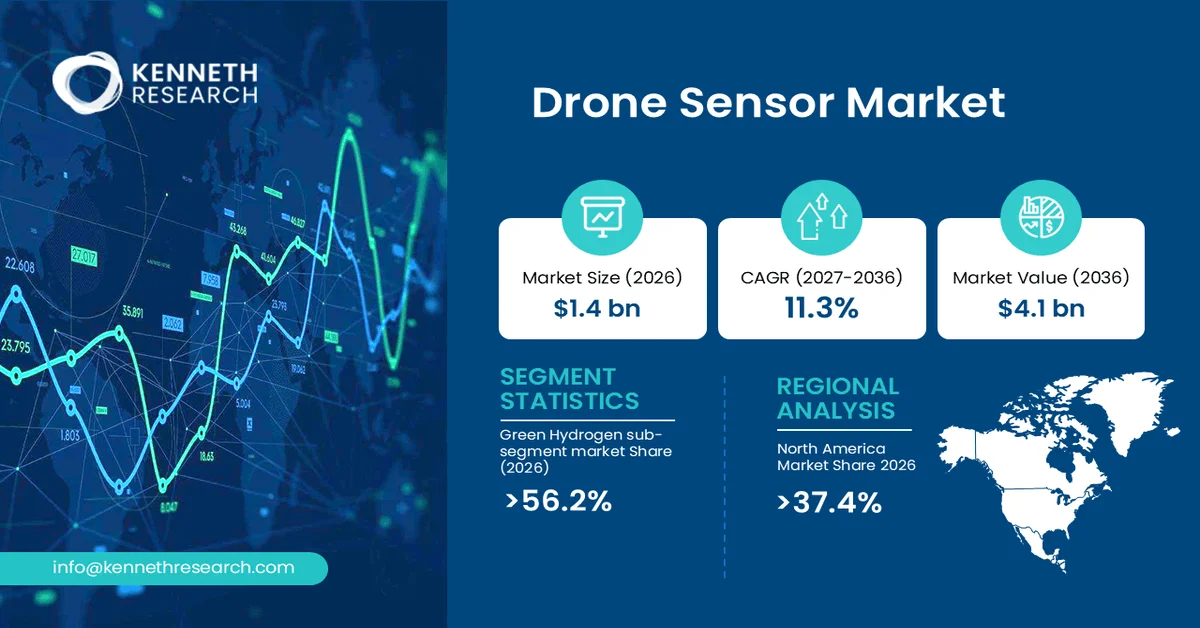
Drone Sensor Market size was valued at USD 1.4 billion in 2026 and is projected to reach USD 4.1 billion by the end of 2036, rising at a CAGR of 11.3% during the forecast period, i.e., 2027-2036. In 2027, the industry size of the drone sensor is estimated at USD 1.7 billion.
The primary growth driver for the drone sensor market is the expansion of commercial beyond-visual-line-of-sight operations, which increases requirements for reliable navigation, positioning, collision avoidance, environmental awareness, and operational safety. Government-backed UAS programs are progressively validating these capabilities, strengthening demand for integrated sensor technologies across increasingly complex drone missions.
The drone sensor market comprises the hardware technologies integrated into unmanned aerial vehicles to collect, measure, interpret, and transmit information required for flight control, navigation, positioning, environmental perception, safety, and mission execution. These technologies can include inertial sensors, optical sensors, GNSS-based positioning components, ultrasonic sensing systems, radar, lidar, imaging sensors, and other sensing devices used according to aircraft configuration and operational requirements.
Drone sensors function as critical data-acquisition components within the broader unmanned aircraft system, converting physical conditions or external signals into information that onboard systems can use for navigation, stabilization, obstacle detection, situational awareness, mapping, inspection, and autonomous decision-making. Sensor architectures can combine multiple sensing modalities to improve reliability and operational performance where individual technologies may be affected by environmental or mission-specific limitations.
Key Drone Sensor Market Insights Summary:
Key Takeaways: Market Trends & Insights
- 2026 global drone sensor market value of USD 1.4 billion, rising to USD 1.7 billion in 2027
- Drone Sensor Market projected to reach USD 4.1 billion by 2036, reflecting an 11.3% CAGR during 2027–2036
- Fixed-wing platforms lead the Platform segment with a 63.6% market share in 2026
- Navigation represents the second and fastest-growing analysis segment within the Application category
- North America leads geographically with a 37.4% market share in 2026, supported by the United States and Canada
Market Drivers
- Expansion of commercial drone fleets and airspace integration
- Increasing demand for sensor-based precision navigation
- Rising deployment of drones for infrastructure inspection and industrial monitoring
- Development of smaller, lighter, and more energy-efficient sensor technologies
Challenges
- Sensor reliability under electromagnetic and GNSS interference
- Difficulties in achieving consistent detect-and-avoid performance
Drone Sensor Market Overview & Supply Chain
Global adoption of drone sensors is increasing as unmanned aircraft transition from relatively simple remotely operated platforms toward more sophisticated commercial, industrial, public-safety, and infrastructure operations. Sensors are central to this transition because they provide the navigation, positioning, perception, detection, and environmental data required for safer and increasingly automated flight. Regulatory authorities are also progressing toward more scalable drone integration, particularly for beyond-visual-line-of-sight operations, increasing the importance of reliable onboard sensing and data acquisition. The U.S. Federal Aviation Administration reported that its BEYOND program completed 70,563 total flights, including 48,383 beyond visual line of sight, during Phase 1 through 2024.
The drone sensor value chain begins with raw-material and component inputs, including semiconductor materials, optical elements, MEMS structures, electronic components, magnets, specialty metals, and sensing substrates. Specialized component suppliers manufacture sensing elements and subassemblies, which are subsequently integrated into complete sensor modules by sensor manufacturers. Production typically involves semiconductor processing, microfabrication, optical assembly, electronics integration, calibration, firmware development, and environmental testing to meet drone-specific performance requirements. Distribution then connects sensor manufacturers with drone OEMs, system integrators, specialized distributors, and aftermarket channels. Drone manufacturers integrate sensors with flight-control systems, navigation architectures, communication equipment, and onboard computing platforms. End users include agriculture, utilities, construction, infrastructure inspection, logistics, public safety, surveying, defense, and industrial operators.
Drone Sensor Market: Growth Drivers & Challenges
Growth Drivers
- Expansion of commercial drone fleets and airspace integration: The expanding commercial drone fleet is strengthening demand for sensors that enable safe navigation, identification, situational awareness, and operational control. As drones move into delivery, inspection, surveying, public-safety, and other recurring missions, sensor systems become increasingly important for maintaining reliable flight performance across varied operating environments. The U.S. Federal Aviation Administration reported in December 2024 that more than one million drones were lawfully registered with the FAA and noted that thousands of commercial, hobbyist, and law-enforcement drones operate in U.S. airspace on a typical day. This provides direct evidence of a substantial installed drone ecosystem requiring sensing technologies.
- Increasing demand for sensor-based precision navigation: The growing need for reliable drone navigation in complex operating environments is driving adoption of sophisticated sensing technologies. Industrial drones increasingly operate around buildings, infrastructure, vegetation, confined spaces, and other environments where conventional positioning alone may not provide sufficient situational information. This encourages manufacturers to combine inertial measurement, optical sensing, lidar, radar, and positioning technologies so that drones can continuously estimate movement and interpret their surroundings. Sensor fusion also enables more robust flight-control decisions by allowing complementary sensing modalities to compensate for individual limitations. For drone OEMs, this creates opportunities to integrate sensing deeper into flight-control and autonomy architectures rather than treating sensors as standalone components.
Challenges
- Sensor reliability under electromagnetic and GNSS interference: Drone sensors must maintain dependable performance despite electromagnetic interference, GNSS jamming, spoofing, signal obstruction, and changing environmental conditions. The root cause is the increasing complexity of radio-frequency environments in which drones operate, combined with the reliance of many navigation architectures on satellite-derived positioning and communications. Interference can degrade positioning inputs and compromise the quality of data delivered to flight-control and autonomy systems. The European Union Aviation Safety Agency identifies GNSS interference as an operational concern requiring mitigation measures, with jamming preventing receivers from locking onto satellite signals and spoofing producing incorrect positioning information.
- Difficulties in achieving consistent detect-and-avoid performance: The lack of universally reliable detect-and-avoid performance across diverse operating environments constrains the deployment of advanced drone sensor systems. The underlying challenge is that individual sensing modalities have inherent limitations: cameras can be affected by visibility, radar can encounter false detections, and cooperative systems cannot identify aircraft that do not transmit compatible signals. The U.S. Government Accountability Office notes that electromagnetic interference and small airborne objects can reduce detection performance or create false detections in counter-UAS systems, illustrating the broader technical difficulty of dependable airborne perception. For drone manufacturers and sensor suppliers, these limitations increase testing, validation, calibration, and system-integration requirements.
Drone Sensor Market Size and Forecast:
| Report Attribute | Details |
|---|---|
| Base Year |
2026 |
| Forecast Period |
2027-2036 |
| CAGR |
11.3% |
| Base Year Market Size (2026) |
USD 1.4 billion |
| Forecast Year Market Size (2036) |
USD 4.1 billion |
| Regional Scope |
|
Drone Sensor Market Segmentation Analysis:
Platform Segment Analysis
In the platform segment, Fixed-wing sub-segment is anticipated to capture the largest market share of 63.6% by the end of 2026.
Fixed-wing drones dominate the platform segment because their aerodynamic configuration supports long-range missions, sustained flight, and coverage of large geographic areas, creating strong requirements for navigation, positioning, imaging, environmental monitoring, and other onboard sensing functions. Government applications further reinforce demand, particularly for surveying, infrastructure monitoring, maritime operations, defense, and remote-area missions where endurance and range are more important than hovering capability. The UK Government specifically identifies fixed-wing drones as suitable for long-range delivery, landscape and infrastructure surveying, reconnaissance, and missions requiring cameras, optical sensors, and LiDAR. Its 2024 Armed Forces equipment statistics also reported 183 uncrewed aircraft systems in service, demonstrating continuing institutional deployment of UAS platforms.
Application Segment Analysis
The Navigation is projected to grow as the second-largest segment in the drone sensor market due to four converging demand drivers.
Navigation is projected to be the fastest-growing application segment as drones increasingly require dependable positioning, flight stabilization, route execution, and situational awareness across complex operating environments. Demand is being reinforced by BVLOS operations, autonomous flight, infrastructure inspection, emergency response, and delivery missions, where navigation performance directly affects operational safety and mission continuity. As drone missions become more autonomous, manufacturers are increasingly combining GNSS, inertial, optical, lidar, and other sensing technologies to improve positioning resilience and reduce dependence on any individual navigation input. This creates opportunities for suppliers offering compact, low-power, multi-sensor navigation modules and sensor-fusion technologies. The future outlook remains favorable as regulatory and industry efforts toward BVLOS integration increase requirements for accurate, resilient, and continuously available navigation data.
Our in-depth analysis of the global drone sensor market includes the following segments:
|
Segment |
Sub-segment |
|
Sensor Type |
|
|
Application |
|
|
Platform |
|
Drone Sensor Market Regional Insights:
North America Market Trends & Insights:
North America drone sensor market is projected to hold the largest revenue share of 37.4% by the end of 2026.
North America maintains its leading position in the drone sensor market, supported by a mature commercial drone ecosystem, strong aerospace and defense capabilities, advanced sensor and semiconductor development, and comparatively developed regulatory frameworks for integrating unmanned aircraft into national airspace. The region’s demand base is reinforced by infrastructure inspection, public safety, surveying, defense, logistics, and industrial applications that require increasingly sophisticated navigation and perception capabilities.
The United States represents the region’s principal commercial and technology hub, benefiting from extensive FAA activity, established UAS operating frameworks, and substantial investment in autonomous aviation technologies.
Canada complements this ecosystem through expanding civil and government drone deployment. Together, the United States and Canada provide a favorable environment for sensor suppliers through regulatory development, technology investment, aerospace expertise, and expanding end-user adoption.
Asia Pacific Market Trends & Insights:
Asia Pacific is emerging as a high-opportunity market for drone sensors, supported by expanding unmanned-aircraft deployment across logistics, agriculture, infrastructure inspection, emergency response, surveying, and industrial operations. The region combines substantial manufacturing capabilities with rapidly developing low-altitude aviation ecosystems, creating opportunities for sensor suppliers across both drone production and downstream applications. Government initiatives are increasingly focused on formalizing airspace access, certification, navigation infrastructure, and commercial use cases.
China represents the region’s principal industrial opportunity, with government authorities actively supporting UAV airworthiness development, manufacturing, and broader low-altitude economic activity. The country’s combination of electronics manufacturing expertise and expanding drone applications provides a strong foundation for domestic sensor integration and component development.
Japan offers a complementary opportunity centered on regulated commercial deployment and advanced autonomous operations. Its Ministry of Land, Infrastructure, Transport and Tourism introduced the regulatory framework enabling Level 4 unmanned-aircraft operations in inhabited areas without visual observers, supporting applications including delivery, infrastructure inspection, surveying, and disaster response.
Leading Companies Operating in the Global Drone Sensor Market:
Here is a list of upstream, downstream, and key players operating in the drone sensor market competitive ecosystem:
- TE Connectivity (Switzerland)
- Company Overview
- Business Strategy
- Key Product Offerings
- Financial Performance
- Key Performance Indicators
- Risk Analysis
- Recent Development
- Regional Presence
- SWOT Analysis
- Robert Bosch GmbH (Germany)
- Sony Semiconductor Solutions Corporation (Japan)
- Infineon Technologies AG (Germany)
- InvenSense (TDK Corp) (United States)
Recent Developments
- In September 2025, TE Connectivity showcased its sensor and connectivity solutions for drones at the Shenzhen eVTOL Industry Conference, presenting its system interconnection capabilities spanning flight control, avionics, structural wiring, high-speed communication, and multi-dimensional sensing . TE provides a range of sensors for commercial and agricultural drones including digital air pressure sensors, humidity sensors, and differential pressure sensors for stable flight control and consistent spraying operations.
- In January 2025, TDK Corporation began mass production of its InvenSense SmartSonic™ ICU-30201 ultrasonic time-of-flight sensor . The MEMS-based sensor provides accurate range measurements at distances up to 9.5m with a configurable wide field of view up to 180°, operates in any lighting condition, and consumes less than 0.5 mW with embedded on-chip processing for presence and occupancy detection, making it suitable for drones, robotics, and smart building systems.
Why Choose Kenneth Research ?
-
Insight with Impact : We don’t just gather data — we uncover stories, trends, and opportunities that fuel business growth.
-
Experts Who Get It : Our team speaks your industry’s language and knows what really matters to your customers and market.
-
Custom-Built for You : Forget one-size-fits-all. We craft research and consulting solutions as unique as your business vision.
-
Partners, Not Just Providers : We work with you, not for you — collaborating closely to turn insights into smart, strategic moves.
-
Results That Speak : Our work powers brands, startups, and industry leaders alike — with a track record of ideas that work in the real world.
Report ID: 1275 |
Published Date: 28 Sep 2026 |
Report Format: |
Delivery Timeline: 48-72 Business Hours

Copyright © 2025 Kenneth Research. All rights reserved. Terms of Use | Privacy Policy
