Report ID: 1460 |
Published Date: 29 Sep 2026 |
Report Format: |
Delivery Timeline: 48-72 Business Hours
Drone Aerspace Security System Market Outlook:
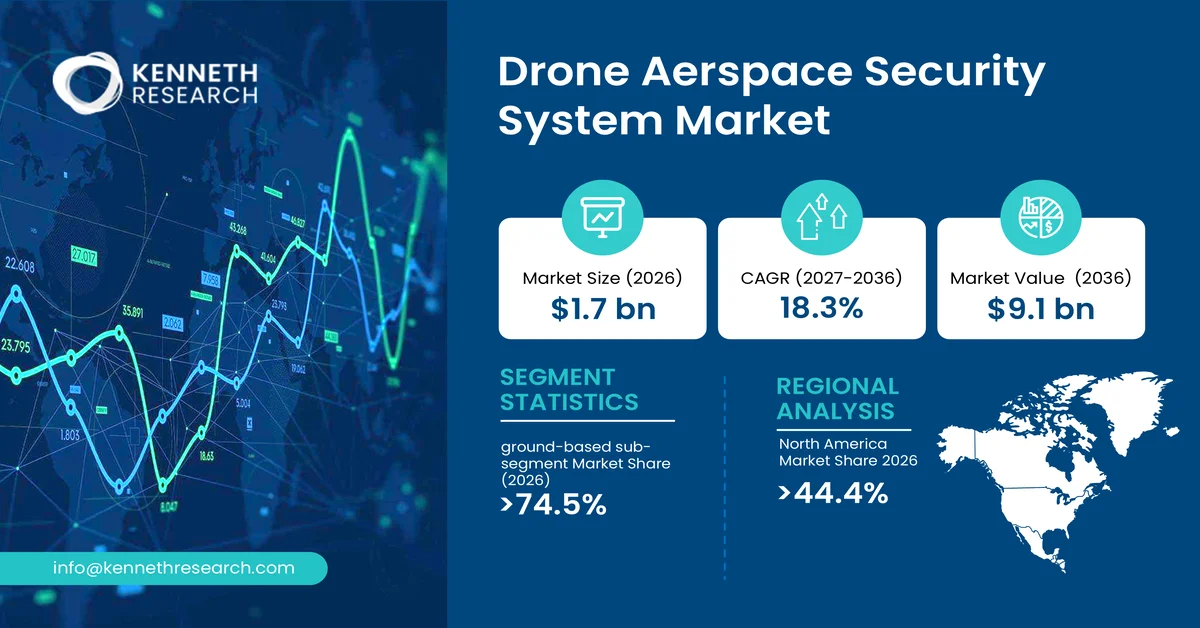
Drone aerspace security system market size was valued at USD 1.7 billion in 2026 and is projected to reach USD 9.1 billion by the end of 2036, rising at a CAGR of 18.3% during the forecast period, i.e., 2027–2036. In 2027, the industry size of the drone aerspace security system market is estimated at USD 2 billion.
The primary growth driver for the drone aerspace security system market is the expanding deployment of unmanned aircraft across commercial, public-safety, and government operations, increasing the need for identification, detection, monitoring, and counter-drone capabilities.
The drone aerspace security system market comprises technologies, equipment, software, and integrated solutions designed to identify, detect, track, monitor, classify, and respond to unauthorized, unsafe, or potentially threatening unmanned aircraft activity. These systems support the protection of controlled airspace, critical infrastructure, public venues, government facilities, military installations, transportation assets, and other sensitive locations.
Key characteristics include drone detection and identification, continuous airspace monitoring, target tracking, threat assessment, command-and-control capabilities, and counter-drone functions. Depending on operational requirements, solutions can combine radar, radio-frequency sensing, electro-optical or infrared technologies, acoustic sensors, data-processing platforms, and authorized mitigation capabilities.
Key Drone Aerspace Security System Market Insights Summary:
Key Takeaways: Market Trends & Insights
- The drone aerspace security system market is valued at USD 1.7 billion in 2026 and is projected to reach USD 9.1 billion by 2036
- The drone aerspace security system market is expected to expand at a CAGR of 18.3% during 2027-2036
- The ground-based segment leads the Platform category with a 74.5% market share in 2026
- North America dominates the drone aerspace security system market with a 44.4% market share in 2026
- The market is projected to increase from USD 2.0 billion in 2027 to USD 9.1 billion by 2036
Market Drivers
- Expansion of advanced UAS traffic management and detection infrastructure
- Strengthening regulatory requirements for drone identification and airspace security
- Increasing protection requirements for critical infrastructure and sensitive facilities
- Advancement of multi-sensor detection, artificial intelligence, and automated threat-classification technologies
Challenges
- High integration complexity and interoperability constraints
- Regulatory and operational constraints on counter-UAS technologies
Drone Aerspace Security System Market Overview & Supply Chain
Adoption of drone aerspace security systems is increasing as unmanned aircraft become more prevalent across commercial, recreational, law-enforcement, defense, and infrastructure environments. Security requirements are consequently expanding from basic detection toward persistent identification, tracking, classification, and authorized mitigation. Regulatory authorities are also strengthening counter-UAS frameworks to address unauthorized activity around sensitive airspace and critical facilities.
The value chain for the drone aerspace security system market begins with specialized input providers supplying semiconductors, radio-frequency components, antennas, radar modules, optical sensors, infrared components, processors, communications equipment, power systems, and structural materials. System manufacturers integrate these inputs into detection, identification, tracking, command-and-control, and counter-UAS platforms, combining hardware with embedded software, analytics, and sensor-fusion capabilities. Technology integrators and specialized security contractors then configure systems according to airspace, infrastructure, defense, or public-safety requirements. Distribution typically involves direct enterprise sales, government procurement, authorized distributors, systems integrators, and security technology partners. End users include defense organizations, airports, law-enforcement agencies, critical-infrastructure operators, energy facilities, industrial sites, and other protected premises.
Drone Aerspace Security System Market - Growth Drivers & Challenges
Growth Drivers
- Expansion of Advanced UAS Traffic Management and Detection Infrastructure: The development of more sophisticated unmanned-aircraft operations is increasing demand for integrated detection, identification, tracking, and airspace-management capabilities. As drones move into more complex operational environments, security systems must provide reliable situational awareness and distinguish authorized aircraft from potentially unsafe or unauthorized activity. This is encouraging airports, public authorities, infrastructure operators, and other protected facilities to evaluate multi-sensor surveillance and counter-UAS architectures rather than relying on isolated detection technologies.
- Strengthening Regulatory Requirements for Drone Identification and Airspace Security: Regulatory development is creating a structural demand driver for drone aerspace security systems because authorities increasingly require greater visibility into unmanned-aircraft activity. Remote identification frameworks allow regulators and authorized security organizations to obtain information that supports airspace awareness, enforcement, and investigation. These requirements also encourage facility operators to deploy complementary detection technologies capable of identifying aircraft that may not conform to expected operating patterns.
Challenges
- High Integration Complexity and Interoperability Constraints: Drone aerspace security systems often require multiple sensing and response technologies to operate as a coordinated security architecture. Integrating radar, radio-frequency detection, electro-optical and infrared sensors, identification systems, command-and-control software, and authorized mitigation capabilities can create interoperability challenges when components originate from different vendors. Legacy security infrastructure can further complicate deployment because new systems must exchange data with existing surveillance, access-control, communications, and security-management platforms.
- Regulatory and Operational Constraints on Counter-UAS Technologies: The commercial deployment of drone aerspace security systems can be constrained by regulatory requirements governing radio-frequency use, aviation safety, privacy, surveillance, and active counter-UAS measures. Detection may be comparatively straightforward, whereas mitigation technologies can involve greater legal and operational complexity because disrupting, intercepting, or disabling an aircraft can affect communications, navigation, nearby aviation activity, or third-party systems.
Drone Aerspace Security System Market Size and Forecast:
| Report Attribute | Details |
|---|---|
| Base Year |
2026 |
| Forecast Year |
2027-2036 |
| CAGR |
18.3% |
| Base Year Market Size (2026) |
USD 1.7 billion |
| Forecast Year Market Size (2036) |
USD 9.1 billion |
| Regional Scope |
|
Drone Aerspace Security System Market - Segment Analysis
Platform Segment Analysis
In the platform segment, ground-based sub-segment is anticipated to capture the largest market share of 74.5% by the end of 2026.
The ground-based segment dominates the drone aerspace security system market because fixed-site deployments provide persistent surveillance and enable security operators to establish defined protection zones around airports, military facilities, critical infrastructure, industrial sites, and other sensitive locations. Demand is supported by the need for continuous detection and tracking rather than temporary or mission-specific monitoring. The U.S. Federal Aviation Administration states that it receives more than 100 unmanned-aircraft sighting reports near airports each month, demonstrating the continuing operational requirement for monitoring drone activity around aviation infrastructure. Ground-based architectures can combine radar, radio-frequency detection, electro-optical systems, command-and-control software, and other sensors within a permanent installation, supporting layered security and centralized monitoring.
Component Segment Analysis
The hardware is projected to grow as the second-largest segment in the drone aerspace security system market due to four converging demand drivers.
The hardware segment is projected to grow as drone aerspace security deployments increasingly require dedicated sensing, communications, computing, and surveillance equipment to support real-time airspace awareness. Demand is being reinforced by regulatory requirements that make drone identification and location information an integral part of safer UAS integration. The U.S. Federal Aviation Administration states that Remote ID applies to drones required to be registered or already registered, including those used for recreation, business, and public safety, and that compliant systems can use either built-in Remote ID capabilities or dedicated broadcast modules. This creates opportunities for hardware suppliers across radio-frequency components, antennas, processors, receivers, sensors, and communications modules. Industry adoption is also shifting toward integrated architectures that combine multiple sensing modalities with processing and command functions.
Our in-depth analysis of the drone aerspace security system market includes the following segments:
|
Segment |
Sub-segment |
|
Component |
|
|
Platform |
|
|
System Range |
|
|
End-User |
|
Drone Aerspace Security System Market - Regional Analysis
North America Market Trends & Insights:
North America drone aerspace security system is projected to hold the largest revenue share of 44.4% by the end of 2026.
Regional leadership is supported by substantial drone deployment, mature aerospace and defense capabilities, established critical-infrastructure protection programs, and comparatively advanced regulatory frameworks for unmanned aircraft.
Within the region, the United States benefits from a large installed base of drone operations and extensive government involvement in UAS integration and security.
Canada provides a complementary growth environment through expanding RPAS regulation and infrastructure. Transport Canada reported 114,580 registered drones for fiscal year 2024–2025, alongside continued development of the national framework governing remotely piloted aircraft. This expanding operational ecosystem supports demand for technologies capable of maintaining airspace visibility and protecting sensitive locations.
Asia Pacific Market Trends & Insights:
Asia Pacific is supported by expanding commercial, industrial, public-safety, and defense applications of unmanned aircraft, alongside increasingly structured government oversight. Demand for drone aerspace security systems is being reinforced by requirements for safer operation around airports, densely populated areas, critical infrastructure, and other sensitive airspace.
Within the region, China represents an important technology and manufacturing center, with government policy emphasizing aviation safety, public security, and structured UAV-industry development. Its regulatory framework explicitly recognizes counter-UAS equipment and establishes requirements for managing unmanned-aircraft operations.
Japan combines substantial industrial activity with stringent airspace controls. Its Ministry of Land, Infrastructure, Transport and Tourism requires registration and remote-identification functionality for unmanned aircraft weighing at least 100 grams, while specified airspace and operating methods require prior permission or approval. These frameworks support continuing demand for integrated security and compliance technologies.
Drone Aerspace Security System Market Competitive Landscape
Here is a list of upstream, downstream, and key players operating in drone aerspace security system market competitive ecosystem:
- Lockheed Martin Corporation (United States)
- Company Overview
- Business Strategy
- Key Product Offerings
- Financial Performance
- Key Performance Indicators
- Risk Analysis
- Recent Development
- Regional Presence
- SWOT Analysis
- Thales Group (France)
- Israel Aerospace Industries (IAI) (Israel)
- Dedrone by Axon (United States)
- DroneShield Ltd. (Australia)
Recent Developments
- In July 2026, Lockheed Martin unveiled MORFIUS™ X-Rotor, an airborne High Power Microwave counter-drone system capable of neutralizing more than 50 enemy drones in a single flight. The system is sensor and command-and-control agnostic, does not require a unique sensor for guidance, and is designed for field recovery and reuse. Prototype production is being accelerated following successful flight, intercept, and lethality tests in Arizona, California, and Oklahoma.
- In September 2025, Dedrone by Axon published its intelligence report revealing a 4.3x increase in DIY drone detections in 2025 compared to 2024, with 37.5% of all detections occurring in low-visibility conditions. The report, based on operational datasets from Europe, the Middle East, and Asia, also showed a decline in DJI drone detections from 95% to 83%, indicating a broader array of drone types including RF-silent flights.
Frequently Asked Question
In 2026, the drone aerspace security system market exceeded USD 1.7 billion.
The drone aerspace security system market is projected to reach USD 9.1 billion by the end of 2036, expanding at a CAGR of 18.3% over the forecast period (2027-2036).
The major players in the market are Lockheed Martin Corporation, Thales Group, Israel Aerospace Industries (IAI), Dedrone by Axon, DroneShield Ltd., and others.
In the Platform segment, the Ground-based sub-segment is anticipated to capture the largest market share of 74.5% in the future and exhibit lucrative growth opportunities during 2027-2036. This growth trajectory is largely attributed to the need for continuous drone detection, tracking, and monitoring around sensitive facilities and critical infrastructure.
North America is projected to hold the largest market share of 44.4% by the end of 2036 and provide more business opportunities in the future. Continuous investments in drone airspace management, critical-infrastructure protection, and counter-UAS capabilities in the United States and Canada are fostering the region's dominance.
Why Choose Kenneth Research ?
-
Insight with Impact : We don’t just gather data — we uncover stories, trends, and opportunities that fuel business growth.
-
Experts Who Get It : Our team speaks your industry’s language and knows what really matters to your customers and market.
-
Custom-Built for You : Forget one-size-fits-all. We craft research and consulting solutions as unique as your business vision.
-
Partners, Not Just Providers : We work with you, not for you — collaborating closely to turn insights into smart, strategic moves.
-
Results That Speak : Our work powers brands, startups, and industry leaders alike — with a track record of ideas that work in the real world.
Report ID: 1460 |
Published Date: 29 Sep 2026 |
Report Format: |
Delivery Timeline: 48-72 Business Hours

Copyright © 2025 Kenneth Research. All rights reserved. Terms of Use | Privacy Policy
