Report ID: 1271 |
Published Date: 14 Sep 2026 |
Report Format: |
Delivery Timeline: 48-72 Business Hours
Display Panel Market Outlook:
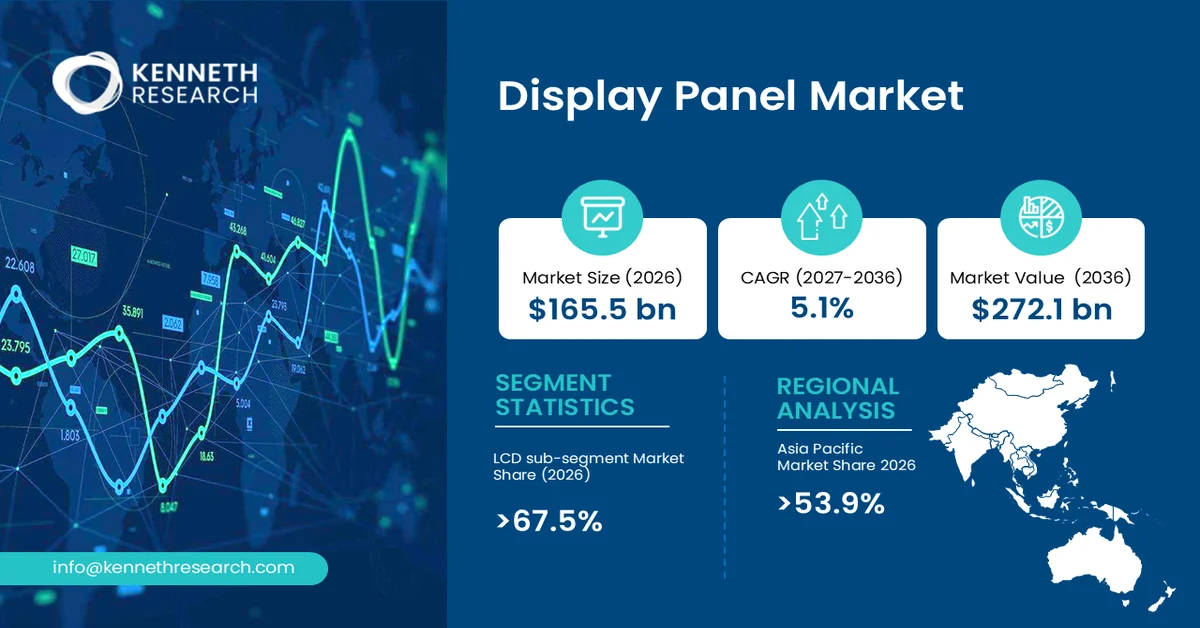
Display Panel Market size was valued at USD 165.5 billion in 2026 and is projected to reach USD 272.1 billion by the end of 2036, rising at a CAGR of 5.1% during the forecast period, i.e., 2027–2036. In 2027, the industry size of the display panel market is estimated at USD 173.9 billion.
The primary growth driver for the display panel market is the expanding integration of advanced displays across smartphones, televisions, computers, automotive systems, industrial equipment, and other electronic devices. Demand is being reinforced by upgrades toward higher-quality visual interfaces, larger screen formats, touch functionality, and emerging display technologies.
The display panel market comprises the manufacturing and supply of electronic display panels that convert electrical signals into visual information for use in consumer, commercial, automotive, industrial, medical, and other electronic applications. Display panels include technologies such as liquid crystal display (LCD), organic light-emitting diode (OLED), and other advanced flat-panel architectures.
Key characteristics include varying screen sizes, resolutions, refresh rates, brightness levels, contrast performance, response times, power requirements, and form factors. Panels may incorporate touch functionality, flexible substrates, backlighting systems, and advanced color-management technologies depending on their intended application.
Key Display Panel Market Insights Summary:
Key Takeaways: Market Trends & Insights
- Display Panel Market projected to grow from USD 165.5 billion in 2026 to USD 272.1 billion by 2036 at a 5.1% CAGR.
- Asia-Pacific accounted for the largest regional share at 53.9% in 2026, supported by concentrated panel manufacturing capabilities, extensive electronics production, and strong technology ecosystems across Japan and China.
- LCD is expected to remain the leading Type of Display segment with a 67.5% share in 2026, supported by its mature manufacturing infrastructure, broad device compatibility, and established applications across televisions, monitors, computers, automotive systems, and industrial equipment.
- HD (including HD, WQHD, and FHD) is positioned for continued demand under the Resolution segment because these formats provide a practical balance between visual quality, processing requirements, power consumption, and product cost.
Market Drivers
- Increasing investment in OLED and next-generation display manufacturing infrastructure.
- Expanding integration of display panels across consumer, automotive, industrial, and medical electronics.
- Rising demand for higher-resolution, brighter, thinner, and more energy-efficient display interfaces.
- Increasing adoption of advanced displays in connected vehicles, smart devices, and digital industrial systems.
Challenges
- High capital intensity and manufacturing complexity.
- Supply-chain concentration and technology dependence.
Display Panel Market: Market Overview & Supply Chain
Display panel adoption is increasing globally as smartphones, televisions, computers, automotive systems, industrial equipment, and other electronic products require increasingly capable visual interfaces. Demand is being supported by upgrades toward larger screens, improved image quality, touch functionality, higher resolution, and more energy-efficient architectures. The manufacturing ecosystem is also expanding through continued investment in flat-panel production and related equipment.
The display panel market value chain begins with raw materials and specialized inputs including glass substrates, semiconductor materials, liquid crystals, organic compounds, polarizing films, color filters, backlight components, transparent conductive materials, and electronic control components. These inputs are supplied to panel manufacturers that undertake substrate preparation, thin-film transistor formation, color-filter processing, cell assembly, deposition, encapsulation, backlighting, cutting, testing, and quality control. Manufacturing equipment providers and process-technology specialists support production-line deployment and maintenance. Finished panels are then supplied directly to original equipment manufacturers, electronics assemblers, automotive suppliers, industrial-equipment producers, and other device manufacturers.
Display Panel Market: Growth Drivers & Challenges
Growth Drivers
- Rising Investment in Advanced OLED and Display Technologies: The transition toward higher-performance display technologies is driving investment across the display-panel manufacturing ecosystem. Manufacturers are upgrading production infrastructure to support OLED and other differentiated panel technologies that offer improved contrast, thinner form factors, lower power consumption, and greater design flexibility. This investment also enables display producers to address demand from smartphones, televisions, IT equipment, automotive displays, and other applications requiring increasingly sophisticated visual interfaces. In June 2025, LG Display announced an investment of KRW 1.26 trillion in new OLED technologies and related infrastructure, with the investment period extending through June 2027.
- Expanding Display Integration Across Consumer and Industrial Electronics: The increasing integration of display interfaces across consumer electronics, automotive systems, industrial equipment, medical devices, and professional applications is creating sustained demand for display panels. Displays have evolved from basic visual-output components into important interfaces for navigation, entertainment, control, information management, and human-machine interaction. Automotive manufacturers are incorporating larger and more sophisticated displays into instrument clusters, infotainment systems, rear-seat entertainment, and other vehicle interfaces, while industrial equipment increasingly uses digital panels for monitoring and control.
Challenges
- High Capital Intensity and Manufacturing Complexity: Display-panel manufacturing requires substantial investment in specialized fabrication facilities, precision equipment, cleanroom infrastructure, utilities, process technology, and highly controlled production environments. The complexity increases as manufacturers transition toward newer generations of LCD and OLED technologies, where production yields and process consistency directly influence commercial viability. India's government has explicitly characterized display manufacturing as a highly capital-intensive and technology-intensive sector involving significant capital investment, high risk, and long development and payback periods. These requirements create substantial entry barriers and favor established manufacturers with technological expertise, large-scale production capabilities, and access to long-term capital.
- Supply-Chain Concentration and Technology Dependence: The display-panel industry faces structural supply-chain risks because production depends on specialized materials, manufacturing equipment, semiconductor components, glass substrates, and highly developed fabrication ecosystems. Concentration of manufacturing capabilities in a limited number of Asian production hubs can expose downstream electronics manufacturers to geopolitical tensions, trade restrictions, logistics disruptions, and fluctuations in component availability. India's NITI Aayog has identified advanced displays as capital- and technology-intensive industries characterized by scale economies and strong incumbent advantages, highlighting the difficulty of developing competitive domestic capabilities.
Display Panel Market Size and Forecast:
| Report Attribute | Details |
|---|---|
| Base Year |
2026 |
| Forecast Year |
2027-2036 |
| CAGR |
5.1% |
| Base Year Market Size (2026) |
USD 165.5 billion |
| Forecast Year Market Size (2036) |
USD 272.1 billion |
| Regional Scope |
|
Display Panel Market: Segment Analysis
Type of Display Segment Analysis
In the Type of Display segment, the LCD sub-segment is anticipated to capture the largest market share of 67.5% in 2026. Its leadership is supported by extensive adoption across televisions, monitors, notebooks, tablets, automotive displays, industrial equipment, and other electronic products. LCD benefits from a mature manufacturing ecosystem, established supply chains, broad panel-size availability, and the ability to serve applications across multiple price and performance categories.
Demand remains supported by the continued requirement for reliable, scalable, and energy-efficient display solutions. The U.S. Department of Energy maintains specific federal procurement guidance for displays and monitors and separately identifies Liquid Crystal Display (LCD) panels or monitors within its federal product classification framework, demonstrating their established role across institutional electronics procurement.
Resolution Segment Analysis
In the Resolution segment, HD (including HD, WQHD, and FHD) is projected to maintain strong demand across the forecast period. These resolution formats provide a practical balance between image clarity, processing requirements, power consumption, and device cost, supporting their use across televisions, monitors, notebooks, tablets, automotive displays, industrial equipment, and other electronic products.
Demand remains particularly relevant in applications where manufacturers need dependable visual performance without the higher hardware and processing requirements associated with ultra-high-resolution formats. Market.us identifies HDTV and Full HD as established resolution categories that continue to serve price-sensitive and mainstream applications, with Full HD remaining relevant in mid-range products because it balances image quality and cost.
Our in-depth analysis of the global display panel market includes the following segments:
|
Segment |
Sub-segment |
|
Display Type |
|
|
Resolution |
|
|
Application |
|
|
Panel Size |
|
Display Panel Market – Regional Analysis
Asia-Pacific Market Trends & Insights:
Asia-Pacific accounted for 53.9% of the display panel market in 2026, making it the dominant regional market. The region's leadership is supported by its extensive display manufacturing ecosystem, strong electronics production base, established semiconductor and component supply chains, and substantial demand for smartphones, televisions, computers, automotive displays, and industrial electronics. Japan and China are particularly important because they combine advanced display technologies with large-scale electronics manufacturing capabilities. China continues to strengthen its position across the display manufacturing value chain, while Japan maintains technological expertise in high-performance display materials, equipment, and precision electronics.
Japan remains an important technology and manufacturing center for the display industry. Its strengths in precision electronics, materials science, semiconductor technologies, and advanced manufacturing support the development of sophisticated LCD and emerging display technologies. Japanese companies also contribute specialized materials and manufacturing equipment used throughout the global display supply chain.
China represents a major production and consumption hub, supported by extensive electronics manufacturing capacity and large domestic demand for smartphones, televisions, computers, and automotive electronics.
North America Market Trends & Insights:
North America represents a significant demand center for display panels, supported by established consumer-electronics, automotive, industrial, healthcare, entertainment, and information-technology industries. Demand is increasingly shaped by the need for high-quality visual interfaces across connected devices, vehicle displays, professional monitors, industrial equipment, and specialized electronic systems. Government initiatives supporting advanced semiconductor and electronics ecosystems are also strengthening the broader regional technology base. In 2024, the Government of Canada announced a C$120 million investment through its Strategic Innovation Fund to expand CMC Microsystems’ network supporting semiconductor design, manufacturing, and commercialization, including intelligent sensor technologies.
U.S. is the principal contributor to regional demand, supported by its large consumer-electronics market, automotive industry, technology sector, entertainment ecosystem, and industrial applications.
Canada offers additional opportunities through automotive manufacturing, electronics, industrial technology, healthcare equipment, and advanced manufacturing.
Display Panel Market: Competitive Landscape
Here is a list of upstream, downstream, and key players operating in the global display panel market competitive ecosystem:
- BOE Technology Group Co., Ltd. (China)
- Company Overview
- Business Strategy
- Key Product Offerings
- Financial Performance
- Key Performance Indicators
- Risk Analysis
- Recent Development
- Regional Presence
- SWOT Analysis
- Samsung Display Co., Ltd. (South Korea)
- LG Display Co., Ltd. (South Korea)
Recent Developments
- June 2026 – BOE launched its Gen 8.6 AMOLED production line in Chengdu and announced the start of mass production and product delivery.
- June 2026 – BOE and vivo launched the Polaris Joint Laboratory to advance display technology, product quality control, and user-experience research for smart devices.
Frequently Asked Question
In 2026, the display panel market exceeded USD 165.5 billion.
The display panel market is projected to reach USD 272.1 billion by the end of 2036, expanding at a CAGR of 5.1% over the forecast period (2027–2036).
The major players in the market are BOE Technology Group Co., Ltd., Samsung Display Co., Ltd., LG Display Co., Ltd., AUO Corporation, Innolux Corporation, Japan Display Inc., and others.
In the Type Of Display segment, the LCD sub-segment is anticipated to capture the largest market share of 67.5% in the future and exhibit lucrative growth opportunities during 2027–2036.
Asia-Pacific is projected to hold the largest market share of 53.9% by the end of 2026 and provide more business opportunities in the future.
Why Choose Kenneth Research ?
-
Insight with Impact : We don’t just gather data — we uncover stories, trends, and opportunities that fuel business growth.
-
Experts Who Get It : Our team speaks your industry’s language and knows what really matters to your customers and market.
-
Custom-Built for You : Forget one-size-fits-all. We craft research and consulting solutions as unique as your business vision.
-
Partners, Not Just Providers : We work with you, not for you — collaborating closely to turn insights into smart, strategic moves.
-
Results That Speak : Our work powers brands, startups, and industry leaders alike — with a track record of ideas that work in the real world.
Report ID: 1271 |
Published Date: 14 Sep 2026 |
Report Format: |
Delivery Timeline: 48-72 Business Hours

Copyright © 2025 Kenneth Research. All rights reserved. Terms of Use | Privacy Policy
