Report ID: 1384 |
Published Date: 24 Sep 2026 |
Report Format: |
Delivery Timeline: 48-72 Business Hours
Direct-to-Chip Liquid Cooling Market Outook:
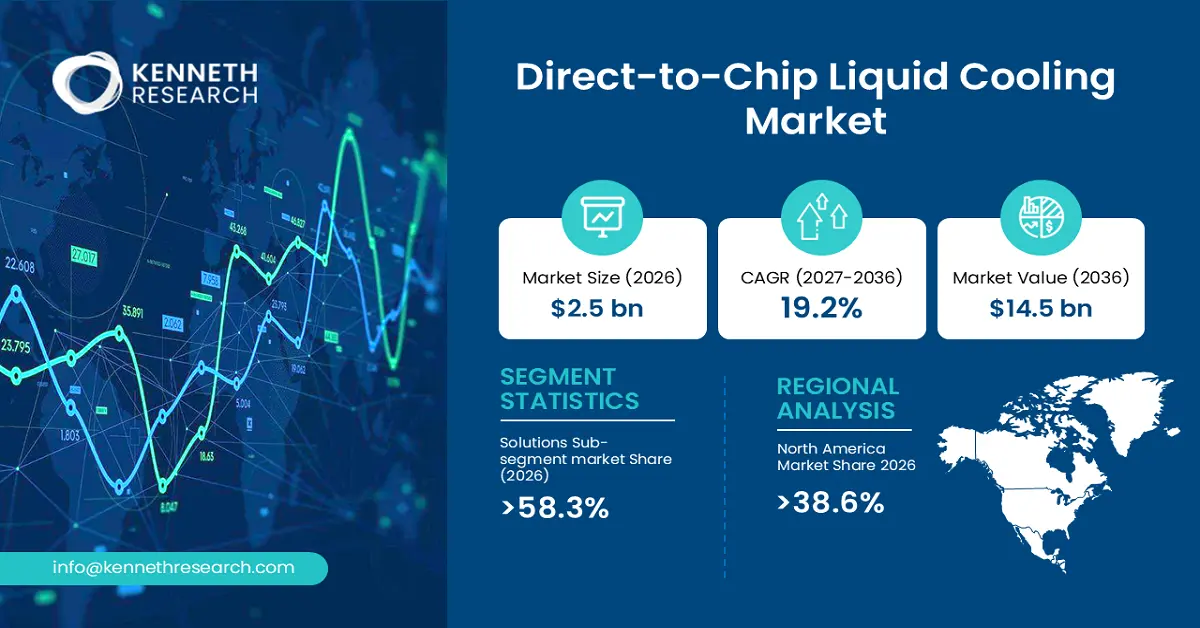
Direct-to-Chip Liquid Cooling Market size was valued at USD 2.5 billion in 2026 and is projected to reach USD 14.5 billion by the end of 2036, rising at a CAGR of 19.2% during the forecast period, i.e., 2027–2036. In 2027, the industry size of the direct-to-chip liquid cooling is estimated at USD 3.0 billion.
The primary growth driver for the direct-to-chip liquid cooling market is the rapid expansion of high-density computing infrastructure, particularly AI-enabled data centers. As processors generate greater heat loads, liquid cooling provides a more effective thermal-management approach than conventional air cooling, supporting reliable operation, performance optimization, and continued deployment of compute-intensive systems.
Direct-to-chip liquid cooling is a thermal-management technology in which a liquid coolant is delivered directly to heat-generating semiconductor components, typically through cold plates or comparable interfaces attached to processors. The technology transfers heat from chips into a circulating liquid loop, which subsequently carries the thermal energy to heat-rejection equipment.
Key characteristics include direct thermal contact with high-heat-density components, controlled coolant circulation, heat exchangers or other heat-rejection mechanisms, and integration with server or rack-level infrastructure. Water-based and other engineered coolants can be selected according to thermal performance, material compatibility, operating conditions, and system design requirements.
Key Direct-to-Chip Liquid Cooling Market Insights Summary:
Key Takeaways: Market Trends & Insights
- AI and high-performance computing workloads are increasing demand for direct-to-chip liquid cooling as processors generate greater heat within increasingly dense server configurations
- Datacenter is the leading application segment, accounting for 58.3% market share in 2026, supported by expanding AI, cloud computing, and high-performance computing infrastructure
- Water-based coolants are projected to grow as their thermal-transfer characteristics support efficient heat removal from high-power processors in direct-to-chip cooling architectures
- North America is the dominant regional market, accounting for 38.6% market share in 2026, supported by established data-center infrastructure and strong investment in AI and high-density computing
- The direct-to-chip liquid cooling market is projected to expand from USD 2.5 billion in 2026 to USD 14.5 billion by 2036, representing a CAGR of 19.2% during 2027-2036
Market Drivers
- Accelerating AI and high-performance computing deployment
- Rising emphasis on energy-efficient data-center infrastructure
- Increasing server and rack power density
- Growing integration of advanced thermal-management technologies
Challenges
- High Initial Infrastructure and Integration Complexity
- Coolant Management, Reliability, and Maintenance Requirements
Direct-to-Chip Liquid Cooling Market Overview & Supply Chain
Adoption of the direct-to-chip liquid cooling market is increasing as computing infrastructure becomes more energy-intensive and processor heat densities rise. The technology is particularly relevant to data centers supporting artificial intelligence, high-performance computing, cloud services, and other compute-intensive workloads, where conventional air cooling can become increasingly constrained by thermal-management requirements.
The direct-to-chip liquid cooling market value chain begins with raw-material and component suppliers providing metals, thermal interface materials, polymers, pumps, valves, tubing, heat exchangers, sensors, and coolant formulations. Specialized manufacturers then engineer and assemble cold plates, manifolds, coolant distribution units, heat-rejection equipment, and integrated cooling loops according to processor, server, rack, and facility requirements. System integrators combine these components with computing infrastructure and facility-level thermal-management systems, while distributors and technology partners support procurement, deployment, and aftermarket requirements. End users primarily include data-center operators, hyperscale and cloud-service providers, enterprise computing facilities, high-performance computing installations, and specialized industrial computing environments.
Direct-to-Chip Liquid Cooling Market: Growth Drivers & Challenges
Growth Drivers
- Rising AI and High-Performance Computing Workloads: The rapid deployment of artificial intelligence and high-performance computing is increasing the thermal-management requirements of modern computing infrastructure. AI workloads rely on high-performance processors that generate substantial heat within increasingly dense server configurations, creating demand for cooling architectures capable of removing heat directly at the component level.
- Increasing Demand for Energy-Efficient Data-Center Infrastructure: Energy efficiency is becoming a strategic consideration for data-center developers and operators as electricity availability, operating costs, and sustainability requirements increasingly influence infrastructure planning. Direct-to-chip liquid cooling can contribute to this transition by transferring processor heat more efficiently than systems dependent predominantly on room-level air circulation.
Challenges
- High Initial Infrastructure and Integration Complexity: A major restraint is the capital and engineering complexity associated with integrating direct-to-chip liquid cooling into existing computing infrastructure. Unlike conventional air-cooling arrangements, liquid systems require cold plates, manifolds, pumps, coolant distribution units, piping, monitoring equipment, and compatible heat-rejection infrastructure. Retrofitting these components into established data centers can require server modifications, rack redesign, plumbing changes, and coordinated facility engineering.
- Coolant Management, Reliability, and Maintenance Requirements: Coolant management presents another important restraint because liquid-based thermal systems introduce operational considerations that are less prominent in conventional air-cooled environments. Coolant selection must account for thermal performance, material compatibility, contamination control, corrosion risks, and long-term system stability. Leaks or component failures can also create operational concerns around sensitive electronic equipment, making monitoring and preventive maintenance essential.
Direct-to-Chip Liquid Cooling Market Size and Forecast:
| Report Attribute | Details |
|---|---|
| Base Year |
2026 |
| Forecast Year |
2027-2036 |
| CAGR |
19.2% |
| Base Year Market Size (2026) |
USD 2.5 Billion |
| Forecast Year Market Size (2037) |
USD 14.5 Billion |
| Regional Scope |
|
Direct-to-Chip Liquid Cooling Market Segment Analysis:
Application Segment Analysis
In the application segment, datacenter sub-segment is anticipated to capture the largest market share of 58.3% by the end of 2026.
The datacenter application segment dominates because the rapid deployment of AI, cloud computing, and high-performance workloads is increasing thermal-management requirements within computing facilities. Higher computational intensity places greater demands on processors and server infrastructure, strengthening the need for cooling architectures capable of efficiently removing heat close to the source. This supports adoption of direct-to-chip liquid cooling, particularly in facilities designed for dense computing environments. The U.S. Department of Energy reports that data centers consumed approximately 4.4% of total U.S. electricity in 2023, demonstrating the substantial energy footprint of the segment and the importance of improving infrastructure efficiency.
Coolant Type Segment Insights
The water-based coolants is projected to grow as the second-largest segment in the direct-to-chip liquid cooling market due to four converging demand drivers.
The water-based coolants segment is projected to grow as data-center operators seek efficient heat-transfer media for increasingly dense computing infrastructure. Water offers strong thermal-transfer characteristics, making it suitable for direct-to-chip architectures where heat must be removed rapidly from processors and other high-power components. Government-backed technical guidance from the U.S. Department of Energy identifies water and other liquids as capable of achieving heat transfer with substantially lower volumetric flow requirements than air, supporting their suitability for liquid-cooled servers. Adoption is also supported by the increasing deployment of liquid cooling for AI and high-performance computing. The Department of Energy's 2024 data-center design guidance states that high-performance computing facilities have been early adopters of direct liquid cooling, with recently observed compute-rack power densities surpassing 125 kW.
Our in-depth analysis of the Direct-to-Chip Liquid Cooling market includes the following segments:
|
Segment |
Sub-segment |
|
Solution Type |
|
|
Cooling Component |
|
|
Coolant Type |
|
|
Application |
|
|
End Use |
|
Direct-to-Chip Liquid Cooling Market Regional Insights:
North America Market Trends & Insights:
North America direct-to-chip liquid cooling market is projected to hold the largest revenue share of 38.6% by the end of 2026.
It is supported by its established data-center ecosystem, advanced computing infrastructure, strong technology investment, and early adoption of high-density computing architectures. The region benefits from substantial hyperscale and colocation capacity, a mature semiconductor and server supply chain, and significant investment in AI infrastructure.
Within North America, the United States represents the principal demand center, supported by extensive data-center investment, AI development, cloud computing, and technology infrastructure.
The Canada market benefits from expanding digital infrastructure, access to relatively low-carbon electricity in several provinces, and growing interest in efficient data-center operations. Together, both countries provide a strong ecosystem for cooling-system manufacturers, technology suppliers, engineering firms, and infrastructure operators, supporting continued regional adoption.
Asia Pacific Market Trends & Insights:
Asia Pacific is emerging as an important growth region for the direct-to-chip liquid cooling market as digitalization, cloud computing, artificial intelligence, and high-performance computing expand across major economies. Industrial activity is being reinforced by investments in hyperscale facilities, sovereign computing infrastructure, telecommunications, and advanced manufacturing.
China represents a major regional opportunity because of its extensive computing infrastructure, continued investment in AI and digital technologies, and government emphasis on green computing. Its policy environment increasingly supports efficient cooling and energy-management technologies, creating opportunities for direct-to-chip solutions in new and upgraded facilities.
India is developing rapidly as an AI and data-center infrastructure market, supported by Digital India, national AI initiatives, and state-level investment programs. Government initiatives are also encouraging domestic development of direct-to-chip liquid-cooling capabilities, strengthening opportunities for local technology suppliers and system integrators.
Leading Companies Operating in the Direct-to-Chip Liquid Cooling Market:
Here is a list of upstream, downstream, and key players operating in Direct-to-Chip Liquid Cooling market competitive ecosystem:
- Vertiv Group Corp. (United States)
- Company Overview
- Business Strategy
- Key Product Offerings
- Financial Performance
- Key Performance Indicators
- Risk Analysis
- Recent Development
- Regional Presence
- SWOT Analysis
- Super Micro Computer, Inc. (United States)
- Schneider Electric (France)
- Asetek (Denmark)
- LiquidStack (United States)
- ZutaCore (United States)
Recent Developments
- In July 2026, Supermicro expanded its Rear Door Heat Exchanger portfolio with ten models ranging from 10 kW to 120 kW per rack, compatible with direct-to-chip liquid cooling and supporting up to 240 kW at rack level.
- ·In January 2026, Vertiv launched the MegaMod HDX modular liquid cooling infrastructure solution supporting rack densities from 50 kW to over 100 kW, with compact configurations up to 1.25 MW and combo solutions scaling to 10 MW.
Frequently Asked Question
In 2026, the direct-to-chip liquid cooling market exceeded USD 2.5 billion.
The direct-to-chip liquid cooling market is projected to reach USD 14.5 billion by the end of 2036, expanding at a CAGR of 19.2% over the forecast period (2027-2036).
The major players in the market are Vertiv Group Corp., Super Micro Computer, Inc., Schneider Electric, Asetek, LiquidStack, ZutaCore, and others.
In the application segment, the datacenter sub-segment is anticipated to capture the largest market share of 58.3% in the future and exhibit lucrative growth opportunities during 2027-2036. This growth trajectory is largely attributed to the expansion of AI and high-performance computing workloads.
North America is projected to hold the largest market share of 38.6% by the end of 2026 and provide more business opportunities in the future. Continuous investments in AI infrastructure, cloud computing, and high-density data centers in the United States and Canada are fostering the region's dominance.
Why Choose Kenneth Research ?
-
Insight with Impact : We don’t just gather data — we uncover stories, trends, and opportunities that fuel business growth.
-
Experts Who Get It : Our team speaks your industry’s language and knows what really matters to your customers and market.
-
Custom-Built for You : Forget one-size-fits-all. We craft research and consulting solutions as unique as your business vision.
-
Partners, Not Just Providers : We work with you, not for you — collaborating closely to turn insights into smart, strategic moves.
-
Results That Speak : Our work powers brands, startups, and industry leaders alike — with a track record of ideas that work in the real world.
Report ID: 1384 |
Published Date: 24 Sep 2026 |
Report Format: |
Delivery Timeline: 48-72 Business Hours

Copyright © 2025 Kenneth Research. All rights reserved. Terms of Use | Privacy Policy
