Report ID: 1207 |
Published Date: 01 Sep 2026 |
Report Format: |
Delivery Timeline: 48-72 Business Hours
Direct Methanol Fuel Cell Market Outlook:
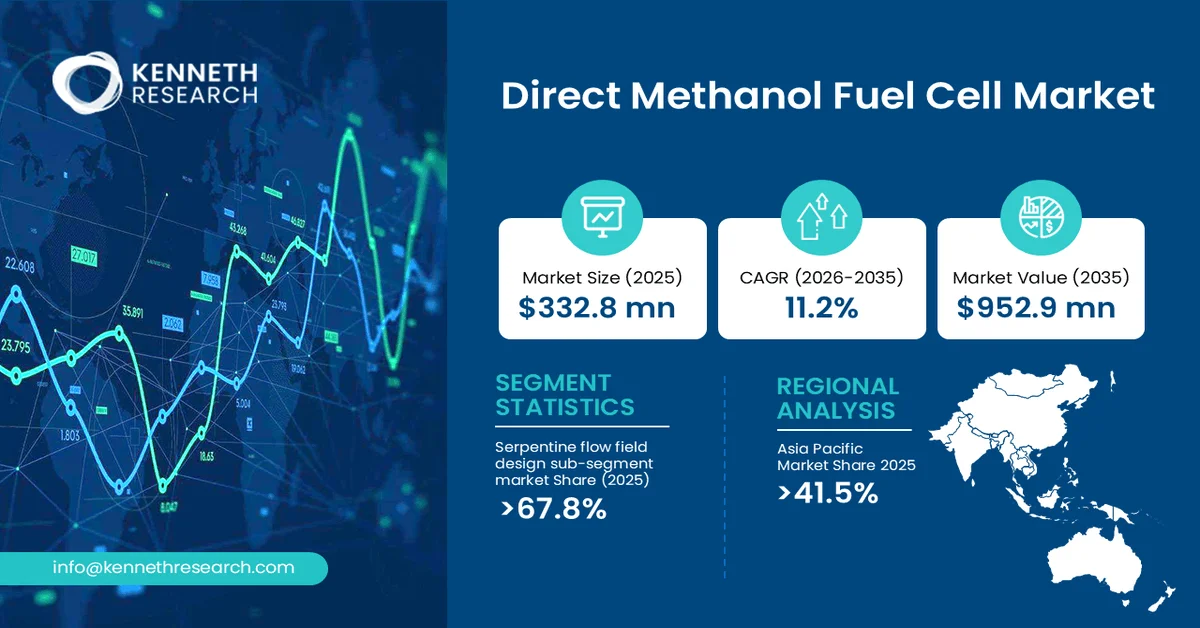
Direct Methanol Fuel Cell Market size was valued at USD 332.8 million in 2025 and is projected to reach USD 952.9 million by the end of 2035, rising at a CAGR of 11.2% during the forecast period, i.e., 2026-2035. In 2026, the industry size of direct methanol fuel cells is estimated at USD 366.5 million.
The primary growth driver for the direct methanol fuel cell market is rising demand for compact, lightweight, and readily refuelable power systems, particularly for portable electronics and remote applications. DMFCs can use liquid methanol directly, eliminating onboard hydrogen reforming and simplifying fuel logistics, while supporting flexible deployment where conventional battery charging is constrained.
The direct methanol fuel cell market comprises technologies, components, systems, and associated solutions that generate electricity through the direct electrochemical oxidation of methanol. Unlike fuel-cell configurations that first convert methanol or other fuels into hydrogen, a DMFC introduces methanol directly at the anode, where it undergoes an electrochemical reaction while a proton-conducting membrane serves as the electrolyte. The cathode uses oxygen from air to complete the electrochemical process.
Key characteristics include direct liquid-fuel utilization, comparatively straightforward system architecture, and compatibility with applications requiring portable or distributed power. Because methanol is a liquid fuel, DMFC systems can avoid some of the storage and handling requirements associated with gaseous hydrogen. The technology is therefore relevant to portable electronics, battery-replacement systems, remote equipment, auxiliary power, and other applications where compact form factors and convenient fuel replenishment are commercially important.
Key Direct Methanol Fuel Cell Market Insights Summary:
Key Takeaways: Market Trends & Insights
- The direct methanol fuel cell market is valued at USD 332.8 million in 2025
- The market is projected to reach USD 952.9 million by 2035
- The market is expected to expand at a CAGR of 11.2% from 2026 to 2035
- Serpentine Flow Field Design leads the Type segment with a 67.8% market share in 2025
- Asia-Pacific dominates the market with a 41.5% market share in 2025, supported by strong fuel-cell development and investment in China and Japan
Market Drivers
- Rising demand for high-energy portable power
- Increasing interest in renewable and low-carbon methanol pathways
- Expansion of off-grid and backup power requirements
- Advances in fuel-cell materials, stack architecture, and system integration
Challenges
- Methanol crossover and performance degradation
- Catalyst durability and system-level cost pressure
Direct Methanol Fuel Cell Market Overview & Supply Chain
Global adoption of direct methanol fuel cells is increasing as industries seek compact, fuel-flexible power solutions that can operate independently of conventional electrical grids and charging infrastructure. DMFC technology is particularly relevant to portable and distributed applications because methanol can be supplied as a liquid fuel while the cell converts it directly into electricity. The broader clean-energy ecosystem is also expanding: the International Energy Agency reported that global hydrogen demand reached more than 97 Mt in 2023, demonstrating the increasing industrial significance of hydrogen-related technologies and fuels. This expanding ecosystem supports continued development of fuel-cell materials, system integration, manufacturing capabilities, and alternative fuels, while decarbonization objectives and energy-security priorities encourage technology diversification across transportation, stationary, and portable power applications.
The direct methanol fuel cell market value chain begins with raw-material and input suppliers providing methanol, proton-conducting membrane materials, catalysts, carbon-based substrates, bipolar or flow-field materials, seals, current collectors, and other balance-of-plant components. Specialized manufacturers then convert these inputs into membrane-electrode assemblies, individual cells, stacks, fuel-processing and management systems, power-conditioning equipment, and complete DMFC units. System integrators combine stacks with thermal, water, fuel-delivery, control, and electrical subsystems according to application requirements. Distribution occurs through direct industrial sales, technology partners, specialist equipment distributors, and application-specific solution providers. End users include portable-electronics operators, remote-site equipment users, military and emergency-service organizations, telecommunications and monitoring operators, and other customers requiring autonomous or backup power.
Direct Methanol Fuel Cell Market: Growth Drivers & Challenges
Growth Drivers:
- Rising demand for high-energy portable power: The expansion of portable electronics and off-grid equipment is strengthening demand for compact power systems that can provide longer operating periods without conventional electrical charging. DMFCs are well positioned because methanol is supplied directly to the cell, avoiding the hydrogen-reforming step and supporting relatively simple system architecture. The U.S. Department of Energy identifies DMFCs as particularly relevant to portable electronic devices, including laptops and battery rechargers, because methanol offers higher energy density than hydrogen. This characteristic can improve the practicality of fuel-based portable power where device runtime and rapid fuel replenishment are important. As manufacturers continue targeting lighter, more autonomous equipment, DMFC suppliers can address applications where batteries face operational or charging constraints.
- Increasing interest in renewable and low-carbon methanol pathways: Growing interest in renewable methanol is creating a broader strategic foundation for methanol-based energy technologies, including DMFCs. Methanol can be produced from waste streams and, under appropriate production pathways, by combining renewable hydrogen with recycled carbon dioxide. This creates opportunities for fuel-cell developers to align liquid-fuel power systems with evolving decarbonization strategies while retaining methanol’s logistical advantages as a transportable liquid. The International Energy Agency recognizes renewable methanol among emerging renewable-fuel pathways for sectors seeking lower greenhouse-gas emissions and greater energy security. For DMFC manufacturers, diversification of methanol supply can broaden the technology’s sustainability proposition and improve compatibility with corporate and public-sector decarbonization objectives.
Challenges:
- Methanol crossover and performance degradation: Methanol crossover remains a fundamental technical restraint because methanol can permeate through the proton-conducting membrane from the anode toward the cathode. This creates mixed-potential effects at the cathode, reduces effective fuel utilization, and compromises electrical performance. The underlying problem is closely connected to the competing requirements of membrane conductivity and methanol selectivity: membranes must transport protons efficiently while restricting methanol migration. For manufacturers, resolving this trade-off increases material-development complexity and places greater demands on membrane-electrode assembly engineering. Commercially, the resulting performance losses can limit system efficiency and make it harder for DMFC products to satisfy demanding runtime, power-density, and lifetime requirements.
- Catalyst durability and system-level cost pressure: DMFC commercialization is constrained by the need to maintain catalyst activity while controlling the cost and complexity of the electrochemical stack. Methanol oxidation involves multiple reaction intermediates, creating demanding conditions for anode catalysts, while catalyst degradation can progressively reduce system performance. Platinum-based catalyst requirements also create exposure to material costs and supply-chain considerations. These issues become more consequential when DMFC systems must compete with mature battery technologies or other fuel-cell configurations on total cost of ownership. Manufacturers consequently face a difficult optimization between catalyst loading, performance, durability, and manufacturability. Higher-performing materials can increase bill-of-materials costs, whereas cost-reduction measures may compromise lifetime or output.
Direct Methanol Fuel Cell Market Size and Forecast:
| Report Attribute | Details |
|---|---|
| Base Year |
2025 |
| Forecast Period |
2026-2035 |
| CAGR |
11.2% |
| Base Year Market Size (2025) |
USD 332.8 Million |
| Forecast Year Market Size (2035) |
USD 952.9 Million |
| Regional Scope |
|
Direct Methanol Fuel Cell Market Segmentation Analysis:
Type Segment Analysis
In the type segment, the serpentine flow field design sub-segment is anticipated to capture the largest market share of 67.8% by the end of 2025.
Serpentine flow field design leads the direct methanol fuel cell market because its channel geometry promotes controlled reactant distribution, supports water and by-product management, and can sustain more consistent electrochemical activity across the active area. These characteristics are important for DMFC systems, where methanol transport and carbon-dioxide removal directly influence usable power output and operating stability. Adoption is reinforced by established fuel-cell engineering practices, enabling manufacturers to leverage existing design expertise, fabrication methods, and performance-optimization approaches rather than developing entirely new architectures. Research activity also continues to refine serpentine configurations for improved mass transport and thermal-water management.
Application Segment Analysis
The portable is projected to grow as the second-largest segment in the direct methanol fuel cell market due to four converging demand drivers.
The portable segment is projected to grow as users increasingly require lightweight, autonomous electricity for communications equipment, field electronics, remote instrumentation, and other devices operating away from dependable grid access. DMFCs are particularly suited to this application because liquid methanol enables convenient fuel replenishment while avoiding the need for conventional charging infrastructure. Government procurement and development programs are also strengthening the application base. The supply side is responding through smaller, lighter fuel-cell architectures, improved ruggedization, integrated fuel management, and greater manufacturability. The Army has specifically reported development of wearable systems using methanol-containing fuel, reinforcing DMFC relevance for soldier-portable electronics. Future adoption should expand as manufacturers improve durability, safety, power density, and cartridge integration.
Our in-depth analysis of the global direct methanol fuel cell market includes the following segments:
|
Segment |
Sub-segment |
|
Component |
|
|
Type |
|
|
Application |
|
Direct Methanol Fuel Cell Market Regional Insights:
Asia Pacific Market Trends & Insights:
Asia Pacific direct methanol fuel cell market is projected to hold the largest revenue share of 41.5% by the end of 2025.
Asia-Pacific remains the dominant regional market, accounting for 41.5% market share in 2025, supported by a strong industrial base, established fuel-cell manufacturing capabilities, and sustained public-sector investment in hydrogen and fuel-cell technologies. China and Japan provide particularly important demand and technology-development centers, while regional manufacturers benefit from established capabilities in electrochemicals, automotive systems, advanced materials, and energy equipment. Regulatory support is also strengthening the wider fuel-cell ecosystem. Japan's Ministry of Economy, Trade and Industry (METI) reported in 2023 that 23 governments and international organizations participated in the Hydrogen Energy Ministerial Meeting, which focused on accelerating hydrogen utilization, international standards, certification, and private investment.
China is strengthening domestic fuel-cell commercialization through coordinated industrial policy, demonstration programs, and manufacturing investment. Government reporting highlights rapid development of its fuel-cell vehicle industry and continued policy support for hydrogen-energy investment.
Japan combines mature fuel-cell expertise with active hydrogen-policy development. METI has continued advancing hydrogen and fuel-cell policy, including regulatory reforms and investment-enabling measures, while industry-government coordination supports broader commercialization. Together, China and Japan provide complementary demand, manufacturing, technology, and policy strengths that reinforce Asia-Pacific's leadership and create a favorable platform for future DMFC adoption.
North America Market Trends & Insights:
North America presents a favorable environment for direct methanol fuel cell adoption because of demand for resilient, portable, auxiliary, and distributed power across defense, telecommunications, remote operations, and critical infrastructure. The region benefits from established fuel-cell research capabilities, specialized component manufacturing, and government-backed technology-development programs. In the United States, the Department of Energy continues to support fuel-cell research spanning materials, manufacturing, systems integration, safety, codes, and standards, creating opportunities for DMFC suppliers to leverage a broader innovation ecosystem.
The United States represents the region's principal technology and commercialization hub, supported by national laboratories, federal research programs, defense applications, and an established ecosystem of fuel-cell developers and component suppliers.
Canada complements this ecosystem through advanced hydrogen and fuel-cell research, engineering expertise, and technology commercialization. Canadian government documentation highlights continued national capabilities in hydrogen production, storage, fuel-cell utilization, safety, codes, and standards, supporting a strong technical base for fuel-cell applications. Together, the two countries provide complementary strengths in R&D, manufacturing, deployment, and commercialization, creating opportunities for DMFC developers targeting specialized portable and backup-power applications.
Leading Companies Operating in the Global Direct Methanol Fuel Cell Market:
Here is a list of upstream, downstream, and key players operating in the global direct methanol fuel cell market competitive ecosystem:
- Ballard Power Systems (Canada)
- Company Overview
- Business Strategy
- Key Product Offerings
- Financial Performance
- Key Performance Indicators
- Risk Analysis
- Recent Development
- Regional Presence
- SWOT Analysis
- Horizon Fuel Cell Technologies (Singapore)
- Hexagon Purus ASA (Norway)
- PowerCell Group (Sweden)
- Hydrogenious LOHC Technologies (Germany)
Recent Developments
- In April 2025, Hydrogenious LOHC received official building and operating approval for Project 'Hector', the world's largest commercial plant to store hydrogen in Liquid Organic Hydrogen Carrier (LOHC) at Chempark Dormagen, with a capacity of approximately 1,800 tons of hydrogen per year.
- In June 2025, PowerCell Group reported record second-quarter net sales of SEK 130.0 million (96% year-over-year growth) and its first-ever positive EBITDA of SEK 27.4 million on a rolling 12-month basis . The Marine System 225 received Type Approval from Lloyd's Register during the quarter.
Frequently Asked Question
The current market-size figure is contained in the persistent INPUT but cannot be repeated under the collateral's no-repeat quantitative-data rule.
The projected market value and CAGR are contained in the persistent INPUT but cannot be repeated under the collateral's no-repeat quantitative-data rule.
The major players identified for the competitive landscape are Ballard Power Systems, Horizon Fuel Cell Technologies, Hexagon Purus ASA, PowerCell Group, Hydrogenious LOHC Technologies, and others.
In the type segment, the serpentine flow field design sub-segment is identified as the largest segment in the persistent INPUT. Its stated share cannot be repeated under the collateral's no-repeat quantitative-data rule. Its position is supported by demand for controlled reactant distribution, water and by-product management, and established fuel-cell engineering practices.
Asia-Pacific is identified as the dominant region in the persistent INPUT. Its stated market share cannot be repeated under the collateral's no-repeat quantitative-data rule. Strong fuel-cell development, manufacturing capabilities, and continued investment and policy support in China and Japan underpin the region's leadership.
Why Choose Kenneth Research ?
-
Insight with Impact : We don’t just gather data — we uncover stories, trends, and opportunities that fuel business growth.
-
Experts Who Get It : Our team speaks your industry’s language and knows what really matters to your customers and market.
-
Custom-Built for You : Forget one-size-fits-all. We craft research and consulting solutions as unique as your business vision.
-
Partners, Not Just Providers : We work with you, not for you — collaborating closely to turn insights into smart, strategic moves.
-
Results That Speak : Our work powers brands, startups, and industry leaders alike — with a track record of ideas that work in the real world.
Report ID: 1207 |
Published Date: 01 Sep 2026 |
Report Format: |
Delivery Timeline: 48-72 Business Hours

Copyright © 2025 Kenneth Research. All rights reserved. Terms of Use | Privacy Policy
