Report ID: 1263 |
Published Date: 01 Sep 2026 |
Report Format: |
Delivery Timeline: 48-72 Business Hours
Digital Radar Market Outlook:
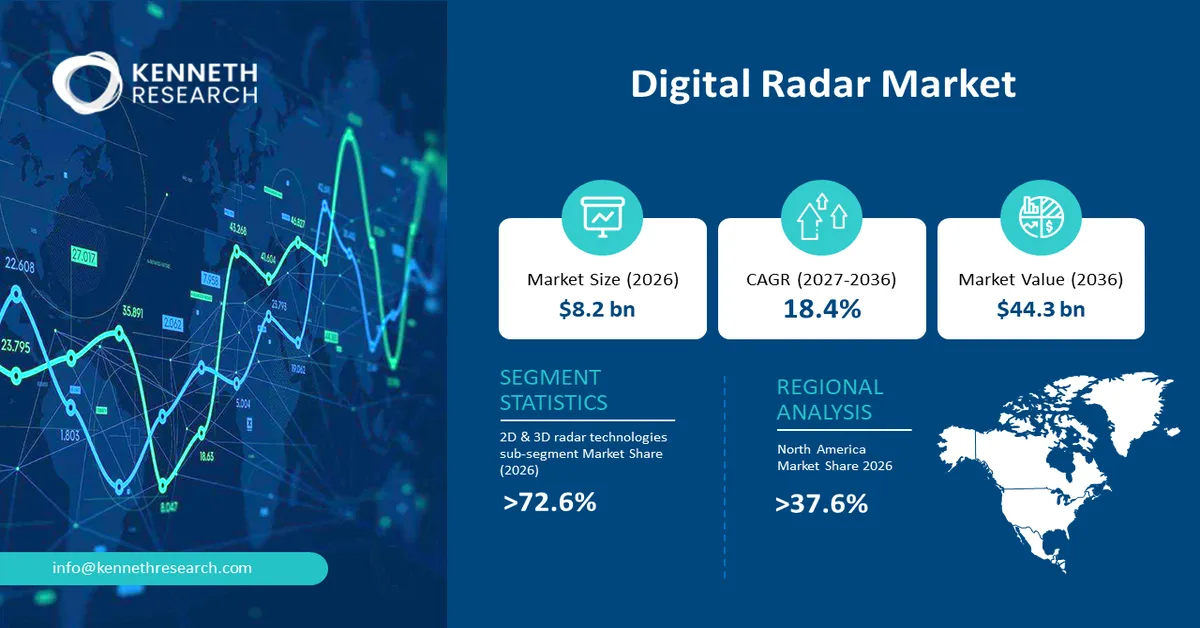
Digital Radar Market size was valued at USD 8.2 billion in 2026 and is projected to reach USD 44.3 billion by the end of 2036, rising at a CAGR of 18.4% during the forecast period, i.e., 2027-2036. In 2027, the industry size of the digital radar is estimated at USD 9.7 billion.
The primary growth driver for the digital radar market is the increasing deployment of advanced radar-based sensing across defense, aerospace, automotive, and security applications.
The digital radar market comprises radar systems that use digital signal processing, high-speed data conversion, software algorithms, and advanced computing architectures to detect, locate, track, and classify objects. Unlike conventional radar architectures that rely heavily on analog signal-processing chains, digital radar systems convert received signals into digital data for sophisticated processing, enabling greater flexibility, accuracy, scalability, and integration with other sensing and command systems.
Digital radar technologies include different dimensional configurations, such as 2D, 3D, and 4D systems, as well as active and passive architectures. They are deployed across defense and aerospace, automotive, security and surveillance, transportation, maritime, industrial, and other specialized applications. Key characteristics include real-time target detection, tracking, digital beamforming, signal classification, interference management, and increasingly AI-enabled analytics.
Key Digital Radar Market Insights Summary:
Key Takeaways: Market Trends & Insights
- Digital radar market projected to grow from USD 8.2 Billion in 2026 to USD 44.3 Billion by 2036 at a 18.4% CAGR.
- North America accounted for the largest regional share at 37.6% in 2026, supported by defense modernization, advanced aerospace capabilities, air-traffic surveillance requirements, and continued investment in radar infrastructure across the U.S. and Canada.
- 2D & 3D radar technologies are expected to remain the leading Dimension segment with a 72.6% market share in 2026, supported by broad deployment across aviation, defense, automotive, weather monitoring, and surveillance applications.
- Active radar is positioned for continued growth under the Type segment, driven by its ability to provide precise target detection and tracking, electronic beam steering, digital signal processing, and enhanced situational awareness.
Market Drivers
- Modernization of legacy radar systems through digital and software-defined architectures.
- Expanding demand for advanced detection, tracking, and situational awareness.
- Increasing deployment of radar for autonomous vehicles, aerospace, and transportation applications.
- Growing integration of AI, digital signal processing, and multi-sensor data fusion.
Challenges
- High modernization and integration complexity.
- Electromagnetic interference and cybersecurity risks.
Digital Radar Market Overview & Supply Chain
Digital radar adoption is increasing globally as defense, aerospace, transportation, weather monitoring, security, and industrial systems require higher-performance sensing, faster data processing, and greater adaptability. The transition from analog toward digital processing enables radar systems to handle increasingly complex data streams and apply sophisticated algorithms closer to the antenna. The U.S. Department of Energy’s Sandia National Laboratories notes that advances in computing are enabling digital components to process radar data streams that previously required substantial analog preprocessing, creating opportunities for more adaptable radar functions and software-defined configurations.
The digital radar market value chain begins with semiconductor devices, RF components, antennas, transmitters, receivers, analog-to-digital converters, processors, memory, power-management components, and specialized software. Component manufacturers supply these inputs to radar system developers and integrators, which undertake system architecture, antenna integration, signal-processing development, software engineering, calibration, testing, and final system validation. Digital processing hardware and software are increasingly important because they determine the system’s ability to perform detection, tracking, classification, filtering, and data fusion. Finished radar systems are supplied through specialized defense and aerospace contractors, technology integrators, industrial equipment providers, and direct procurement channels.
Digital Radar Market: Growth Drivers & Challenges
Growth Drivers:
- Modernization of radar systems through digital architectures: The transition from legacy analog radar toward digital and software-defined architectures is accelerating demand for advanced digital radar systems. Digital processing enables radar operators to modify signal characteristics, reconfigure system functions, and support multiple missions through software rather than relying exclusively on dedicated hardware. This improves operational flexibility while supporting applications such as surveillance, reconnaissance, electronic warfare, and target tracking. Sandia National Laboratories reported in 2024 that advances in computing are enabling digital components to process radar data streams that historically required substantial analog preprocessing. Its RAMSES platform supports rapid prototyping of next-generation radar capabilities, including target recognition and tracking.
- Expanding demand for advanced detection and situational awareness: Growing requirements for accurate detection, tracking, and situational awareness are supporting the adoption of digital radar across defense, aerospace, transportation, security, and autonomous systems. Digital radar can process complex signals rapidly and integrate information from multiple sensing channels, enabling users to identify and track objects in challenging operating environments. Its ability to operate across darkness, adverse weather, cluttered environments, and contested electromagnetic conditions strengthens its relevance where optical sensing alone may be insufficient. Digital architectures also allow radar functions to evolve through software updates, supporting longer system lifecycles and reducing dependence on completely new hardware for every capability enhancement.
Challenges:
- High modernization and integration complexity: Digital radar modernization requires substantial technical coordination because new architectures must integrate advanced processors, RF components, antennas, software, communication interfaces, and existing surveillance infrastructure. Replacing legacy systems can also create operational disruption and compatibility challenges, particularly for defense and air-traffic applications where continuous surveillance is essential. The FAA has identified aging radar infrastructure as a significant operational challenge and noted that obsolete systems require increasingly frequent maintenance while creating higher sustainment risks. Modernization therefore requires careful migration planning, interoperability testing, cybersecurity controls, and workforce training.
- Electromagnetic interference and cybersecurity risks: The growing digitalization and connectivity of radar systems increases exposure to electromagnetic interference, spectrum congestion, spoofing, jamming, and cybersecurity threats. Digital radar platforms increasingly exchange data with command networks, communication systems, and other sensors, making secure architecture and resilient signal processing essential. In aviation and defense applications, compromised or degraded radar information can directly affect surveillance quality and operational decision-making. The FAA's Mode S Beacon Replacement System program specifically incorporates contemporary surveillance interfaces and cybersecurity safeguards while replacing outdated radar components, demonstrating the importance of security during radar modernization.
Digital Radar Market Size and Forecast:
| Report Attribute | Details |
|---|---|
| Base Year |
2026 |
| Forecast Period |
2027-2036 |
| CAGR |
18.4% |
| Base Year Market Size (2026) |
USD 8.2 billion |
| Forecast Year Market Size (2036) |
USD 44.3 billion |
| Regional Scope |
|
Digital Radar Market Segmentation Analysis:
Dimension Segment Analysis
In the Dimension segment, 2D & 3D radar technologies are anticipated to capture the largest market share of 72.6% in 2026. Their dominance is supported by broad deployment across air-traffic surveillance, defense, security, weather monitoring, maritime operations, and transportation applications. Two-dimensional radar provides reliable range and azimuth information, while 3D configurations add elevation data, enabling more comprehensive target tracking and situational awareness.
Demand is further supported by modernization of aging radar infrastructure and the need for systems capable of integrating with contemporary digital surveillance networks. The U.S. Federal Aviation Administration has identified radar as a critical component of national airspace surveillance and is pursuing modernization of its radar infrastructure to improve safety, resilience, and compatibility with emerging technologies.
Type Segment Analysis
In the Type segment, the Active sub-segment is projected to witness strong growth throughout the forecast period. Active radar systems, particularly those incorporating Active Electronically Scanned Array (AESA) architectures, provide rapid electronic beam steering, simultaneous target tracking, improved detection performance, and greater operational flexibility. These characteristics make active radar increasingly relevant across air-defense, airborne surveillance, maritime monitoring, counter-UAS, and other mission-critical applications.
On the supply side, manufacturers are developing active radar platforms with digital beamforming, advanced signal processing, GaN-based transmit/receive modules, and software-defined architectures. Northrop Grumman describes its AESA radar portfolio as supporting air, land, and sea missions, while emphasizing adaptable architectures and rapid software updates.
Our in-depth analysis of the global digital radar market includes the following segments:
|
Segment |
Sub-segment |
|
Dimension |
|
|
Type |
|
|
Application |
|
|
Vertical |
|
Digital Radar Market Regional Insights:
North America Market Trends & Insights:
North America accounted for 37.6% of the digital radar market in 2026, making it the dominant regional market. Regional leadership is supported by substantial defense modernization, advanced aerospace infrastructure, air-traffic surveillance requirements, weather-monitoring networks, and continued investment in next-generation sensing systems. The U.S. is pursuing significant radar modernization across its National Airspace System, while Canada is strengthening continental surveillance capabilities through NORAD modernization. The FAA's January 2026 radar modernization initiative awarded contracts to RTX and Indra to replace aging surveillance radar infrastructure, demonstrating continued government demand for modern radar technologies.
U.S. represents the principal regional market, supported by extensive defense, aerospace, air-traffic-control, weather, and homeland-security applications. The FAA continues to treat ground-based radar as an essential surveillance capability and is modernizing systems to improve resilience and operational performance.
Canada offers substantial opportunities through aerospace-defense modernization and weather-monitoring infrastructure. Canada's government has prioritized advanced surveillance systems, including over-the-horizon radar, to improve early detection and tracking of potential threats across North America.
Asia-Pacific Market Trends & Insights:
Asia-Pacific represents an important growth market for digital radar, supported by defense modernization, maritime surveillance requirements, airspace monitoring, automotive sensing, and expanding investment in advanced electronic systems. Governments across the region are strengthening radar capabilities to improve national security, border surveillance, and situational awareness. Japan, China, and other regional economies are also developing advanced electronically scanned and digital radar technologies, creating opportunities for radar manufacturers, semiconductor suppliers, antenna specialists, and system integrators.
Japan is a technologically advanced radar market with strong capabilities in electronics, semiconductors, automotive systems, aerospace, and defense. Government-led surveillance modernization and investment in advanced sensing technologies are supporting opportunities for active and digitally processed radar solutions.
China provides substantial opportunities because of its large manufacturing ecosystem, expanding defense capabilities, automotive production, and investment in intelligent transportation.
Leading Companies Operating in the Global Digital Radar Market:
Here is a list of upstream, downstream, and key players operating in the global digital radar market competitive ecosystem:
- Lockheed Martin Corporation (United States)
- Company Overview
- Business Strategy
- Key Product Offerings
- Financial Performance
- Key Performance Indicators
- Risk Analysis
- Recent Development
- Regional Presence
- SWOT Analysis
- Northrop Grumman Corporation (United States)
- Thales Group (France)
Recent Developments
- October 2025 - Northrop Grumman highlighted the integration of its Scalable Agile Beam Radar (SABR) AESA radar with its Integrated Viper Electronic Warfare Suite for the F-16.
- June 2026 - Thales and the Netherlands Ministry of Defence announced a strategic partnership to expand radar-system production, development, and testing capacity in Hengelo.
Frequently Asked Question
In 2026, the digital radar market exceeded USD 8.2 billion.
The digital radar market is projected to reach USD 44.3 billion by the end of 2036, expanding at a CAGR of 18.4% over the forecast period (2027-2036).
The major players in the market are Lockheed Martin Corporation, Northrop Grumman Corporation, Thales Group, Leonardo S.p.A., Saab AB, Bharat Electronics Limited, and others.
In the Dimension segment, the 2D & 3D radar technologies sub-segment is anticipated to capture the largest market share of 72.6% in the future and exhibit lucrative growth opportunities during 2027-2036.
North America is projected to hold the largest market share of 37.6% by the end of 2026 and provide more business opportunities in the future.
Why Choose Kenneth Research ?
-
Insight with Impact : We don’t just gather data — we uncover stories, trends, and opportunities that fuel business growth.
-
Experts Who Get It : Our team speaks your industry’s language and knows what really matters to your customers and market.
-
Custom-Built for You : Forget one-size-fits-all. We craft research and consulting solutions as unique as your business vision.
-
Partners, Not Just Providers : We work with you, not for you — collaborating closely to turn insights into smart, strategic moves.
-
Results That Speak : Our work powers brands, startups, and industry leaders alike — with a track record of ideas that work in the real world.
Report ID: 1263 |
Published Date: 01 Sep 2026 |
Report Format: |
Delivery Timeline: 48-72 Business Hours

Copyright © 2025 Kenneth Research. All rights reserved. Terms of Use | Privacy Policy
