Report ID: 1222 |
Published Date: 28 Sep 2026 |
Report Format: |
Delivery Timeline: 48-72 Business Hours
Data Center Plastics Market Outlook:
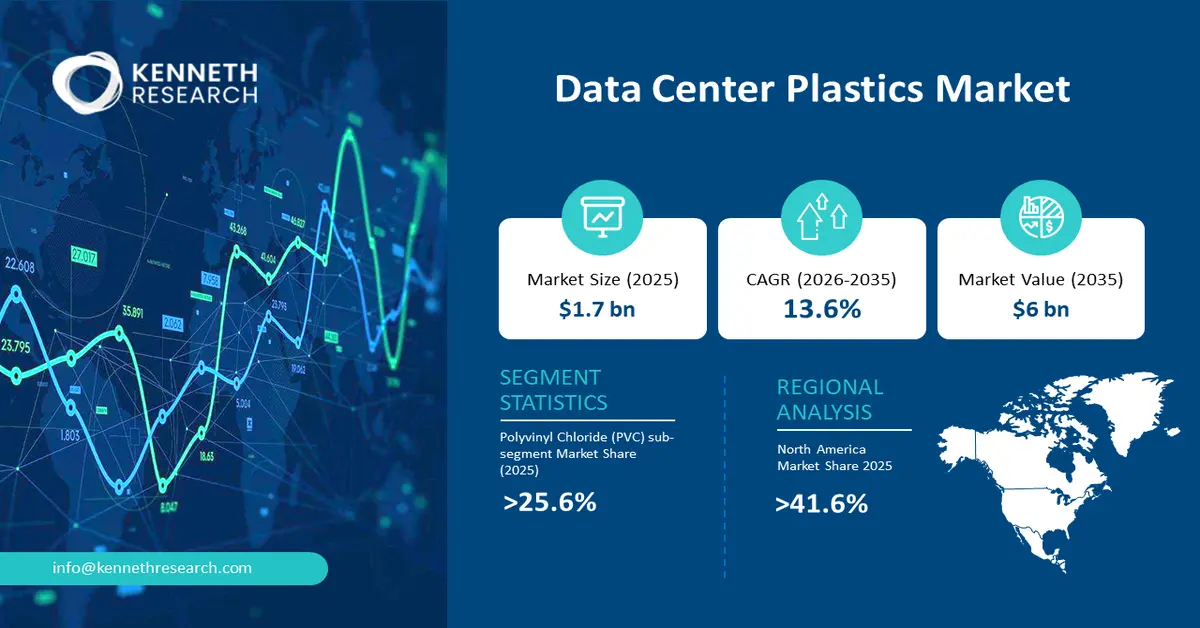
Data Center Plastics Market size was valued at USD 1.7 billion in 2025 and is projected to reach USD 6 billion by the end of 2035, rising at a CAGR of 13.6% during the forecast period, i.e., 2026-2035. In 2026, the industry size of data center plastics is estimated at USD 1.9 billion.
The primary growth driver for the data center plastics market is rapid data center expansion associated with artificial intelligence and digital services. The IEA reports that investment in data centers has nearly doubled since 2022, reinforcing demand for infrastructure materials supporting new facilities, equipment deployment, connectivity, cooling, safety, and reliability.
The data center plastics market comprises plastic materials, components, and engineered products used across data center infrastructure and supporting systems. These solutions serve applications where electrical insulation, mechanical protection, lightweight construction, corrosion resistance, dimensional stability, thermal management, and installation flexibility are important. Plastic types can include commodity and engineering polymers selected according to the requirements of power distribution, cabling, cooling, equipment protection, structural assemblies, and facility interiors. Product forms span components used for cable organization, conduits, insulation, housings, fittings, protective barriers, and other infrastructure functions.
Industrial relevance stems from the need to integrate dense computing equipment with dependable physical infrastructure. Plastics can support organized cable routing, protection of electrical and communication systems, equipment isolation, and efficient installation while accommodating demanding operating environments. Material selection also depends on fire performance, durability, chemical resistance, maintenance requirements, regulatory expectations, and compatibility with surrounding systems.
Key Data Center Plastics Market Insights Summary:
Key Takeaways: Market Trends & Insights
- The data center plastics market is projected to expand from USD 1.9 billion in 2026 to USD 6.0 billion by 2035, reflecting a 13.6% CAGR
- Polyvinyl Chloride (PVC) dominated the Plastic Type segment with a 25.6% market share in 2025, supported by demand for insulation, cable protection, and durable infrastructure components
- Cable Management Components represent the fastest-growing analysis segment, driven by increasing cable density, networking complexity, and demand for organized infrastructure
- North America led the global market with a 41.6% market share in 2025, supported by data center expansion and infrastructure investment across the United States and Canada
- Asia Pacific represents a key secondary growth region, with China and Japan offering opportunities from expanding computing infrastructure, cloud adoption, AI deployment, and digital transformation
Market Drivers
- AI-driven high-performance computing infrastructure expansion
- Increasing deployment of advanced cooling and thermal-management systems
- Greater emphasis on electrical safety, insulation, and infrastructure reliability
- Growth of modular, prefabricated, and rapidly deployable data center construction
Challenges
- Complex Material Formulations and Recycling Constraints
- Tightening Chemical and Environmental Compliance Requirements
Data Center Plastics Market Overview & Supply Chain
Global adoption of data center plastics is increasing as operators expand high-density computing infrastructure and address demanding requirements for electrical insulation, cable routing, cooling, equipment protection, fire performance, and installation efficiency.
The data center plastics market value chain begins with upstream producers of petrochemical feedstocks, polymer resins, additives, reinforcements, flame-retardant systems, and specialty compounds. Resin producers and compounders formulate materials according to requirements such as dielectric performance, mechanical strength, thermal stability, chemical resistance, flame behavior, and processing characteristics. Component manufacturers then convert these materials through extrusion, injection molding, thermoforming, machining, and related processes into conduits, cable-management components, housings, fittings, barriers, insulation elements, and other infrastructure products. Distributors, electrical wholesalers, specialty suppliers, and system integrators connect manufacturers with data center developers and contractors. End users include hyperscale operators, colocation providers, enterprise data centers, telecommunications facilities, and cloud infrastructure companies.
Data Center Plastics Market: Growth Drivers & Challenges
Growth Drivers:
- Expansion of AI and high-density data center infrastructure: The rapid deployment of artificial intelligence and high-performance computing is increasing the complexity and density of data center infrastructure, creating broader requirements for plastics used in cable routing, electrical protection, insulation, cooling systems, equipment housings, and facility components. The U.S. Department of Energy reports that data center load growth in the United States has tripled over the past decade, reflecting the combined influence of data center expansion, AI applications, domestic manufacturing, and electrification. This infrastructure expansion supports demand for lightweight, electrically insulating, corrosion-resistant, and easily fabricated polymer components. As rack densities and supporting infrastructure become more demanding, material specifications are likely to become increasingly application-specific, encouraging greater use of engineered plastics and specialized compounds.
- Increasing demand for efficient cable management and infrastructure protection: The increasing complexity of data center electrical and networking architectures is strengthening demand for reliable cable-management components and protective plastic systems. Modern facilities contain extensive power, fiber-optic, networking, and control connections that require organized routing, separation, mechanical protection, and accessibility for installation and maintenance. Plastics are well suited to these requirements because they can be molded or extruded into standardized channels, trays, conduits, clips, fittings, and protective assemblies while providing electrical insulation and corrosion resistance. As operators prioritize uptime, maintainability, and efficient use of constrained facility space, cable-management solutions become an integral part of infrastructure design rather than a secondary accessory.
Challenges:
- Complex material formulations and recycling constraints: Data center plastics must satisfy demanding fire-safety, electrical, thermal, chemical, and mechanical requirements simultaneously, which often requires additives, fillers, reinforcements, or multi-material constructions. These formulations can complicate separation and recycling when components reach end of life. The U.S. Department of Energy identifies mixed polymer compositions and halogen-containing polymers or additives, including PVC and flame retardants, as particularly challenging for plastics recycling. This creates a commercial constraint because manufacturers must balance performance requirements against recyclability, while recyclers face higher sorting and processing complexity. The issue can also increase qualification costs for alternative materials, particularly where operators require proven reliability and compliance with established specifications.
- Tightening chemical and environmental compliance requirements: Increasing scrutiny of chemicals used in electrical and electronic plastics creates a continuing restraint for suppliers serving data center infrastructure. Flame retardants, plasticizers, stabilizers, and other additives may be necessary to achieve safety or performance specifications, yet their environmental and regulatory profiles can create additional qualification and compliance requirements. This can force manufacturers to reformulate established grades, validate substitute materials, and manage different requirements across jurisdictions and applications. Commercially, these changes can lengthen product-development cycles and increase testing, certification, documentation, and supply-chain coordination requirements. They can also create uncertainty around the long-term availability of particular formulations, particularly when customers expect extended infrastructure lifecycles.
Data Center Plastics Market Size and Forecast:
| Report Attribute | Details |
|---|---|
| Base Year |
2025 |
| Forecast Period |
2026-2035 |
| CAGR |
13.6% |
| Base Year Market Size (2025) |
USD 1.7 billion |
| Forecast Year Market Size (2035) |
USD 6.0 billion |
| Regional Scope |
|
Data Center Plastics Market Segmentation Analysis:
Plastic Type Segment Analysis
In the plastic type segment, the polyvinyl chloride (PVC) sub-segment is anticipated to capture the largest market share of 25.6% by the end of 2025.
Polyvinyl chloride (PVC) leads the plastic-type segment because its combination of electrical insulation, flame resistance, durability, chemical resistance, and processing flexibility makes it suitable for conduits, cable insulation, protective components, and infrastructure applications within data centers. Demand is supported by the increasing density of electrical and networking infrastructure required for AI-oriented computing environments. On the supply side, PVC benefits from mature resin production, established compounding capabilities, broad processing infrastructure, and extensive component-manufacturing expertise. Its adaptability across rigid and flexible formulations also supports application-specific designs. Going forward, demand should remain supported by expanding electrical and networking architectures, while suppliers increasingly focus on fire performance, durability, regulatory compliance, and improved material sustainability.
Product Type Segment Analysis
The cable management components is projected to grow as the second-largest segment in the data center plastics market due to four converging demand drivers.
Cable management components are projected to grow rapidly as data center architectures become increasingly dense, interconnected, and dependent on high-speed networking. These components—including cable trays, ducts, raceways, clips, channels, and protective fittings—help organize increasingly complex power and data connections while supporting installation efficiency, accessibility, and physical protection. Demand is particularly supported by AI-oriented infrastructure, where higher-performance networking requires more sophisticated connectivity arrangements. Lawrence Berkeley National Laboratory reports that InfiniBand switch units are projected to reach 1.8 million units in 2028, demonstrating the accelerating deployment of high-performance networking infrastructure. This networking transition increases the need for structured cable-routing systems capable of accommodating greater connection density and evolving equipment configurations.
Our in-depth analysis of the global data center plastics market includes the following segments:
|
Segment |
Sub-segment |
|
Plastic Type |
|
|
Product Type |
|
|
Data Center Type |
|
|
Application |
|
|
End User |
|
|
Distribution Channel |
|
Data Center Plastics Market Regional Insights:
North America Market Trends & Insights:
North America data center plastics market is projected to hold the largest revenue share of 41.6% by the end of 2025.
Regional leadership is supported by extensive data center infrastructure, advanced cloud and AI ecosystems, established plastics manufacturing capabilities, and sustained investment in digital infrastructure. The United States remains the principal demand center, while Canada provides an expanding market supported by digital infrastructure investment and power availability. Regulatory and public-sector initiatives are also strengthening the regional development pipeline. In April 2025, the U.S. Department of Energy identified 16 potential federal sites for data center and AI infrastructure development, demonstrating direct government support for accelerating data center deployment and associated energy infrastructure.
The United States represents the region's principal market, supported by hyperscale cloud operators, AI infrastructure development, semiconductor ecosystems, and large-scale power and construction programs. Government initiatives increasingly connect data center expansion with national technology and energy priorities.
Canada complements this ecosystem through growing digital infrastructure investment and established electricity infrastructure. Statistics Canada reports that Canadian businesses have continued investing in digital infrastructure, providing a supportive foundation for data-intensive industries and related facility requirements.
Asia Pacific Market Trends & Insights:
Asia Pacific is emerging as a strategically important market for data center plastics, supported by accelerating cloud adoption, artificial intelligence deployment, digital transformation, and expansion of computing infrastructure. Industrial activity across the region is encouraging investment in data centers, networking infrastructure, power systems, and cooling facilities, creating demand for plastics used in cable routing, electrical insulation, equipment protection, and thermal-management applications. Government initiatives are also strengthening the development environment.
China represents a major regional opportunity because government policy is increasingly focused on expanding computing-power and data infrastructure while integrating digital technologies throughout industry. This creates potential demand for plastics across electrical, networking, cooling, and facility applications.
Japan offers a complementary opportunity through its emphasis on resilient digital infrastructure and the decentralization of data centers. Its government has specifically linked new data center investment with cloud computing and generative AI, while promoting infrastructure development suited to regional digitalization.
Leading Companies Operating in the Global Data Center Plastics Market:
Here is a list of upstream, downstream, and key players operating in the global data center plastics market competitive ecosystem:
- Covestro AG (Germany)
- Company Overview
- Business Strategy
- Key Product Offerings
- Financial Performance
- Key Performance Indicators
- Risk Analysis
- Recent Development
- Regional Presence
- SWOT Analysis
- BASF SE (Germany)
- Teijin Limited (Japan)
- Borealis AG (Austria)
- Formosa Plastics Group (Taiwan)
Recent Developments
- In November 2025, Formosa Plastics Group's Nan Ya Plastics formed a strategic partnership with Japan's Nittobo to expand supply of specialty glass-fiber fabrics for advanced electronic materials. By 2027, Nan Ya will weave 20% of Nittobo's specialty glass-fiber fabrics for the global market, supporting AI server and high-end PCB demand.
- In May 2025, Covestro introduced smart material breakthroughs for AI applications, including Makrolon® thermally conductive polycarbonate materials that replace traditional metal cooling components in high-performance laptops and Desmopan® XHR series TPU with thermal wear resistance for heat-exposed components. The company also demonstrated low-temperature impact-resistant polycarbonate for outdoor 5G infrastructure and Desmopan® IT series TPU integrated with PC/ABS for smart Wi-Fi router panels.
Frequently Asked Question
In 2025, the data center plastics market exceeded USD 1.7 billion.
The data center plastics market is projected to reach USD 6.0 billion by the end of 2035, expanding at a CAGR of 13.6% over the forecast period (2026-2035).
The major players in the market are Covestro AG, BASF SE, Teijin Limited, Borealis AG, Formosa Plastics Group, and others.
In the plastic type segment, the polyvinyl chloride (PVC) sub-segment is anticipated to capture the largest market share of 25.6% in the future and exhibit lucrative growth opportunities during 2026-2035. This growth trajectory is largely attributed to increasing demand for electrical insulation, cable protection, durability, and flame-performance characteristics in expanding data center infrastructure.
North America is projected to hold the largest market share of 41.6% by the end of 2035 and provide more business opportunities in the future. Continuous investments in data center, AI, cloud computing, and digital infrastructure across the United States and Canada are fostering the region's dominance.
Why Choose Kenneth Research ?
-
Insight with Impact : We don’t just gather data — we uncover stories, trends, and opportunities that fuel business growth.
-
Experts Who Get It : Our team speaks your industry’s language and knows what really matters to your customers and market.
-
Custom-Built for You : Forget one-size-fits-all. We craft research and consulting solutions as unique as your business vision.
-
Partners, Not Just Providers : We work with you, not for you — collaborating closely to turn insights into smart, strategic moves.
-
Results That Speak : Our work powers brands, startups, and industry leaders alike — with a track record of ideas that work in the real world.
Report ID: 1222 |
Published Date: 28 Sep 2026 |
Report Format: |
Delivery Timeline: 48-72 Business Hours

Copyright © 2025 Kenneth Research. All rights reserved. Terms of Use | Privacy Policy
