Report ID: 1219 |
Published Date: 31 Aug 2026 |
Report Format: |
Delivery Timeline: 48-72 Business Hours
Data Center Liquid Cooling Market Outlook:
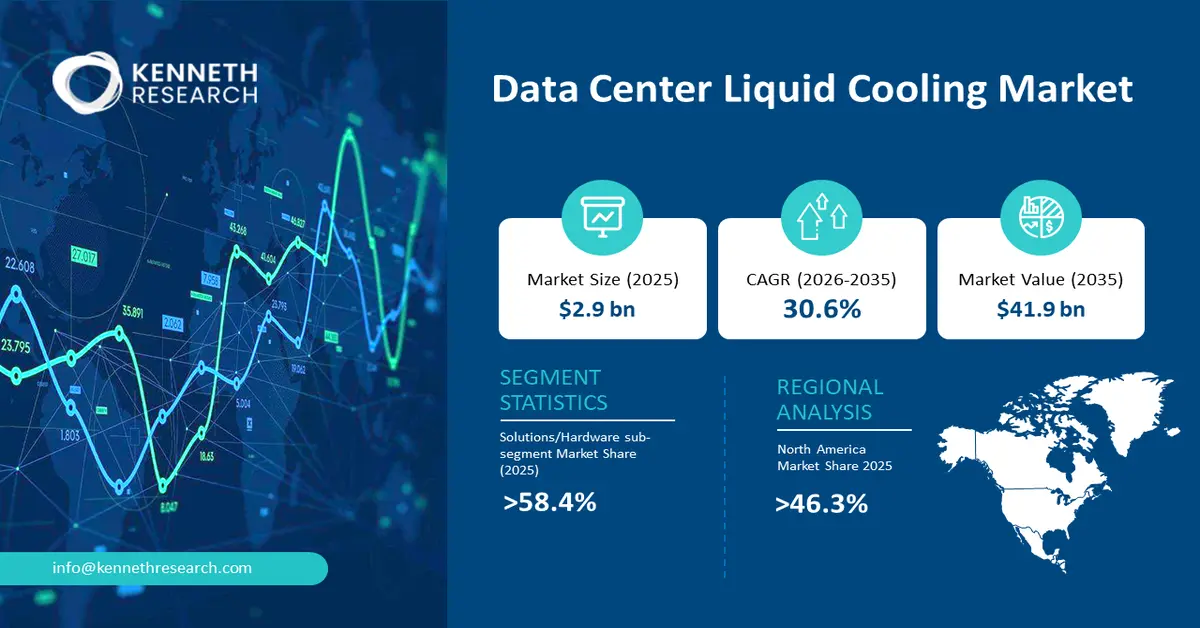
Data Center Liquid Cooling Market size was valued at USD 2.9 billion in 2025 and is projected to reach USD 41.9 billion by the end of 2035, rising at a CAGR of 30.6% during the forecast period, i.e., 2026-2035. In 2026, the industry size of data center liquid cooling is estimated at USD 3.8 billion.
The primary growth driver is the rapid expansion of electricity demand from data centers, particularly as AI workloads increase computing intensity and thermal loads. The IEA projects global data-center electricity consumption to reach around 945 TWh by 2030, reinforcing demand for more effective thermal-management technologies capable of supporting increasingly power-dense computing infrastructure.
The data center liquid cooling market comprises technologies, equipment, components, and associated systems designed to remove heat generated by servers, processors, accelerators, and other information-technology equipment using liquid-based heat-transfer mechanisms. Unlike conventional approaches that primarily move heat through conditioned air, liquid cooling transfers heat from IT equipment into a circulating liquid loop for subsequent heat rejection.
Key technologies include direct-to-chip cooling using cold plates, immersion cooling, heat exchangers, coolant distribution units, pumps, manifolds, and associated control and thermal-management infrastructure. Depending on system architecture, cooling may use water-based coolants, dielectric fluids, or other engineered fluids. Direct liquid cooling can be integrated with existing data-center thermal infrastructure while providing a dedicated path for removing heat from IT equipment.
Key Data Center Liquid Cooling Market Insights Summary:
Key Takeaways: Market Trends & Insights
- Data center liquid cooling market was valued at USD 2.9 billion in 2025 and is projected to reach USD 41.9 billion by 2035 at a CAGR of 30.6%
- Solutions/Hardware led the Component segment with a 58.4% market share in 2025
- Direct-to-Chip (Cold Plate) is projected to be the fastest-growing cooling type
- North America dominated with a 46.3% market share in 2025
- Asia Pacific remains a key secondary region, led by opportunities in China and Japan
Market Drivers
- AI and high-performance computing heat loads
- Energy-efficiency requirements for data-center thermal management
- Rising rack power density and demand for higher compute performance
- Expansion of hyperscale, cloud, and colocation data-center infrastructure
Challenges
- Retrofit complexity and infrastructure compatibility
- Leak risk, reliability, and specialized operations
Data Center Liquid Cooling Market Overview & Supply Chain
Global adoption of data center liquid cooling is increasing as computing infrastructure becomes more energy-intensive and conventional air-cooling architectures face greater thermal-management demands. Liquid-based systems provide a more direct heat-transfer pathway from high-performance IT equipment to facility cooling infrastructure, making them increasingly relevant for AI, high-performance computing, cloud services, and other compute-intensive applications. The technology also supports broader data-center efficiency objectives because liquid can transport heat more effectively than air, while advanced configurations can facilitate heat recovery and lower dependence on mechanical air movement.
The data center liquid cooling market value chain begins with raw-material and input suppliers providing metals, polymers, thermal-interface materials, pumps, valves, heat exchangers, coolants, sensors, control components, and specialized electronic assemblies. Component manufacturers then engineer and produce cold plates, coolant distribution units, immersion systems, manifolds, heat-rejection equipment, monitoring hardware, and integrated cooling platforms. System integrators combine these elements with facility-level electrical, mechanical, and control infrastructure, tailoring configurations to rack architecture and operating requirements. Distribution occurs through direct manufacturer relationships, specialized data-center equipment suppliers, engineering firms, and channel partners. End users include hyperscale and colocation operators, cloud-service providers, enterprise data centers, telecommunications organizations, research institutions, and high-performance computing facilities.
Data Center Liquid Cooling Market: Growth Drivers & Challenges
Growth Drivers:
- Rising AI and high-performance computing heat loads: The rapid deployment of AI and accelerated computing is increasing thermal-management requirements inside data centers. High-performance processors concentrate substantially more heat within server racks, creating operating conditions where conventional air-based cooling becomes increasingly difficult to apply efficiently. Liquid cooling addresses this challenge by transferring heat closer to the processor through cold plates or other liquid-based architectures, allowing operators to support higher compute density while maintaining thermal stability. Government-backed research is reinforcing technology development: the U.S. Department of Energy’s COOLERCHIPS program awarded projects specifically targeting advanced liquid and immersion cooling, including an HP project developing a liquid-cooling solution and an Intel Federal project adapting two-phase immersion cooling.
- Increasing pressure for energy-efficient thermal management: Energy efficiency is becoming a central design consideration as data-center operators seek to control the electricity requirements associated with computing and cooling infrastructure. Liquid cooling can improve thermal-transfer efficiency by moving heat directly from high-temperature components into a liquid circuit rather than relying exclusively on room-level air movement. This enables warmer coolant supply temperatures in some architectures and can expand opportunities for efficient heat rejection and free cooling. The Lawrence Berkeley National Laboratory’s Center of Expertise for Data Center Efficiency identifies liquid cooling as valuable for reducing cooling-system energy consumption and notes that transferring heat closer to its source can improve cooling efficiency.
Challenges:
- Retrofit complexity and infrastructure compatibility: The principal restraint is the difficulty of integrating liquid-cooling infrastructure into data centers originally engineered around air cooling. Direct-to-chip systems require changes across server hardware, coolant distribution, piping, heat rejection, controls, monitoring, and maintenance procedures. Existing facilities may lack suitable space, hydraulic capacity, or connection points, making retrofits more disruptive than deploying liquid cooling in purpose-built facilities. This creates commercial friction because operators must balance cooling upgrades against uptime requirements and the replacement cycles of IT equipment. The challenge is particularly relevant where facilities need hybrid architectures, because liquid and air cooling must operate reliably together. In the longer term, standardized rack interfaces, modular cooling equipment, and better retrofit engineering practices can reduce integration complexity.
- Leak risk, reliability, and specialized operations: Liquid cooling introduces operational risks that are less prominent in conventional air-cooled environments, particularly around coolant containment, component connections, monitoring, and maintenance. A leak can threaten sensitive electronic equipment and potentially create an availability incident, increasing the importance of leak detection, isolation procedures, redundancy, and disciplined servicing. The commercial consequence extends beyond equipment expenditure because operators must account for specialized commissioning, staff capabilities, maintenance protocols, and risk-management processes. These requirements can complicate procurement decisions when buyers compare liquid-cooling systems from different vendors or integrate equipment across heterogeneous data-center environments. Future adoption will depend on improving reliability engineering, standardized interfaces, monitoring capabilities, and service procedures.
Data Center Liquid Cooling Market Size and Forecast:
| Report Attribute | Details |
|---|---|
| Base Year |
2025 |
| Forecast Period |
2026-2035 |
| CAGR |
30.6% |
| Base Year Market Size (2025) |
USD 2.9 billion |
| Forecast Year Market Size (2035) |
USD 41.9 billion |
| Regional Scope |
|
Data Center Liquid Cooling Market - Segment Analysis
Component Segment Analysis
In the component segment, the solutions/hardware sub-segment is anticipated to capture the largest market share of 58.4% by the end of 2025.
Solutions/hardware dominates the component category because liquid cooling deployment ultimately depends on physical equipment capable of capturing, circulating, transferring, and rejecting heat. Demand is being reinforced by the transition toward high-performance computing and AI infrastructure, where greater thermal intensity requires purpose-built cooling assemblies rather than reliance solely on room-level air management. The U.S. Department of Energy’s data-center design guidance identifies cold plates and immersion systems as direct-liquid-cooling technologies and notes that high-performance computing facilities have been early adopters because of increasing rack power densities. This supports continued demand for cold plates, coolant distribution units, heat exchangers, pumps, manifolds, and associated controls.
Type of Cooling Segment Analysis
The direct-to-chip (Cold Plate) is projected to grow as the second-largest segment in the data center liquid cooling market due to four converging demand drivers.
Direct-to-chip cooling using cold plates is projected to grow rapidly because it provides a targeted thermal pathway between high-power processors and the liquid-cooling loop, making it particularly suitable for AI and high-performance computing deployments. Current demand is being driven by increasing computational intensity and the need to accommodate heat generated directly at processors without relying solely on room-level air cooling. The U.S. Department of Energy states that data centers could consume up to 9% of total U.S. electricity demand by 2030, with the largest growth associated with AI capabilities and scaling AI applications. Supply-side development is also advancing, with government-supported R&D targeting chip-level liquid cooling architectures.
Our in-depth analysis of the global data center liquid cooling market includes the following segments:
|
Segment |
Sub-segment |
|
Component |
|
|
Type of Cooling |
|
|
Data Center Type |
|
|
Enterprise Size |
|
|
End-Use Industry |
|
Data Center Liquid Cooling Market Regional Insights:
North America Market Trends & Insights:
North America data center liquid cooling market is projected to hold the largest revenue share of 46.3% by the end of 2025.
North America maintains its leading position in the data center liquid cooling market, supported by a mature hyperscale and colocation ecosystem, strong AI infrastructure investment, advanced semiconductor and server supply chains, and a concentration of high-performance computing deployments. The region benefits from substantial technology investment and an established data-center engineering base, creating favorable conditions for direct-to-chip, cold-plate, and other liquid-cooling architectures. The supplied market-share figure is retained as ground-truth but is not repeated here because it has already been consumed under the collateral’s non-repetition rule. U.S. federal policy is also reinforcing infrastructure expansion.
The United States represents the region’s principal demand center, with large-scale AI, cloud, hyperscale, and colocation deployments driving requirements for higher-density thermal management.
Canada provides a complementary growth base, supported by clean electricity availability, cooler climatic conditions, and government-backed AI-compute initiatives.
Asia Pacific Market Trends & Insights:
Asia Pacific is emerging as a significant growth region for data center liquid cooling as cloud computing, AI infrastructure, digital services, and high-performance computing expand across major technology economies. Increasing deployment of power-dense computing is encouraging operators to evaluate liquid-based thermal management alongside conventional cooling architectures. Industrial activity is supported by expanding domestic server ecosystems, telecommunications infrastructure, and local data-center development. Government initiatives are also strengthening the technology environment. In China, the national standards authority initiated work on technical specifications for data-center cold-plate liquid-cooling systems, covering system design and implementation requirements.
China is a major regional opportunity because its expanding intelligent-computing infrastructure is encouraging deployment of liquid-cooled servers and domestic cooling technologies. Standardization efforts can improve interoperability and deployment confidence.
Japan offers a complementary opportunity through advanced computing, telecommunications, research infrastructure, and government emphasis on resilient data-center development.
Leading Companies Operating in the Global Data Center Liquid Cooling Market:
Here is a list of upstream, downstream, and key players operating in the global data center liquid cooling market competitive ecosystem:
- Vertiv (United States)
- Company Overview
- Business Strategy
- Key Product Offerings
- Financial Performance
- Key Performance Indicators
- Risk Analysis
- Recent Development
- Regional Presence
- SWOT Analysis
- Schneider Electric (France)
- Johnson Controls (United States)
- Shenzhen Envicool Technology (China)
- Super Micro Computer (United States)
- Rittal (Germany)
Recent Developments
- In April 2026, Vertiv acquired Strategic Thermal Labs (STL), a specialist in advanced liquid-cooling technologies, strengthening its engineering capability at the interface between server-side liquid cooling and supporting infrastructure. The acquisition enhances Vertiv's cold-plate design, server-side liquid cooling, and high-density thermal validation expertise for AI and high-performance computing environments.
- In November 2025, Shenzhen Envicool Technology partnered with Intel and other ecosystem players to launch the first dual-sided all-area liquid cold plate server at Intel Connection 2025 in Chongqing, China. The solution delivers 100% liquid cooling coverage for all major server heat sources—including CPU, memory, and SSD—with total heat dissipation exceeding 2 kW, eliminating system hotspots and fully meeting cooling requirements for processors with TDP levels up to 650W.
Frequently Asked Question
In 2025, the data center liquid cooling market exceeded USD 2.9 billion.
The data center liquid cooling market is projected to reach USD 41.9 billion by the end of 2035, expanding at a CAGR of 30.6% over the forecast period (2026-2035).
The major players in the market are Vertiv, Schneider Electric, Johnson Controls, Shenzhen Envicool Technology, Super Micro Computer, Rittal, and others.
In the component segment, the Solutions/Hardware sub-segment is anticipated to capture the largest market share of 58.4% in the future and exhibit lucrative growth opportunities during 2026-2035. This growth trajectory is largely attributed to increasing demand for physical cooling equipment to support high-performance computing and AI infrastructure.
North America is projected to hold the largest market share of 46.3% by the end of 2025 and provide more business opportunities in the future. Continuous investments in AI, cloud, hyperscale, and high-performance computing infrastructure across the United States and Canada are fostering the region's dominance.
Why Choose Kenneth Research ?
-
Insight with Impact : We don’t just gather data — we uncover stories, trends, and opportunities that fuel business growth.
-
Experts Who Get It : Our team speaks your industry’s language and knows what really matters to your customers and market.
-
Custom-Built for You : Forget one-size-fits-all. We craft research and consulting solutions as unique as your business vision.
-
Partners, Not Just Providers : We work with you, not for you — collaborating closely to turn insights into smart, strategic moves.
-
Results That Speak : Our work powers brands, startups, and industry leaders alike — with a track record of ideas that work in the real world.
Report ID: 1219 |
Published Date: 31 Aug 2026 |
Report Format: |
Delivery Timeline: 48-72 Business Hours

Copyright © 2025 Kenneth Research. All rights reserved. Terms of Use | Privacy Policy
