Report ID: 1253 |
Published Date: 01 Sep 2026 |
Report Format: |
Delivery Timeline: 48-72 Business Hours
Chemical Sensors Market Outlook:
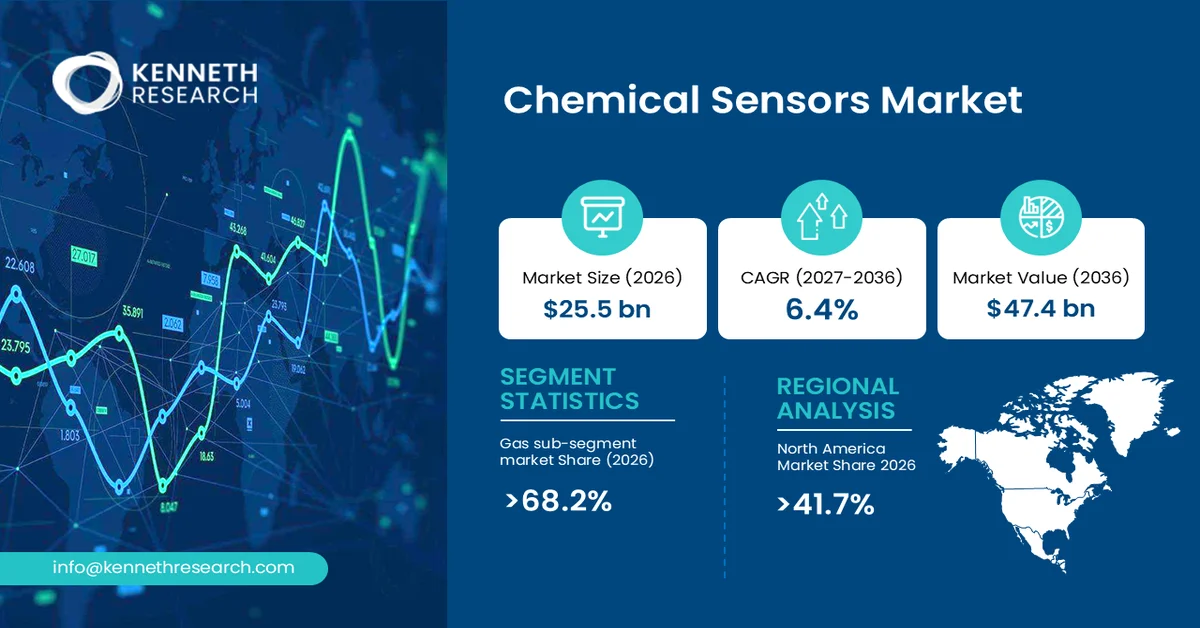
Chemical Sensors Market size was valued at USD 25.5 Billion in 2026 and is projected to reach USD 47.4 Billion by the end of 2036, rising at a CAGR of 6.4% during the forecast period, i.e., 2027–2036. In 2027, the industry size of the chemical sensors is estimated at USD 27.1 Billion.
The primary growth driver for the chemical sensors market is the increasing need for real-time detection of gases and chemical substances across environmental monitoring, industrial safety, process control, healthcare, aerospace, and security applications.
The chemical sensors market comprises devices and sensing systems designed to detect, identify, or quantify specific chemical substances by converting chemical interactions into measurable electrical, optical, thermal, mechanical, or other analytical signals. A chemical sensor generally combines a recognition element that interacts selectively with a target analyte and a transducer that converts this interaction into a usable output.
Chemical sensors can detect substances present in gas, liquid, or other sample environments and are characterized by sensitivity, selectivity, response time, detection limit, stability, size, and power requirements. Major technologies include electrochemical, optical, semiconductor, catalytic, and other sensing mechanisms.
Key Chemical Sensors Market Insights Summary:
Key Takeaways: Market Trends & Insights
- Chemical Sensors Market projected to grow from USD 25.5 Billion in 2026 to USD 47.4 Billion by 2036 at a 6.4% CAGR.
- North America accounted for the largest regional share at 41.7% in 2025, supported by strong industrial safety requirements, environmental monitoring infrastructure, advanced sensing capabilities, and chemical detection applications across the U.S. and Canada.
- Gas is expected to remain the leading Particle Type segment with a 68.2% market share in 2035, supported by increasing requirements for hazardous-gas detection, emissions monitoring, industrial safety, and real-time environmental monitoring.
- Electrochemical technology is positioned for continued growth because of its sensitivity, low-power operation, and suitability for detecting specific gases and chemical substances across industrial, environmental, healthcare, and safety applications.
Market Drivers
- Rising demand for real-time chemical and environmental monitoring.
- Increasing adoption of electrochemical sensing technologies.
- Growing deployment of connected and miniaturized chemical sensors.
- Increasing demand for industrial safety, process-control, and hazardous-gas detection systems.
Challenges
- Sensor accuracy, selectivity, and calibration requirements.
- Lack of standardization and data-quality concerns.
Chemical Sensors Market Overview & Supply Chain
Chemical sensor adoption is increasing globally because industries and public agencies require faster, on-site measurement of gases, vapors, and other chemical substances for environmental monitoring, workplace safety, process control, and healthcare applications. The U.S. National Institute of Standards and Technology (NIST) identifies chemical and biochemical microsensors as important for rapid, sensitive, and selective on-site measurements across environmental monitoring and manufacturing process control.
The chemical sensors market value chain begins with sensing materials and specialized input components, including electrodes, catalysts, semiconducting materials, polymers, membranes, nanomaterials, optical components, substrates, and electronic circuitry. These inputs are supplied to sensor manufacturers that develop the sensing element, transducer, signal-conditioning electronics, packaging, calibration systems, and associated software. Manufacturing involves material deposition, electrode formation, sensor assembly, encapsulation, calibration, testing, and quality assurance. Finished sensors may be integrated into portable detectors, fixed monitoring systems, industrial analyzers, environmental-monitoring equipment, medical devices, and connected sensing platforms. Distribution occurs through direct sales, specialized instrumentation suppliers, industrial automation channels, and technology integrators.
Chemical Sensors Market: Growth Drivers & Challenges
Growth Drivers
- Rising demand for real-time chemical and environmental monitoring: The increasing need for rapid, localized, and continuous detection of chemical substances is accelerating chemical sensor adoption across environmental monitoring, industrial process control, occupational safety, healthcare, and security applications. Unlike laboratory-based analytical methods that can require sample preparation and centralized testing, chemical sensors can provide measurements directly at or near the point of use. NIST highlights the growing need for reliable sensor-based technologies capable of delivering actionable chemical and biochemical measurements on-site, including applications in environmental monitoring and manufacturing process control.
- Increasing adoption of electrochemical sensing technologies: The expanding use of electrochemical sensing is supporting chemical sensor adoption because these technologies can deliver sensitive detection while enabling compact instrumentation and relatively straightforward electronic integration. Electrochemical sensors are applicable across industrial safety, environmental protection, healthcare, food safety, automotive systems, and process monitoring. Government-backed research in India is also advancing electrochemical sensing capabilities: in 2024, the Ministry of Science & Technology reported the development of novel electrochemical and optical sensors using metal-organic frameworks and two-dimensional materials for rapid detection of health, food-quality, and environmental parameters.
Challenges
- Sensor accuracy, selectivity, and calibration requirements: A major restraint for the chemical sensors market is the difficulty of maintaining reliable accuracy and selectivity under real-world operating conditions. Chemical sensors can experience interference from humidity, temperature fluctuations, cross-sensitive compounds, sensor aging, and changes in the surrounding environment. These factors can produce inconsistent measurements and increase the need for calibration, compensation algorithms, and periodic maintenance. The U.S. Government Accountability Office noted that lower-cost air-quality sensors can be useful for real-time monitoring, but their deployment and data interpretation require appropriate expertise and that additional capabilities remain under development.
- Lack of standardization and data-quality concerns: The increasing deployment of chemical and air sensors is creating challenges around standardized performance evaluation, data quality, and comparability between devices. Different sensor technologies can exhibit variations in sensitivity, selectivity, response behavior, calibration requirements, and environmental performance, making it difficult for end users to compare measurements across manufacturers or integrate heterogeneous sensor networks. For manufacturers, compliance with evolving performance expectations can increase testing and certification requirements, while users may face additional costs for validation and data-quality management.
Chemical Sensors Market Size and Forecast:
| Report Attribute | Details |
|---|---|
| Base Year |
2026 |
| Forecast Period |
2027-2036 |
| CAGR |
6.4% |
| Base Year Market Size (2026) |
USD 25.5 billion |
| Forecast Year Market Size (2036) |
USD 47.4 billion |
| Regional Scope |
|
Chemical Sensors Market Segmentation Analysis:
Particle Type Segment Analysis
In the Particle Type segment, the Gas sub-segment is anticipated to capture the largest market share of 68.2% in 2026. Its dominance is supported by extensive demand for detecting hazardous, toxic, combustible, and environmentally significant gases across industrial safety, emissions monitoring, process control, environmental surveillance, and healthcare applications. Gas sensors provide continuous, on-site monitoring that can identify chemical hazards before they escalate into operational or safety incidents.
Government activity is reinforcing this demand. In February 2024, the U.S. Environmental Protection Agency announced funding to expand and upgrade air-quality monitoring networks and specifically support deployment and operation of air-quality sensors in underserved communities. On the supply side, manufacturers are developing increasingly selective, compact, low-power, and connected gas-sensing platforms using electrochemical, semiconductor, infrared, and other technologies.
Technology Segment Analysis
In the Technology segment, the Electrochemical sub-segment is projected to witness strong growth during the forecast period. Electrochemical sensors are increasingly adopted because they can provide sensitive, rapid, and continuous detection while supporting compact device designs and relatively low-power operation. Their applicability across gas detection, environmental monitoring, industrial safety, healthcare diagnostics, and process control broadens the addressable demand base.
Industry adoption is also being supported by advances in electrode materials, miniaturization, and integration with connected monitoring platforms. Government-backed research is contributing to this technology development; India's Department of Science and Technology has highlighted electrochemical sensor innovations using advanced materials for environmental, food-quality, and health-related detection applications.
Our in-depth analysis of the global chemical sensors market includes the following segments:
|
Segment |
Sub-segment |
|
Product Type |
|
|
Technology |
|
|
Particle Type |
|
|
Application |
|
|
End-use Industry |
|
Chemical Sensors Market Regional Insights:
North America Trends & Insights:
North America accounted for 41.7% of the chemical sensors market in 2026, making it the dominant regional market. Regional leadership is supported by strong industrial activity, stringent workplace and environmental monitoring requirements, advanced healthcare infrastructure, and established chemical, petrochemical, manufacturing, and aerospace industries. The U.S. has a mature ecosystem of sensor manufacturers and industrial instrumentation providers, while Canada is strengthening environmental monitoring and advanced technology capabilities. Regulatory emphasis on hazardous-gas detection and air-quality monitoring also supports sustained sensor demand across industrial and public-sector applications. The U.S. EPA continues to develop performance targets and testing protocols for air sensors, encouraging more reliable deployment of sensor technologies for air-quality applications.
U.S. represents the principal regional market, supported by extensive chemical processing, oil and gas, manufacturing, healthcare, and environmental-monitoring activities. The country also has a strong technology base for electrochemical, optical, semiconductor, and connected sensing systems.
Canada offers additional opportunities through resource extraction, energy, chemical processing, environmental monitoring, and industrial safety applications. Demand for reliable gas and chemical detection is supported by the country's industrial operating environments and emphasis on worker and environmental protection.
Asia-Pacific Trends & Insights:
Asia-Pacific represents an important growth market for chemical sensors, supported by expanding manufacturing activity, environmental monitoring requirements, industrial safety needs, healthcare applications, and increasing deployment of connected sensing technologies. Governments across the region are strengthening chemical and environmental monitoring capabilities, creating opportunities for gas detection, electrochemical sensing, air-quality monitoring, and industrial process-control solutions.
Japan offers strong opportunities through its advanced automotive, electronics, semiconductor, healthcare, and industrial-automation industries. The country's emphasis on environmental chemical monitoring and precision technologies supports demand for accurate and reliable chemical-sensing solutions. Japan's Ministry of the Environment maintains ongoing chemical-environment monitoring programs covering multiple chemical substances.
China provides substantial opportunities because of its large manufacturing base, energy and chemical industries, environmental-management requirements, and expanding industrial automation. Growing demand for emissions monitoring, workplace safety, and process control supports deployment of gas and electrochemical sensors.
Leading Companies Operating in the Global Chemical Sensors Market:
Here is a list of upstream, downstream, and key players operating in the global chemical sensors market competitive ecosystem:
- Honeywell International Inc. (United States)
- Company Overview
- Business Strategy
- Key Product Offerings
- Financial Performance
- Key Performance Indicators
- Risk Analysis
- Recent Development
- Regional Presence
- SWOT Analysis
- Siemens AG (Germany)
- Emerson Electric Co. (United States)
Recent Developments
- May 2025: Honeywell announced its new Hydrogen Leak Detector (HLD) sensor, designed to identify microscopic hydrogen leaks in real time using thermal-conductivity detection technology.
- March 2025: Figaro Engineering updated its product information for the TGS1820 acetone gas sensor, highlighting its high sensitivity to acetone, low interference from ethanol and hydrogen, compact size, and low power consumption.
Frequently Asked Question
In 2026, the chemical sensors market exceeded USD 25.5 billion.
The chemical sensors market is projected to reach USD 47.4 billion by the end of 2036, expanding at a CAGR of 6.4% over the forecast period (2027–2036).
The major players in the market are Honeywell International Inc., Siemens AG, Emerson Electric Co., Thermo Fisher Scientific Inc., Figaro Engineering Inc., Drägerwerk AG & Co. KGaA, and others.
In the Particle Type segment, the Gas sub-segment is anticipated to capture the largest market share of 68.2% in the future and exhibit lucrative growth opportunities during 2027–2036.
North America is projected to hold the largest market share of 41.7% by the end of 2036 and provide more business opportunities in the future.
Why Choose Kenneth Research ?
-
Insight with Impact : We don’t just gather data — we uncover stories, trends, and opportunities that fuel business growth.
-
Experts Who Get It : Our team speaks your industry’s language and knows what really matters to your customers and market.
-
Custom-Built for You : Forget one-size-fits-all. We craft research and consulting solutions as unique as your business vision.
-
Partners, Not Just Providers : We work with you, not for you — collaborating closely to turn insights into smart, strategic moves.
-
Results That Speak : Our work powers brands, startups, and industry leaders alike — with a track record of ideas that work in the real world.
Report ID: 1253 |
Published Date: 01 Sep 2026 |
Report Format: |
Delivery Timeline: 48-72 Business Hours

Copyright © 2025 Kenneth Research. All rights reserved. Terms of Use | Privacy Policy
