Report ID: 1224 |
Published Date: 31 Aug 2026 |
Report Format: |
Delivery Timeline: 48-72 Business Hours
Carbon Capture and Storage Market Outlook:
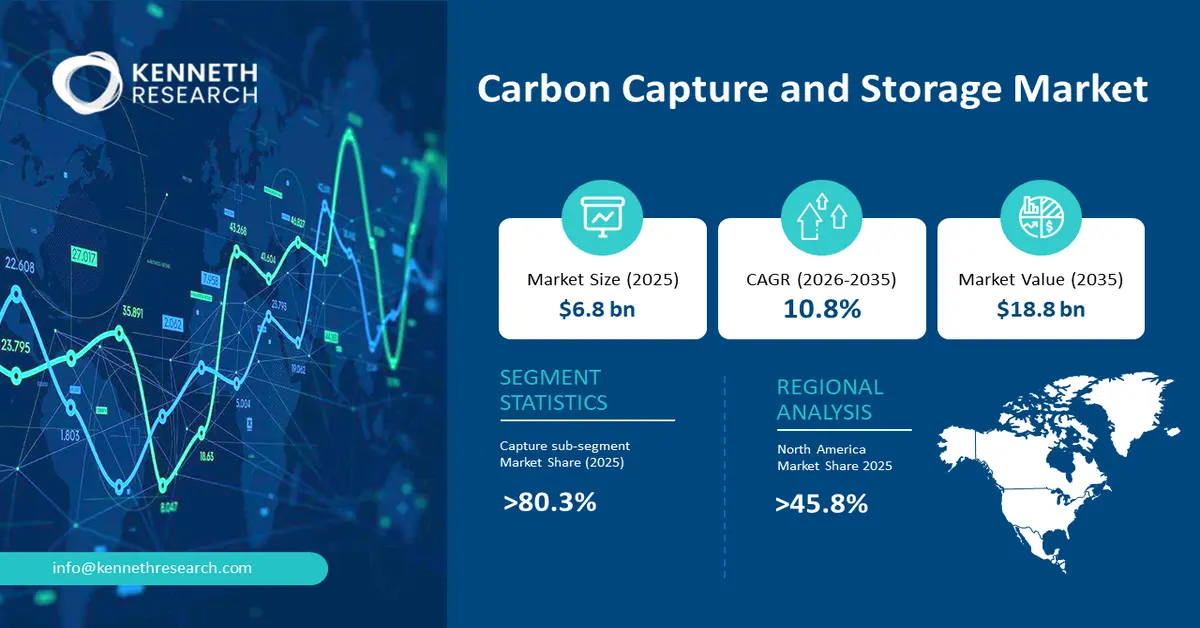
Carbon Capture and Storage Market size was valued at USD 6.8 billion in 2025 and is projected to reach USD 18.8 billion by the end of 2035, rising at a CAGR of 10.8% during the forecast period, i.e., 2026-2035. In 2026, the industry size of the carbon capture and storage is estimated at USD 7.5 billion.
The primary growth driver for the carbon capture and storage market is the accelerating decarbonization of hard-to-abate industries, including cement, steel, refining, chemicals, and hydrogen production.
The carbon capture and storage (CCS) market encompasses technologies and services used to capture carbon dioxide emissions from industrial facilities and power-generation sources, transport the captured CO₂, and permanently store it in suitable geological formations.
Key characteristics of CCS include point-source emissions capture, CO₂ compression and conditioning, dedicated transportation infrastructure, geological storage-site development, monitoring, and long-term storage management. Capture technologies can be deployed across sectors such as cement, steel, hydrogen, fertilizer, natural gas processing, and refining.
Key Carbon Capture and Storage Market Insights Summary:
Key Takeaways: Market Trends & Insights
- Carbon Capture and Storage Market projected to grow from USD 6.8 billion in 2025 to USD 18.8 billion by 2035 at a 10.8% CAGR.
- North America accounted for the largest regional share at 45.8% in 2025, supported by strong industrial decarbonization initiatives, established CO₂ infrastructure, and policy support across the U.S. and Canada.
- Capture is expected to remain the leading Service segment with an 80.3% market share, driven by increasing deployment of carbon-capture systems across hard-to-abate industrial sectors.
- Post-Combustion Capture is projected to witness strong adoption as its retrofit compatibility allows existing industrial and power facilities to reduce CO₂ emissions without completely replacing established production infrastructure.
Market Drivers
- Government support for industrial carbon capture deployment
- Growing decarbonization requirements in hard-to-abate industries
- Expansion of shared CO₂ transportation and storage infrastructure
- Advancement of capture technologies and integrated carbon-management hubs
Challenges
- Complex permitting and regulatory processes
- High infrastructure costs and storage availability
Carbon Capture and Storage Market Overview & Supply Chain
Global adoption of carbon capture and storage is increasing as governments and industries pursue emissions reductions in sectors where direct electrification and fuel switching remain difficult. CCS is particularly relevant to cement, steel, chemicals, hydrogen, natural gas processing, refining, and power generation, where capturing CO₂ at concentrated emission sources can complement other decarbonization measures. The International Energy Agency reports that more than 30 final investment decisions for CCUS projects were reached during the two years to 2026, demonstrating strengthening investment momentum across transport and storage, industry, and power applications.
The carbon capture and storage value chain begins with technology and equipment inputs, including solvents, sorbents, membranes, compressors, separation systems, pipelines, monitoring equipment, and geological-site development services. Capture technology providers and engineering companies design and install systems that separate CO₂ from industrial exhaust streams before compression and conditioning. Transport operators then move captured CO₂ through dedicated pipelines, shipping networks, or other specialized infrastructure to designated storage locations. Storage developers characterize geological formations, develop injection infrastructure, and implement monitoring systems to ensure secure containment.
Carbon Capture and Storage Market: Growth Drivers & Challenges
Growth Drivers:
- Government support for industrial carbon capture deployment: Government funding and policy support are accelerating carbon capture deployment by reducing the financial and technological barriers associated with first-of-a-kind industrial projects. Carbon capture is particularly important for cement, steel, chemicals, refining, and other sectors where process emissions and high-temperature operations make conventional electrification difficult. In 2024, the U.S. Department of Energy announced USD 8 million in federal funding for 14 projects focused on advancing carbon-capture technologies for industrial facilities and power plants.
- Growing decarbonization requirements in hard-to-abate industries: Increasing pressure to reduce industrial greenhouse-gas emissions is strengthening demand for carbon capture and storage as a complementary decarbonization pathway. Heavy industries such as cement, steel, chemicals, refining, and hydrogen production generate emissions that can be difficult to eliminate through renewable electricity, efficiency improvements, or fuel switching alone. Carbon capture allows these facilities to address concentrated CO₂ emissions while maintaining existing industrial processes and infrastructure. The technology is particularly relevant where process chemistry itself generates carbon dioxide, making emissions reduction through conventional energy substitution insufficient.
Challenges:
- Complex permitting and regulatory processes: Complex permitting requirements remain a significant restraint on carbon capture and storage deployment, particularly for CO₂ pipelines and geological storage facilities. Projects often cross multiple jurisdictions and require coordination among environmental, land, pipeline, and subsurface regulators. These processes can extend development timelines, increase planning costs, and create uncertainty around project commissioning. The International Energy Agency identifies lengthy permitting procedures as a major barrier to CCUS expansion and recommends clearer approval timelines and coordinated regulatory frameworks.
- High infrastructure costs and storage availability: The capital intensity of CO₂ transportation and geological storage creates another major challenge for market development. Capture facilities require dependable access to transportation networks and suitable storage sites, but infrastructure must often be developed before sufficient volumes of captured CO₂ are available. This creates a coordination problem between emitters, pipeline operators, storage developers, and investors. The IEA identifies transport and storage infrastructure as capital-intensive and notes that uncertain future demand can increase project risk.
Carbon Capture and Storage Market Size and Forecast:
| Report Attribute | Details |
|---|---|
| Base Year |
2025 |
| Forecast Period |
2026-2035 |
| CAGR |
10.8% |
| Base Year Market Size (2025) |
USD 6.8 billion |
| Forecast Year Market Size (2035) |
USD 18.8 billion |
| Regional Scope |
|
Carbon Capture and Storage Market Segmentation Analysis:
Service Segment Analysis
In the Service segment, the Capture sub-segment is anticipated to capture the largest market share of 80.3% by the end of 2025.
Its dominance is driven by the central role of CO₂ capture in the CCS value chain, particularly across hard-to-abate industries such as cement, steel, refining, chemicals, and hydrogen production. Demand is increasing as industrial operators seek to reduce emissions while maintaining existing production processes. The U.S. Department of Energy identifies carbon capture as an important decarbonization pathway for industries with high-temperature and high-pressure operations that are difficult to electrify.
Technology Type Segment Analysis
The Post-Combustion Capture technology segment is projected to grow as industrial operators seek practical retrofit solutions for reducing CO₂ emissions from existing combustion-based facilities. The technology separates carbon dioxide from flue gas after fuel combustion, allowing capture equipment to be integrated with established power and industrial assets without completely redesigning the underlying production process. Adoption is supported by demand from cement, steel, refining, chemicals, and power-generation facilities where existing infrastructure represents a substantial long-term investment. On the supply side, technology developers are advancing solvents, membranes, process configurations, and energy-efficiency improvements to reduce the operational burden of capture systems. The U.S. Department of Energy's NETL is supporting engineering-scale testing of post-combustion capture technology at an industrial iron and steel facility, demonstrating continued government-backed development of retrofit-oriented solutions.
Our in-depth analysis of the global carbon capture and storage market includes the following segments:
|
Segment |
Sub-segment |
|
Service |
|
|
Technology |
|
|
Application |
|
|
Capture Source |
|
|
Storage Type |
|
Carbon Capture and Storage Market Regional Insights:
North America Market Trends & Insights:
North America is the dominant region in the carbon capture and storage market, accounting for 45.8% in 2025.
Regional leadership is supported by extensive industrial activity, established oil and gas infrastructure, substantial geological storage potential, and strong policy support for carbon-management projects. The U.S. has developed a broad ecosystem spanning carbon-capture technology, CO₂ transportation, geological storage, engineering, and project development, while Canada is advancing integrated carbon-management projects through federal and provincial incentives. The U.S. Congressional Budget Office identifies federal financial support as a key factor encouraging CCS development and notes the growing role of policy in determining future deployment.
The U.S. remains the principal contributor, supported by its large industrial base, established CO₂ infrastructure, and federal programs targeting carbon capture, transportation, and storage. Government support is encouraging commercial-scale projects across industrial and energy-intensive sectors.
Canada is strengthening its position through regulatory and fiscal measures supporting carbon-management infrastructure. The Canadian government has highlighted the Polaris Carbon Capture and Atlas Carbon Storage Hub projects in Alberta as examples of projects progressing with support from the federal CCUS investment tax credit.
Europe Market Trends & Insights:
Asia Pacific represents a strategically important market for carbon capture and storage, supported by large industrial bases, substantial emissions from hard-to-abate sectors, expanding decarbonization programs, and increasing development of CO₂ transportation and geological-storage infrastructure. Governments are strengthening regulatory frameworks and project-development mechanisms to encourage CCS commercialization. Japan, in particular, is establishing a dedicated regulatory framework for CO₂ storage.
Japan is emerging as an important CCS market because of its concentrated industrial emissions, limited domestic geological options, and strong emphasis on cross-border CO₂ transport and storage. Its new regulatory framework is designed to support commercial CCS development from the early 2030s.
China offers substantial long-term potential because of its large industrial and power sectors and growing focus on CCUS technologies. The country's introduction of a national standard for post-combustion CO₂ capture systems further supports technology standardization and industrial deployment.
Leading Companies Operating in the Global Carbon Capture and Storage Market:
Here is a list of upstream, downstream, and key players operating in the global carbon capture and storage market competitive ecosystem:
- Mitsubishi Heavy Industries(Japan)
- Company Overview
- Business Strategy
- Key Product Offerings
- Financial Performance
- Key Performance Indicators
- Risk Analysis
- Recent Development
- Regional Presence
- SWOT Analysis
- SLB Capturi(Norway)
- Air Liquide(France)
- Baker Hughes(United States)
Recent Developments
- December 2025 – Mitsubishi Heavy Industries and Worley announced plans to deliver a full-scale carbon-capture facility for Heidelberg Materials UK’s Padeswood Cement Works following the project’s final investment decision.
- June 2025 –SLB Capturi reported progress on major European carbon-capture projects, including its modular Just Catch™ 400 solution for Hafslund Celsio’s waste-to-energy facility in Oslo.
Frequently Asked Question
In 2025, the carbon capture and storage market exceeded USD 6.8 billion.
The carbon capture and storage market is projected to reach USD 18.8 billion by the end of 2035, expanding at a CAGR of 10.8% over the forecast period (2026–2035).
The major players in the market are Mitsubishi Heavy Industries, SLB Capturi, Carbon Clean, Air Liquide, Baker Hughes, and others.
In the service segment, the capture sub-segment is anticipated to capture the largest market share of 80.3% in the future and exhibit lucrative growth opportunities during 2026–2035. This growth trajectory is largely attributed to increasing demand for emissions reduction solutions across hard-to-abate industries.
North America is projected to hold the largest market share of 45.8% by the end of 2025 and provide more business opportunities in the future. Strong industrial decarbonization initiatives and continued CCS investments across the U.S. and Canada are fostering the region's dominance.
Why Choose Kenneth Research ?
-
Insight with Impact : We don’t just gather data — we uncover stories, trends, and opportunities that fuel business growth.
-
Experts Who Get It : Our team speaks your industry’s language and knows what really matters to your customers and market.
-
Custom-Built for You : Forget one-size-fits-all. We craft research and consulting solutions as unique as your business vision.
-
Partners, Not Just Providers : We work with you, not for you — collaborating closely to turn insights into smart, strategic moves.
-
Results That Speak : Our work powers brands, startups, and industry leaders alike — with a track record of ideas that work in the real world.
Report ID: 1224 |
Published Date: 31 Aug 2026 |
Report Format: |
Delivery Timeline: 48-72 Business Hours

Copyright © 2025 Kenneth Research. All rights reserved. Terms of Use | Privacy Policy
