Report ID: 1450 |
Published Date: 28 Sep 2026 |
Report Format: |
Delivery Timeline: 48-72 Business Hours
Border Security Technologies Market Outlook:
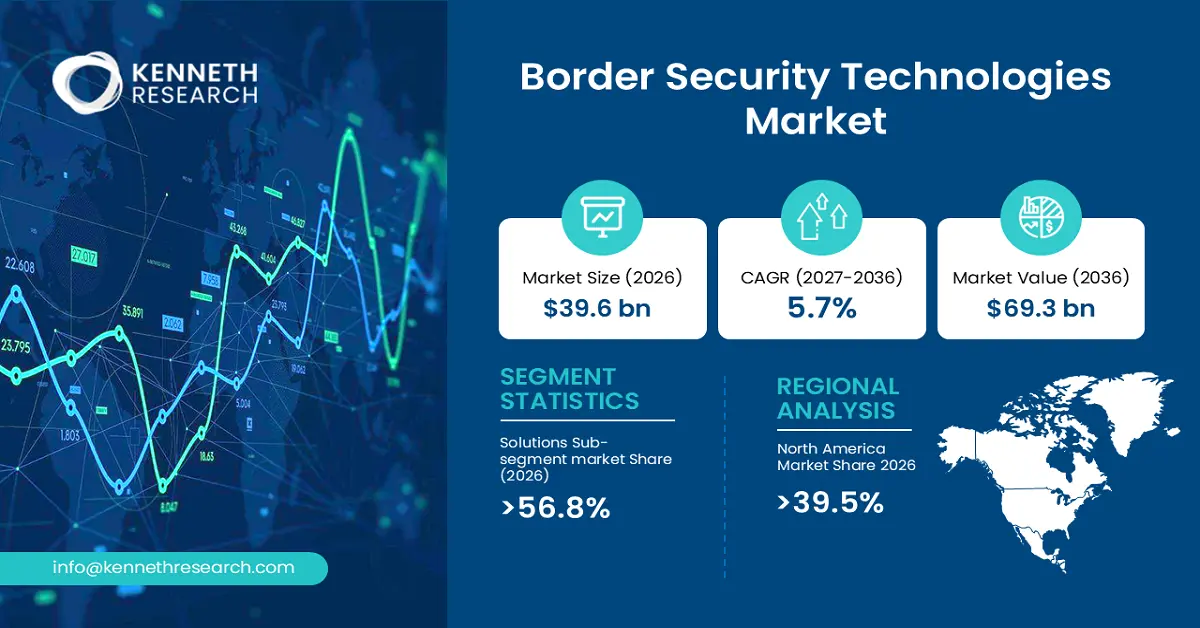
Border Security Technologies Market size was valued at USD 39.6 billion in 2026 and is projected to reach USD 69.3 billion by the end of 2036, rising at a CAGR of 5.7% during the forecast period, i.e., 2027-2036. In 2027, the industry size of the global border security technologies market is estimated at USD 42.1 billion.
The primary growth driver is expansion of sensor-enabled border surveillance. U.S. Border Patrol reported deploying additional camera towers and unattended ground sensors along the northern border through fiscal year 2024, reflecting continued investment in technologies that extend detection, identification, tracking, and situational awareness across difficult terrain and operating environments effectively.
Border security technologies comprise integrated hardware, software, communications, and data-processing capabilities used by government agencies to monitor, detect, identify, track, and respond to activities across international boundaries and at border-crossing environments. The market includes land-based surveillance systems, radar, electro-optical and infrared cameras, unattended ground sensors, autonomous surveillance towers, communications infrastructure, command-and-control platforms, and analytics that combine information from multiple sources.
A defining characteristic is the integration of distributed sensing with centralized or networked operational awareness. Technologies can be fixed, mobile, portable, or autonomous, allowing agencies to adapt surveillance coverage to terrain, weather, traffic patterns, and mission requirements. Modern systems increasingly emphasize automated detection, real-time alerts, data fusion, interoperability, and persistent monitoring.
Key Border Security Technologies Market Insights Summary:
Key Takeaways: Market Trends & Insights
- The border security technologies market is valued at USD 39.6 billion in 2026 and is projected to reach USD 69.3 billion by 2036
- The border security technologies market is expected to expand at a CAGR of 5.7% during 2027-2036
- The Ground Based segment leads the Application category with a 56.8% market share in 2026
- North America dominates the regional landscape with a 39.5% market share in 2026
- Radar Systems is identified as the second and fastest-growing analysis segment within the Systems category
Market Drivers
- Integration of radar, cameras, sensors, unmanned systems, and command-and-control platforms
- Expansion of autonomous surveillance and artificial-intelligence-enabled threat detection
- Modernization of legacy border surveillance infrastructure
- Growing demand for persistent monitoring across remote, complex, and high-risk border environments
Challenges
- High integration complexity across legacy and new systems
- Procurement constraints and lengthy government acquisition cycles
Border Security Technologies Market Overview & Supply Chain
Adoption of border security technologies is increasing as governments seek persistent surveillance, faster threat detection, and greater operational coverage across land, maritime, and remote border environments. Technological advances in radar, electro-optical systems, unattended sensors, autonomous surveillance, communications, and data integration are enabling agencies to supplement personnel with networked monitoring capabilities. Regulatory and operational requirements also encourage modernization as border agencies address cross-border crime, irregular movement, smuggling, and difficult terrain.
The value chain for border security technologies begins with raw-material and component suppliers providing semiconductors, optical assemblies, radar components, radio-frequency equipment, batteries, metals, enclosures, cabling, and computing hardware. Specialized technology developers then engineer and manufacture surveillance platforms, sensors, radar systems, cameras, communications equipment, autonomous systems, and command-and-control software, frequently integrating components from multiple suppliers. System integrators configure hardware, software, communications, analytics, and cybersecurity capabilities into mission-specific architectures and conduct testing, validation, and compliance activities. Distribution typically occurs through direct government procurement, prime contractors, authorized technology partners, and specialized defense and security distributors.
Border Security Technologies Market: Growth Drivers & Challenges
Growth Drivers
- Rising Adoption of Integrated Surveillance and Detection Technologies: Border agencies are increasingly integrating cameras, radar, sensors, unmanned systems, and analytics into coordinated surveillance architectures. This integration allows agencies to detect activity, correlate information from multiple sources, and provide operators with a more continuous view of remote or difficult terrain. The U.S. Government Accountability Office reported in 2026 that U.S. Customs and Border Protection had increased its deployment of surveillance technologies along the northern border, including cameras, radar sites, and sensors.
- Expansion of Autonomous and AI-Enabled Border Monitoring: The increasing use of artificial intelligence, machine learning, autonomous surveillance, and advanced analytics is creating another pathway for market expansion. These technologies can automate portions of detection, classification, tracking, and information processing, helping border agencies manage large volumes of surveillance data. U.S. Border Patrol's strategic planning identifies machine learning, artificial intelligence, and autonomous technologies as tools for improving situational awareness, automating processes, and supporting near-real-time tracking of potential threats.
Challenges
- High Integration Complexity Across Legacy and New Systems: Border agencies often operate heterogeneous technology environments built through successive procurement programs, resulting in different communications protocols, data formats, software architectures, and hardware generations. Integrating new radar, sensors, cameras, unmanned platforms, analytics, and command systems into these environments can require substantial systems engineering and interoperability work. The resulting complexity can lengthen procurement cycles, increase deployment requirements, and create additional testing and cybersecurity obligations for suppliers.
- Procurement Constraints and Lengthy Government Acquisition Cycles: Border security technology purchases are predominantly shaped by government budgeting, acquisition procedures, operational requirements, and lengthy evaluation processes. Large deployments can involve multiple approval stages, technical assessments, field testing, cybersecurity reviews, contracting requirements, and coordination among different agencies. These processes can extend the period between technology development and revenue realization, particularly for suppliers introducing newer surveillance or autonomous capabilities.
Border Security Technologies Market Size and Forecast:
| Report Attribute | Details |
|---|---|
| Base Year |
2026 |
| Forecast Year |
2027-2036 |
| CAGR |
5.7% |
| Base Year Market Size (2026) |
USD 39.6 Billion |
| Forecast Year Market Size (2036) |
USD 69.3 Billion |
| Regional Scope |
|
Border Security Technologies Market Segmentation Analysis:
Application Segment Analysis
In the application segment, ground based sub-segment is anticipated to capture the largest market share of 56.8% by the end of 2026.
The ground-based segment dominates because border agencies require persistent surveillance across terrestrial boundaries, particularly in remote areas where continuous physical patrols are difficult to sustain. Demand is supported by the deployment of fixed and mobile technologies such as camera towers, unattended ground sensors, autonomous surveillance towers, and radar installations. A recent U.S. Government Accountability Office review found that U.S. Border Patrol deployed 28 additional camera towers and 1,450 additional unattended ground sensors along the northern border between the end of fiscal year 2019 and the end of fiscal year 2024. This deployment demonstrates continued agency investment in land-based detection infrastructure.
Systems Segment Analysis
The radar systems is projected to grow as the second-largest segment in the border security technologies market due to four converging demand drivers.
Radar systems are projected to grow as border agencies expand persistent detection capabilities across difficult terrain and areas where continuous physical patrols are challenging. Radar can provide wide-area movement detection and, when integrated with cameras and other sensors, support identification and tracking of potential incursions. U.S. Customs and Border Protection is explicitly incorporating radar into its modernization strategy, alongside autonomous surveillance systems, sensors, aerial platforms, and AI-driven analytics. Supply-side development is increasingly focused on compact, networked, and sensor-integrated radar capable of operating within broader surveillance architectures. This supports demand for systems that can feed real-time information into centralized command environments. Future growth should therefore be supported by modernization programs emphasizing persistent detection, sensor integration, and coverage expansion across remote border environments.
Our in-depth analysis of the Border Security Technologies market includes the following segments:
|
Segment |
Sub-segment |
|
Systems |
|
|
Application |
|
Border Security Technologies Market Regional Insights:
North America Market Trends & Insights:
North America border security technologies is projected to hold the largest revenue share of 39.5% by the end of 2026.
The region benefits from substantial technology procurement capabilities, established defense and homeland-security ecosystems, and demand for integrated systems across land, maritime, and air environments.
The United States represents the principal technology deployment market within North America, with federal border-security agencies pursuing expanded surveillance and modernization capabilities.
Canada provides an additional demand base through its extensive international boundary and requirements for coordinated border management. A recent U.S. Government Accountability Office assessment found that the number of Border Patrol agents assigned to and working along the northern border decreased by about 6% from fiscal year 2019 through fiscal year 2024, highlighting the operational importance of technology-enabled surveillance and monitoring.
Europe Market Trends & Insights:
Europe represents an important secondary market, supported by increasing demand for integrated border surveillance, automated border checks, biometric identification, and interoperable information systems. The European Union is pursuing a coordinated approach to external-border management through European integrated border management, with technology increasingly positioned as an enabler of risk-based surveillance and more efficient border operations.
Germany has a substantial role in European border-security technology adoption, with government initiatives supporting modernization of Federal Police capabilities, including the use of drones for sensor carriage and detection.
France is likewise expanding technology-enabled border operations, with its interior-security programming emphasizing surveillance drones, thermal and infrared cameras, automated license-plate recognition, and interoperable information systems. These national initiatives complement broader EU programs and create opportunities for technology providers able to meet European interoperability, security, and operational requirements.
Leading Companies Operating in the Border Security Technologies Market:
Here is a list of upstream, downstream, and key players operating in Border Security Technologies market competitive ecosystem:
- BAE Systems plc (United Kingdom)
- Company Overview
- Business Strategy
- Key Product Offerings
- Financial Performance
- Key Performance Indicators
- Risk Analysis
- Recent Development
- Regional Presence
- SWOT Analysis
- Thales Group (France)
- Leidos (United States)
- SITA (Switzerland)
- IDEMIA (France)
Recent Developments
- In January 2026, Thales Group announced it was named Frost & Sullivan's 2025 Company of the Year in the Automated Border Control (ABC) eGates industry. The recognition highlights Thales's ability to deliver scalable, sustainable solutions, with its biometric eGates enabling border crossings in less than 15 seconds using multi-modal biometrics and AI-driven accuracy.
- In December 2025, Leidos announced a collaboration with CargoSeer to integrate AI-powered trade-analysis algorithms into its Mezzo™ Enterprise Software Platform. The joint solution aims to enhance non-intrusive inspection (NII) for customs and border protection agencies, providing instant, actionable intelligence to assess security risks without slowing the flow of goods.
Frequently Asked Question
In 2026, the border security technologies market exceeded USD 39.6 billion.
The border security technologies market is projected to reach USD 69.3 billion by the end of 2036, expanding at a CAGR of 5.7% over the forecast period (2027-2036).
The major players in the market are BAE Systems plc, Thales Group, Leidos, SITA, IDEMIA, and others.
In the Application segment, the Ground Based sub-segment is anticipated to capture the largest market share of 56.8% in the future and exhibit lucrative growth opportunities during 2027-2036. This growth trajectory is largely attributed to increasing demand for persistent surveillance across remote and difficult border environments.
North America is projected to hold the largest market share of 39.5% by the end of 2026 and provide more business opportunities in the future. Continuous investments in border surveillance, radar, sensors, cameras, and integrated security infrastructure in the United States and Canada are fostering the region's dominance.
Why Choose Kenneth Research ?
-
Insight with Impact : We don’t just gather data — we uncover stories, trends, and opportunities that fuel business growth.
-
Experts Who Get It : Our team speaks your industry’s language and knows what really matters to your customers and market.
-
Custom-Built for You : Forget one-size-fits-all. We craft research and consulting solutions as unique as your business vision.
-
Partners, Not Just Providers : We work with you, not for you — collaborating closely to turn insights into smart, strategic moves.
-
Results That Speak : Our work powers brands, startups, and industry leaders alike — with a track record of ideas that work in the real world.
Report ID: 1450 |
Published Date: 28 Sep 2026 |
Report Format: |
Delivery Timeline: 48-72 Business Hours

Copyright © 2025 Kenneth Research. All rights reserved. Terms of Use | Privacy Policy
