Report ID: 1341 |
Published Date: 10 Sep 2026 |
Report Format: |
Delivery Timeline: 48-72 Business Hours
Boiler Market Outlook:
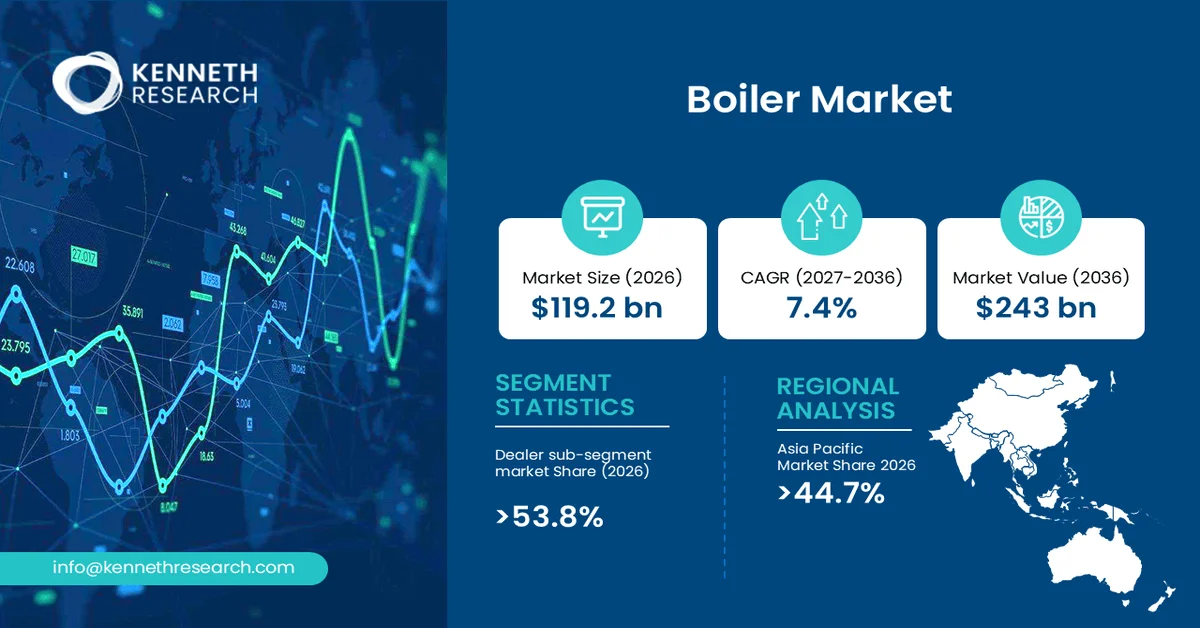
Boiler Market size was valued at USD 119.2 billion in 2026 and is projected to reach USD 243 billion by the end of 2036, rising at a CAGR of 7.4% during the forecast period, i.e., 2027-2036. In 2027, the industry size of the boiler is estimated at USD 127.8 billion.
The primary growth driver is industrial decarbonization and electrification, as manufacturers seek efficient heat-generation technologies while reducing fossil-fuel dependence. The IEA reports that industry accounts for 30% of global energy consumption, highlighting the scale of energy demand that can support investment in efficient boilers, electric boilers, heat-recovery systems, and lower-carbon industrial heating solutions.
The boiler market comprises the manufacturing, sale, installation, and servicing of equipment designed to generate hot water, steam, or other thermal energy by transferring heat from a fuel or electricity source to a working fluid. Boiler systems serve residential, commercial, institutional, and industrial applications, with configurations differentiated by fuel type, output, operating pressure, capacity, combustion technology, and heat-transfer design.
Key characteristics include packaged and field-assembled systems, steam and hot-water configurations, combustion-based and electric technologies, and increasingly integrated controls for monitoring, efficiency optimization, and emissions management. Equipment selection depends on required thermal output, operating conditions, fuel availability, installation requirements, lifecycle economics, and applicable regulatory standards.
Key Boiler Market Insights Summary:
Key Takeaways: Market Trends & Insights
- The boiler market is projected to increase from USD 119.2 billion in 2026 to USD 243 billion by 2036
- The boiler market is expected to expand at a CAGR of 7.4% during 2027-2036
- Dealer is the leading sales channel sub-segment, accounting for 53.8% market share in 2026
- Asia Pacific is the dominant regional market, representing 44.7% market share in 2026
- Industrial is identified as the second and fastest analysis segment under the Technology category
Market Drivers
- Industrial decarbonization and emissions-reduction initiatives
- Energy-efficiency upgrades and replacement of aging boiler infrastructure
- Electrification and integration of renewable electricity into process heat
- Digitalization, automation, and advanced boiler-control technologies
Challenges
- High cost of low-carbon boiler transition
- Regulatory fragmentation and compliance complexity
Boiler Market Overview & Supply Chain
Adoption across the boiler market is increasing as manufacturers, utilities, commercial facilities, and process industries prioritize reliable thermal energy, operational efficiency, fuel flexibility, and lower-emission heat generation. Modern systems increasingly incorporate advanced combustion controls, heat recovery, digital monitoring, and electrification options, while regulatory and decarbonization pressures are accelerating demand for equipment that can support cleaner industrial heat strategies.
The boiler market value chain begins with suppliers of steel, alloys, tubes, refractory materials, insulation, burners, pumps, valves, control systems, and electrical components. Boiler manufacturers then design, fabricate, assemble, test, and certify packaged or customized systems, often working with specialized engineering firms and component suppliers. Downstream activities include project engineering, installation, commissioning, distribution through direct sales and dealer networks, and aftermarket services such as maintenance, retrofits, replacement parts, and performance upgrades. End users span industrial manufacturers, power and utility operators, commercial buildings, institutions, and other facilities requiring steam or hot water.
Boiler Market: Growth Drivers & Challenges
Growth Drivers:
- Industrial heat electrification: The transition toward lower-carbon industrial heat is creating demand for electric and hybrid boiler configurations that can replace or complement fossil-fuel-fired systems. Electrification enables manufacturers to connect steam generation with renewable electricity, improve operational flexibility, and reduce direct combustion emissions. It also encourages boiler manufacturers to develop systems with advanced controls, thermal storage compatibility, and flexible load management.
- Industrial modernization and process efficiency: Industrial facilities are increasingly modernizing thermal infrastructure to improve reliability, reduce energy losses, and maintain competitive production economics. Aging boiler assets can create maintenance burdens, inefficient fuel utilization, and operational constraints, encouraging operators to replace or upgrade equipment rather than sustain legacy systems. Modern boilers can integrate automated combustion management, heat recovery, water-treatment controls, variable-speed components, remote monitoring, and optimized steam management. These capabilities allow manufacturers to align thermal output more closely with production requirements while improving equipment availability and maintenance planning.
Challenges:
- High cost of low-carbon boiler transition: The shift from conventional fossil-fuel boilers toward electric, hybrid, and other lower-carbon heating systems can create a difficult business case for industrial users. The root cause is the interaction between equipment investment, electricity pricing, site-specific grid requirements, and the need to integrate new systems with existing steam and process infrastructure. The IEA notes that electric boilers can face substantially higher operating costs than natural-gas alternatives in some markets, while grid-connection requirements can also become a significant barrier.
- Regulatory fragmentation and compliance complexity: Boiler manufacturers and operators face increasingly complex regulatory requirements covering safety, efficiency, emissions, fuel use, inspection, certification, and equipment design. The root challenge is that requirements differ substantially across jurisdictions, forcing manufacturers serving multiple markets to adapt product configurations, documentation, testing, and compliance processes to local rules. For operators, regulatory changes can accelerate replacement of equipment that remains technically functional, creating unplanned capital requirements and uncertainty over technology selection.
Boiler Market Size and Forecast:
| Report Attribute | Details |
|---|---|
| Base Year |
2026 |
| Forecast Period |
2027-2036 |
| CAGR |
7.4% |
| Base Year Market Size (2026) |
USD 119.2 billion |
| Forecast Year Market Size (2036) |
USD 243 billion |
| Regional Scope |
|
Boiler Market Segmentation Analysis:
Sales Channel Segment Analysis
In the sales channel segment, dealer sub-segment is anticipated to capture the largest market share of 53.8% by the end of 2026.
The dealer segment dominates because boiler purchases frequently require product selection, application guidance, installation coordination, commissioning, and after-sales support, making intermediary expertise commercially important. Demand is reinforced by replacement projects, localized purchasing, and customers seeking readily available equipment and technical assistance. U.S. Department of Energy documentation identifies manufacturers, wholesalers/distributors, retailers, plumbing contractors, builders, and manufactured-home dealers/retailers as key parties in the consumer boiler distribution chain. This structure supports dealer-led procurement because distributors and dealers can combine inventory access with technical relationships across installers and end users. Supply-side participants also benefit from established dealer networks that extend geographic reach without requiring manufacturers to manage every customer interaction directly. As efficiency requirements and system complexity increase, dealer capabilities in product specification, compliance, installation coordination, and service become more valuable.
Technology Segment Analysis
The industrial is projected to grow as the second-largest segment in the boiler market due to four converging demand drivers.
The industrial segment is projected to grow as manufacturing facilities require dependable steam and process heat for production, while operators increasingly modernize thermal systems for efficiency, reliability, and emissions management. Industrial boilers remain integral to sectors such as chemicals, food processing, paper, refining, and metals, where continuous thermal output is essential. The U.S. Energy Information Administration’s current industrial-demand modeling explicitly incorporates conventional boilers and cogeneration to meet manufacturing steam requirements, reflecting the continuing importance of boiler-based steam generation in industrial energy planning. Technology adoption is also shifting toward higher-efficiency equipment, electrification, cogeneration, advanced controls, and heat-recovery solutions.
Our in-depth analysis of the boiler market includes the following segments:
|
Segment |
Sub-segment |
|
Fuel |
|
|
Capacity |
|
|
Technology |
|
|
Application |
|
|
Sales Channel |
|
Boiler Market Regional Insights:
Asia Pacific Market Trends & Insights:
Asia Pacific boiler market is projected to hold the largest revenue share of 44.7% by the end of 2026.
It is supported by its extensive manufacturing base, large industrial energy requirements, expanding infrastructure, and continued investment in process industries. Regional dominance is reinforced by strong production ecosystems for industrial equipment and components, established engineering capabilities, and sustained investment in energy and manufacturing infrastructure.
China combines extensive manufacturing activity, domestic equipment production, and large-scale industrial energy demand, supporting both boiler consumption and regional supply-chain depth. Continued industrial modernization should sustain demand for efficient and technologically advanced boiler systems.
Japan represents a technology-intensive market characterized by mature industrial infrastructure and emphasis on energy efficiency. Its manufacturing sector provides a strong application base for sophisticated boiler and process-heat technologies, while established engineering capabilities support replacement and modernization opportunities.
North America Market Trends & Insights:
North America represents an established boiler market supported by substantial industrial activity, commercial infrastructure, replacement demand, and growing emphasis on energy efficiency. Demand is increasingly shaped by modernization of aging thermal assets, tighter efficiency expectations, industrial decarbonization, and the need for dependable steam and hot-water generation.
The United States combines a broad industrial base with established boiler manufacturing, engineering, distribution, and service networks. Demand opportunities are concentrated in replacement, efficiency upgrades, industrial steam optimization, and compliance-driven modernization. Federal efficiency requirements and procurement policies further encourage adoption of higher-performing systems.
Canada offers opportunities through industrial decarbonization and clean-technology deployment. Government initiatives specifically support industrial energy efficiency, electrification, and lower-carbon process heating, creating a favorable environment for electric, hybrid, and high-efficiency boiler technologies.
Leading Companies Operating in the Global Boiler Market:
Here is a list of upstream, downstream, and key players operating in global boiler market competitive ecosystem:
- Vaillant Group (Germany)
- Company Overview
- Business Strategy
- Key Product Offerings
- Financial Performance
- Key Performance Indicators
- Risk Analysis
- Recent Development
- Regional Presence
- SWOT Analysis
- BDR Thermea Group (Netherlands)
- Babcock & Wilcox Enterprises, Inc. (United States)
- Mitsubishi Heavy Industries, Ltd. (Japan)
Recent Developments
- In July 2026, Mitsubishi Heavy Industries' Mitsubishi Power received a contract to supply boiler components for converting heavy oil-fired boilers at the Jeddah South and Shuqaiq power plants in Saudi Arabia into dual-fuel boilers capable of switching between natural gas and heavy oil. The project, part of Saudi Vision 2030, aims to increase natural gas's share in power generation to over 50%.
- In August 2026, Babcock & Wilcox signed an agreement with Siemens Energy to commence work on 20 steam turbine generator sets totaling 1 gigawatt of capacity for data center power generation projects. The agreement secures capacity for B&W's FastPower℠ program, addressing the rapidly growing energy demands of AI data centers.
Frequently Asked Question
In 2026, the boiler market exceeded USD 119.2 billion.
The boiler market is projected to reach USD 243 billion by the end of 2036, expanding at a CAGR of 7.4% over the forecast period (2027-2036).
The major players in the market are Vaillant Group, BDR Thermea Group, Babcock & Wilcox Enterprises, Inc., Mitsubishi Heavy Industries, Ltd., and others.
In the sales channel segment, the dealer sub-segment is anticipated to capture the largest market share of 53.8% in the future and exhibit lucrative growth opportunities during 2027-2036. This growth trajectory is largely attributed to the importance of dealer networks in product distribution, technical support, installation coordination, and after-sales service.
Asia Pacific is projected to hold the largest market share of 44.7% by the end of 2026 and provide more business opportunities in the future. Continuous industrial modernization and manufacturing activity in China and Japan are fostering the region’s dominance.
Why Choose Kenneth Research ?
-
Insight with Impact : We don’t just gather data — we uncover stories, trends, and opportunities that fuel business growth.
-
Experts Who Get It : Our team speaks your industry’s language and knows what really matters to your customers and market.
-
Custom-Built for You : Forget one-size-fits-all. We craft research and consulting solutions as unique as your business vision.
-
Partners, Not Just Providers : We work with you, not for you — collaborating closely to turn insights into smart, strategic moves.
-
Results That Speak : Our work powers brands, startups, and industry leaders alike — with a track record of ideas that work in the real world.
Report ID: 1341 |
Published Date: 10 Sep 2026 |
Report Format: |
Delivery Timeline: 48-72 Business Hours

Copyright © 2025 Kenneth Research. All rights reserved. Terms of Use | Privacy Policy
