Report ID: 1447 |
Published Date: 29 Sep 2026 |
Report Format: |
Delivery Timeline: 48-72 Business Hours
Bioimpedance Devices Market Outlook:
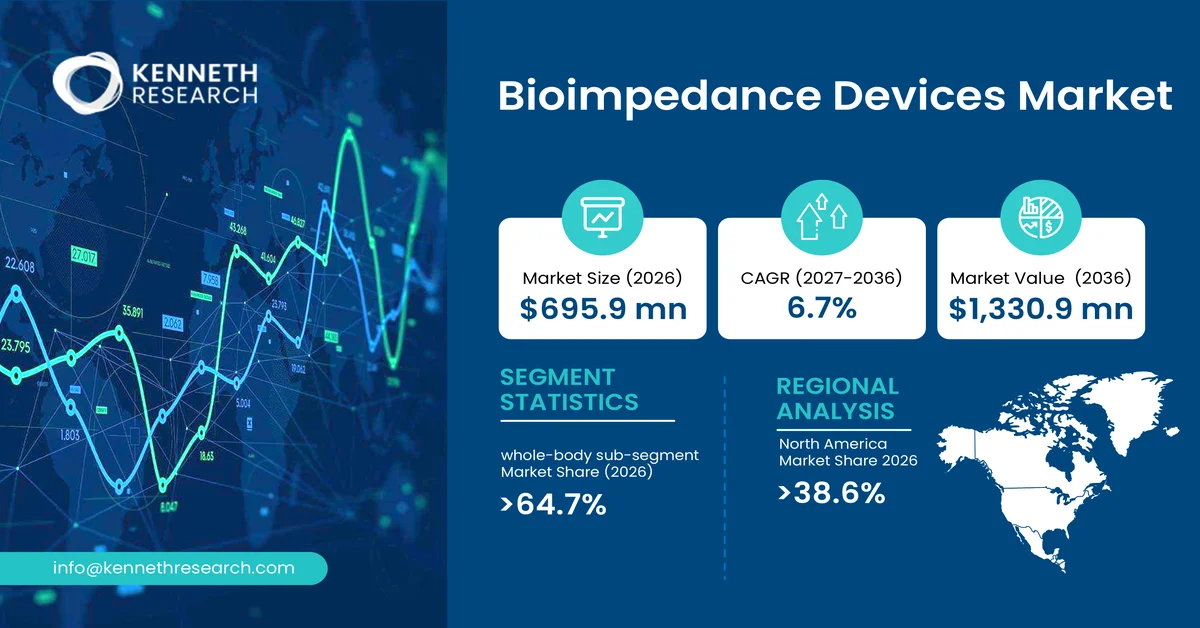
Bioimpedance devices market size was valued at USD 695.9 million in 2026 and is projected to reach USD 1,330.9 million by the end of 2036, expanding at a CAGR of 6.7% during the forecast period, i.e., 2027–2036. In 2027, the industry size of the global bioimpedance devices market is estimated at USD 742.4 million.
The increasing burden of obesity and related metabolic conditions is strengthening demand for objective body-composition assessment. U.S. government data report that obesity affected 40.3% of adults aged 20 and older during August 2021–August 2023, supporting greater clinical need for tools that assess body composition beyond conventional weight and BMI measurements.
Bioimpedance Devices Market comprises medical and diagnostic devices that use bioelectrical impedance measurements to estimate body-composition or fluid-related parameters. These systems introduce a small alternating electrical current through the body and evaluate electrical responses, including resistance, reactance, and impedance, which can then be processed through algorithms to derive physiological measurements. The U.S. Food and Drug Administration classifies relevant devices as impedance plethysmographs and describes their use in estimating body-composition parameters through electrical measurements and algorithmic calculations.
Key characteristics include configurations designed for different measurement sites and applications, with systems capable of assessing parameters such as fat mass, fat-free mass, total body water, and fluid distribution. FDA-cleared device documentation also identifies applications involving multi-frequency and segmental bioelectrical impedance analysis.
Key Bioimpedance Devices Market Insights Summary:
Key Takeaways: Market Trends & Insights
- The bioimpedance devices market is projected to increase from USD 695.9 million in 2026 to USD 1,330.9 million by 2036, representing a CAGR of 6.7% during 2027–2036
- The whole-body application segment holds the largest share at 64.7% in 2026, supported by demand for comprehensive body-composition assessment
- North America accounts for 38.6% of the bioimpedance devices market in 2026, supported by established healthcare infrastructure and demand across the United States and Canada
- The wired modality is identified as the second and fastest analysis segment, supported by demand for consistent measurement, clinical workflow integration, and reliable data transmission
Market Drivers
- Rising global obesity burden and demand for body-composition assessment
- Technology integration and expansion of data-driven healthcare
- Growing emphasis on preventive and personalized health management
- Increasing use of non-invasive and repeatable physiological measurement technologies
Challenges
- Measurement Variability and Dependence on Testing Conditions
Bioimpedance Devices Market Overview & Supply Chain
Global adoption of bioimpedance devices is increasing as healthcare systems place greater emphasis on objective assessment of body composition, metabolic health, and nutrition. The technology provides a non-invasive approach that can complement conventional anthropometric measurements and support longitudinal monitoring.
The bioimpedance devices market value chain begins with specialized inputs including electronic components, electrodes, conductive materials, sensors, circuit boards, plastics, displays, batteries or power systems, and embedded computing components. Component suppliers feed these inputs into device manufacturers, which undertake hardware assembly, electrical integration, software and algorithm development, calibration, testing, quality assurance, and regulatory compliance. Finished systems move through direct sales, medical-equipment distributors, specialist distributors, and institutional procurement channels before reaching hospitals, clinics, diagnostic centers, nutrition and fitness facilities, research organizations, and other professional users.
Bioimpedance Devices Market - Growth Drivers & Challenges
Growth Drivers
- Rising Global Obesity Burden and Demand for Body-Composition Assessment: The expanding burden of obesity is increasing the need for more informative approaches to assess body composition and monitor changes during clinical and nutritional interventions. As healthcare providers increasingly emphasize individualized intervention and longitudinal measurement, adoption can expand beyond specialist facilities into broader outpatient and professional health settings.
- Technology Integration and Expansion of Data-Driven Healthcare: Advances in sensor design, multi-frequency measurement, embedded computing, software algorithms, and connectivity are improving the practical utility of bioimpedance systems. Modern devices can translate electrical measurements into multiple body-composition indicators, allowing healthcare professionals to evaluate changes over time rather than relying solely on body weight.
Challenges
- Measurement Variability and Dependence on Testing Conditions: A major restraint is the sensitivity of bioimpedance measurements to physiological and procedural conditions. Hydration status, recent food or fluid intake, physical activity, body positioning, skin-electrode contact, and measurement protocol can influence electrical impedance and consequently affect derived body-composition estimates. Differences in algorithms and device configurations can also produce inconsistent results between manufacturers or measurement platforms.
- Regulatory and Clinical Validation Complexity: Bioimpedance devices intended for clinical use must demonstrate appropriate safety, performance, and reliability for their intended applications, while manufacturers may face different regulatory expectations across jurisdictions. The challenge becomes more pronounced when devices generate derived physiological parameters rather than directly measuring a single physical variable, because manufacturers must substantiate the algorithms and intended clinical claims supporting those outputs.
Bioimpedance Devices Market Size and Forecast:
| Report Attribute | Details |
|---|---|
| Base Year |
2026 |
| Forecast Year |
2027-2036 |
| CAGR |
6.7% |
| Base Year Market Size (2026) |
USD 695.9 million |
| Forecast Year Market Size (2036) |
USD 1,330.9 million |
| Regional Scope |
|
Bioimpedance Devices Market - Segment Analysis
Application Segment Analysis
In the application segment, whole-body sub-segment is anticipated to capture the largest market share of 64.7% by the end of 2026.
The whole-body segment leads because it provides a comprehensive assessment of body composition through measurements collected across the body, making it suitable for routine clinical evaluation, nutritional assessment, obesity management, fitness monitoring, and research. Its broad applicability supports adoption across hospitals, clinics, diagnostic facilities, nutrition practices, and professional wellness settings. Demand is also reinforced by the increasing clinical focus on obesity and metabolic health. In 2022, the U.S. Centers for Disease Control and Prevention reported that 22 states had adult obesity prevalence at or above 35%, compared with 19 states in 2021, highlighting sustained demand for assessment and management approaches related to excess body weight.
Modality Segment Insights
The wired is projected to grow as the second-largest segment in the bioimpedance devices market due to four converging demand drivers.
The wired modality is projected to grow as healthcare providers continue to favor controlled, stable measurement environments where consistent electrical contact, signal integrity, and uninterrupted data transmission are priorities. Demand is supported by the growing requirement for physiological monitoring across chronic-care pathways. The U.S. Centers for Disease Control and Prevention reported that approximately 194 million U.S. adults had at least one chronic condition in 2023, reinforcing the need for dependable clinical monitoring technologies. Wired systems remain particularly relevant in hospitals, clinics, diagnostic facilities, and research environments because fixed connections can simplify power management, data transfer, and integration with dedicated clinical equipment. Industry adoption is also supported by the availability of established wired architectures and measurement configurations that manufacturers can optimize for repeatability and clinical workflows.
Our in-depth analysis of the bioimpedance devices market includes the following segments:
|
Segment |
Sub-segment |
|
Product Type |
|
|
Modality |
|
|
Application |
|
Bioimpedance Devices Market - Regional Analysis
North America Market Trends & Insights:
North America bioimpedance devices market is projected to hold the largest revenue share of 38.6% by the end of 2026.
Regional leadership is supported by established healthcare infrastructure, high adoption of diagnostic technologies, strong clinical research capabilities, and the presence of sophisticated medical-device manufacturing and distribution networks.
The United States benefits from extensive hospital and outpatient networks, advanced medical-device capabilities, and strong demand for clinical measurement technologies.
Canada provides an additional growth opportunity through increasing attention to obesity and chronic-disease management. Together, both countries provide a substantial installed healthcare base and favorable conditions for continued adoption.
Asia Pacific Market Trends & Insights:
Asia Pacific presents strong long-term opportunities for bioimpedance devices as healthcare systems expand preventive care, chronic-disease management, digital health infrastructure, and technology-enabled clinical services. Industrial activity is supported by growing medical-device capabilities, electronics manufacturing ecosystems, healthcare digitization, and investment in connected diagnostic technologies.
China offers opportunities through its expanding healthcare infrastructure, domestic medical-device ecosystem, and government emphasis on preventive health, nutrition, and weight management.
Japan provides a technologically mature environment where an aging population, healthcare digitalization, medical-device innovation, and data-enabled care can support adoption. Its regulatory authorities are also actively developing pathways for innovative digital medical technologies.
Bioimpedance Devices Market Competitive Landscape
Here is a list of upstream, downstream, and key players operating in bioimpedance devices market competitive ecosystem:
- Tanita Corporation (Japan)
- Company Overview
- Business Strategy
- Key Product Offerings
- Financial Performance
- Key Performance Indicators
- Risk Analysis
- Recent Development
- Regional Presence
- SWOT Analysis
- InBody Co., Ltd. (South Korea)
- Bodystat Ltd. (United Kingdom)
- Akern Srl (Italy)
Recent Developments
- In May 2026, InBody Co., Ltd. began sales of the InBodyDial H40 home body composition scale. The H40 supports both the InBody app and the new InBody+ app, and uses the same BIA technology as professional InBody devices—including segmental measurement, 8-point contact electrodes, and multi-frequency analysis—without statistical corrections based on age or gender.
- In April 2026, Tanita Corporation introduced the MC-800 professional body composition analyzer at FIBO in Cologne, Germany. Designed specifically for fitness operators, the device delivers a comprehensive body composition breakdown in 15 seconds and sends results directly to members' iOS or Android devices via the TANITA Universe app, supporting both self-service and trainer-led use.
Frequently Asked Question
In 2026, the bioimpedance devices market exceeded USD 695.9 million.
The bioimpedance devices market is projected to reach USD 1330.9 million by the end of 2036, expanding at a CAGR of 6.7% over the forecast period (2027-2036).
The major players in the market are Tanita Corporation, InBody Co., Ltd., Bodystat Ltd., Akern Srl, and others.
In the Application segment, the whole-body sub-segment is anticipated to capture the largest market share of 64.7% in the future and exhibit lucrative growth opportunities during 2027-2036. This growth trajectory is largely attributed to increasing demand for comprehensive body-composition assessment across clinical and healthcare settings.
North America is projected to hold the largest market share of 38.6% by the end of 2036 and provide more business opportunities in the future. Established healthcare infrastructure and strong demand across the United States and Canada are fostering the region's dominance.
Why Choose Kenneth Research ?
-
Insight with Impact : We don’t just gather data — we uncover stories, trends, and opportunities that fuel business growth.
-
Experts Who Get It : Our team speaks your industry’s language and knows what really matters to your customers and market.
-
Custom-Built for You : Forget one-size-fits-all. We craft research and consulting solutions as unique as your business vision.
-
Partners, Not Just Providers : We work with you, not for you — collaborating closely to turn insights into smart, strategic moves.
-
Results That Speak : Our work powers brands, startups, and industry leaders alike — with a track record of ideas that work in the real world.
Report ID: 1447 |
Published Date: 29 Sep 2026 |
Report Format: |
Delivery Timeline: 48-72 Business Hours

Copyright © 2025 Kenneth Research. All rights reserved. Terms of Use | Privacy Policy
