Report ID: 1274 |
Published Date: 01 Sep 2026 |
Report Format: |
Delivery Timeline: 48-72 Business Hours
Biofuel From Sugar Crops Market Outlook:
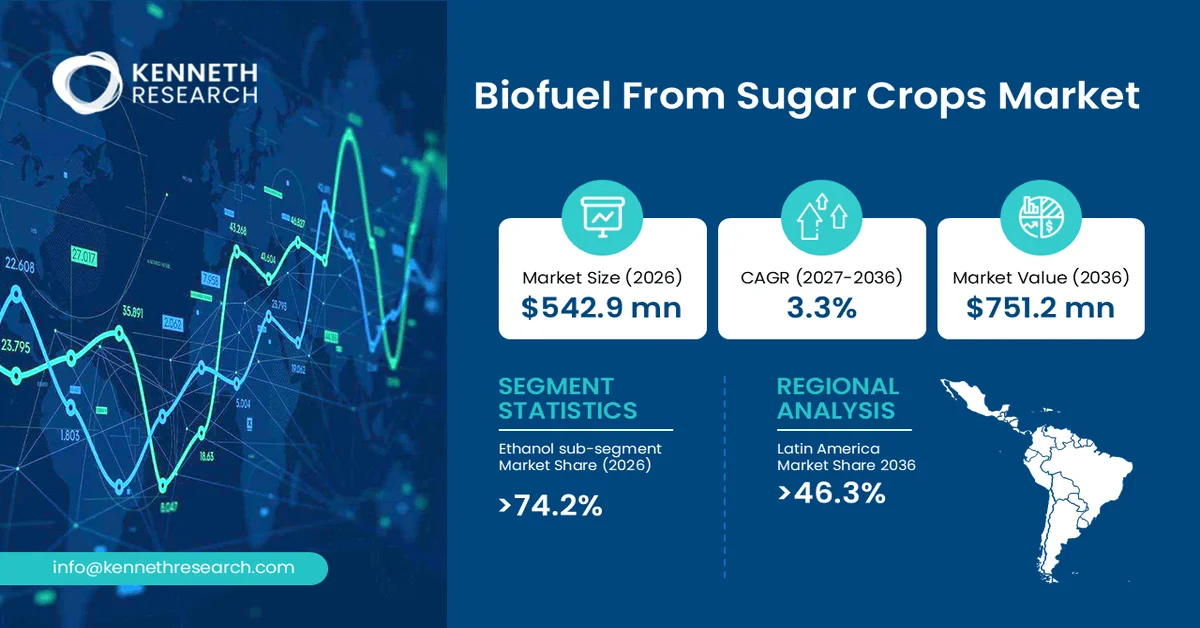
Biofuel From Sugar Crops Market size was valued at USD 542.9 million in 2026 and is projected to reach USD 751.2 million by the end of 2036, rising at a CAGR of 3.3% during the forecast period, i.e., 2027-2036. In 2027, the industry size of the biofuel from sugar crops is estimated at USD 560.8 million.
Decarbonization mandates and policies promoting renewable transport fuels are a primary growth driver for the biofuel from sugar crops market. Brazil’s RenovaBio framework reinforces demand by establishing compulsory emissions-reduction targets for fuel commercialization; its 2025 target is 40.39 million CBIOs, supporting structured market demand for certified biofuels.
The biofuel from sugar crops market comprises the production, processing, distribution, and utilization of renewable fuels derived from sugar-bearing crops, principally sugarcane. The market encompasses biofuels produced by converting crop-derived sugars and associated biomass into transportation and energy fuels, with ethanol representing the principal commercial product category. Production systems can integrate agricultural cultivation, sugar extraction, fermentation, distillation, and downstream fuel distribution, while some facilities also utilize residual biomass for energy generation.
Sugarcane-based biofuel production is particularly relevant where established sugar-energy industries provide integrated feedstock and processing infrastructure. Government energy analysis identifies sugarcane as a major contributor to Brazil’s bioenergy system, while ethanol production remains closely connected with the country’s transportation-fuel framework.
Key Biofuel From Sugar Crops Market Insights Summary:
Key Takeaways: Market Trends & Insights
- Biofuel From Sugar Crops Market reached USD 542.9 million in 2026 and is projected to reach USD 751.2 million by 2036
- The market is expected to expand at a 3.3% CAGR during 2027-2036
- Ethanol leads the Biofuel Type segment with a 74.2% market share in 2026
- Latin America dominates the market with a 46.3% market share in 2026, supported by Brazil and Argentina
- First-generation feedstock is identified as the second and fastest analysis segment, supported by established sugar-crop cultivation and ethanol production infrastructure
Market Drivers
- Accelerating ethanol-blending mandates and fuel decarbonization
- Integrated sugar-energy processing and feedstock flexibility
- Expansion of renewable-fuel infrastructure and downstream distribution networks
- Rising emphasis on agricultural value creation and domestic energy security
Challenges
- Feedstock competition and agricultural supply volatility
- Sustainability compliance and land-use constraints
Biofuel From Sugar Crops Market Overview & Supply Chain
Global adoption of biofuel from sugar crops is increasing as governments and energy industries seek lower-emission alternatives for transport while retaining compatibility with established fuel infrastructure. Sugar-crop-derived ethanol is commercially mature and can be integrated into conventional fuel systems through blending, supporting decarbonization without requiring complete replacement of existing vehicle fleets. The International Energy Agency identifies renewable fuels as increasingly important for sectors that are difficult to electrify, while bioenergy benefits from commercialized production technologies and established policy support.
The biofuel from sugar crops market value chain begins with agricultural inputs, principally sugarcane and other sugar-bearing crops, supported by farmland, planting materials, fertilizers, water, harvesting equipment, and agricultural services. Feedstock is transported to integrated sugar and ethanol facilities, where crops are processed to extract fermentable sugars before fermentation, distillation, dehydration, and fuel conditioning. Production facilities may also utilize processing residues for internal energy generation, improving resource integration. Finished biofuel moves through fuel terminals, storage infrastructure, blending facilities, pipelines, road transportation, and other distribution channels before reaching fuel retailers and industrial users. End users primarily include road-transport operators, commercial fleets, fuel distributors, and other energy consumers.
Biofuel From Sugar Crops Market: Growth Drivers & Challenges
Growth Drivers
- Accelerating ethanol-blending mandates and fuel decarbonization: Government-led ethanol-blending mandates are strengthening structural demand for sugar-crop-derived biofuel by creating predictable offtake requirements for producers and fuel distributors. The mechanism is particularly relevant to sugar-crop feedstocks because established sugar-processing ecosystems can redirect suitable outputs toward fuel production when policy incentives favor ethanol. Over the coming years, sustained blending programs are expected to improve demand visibility, encourage capacity optimization, and deepen integration between agricultural producers, sugar mills, ethanol manufacturers, and downstream fuel companies.
- Integrated sugar-energy processing and feedstock flexibility: Integration between sugar manufacturing and ethanol production is strengthening the commercial resilience of sugar-crop biofuel operations. Producers can utilize multiple outputs from sugar processing, including fermentable intermediates and molasses, while integrated facilities can coordinate sugar production, ethanol manufacturing, energy generation, storage, and logistics. This configuration allows operators to respond more effectively to changing commodity economics and fuel demand while improving utilization of existing industrial infrastructure. Feedstock flexibility is also becoming strategically important as producers seek to balance food, sugar, and fuel markets without depending on a single revenue stream.
Challenges
- Feedstock competition and agricultural supply volatility: A fundamental restraint is the dependence of biofuel production on agricultural feedstocks whose availability and economics are influenced by weather, yields, harvest cycles, and competing sugar markets. For sugarcane-based ethanol producers, the same crop can support both fuel and sugar production, creating a commercial trade-off when relative prices shift. This can affect plant utilization, procurement costs, inventory planning, and producer margins. The IEA notes that sugarcane ethanol economics can be influenced by competition between ethanol and sweetener production, making feedstock allocation an important operational consideration.
- Sustainability compliance and land-use constraints: Environmental sustainability requirements can constrain expansion when additional sugar-crop cultivation raises concerns around land use, lifecycle emissions, biodiversity, and competition with food production. These concerns increasingly influence market access because biofuel producers must demonstrate that feedstocks and production pathways satisfy applicable sustainability frameworks. The IEA identifies land-use impacts as a significant issue in biofuel greenhouse-gas accounting, with indirect land-use change particularly difficult to quantify and verify. For producers, this creates additional requirements for traceability, certification, emissions measurement, agricultural monitoring, and supply-chain documentation.
Biofuel From Sugar Crops Market Size and Forecast:
| Report Attribute | Details |
|---|---|
| Base Year |
2026 |
| Forecast Period |
2027-2036 |
| CAGR |
3.3% |
| Base Year Market Size (2026) |
USD 542.9 million |
| Forecast Year Market Size (2036) |
USD 751.2 million |
| Regional Scope |
|
Biofuel From Sugar Crops Market Segmentation Analysis:
Biofuel Type Segment Analysis
In the biofuel type segment, Ethanol sub-segment is anticipated to capture the largest market share of 74.2% by the end of 2026.
Ethanol dominates the biofuel from sugar crops market because it has the strongest combination of established fuel compatibility, extensive blending infrastructure, mature production technology, and policy-backed demand. Sugarcane ethanol benefits particularly from integrated sugar-energy facilities, where producers can convert fermentable sugars into fuel while coordinating sugar production and energy generation. Demand is also supported by flexible-fuel vehicle fleets and established distribution networks, allowing ethanol to compete directly with conventional gasoline in several major consuming markets.
Feedstock Generation Segment Analysis
The First-generation Feedstock is projected to grow as the second-largest segment in the biofuel from sugar crops market due to four converging demand drivers.
First-generation feedstock is projected to expand because sugarcane remains a commercially mature and readily accessible input for conventional ethanol production. Existing agricultural networks, established milling infrastructure, proven fermentation processes, and integrated sugar-ethanol facilities reduce the execution risk associated with scaling this feedstock pathway. Demand is reinforced by fuel-blending policies and growing preference for renewable transport fuels, while producers can adjust sugar and ethanol output according to prevailing market conditions. Brazil’s government-backed energy analysis reported that 17.9 billion liters of hydrated ethanol were consumed by October 2024, up 29.7% from the corresponding period of 2023, demonstrating strong downstream demand for the fuel pathway supported by first-generation production.
Our in-depth analysis of the biofuel from sugar crops market includes the following segments:
|
Segment |
Sub-segment |
|
Biofuel Type |
|
|
Pathways |
|
|
Feedstock Type |
|
|
Source |
|
|
Production Technology |
|
|
Application |
|
Biofuel From Sugar Crops Market Regional Insights:
Latin America Market Trends & Insights:
Latin America biofuel from sugar crops market is projected to hold the largest revenue share of 46.3% by the end of 2026.
Its leadership is underpinned by a deeply established sugarcane agricultural base, integrated sugar-and-ethanol processing infrastructure, extensive domestic fuel distribution networks, and supportive renewable-fuel policies. Brazil is the region’s principal production hub, combining large-scale sugarcane cultivation with mature ethanol manufacturing and established flex-fuel transportation infrastructure.
Brazil remains the regional anchor because producers can integrate sugar, ethanol, and energy generation while responding to domestic fuel demand and export opportunities.
Argentina provides a complementary market, supported by its agricultural economy and established biofuel industry, with ethanol production linked to sugarcane cultivation in the northwest. Across the region, regulatory mechanisms, domestic blending requirements, agricultural capabilities, and investment in processing capacity strengthen market participation. Continued modernization of sugar-energy facilities, logistics infrastructure, and low-carbon fuel policies should reinforce Latin America’s competitive position, while Brazil is likely to remain the principal regional investment and production center.
Europe Market Trends & Insights:
Europe represents an important secondary region for the biofuel from sugar crops market because transport decarbonization policies continue to support renewable fuels while the region maintains established fuel-distribution and vehicle infrastructure. The European Union’s revised Renewable Energy Directive provides a regulatory framework for renewable transport fuels and strengthens sustainability requirements, creating opportunities for producers that can demonstrate compliant feedstock sourcing and lifecycle emissions performance.
Germany has a mature biofuel industry supported by federal climate policy and obligations on fuel suppliers to reduce transport-related greenhouse-gas emissions. Government policy increasingly emphasizes fuels with stronger emissions-reduction potential, creating a market environment in which technically compliant bioethanol can participate alongside advanced biofuels and electrification.
France has a well-established bioethanol ecosystem linked to sugar-beet and cereal agriculture, with ethanol incorporated into conventional gasoline grades and high-ethanol E85 fuel. Government policy identifies sustainable fuels as part of the decarbonization pathway for transport modes that are more difficult to electrify, supporting continued development of renewable-fuel supply chains and related agricultural and industrial capabilities.
Leading Companies Operating in the Global Biofuel From Sugar Crops Market:
Here is a list of upstream, downstream, and key players operating in the Biofuel From Sugar Crops competitive ecosystem:
- Archer Daniels Midland Company (ADM) (United States)
- Company Overview
- Business Strategy
- Key Product Offerings
- Financial Performance
- Key Performance Indicators
- Risk Analysis
- Recent Development
- Regional Presence
- SWOT Analysis
- Praj Industries Limited (India)
- Bajaj Hindusthan Sugar Ltd. (India)
- Raízen Energia S.A. (Brazil)
Recent Developments
- In June 2025, Praj Industries, the International Air Transport Association (IATA), and the Indian Sugar & Bio-energy Manufacturers Association (ISMA) signed a strategic MOU to drive the certification and adoption of sustainable aviation fuel (SAF) in India, focusing on lifecycle assessment of SAF derived from sugarcane feedstock via the ethanol-to-jet pathway . The partnership aligns with India's SAF blending mandate targeting 1% by 2027 and 2% by 2028.
- In September 2025, the Indian government removed all limits on ethanol production from sugarcane juice, sugar syrup, and molasses for the ethanol supply year 2025-26, reversing restrictions imposed in 2023-24 due to lower sugarcane availability . Sugar companies including Bajaj Hindusthan Sugar and others surged by up to 15% following the announcement, as the policy supports India's target of 20% ethanol blending in petrol.
Frequently Asked Question
In 2026, the biofuel from sugar crops market exceeded USD 542.9 million.
The biofuel from sugar crops market is projected to reach USD 751.2 million by the end of 2036, expanding at a CAGR of 3.3% over the forecast period (2027-2036).
The major players in the market are Archer Daniels Midland Company (ADM), Praj Industries Limited, Bajaj Hindusthan Sugar Ltd., Raízen Energia S.A., and others.
In the Biofuel Type segment, the Ethanol sub-segment is anticipated to capture the largest market share of 74.2% in the future and exhibit lucrative growth opportunities during 2027-2036. This growth trajectory is largely attributed to accelerating ethanol-blending mandates and fuel decarbonization.
Latin America is projected to hold the largest market share of 46.3% by the end of 2036 and provide more business opportunities in the future. Established sugarcane cultivation, integrated sugar-ethanol processing, and supportive fuel policies in Brazil and Argentina are fostering the region's dominance.
Why Choose Kenneth Research ?
-
Insight with Impact : We don’t just gather data — we uncover stories, trends, and opportunities that fuel business growth.
-
Experts Who Get It : Our team speaks your industry’s language and knows what really matters to your customers and market.
-
Custom-Built for You : Forget one-size-fits-all. We craft research and consulting solutions as unique as your business vision.
-
Partners, Not Just Providers : We work with you, not for you — collaborating closely to turn insights into smart, strategic moves.
-
Results That Speak : Our work powers brands, startups, and industry leaders alike — with a track record of ideas that work in the real world.
Report ID: 1274 |
Published Date: 01 Sep 2026 |
Report Format: |
Delivery Timeline: 48-72 Business Hours

Copyright © 2025 Kenneth Research. All rights reserved. Terms of Use | Privacy Policy
