Report ID: 1343 |
Published Date: 10 Sep 2026 |
Report Format: |
Delivery Timeline: 48-72 Business Hours
Battery Plate Market Outlook:
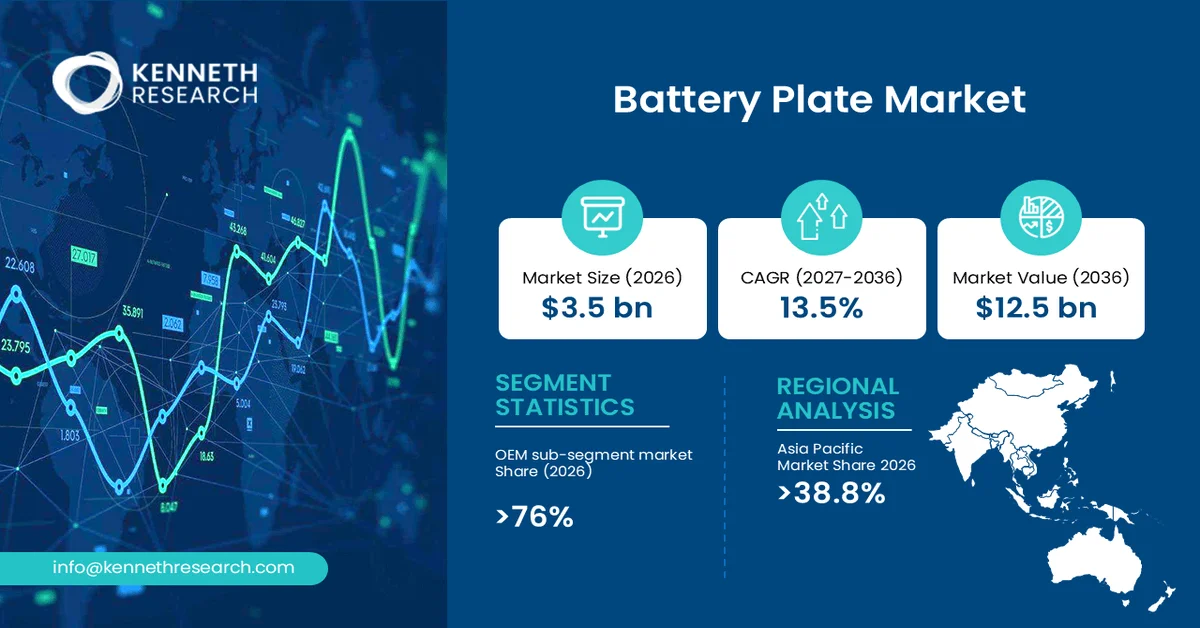
Battery Plate Market size was valued at USD 3.5 billion in 2026 and is projected to reach USD 12.5 billion by the end of 2036, rising at a CAGR of 13.5% during the forecast period, i.e., 2027–2036. In 2027, the industry size of the battery plate is estimated at USD 4 billion.
The primary growth driver for the battery plate market is the sustained need for dependable lead-based energy storage across automotive starting, lighting and ignition systems, backup power, material-handling equipment, and stationary applications.
The battery plate market refers to the industry involved in producing and supplying the positive and negative electrode plates used as core electrochemical components within rechargeable batteries. These plates contain active materials that participate in charge and discharge reactions, enabling batteries to store and release electrical energy.
Battery plates are engineered according to requirements such as electrical conductivity, power delivery, durability, charging characteristics, corrosion resistance, and operating conditions. Manufacturing processes can involve grid production, active-material preparation, pasting, curing, drying, and assembly into finished battery structures.
Key Battery Plate Market Insights Summary:
Key Takeaways: Market Trends & Insights
- Battery Plate Market is projected to grow from USD 3.5 billion in 2026 to USD 12.5 billion by 2036, expanding at a 13.5% CAGR during the forecast period.
- Asia-Pacific accounted for the largest regional share at 38.8% in 2026, supported by strong automotive manufacturing ecosystems, established battery production capabilities, and industrial demand across Japan and China.
- OEM will remain the leading distribution channel, accounting for 76% of the market in 2026, driven by direct integration with vehicle manufacturers and demand for application-specific battery components.
- Lead-Acid Battery is expected to maintain strong growth as established applications across automotive starting systems, telecommunications, industrial equipment, and backup power continue to require reliable energy-storage solutions.
Market Drivers
- Expansion of automotive and auxiliary power applications
- Increasing emphasis on battery recycling and circular material flows
- Rising demand for reliable backup-power systems
- Development of higher-performance lead-acid battery technologies
Challenges
- Environmental and regulatory compliance pressure
- Raw-material cost volatility and manufacturing complexity
Battery Plate Market Overview & Supply Chain
The battery plate market is supported by the continued industrial role of lead-acid batteries across automotive starting systems, backup power, and other energy-storage applications. The Government of India’s Principal Scientific Adviser identifies lead-acid batteries as serving automotive starting systems and backup power, reinforcing their relevance across established mobility and stationary-power applications.
The industry value chain begins with the sourcing and processing of lead and other inputs required to produce battery grids and active plate materials. Manufacturers then undertake grid casting or fabrication, paste preparation, pasting, curing, drying, and plate finishing before integrating plates into battery assemblies. Quality control is critical because plate formulation, structural integrity, corrosion resistance, and active-material utilization directly affect battery performance.
Battery Plate Market: Growth Drivers & Challenges
Growth Drivers:
- Expansion of automotive and auxiliary power applications: The automotive sector remains a key demand engine for battery plates because lead-acid batteries continue to perform essential starting, lighting, ignition, and auxiliary-power functions. The U.S. Department of Energy notes that lead-acid batteries can provide high power and are used in safety-critical auxiliary applications in electric vehicles, including systems requiring dependable low-voltage power.
- Increasing emphasis on battery recycling and circular material flows: The growing focus on battery recycling is supporting a more structured ecosystem around lead-acid battery production. Formal collection and recycling systems can improve the availability of recovered lead, helping manufacturers maintain material supply while reducing dependence on newly extracted resources. Government policies requiring responsible battery collection and recycling are also encouraging greater participation from producers, recyclers, and other industry stakeholders.
Challenges:
- Environmental and regulatory compliance pressure: Battery plate manufacturing involves lead-based materials, making environmental management and occupational safety critical commercial considerations. Manufacturers must control emissions, manage process residues, maintain safe handling procedures, and ensure appropriate treatment of production waste. Increasingly structured battery-waste regulations are also extending compliance expectations across producers and recyclers, requiring stronger traceability and coordination throughout the product lifecycle. This can increase capital requirements for pollution-control systems, worker-protection measures, waste treatment, documentation, and compliance management.
- Raw-material cost volatility and manufacturing complexity: Battery plate manufacturers remain exposed to fluctuations in the cost and availability of lead and other essential production inputs. Changes in raw-material prices can directly affect manufacturing economics, inventory planning, and pricing negotiations with battery producers and OEM customers. At the same time, producing plates with consistent electrochemical performance requires tight control over material formulation, grid construction, pasting, curing, and quality assurance. Variations in these processes can affect battery durability, power delivery, and service life, increasing warranty and quality-related risks. Manufacturers therefore need reliable procurement strategies, process automation, rigorous testing, and strong supplier relationships to protect production continuity.
Battery Plate Market Size and Forecast:
| Report Attribute | Details |
|---|---|
| Base Year |
2026 |
| Forecast Period |
2027-2036 |
| CAGR |
13.5% |
| Base Year Market Size (2026) |
USD 3.5 billion |
| Forecast Year Market Size (2036) |
USD 12.5 billion |
| Regional Scope |
|
Battery Plate Market Segmentation Analysis:
Distribution Channel Segment Analysis
In the distribution channel segment, the OEM sub-segment is anticipated to capture the largest market share of 76% in 2026.
The OEM segment dominates the distribution channel because battery manufacturers can integrate directly with vehicle producers and other original-equipment platforms, creating recurring demand for application-specific battery components. Direct OEM relationships enable battery-plate suppliers to align plate design, material formulation, dimensional specifications, durability requirements, and quality controls with battery-system requirements established during vehicle development. This channel also provides greater visibility into production schedules and facilitates long-term supply agreements, supporting more predictable manufacturing and procurement planning.
Automotive production remains an important demand foundation for OEM-oriented battery-plate suppliers. India’s Ministry of Heavy Industries reported that domestic automobile production reached around 31 million vehicles in 2024-25, demonstrating the scale of the vehicle manufacturing ecosystem that supports original-equipment component demand.
Battery Type Segment Analysis
The lead-acid battery segment is positioned for continued growth because its established technology remains important for automotive starting systems, telecommunications, uninterruptible power supplies, industrial equipment, and stationary backup applications. Its combination of high surge-power capability, mature manufacturing infrastructure, established servicing practices, and extensive recycling networks supports continued adoption where reliability and cost efficiency are priorities. Battery-plate manufacturers therefore benefit from demand for plate designs that deliver consistent current output, cycling durability, and dependable performance across varied operating environments.
Telecommunications infrastructure provides an additional demand avenue because backup batteries are required to maintain network continuity during grid interruptions. India’s Telecom Regulatory Authority reported 944.96 million broadband subscribers as of December 2024, highlighting the extensive communications infrastructure requiring dependable supporting power systems.
Our in-depth analysis of the global battery plate market includes the following segments:
|
Segment |
Sub-segment |
|
Plate Type |
|
|
Battery Type |
|
|
Application |
|
|
Distribution Channel |
|
Battery Plate Market Regional Insights:
Asia-Pacific Market Trends & Insights:
Asia-Pacific holds the leading position in the battery plate market, accounting for 38.8% in 2026, supported by its extensive automotive manufacturing base, established battery-production ecosystem, and strong industrial demand across China and Japan. The region benefits from vertically developed manufacturing capabilities spanning lead processing, battery-component production, assembly, distribution, and recycling. This integrated ecosystem enables battery-plate manufacturers to serve both original-equipment customers and replacement markets efficiently.
China represents the region’s largest manufacturing and consumption center. According to China’s Ministry of Industry and Information Technology, the country produced 31.282 million motor vehicles in 2024, demonstrating the substantial scale of its automotive manufacturing ecosystem.
Japan contributes through its mature automotive industry, sophisticated manufacturing capabilities, and established battery-technology expertise. Its emphasis on manufacturing quality, engineering precision, and vehicle electrification also creates opportunities for suppliers capable of meeting stringent technical requirements.
North America Market Trends & Insights:
North America represents an important secondary market for battery plates, supported by a mature automotive manufacturing ecosystem, established battery supply chains, and continued investment in vehicle electrification and energy infrastructure. The U.S. remains the principal industrial center, with extensive vehicle assembly and component manufacturing capabilities. Government-backed industrial programs are also encouraging localized battery and automotive supply chains, creating opportunities for suppliers that can provide reliable, application-specific battery components.
The U.S. is also attracting substantial investment across the broader battery ecosystem, particularly as automakers develop more localized supply chains.
Canada complements this activity through its established automotive manufacturing base and government-backed initiatives supporting battery and vehicle production.
Leading Companies Operating in the Global Battery Plate Market:
Here is a list of upstream, downstream, and key players operating in the global battery plate market competitive ecosystem:
- Exide Industries (India)
- Company Overview
- Business Strategy
- Key Product Offerings
- Financial Performance
- Key Performance Indicators
- Risk Analysis
- Recent Development
- Regional Presence
- SWOT Analysis
- Amara Raja Energy & Mobility (India)
- East Penn Manufacturing (U.S)
Recent Developments
- May 2025 — GS Yuasa announced the renewed ECO.R Revolution automotive battery series for both idling-stop and general vehicles, with sales scheduled to begin in July 2025.
- March 2025-- Amara Raja laid the foundation stone for Giga Factory-1 at Divitipally, Telangana, as part of a broader manufacturing development involving battery and energy-technology facilities.
Frequently Asked Question
In 2026, the battery plate market was valued at USD 3.5 billion.
The battery plate market is projected to reach USD 12.5 billion by the end of 2036, expanding at a CAGR of 13.5% over the forecast period (2027-2036).
The major players in the market are Exide Industries, Amara Raja Energy & Mobility, East Penn Manufacturing, GS Yuasa, and others.
In the distribution channel segment, the OEM sub-segment is anticipated to capture the largest market share of 76% in 2026 and exhibit lucrative growth opportunities during 2027–2036. This growth trajectory is largely attributed to sustained demand for application-specific battery components from vehicle manufacturers.
Asia-Pacific is projected to hold the largest market share of 38.8% in 2026 and provide more business opportunities in the future. Strong automotive manufacturing ecosystems and established battery-production capabilities in Japan and China are fostering the region's dominance.
Why Choose Kenneth Research ?
-
Insight with Impact : We don’t just gather data — we uncover stories, trends, and opportunities that fuel business growth.
-
Experts Who Get It : Our team speaks your industry’s language and knows what really matters to your customers and market.
-
Custom-Built for You : Forget one-size-fits-all. We craft research and consulting solutions as unique as your business vision.
-
Partners, Not Just Providers : We work with you, not for you — collaborating closely to turn insights into smart, strategic moves.
-
Results That Speak : Our work powers brands, startups, and industry leaders alike — with a track record of ideas that work in the real world.
Report ID: 1343 |
Published Date: 10 Sep 2026 |
Report Format: |
Delivery Timeline: 48-72 Business Hours

Copyright © 2025 Kenneth Research. All rights reserved. Terms of Use | Privacy Policy
