Report ID: 1453 |
Published Date: 28 Sep 2026 |
Report Format: |
Delivery Timeline: 48-72 Business Hours
B2B Telecommunication Market Outlook:
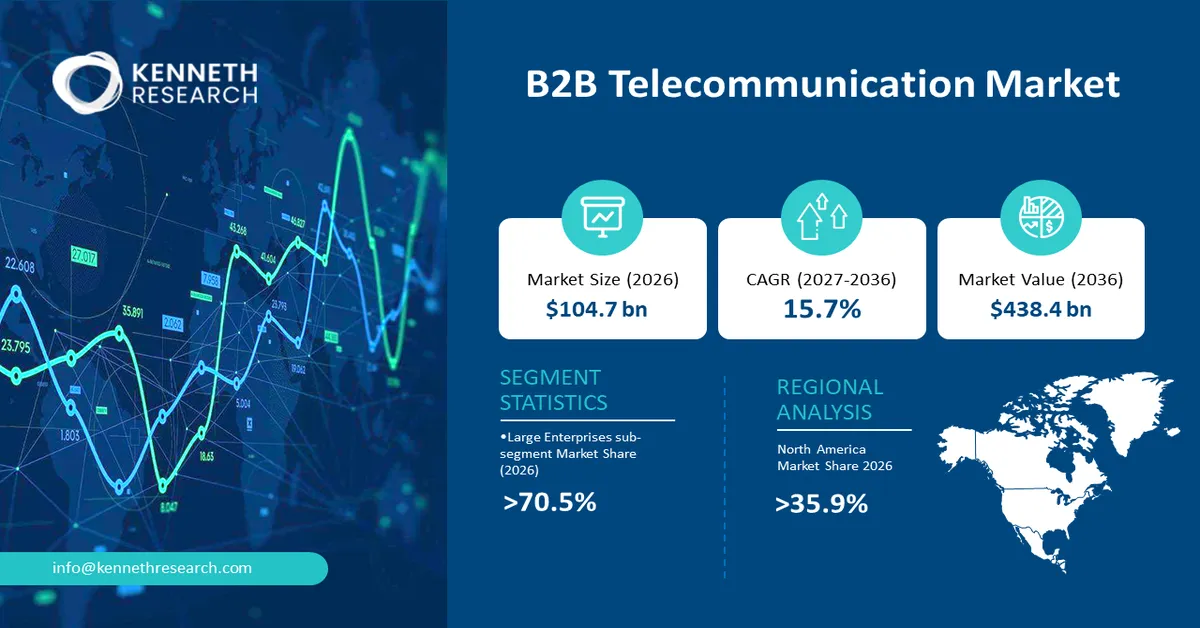
B2B Telecommunication Market size was valued at USD 104.7 billion in 2026 and is projected to reach USD 438.4 billion by the end of 2036, rising at a CAGR of 15.7% during the forecast period, i.e., 2027-2036. In 2027, the industry size of the B2B telecommunication is estimated at USD 120.8 billion.
The rapid adoption of cloud computing, artificial intelligence, IoT, and digital business platforms is driving demand for scalable B2B telecommunication services, as enterprises increasingly require high-capacity connectivity, secure communications, cloud access, and integrated network solutions to support distributed operations and digital transformation.
The B2B telecommunication market comprises communication services and connectivity solutions provided to businesses and organizations to support enterprise communications, digital operations, data exchange, and network infrastructure. The market encompasses telecommunications services designed for organizational requirements rather than individual consumers, including enterprise connectivity, voice and data communications, broadband, mobile services, managed networks, and other business-oriented communication solutions.
A key characteristic of the market is its emphasis on scalable, reliable, secure, and high-performance connectivity capable of supporting organizations with diverse operational requirements. B2B telecommunications increasingly integrates with cloud computing, Internet of Things (IoT), artificial intelligence, cybersecurity, and digital workplace technologies, enabling enterprises to manage distributed operations and connected business environments.
Key B2B Telecommunication Market Insights Summary:
Key Takeaways: Market Trends & Insights
- B2B telecommunication market projected to grow from USD 104.7 billion in 2026 to USD 438.4 billion by 2036 at a 15.7% CAGR
- North America accounted for the largest regional share at 35.9% in 2026, driven by mature telecommunications infrastructure, advanced enterprise connectivity, and continued investment in 5G and cloud-linked networks
- Large Enterprises will remain the leading enterprise segment with a 70.5% market share in 2026, supported by extensive demand for high-capacity connectivity, managed communication services, cloud integration, and secure enterprise infrastructure
- BFSI sector will continue to witness strong demand due to increasing reliance on secure, always-on connectivity for digital banking, payment processing, cloud applications, and distributed financial operations
Market Drivers
- Rapid adoption of cloud computing and cloud-based enterprise applications
- Expansion of IoT-enabled and digitally connected business operations
- Increasing deployment of 5G, private networks, and high-speed enterprise connectivity
- Growing demand for secure managed communications and integrated network services
Challenges
- Cybersecurity and Network Resilience Requirements
- High Infrastructure Investment and Technology Transition Costs
B2B Telecommunication Market Overview & Supply Chain
The B2B telecommunication market is expanding as businesses increasingly depend on reliable connectivity for cloud applications, digital collaboration, connected devices, cybersecurity, remote operations, and data-intensive workflows. The convergence of telecommunications with cloud computing, IoT, AI, and enterprise software is shifting connectivity from a basic communication utility toward an integrated business infrastructure layer. This trend is particularly relevant across manufacturing, financial services, retail, logistics, healthcare, and professional services, where continuous data exchange and low-latency communications support operational efficiency and digital transformation.
The supply chain begins with network infrastructure inputs, including optical fiber, networking equipment, radio-access equipment, servers, power systems, and specialized telecommunications hardware and software. These inputs are integrated by equipment manufacturers and network technology providers into connectivity, communications, cloud-networking, and managed-service solutions. Telecommunications operators then deploy and maintain fixed, mobile, fiber, wireless, and enterprise network infrastructure, while technology providers contribute orchestration, cybersecurity, cloud integration, analytics, and network-management capabilities.
B2B Telecommunication Market: Growth Drivers & Challenges
Growth Drivers:
- Expansion of cloud-based enterprise operations: The increasing migration of enterprise applications, storage, collaboration tools, and business processes to cloud environments is strengthening demand for high-performance telecommunications services. Cloud-dependent organizations require reliable broadband, dedicated connectivity, low-latency networks, secure data transmission, and managed network services to maintain access to distributed applications and digital resources. This is particularly important for large enterprises operating across multiple offices, data centers, production sites, and remote locations.
- Increasing adoption of connected and distributed business infrastructure: Businesses are deploying connected devices, industrial systems, digital workplaces, remote assets, and distributed operational platforms that require continuous communication between locations, machines, employees, customers, and cloud environments. This is increasing demand for scalable fixed and wireless connectivity, private networks, managed communications, and integrated network services. Manufacturing, logistics, retail, financial services, and professional enterprises are particularly dependent on dependable connectivity as their operations become more digitally interconnected.
Challenges:
- Cybersecurity and network resilience requirements: The increasing dependence of enterprises on telecommunications infrastructure is raising the consequences of network disruption, unauthorized access, and data compromise. Greater virtualization, cloud integration, open network architectures, and the deployment of 5G introduce additional security considerations across enterprise connectivity environments. Telecommunications providers must therefore continuously strengthen network monitoring, identity management, threat detection, encryption, and resilience capabilities while maintaining service performance.
- High infrastructure investment and technology transition costs: Telecommunications providers must continually invest in fiber, 5G, network virtualization, cloud integration, and other high-capacity infrastructure while managing the retirement of legacy technologies. The transition requires substantial capital expenditure, technical expertise, and coordination with customers and regulators. Operators also need to maintain service continuity while migrating enterprises from older connectivity technologies to newer infrastructure.
B2B Telecommunication Market Size and Forecast:
| Report Attribute | Details |
|---|---|
| Base Year |
2026 |
| Forecast Period |
2027-2036 |
| CAGR |
15.7% |
| Base Year Market Size (2026) |
USD 104.7 billion |
| Forecast Year Market Size (2036) |
USD 438.4 billion |
| Regional Scope |
|
B2B Telecommunication Market Segmentation Analysis:
Enterprises Type Segment Analysis
In the B2B telecommunication market, the large enterprises segment is anticipated to hold the largest share of 70.5% in 2026 under the by enterprise category.
Its dominance is supported by the extensive and complex connectivity requirements of multinational corporations, financial institutions, manufacturers, technology companies, and other organizations operating across multiple offices, facilities, data centers, and geographic markets.
Large enterprises typically require high-capacity fixed and wireless connectivity, dedicated networks, cloud connectivity, managed communication services, cybersecurity integration, and reliable network performance to support business-critical operations. Their greater IT budgets and ability to enter long-term service agreements also support adoption of advanced telecommunications solutions. This broad digital infrastructure dependence is expected to sustain demand for integrated enterprise telecommunications services as organizations expand cloud, AI, IoT, and distributed-work environments.
Vertical Type Segment Analysis
The BFSI sector is projected to remain a significant vertical within the B2B telecommunication market as banks, financial institutions, and insurers increasingly depend on secure, always-on communications for digital banking, payment processing, customer engagement, branch connectivity, cloud applications, and distributed operations. Financial institutions require high network availability and secure data transmission because even short service interruptions can affect transaction processing and customer-facing digital services. The rapid expansion of digital payments is further increasing the need for resilient telecommunications infrastructure connecting financial institutions with customers, payment platforms, merchants, and technology providers.
Our in-depth analysis of the B2B telecommunication market includes the following segments:
|
Segment |
Sub-segment |
|
By Solution |
|
|
By Enterprise Size |
|
|
By Vertical |
|
B2B Telecommunication Market Regional Insights:
North America Market Trends & Insights:
North America is anticipated to remain the dominant region in the B2B telecommunication market, accounting for 35.9% of the market in 2026.
Regional leadership is supported by mature telecommunications infrastructure, extensive enterprise connectivity requirements, advanced cloud and data-center ecosystems, and continued investment in 5G and next-generation network technologies. The region also benefits from strong demand for private wireless networks, managed connectivity, cybersecurity, and cloud-linked communications across financial services, technology, manufacturing, healthcare, retail, and government.
The U.S. represents the principal telecommunications market within North America, supported by large-scale enterprise demand, extensive broadband infrastructure, major technology ecosystems, and continued development of 5G and private wireless networks.
Canada complements regional growth through continued investment in high-speed telecommunications infrastructure, spectrum availability, and network reliability. Canada's government has identified reliable high-speed internet and next-generation wireless services such as 5G as important components of its digital economy and telecommunications strategy.
Asia-Pacific Market Trends & Insights:
Asia-Pacific is expected to remain a significant growth region in the B2B telecommunication market, supported by rapid digitalization, expanding enterprise connectivity requirements, 5G deployment, cloud adoption, data-center development, and increasing integration of telecommunications with industrial technologies. Governments across the region are strengthening digital infrastructure and encouraging the use of advanced connectivity in manufacturing, transportation, healthcare, energy, and other industries.
Japan represents an advanced enterprise telecommunications environment, supported by high digital infrastructure requirements, cloud and data-center expansion, 5G/Open RAN development, and government initiatives focused on resilient digital infrastructure.
China offers substantial opportunities through continued 5G infrastructure expansion and government-supported industrial applications. Its updated 5G action plan promotes industry virtual private networks across sectors including manufacturing, energy, healthcare, and education, while encouraging integration with cloud and edge-computing infrastructure.
Leading Companies Operating in the B2B Telecommunication Market:
Here is a list of upstream, downstream, and key players operating in the global B2B telecommunication market competitive ecosystem:
- AT&T (U.S.)
- Company Overview
- Business Strategy
- Key Product Offerings
- Financial Performance
- Key Performance Indicators
- Risk Analysis
- Recent Development
- Regional Presence
- SWOT Analysis
- Verizon (U.S.)
- Deutsche Telekom (Germany)
- Orange Business (France)
- Vodafone Business (U.K)
Recent Developments
- December 2025 – Verizon Business introduced 5G Network Slice – Enhanced Internet, a fixed-wireless business service using network slicing to provide SLA-backed performance and enhanced uplink capacity. The solution is designed for enterprise applications such as AI inference, computer vision, and machine learning that require continuous data movement between edge environments and cloud platforms.
- October 2025 – AT&T Business launched AT&T Express Waves, a high-capacity fiber solution designed for AI, cloud, and edge-computing workloads. The offering provides 100G or 400G wavelength options and rapid service activation between key U.S. metropolitan areas.
Frequently Asked Question
In 2026, the b2b telecommunication market exceeded USD 104.7 billion.
The B2B telecommunication market is projected to reach USD 438.4 billion by the end of 2036, expanding at a CAGR of 15.7% over the forecast period (2027-2036).
The major players in the market are AT&T, Verizon, Deutsche Telekom, Orange Business, and Vodafone Business.
In the by enterprise segment, the large enterprises sub-segment is anticipated to capture the largest market share of 70.5% in the future and exhibit lucrative growth opportunities during 2027-2036.
North America is projected to hold the largest market share of 35.9% by the end of 2026 and provide more business opportunities in the future.
Why Choose Kenneth Research ?
-
Insight with Impact : We don’t just gather data — we uncover stories, trends, and opportunities that fuel business growth.
-
Experts Who Get It : Our team speaks your industry’s language and knows what really matters to your customers and market.
-
Custom-Built for You : Forget one-size-fits-all. We craft research and consulting solutions as unique as your business vision.
-
Partners, Not Just Providers : We work with you, not for you — collaborating closely to turn insights into smart, strategic moves.
-
Results That Speak : Our work powers brands, startups, and industry leaders alike — with a track record of ideas that work in the real world.
Report ID: 1453 |
Published Date: 28 Sep 2026 |
Report Format: |
Delivery Timeline: 48-72 Business Hours

Copyright © 2025 Kenneth Research. All rights reserved. Terms of Use | Privacy Policy
