Report ID: 1349 |
Published Date: 10 Sep 2026 |
Report Format: |
Delivery Timeline: 48-72 Business Hours
Automotive Test Equipment Market Outlook:
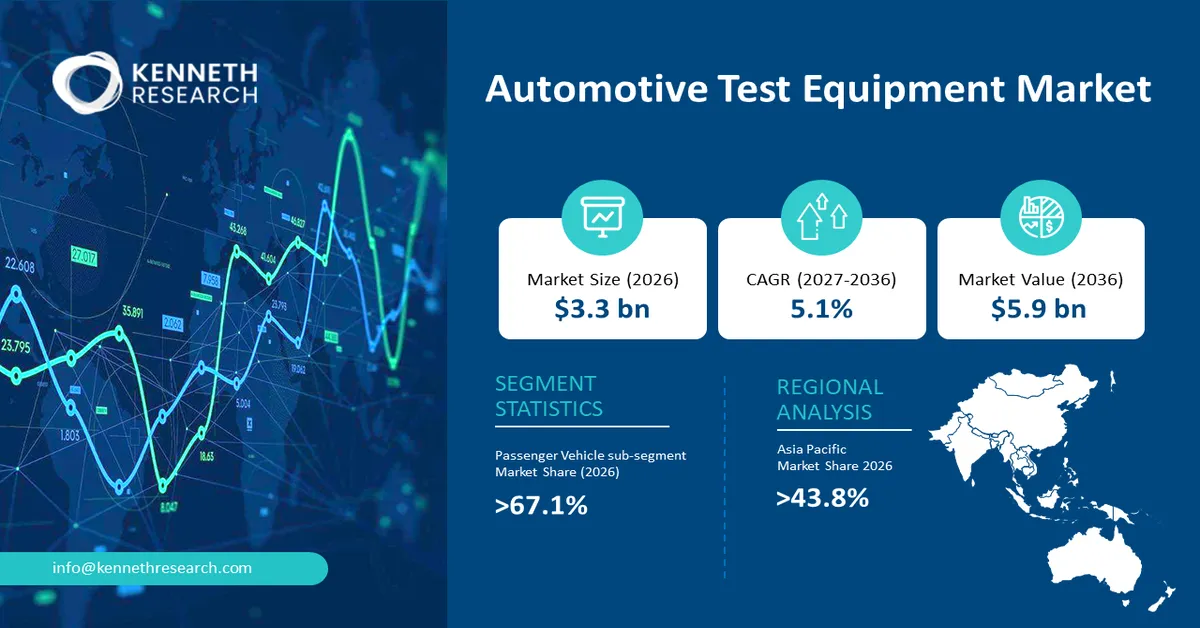
Automotive Test Equipment Market size was valued at USD 3.3 billion in 2026 and is projected to reach USD 5.9 billion by the end of 2036, rising at a CAGR of 5.1% during the forecast period, i.e., 2027-2036. In 2027, the industry size of the automotive test equipment is estimated at USD 3.5 billion.
The primary growth driver for the automotive test equipment market is the increasing complexity of modern vehicles and the growing need for comprehensive testing and diagnostics. The integration of advanced electronics, connected systems, driver-assistance technologies, and increasingly sophisticated powertrains requires accurate testing throughout vehicle development, manufacturing, servicing, and maintenance.
The automotive test equipment market refers to the industry comprising equipment, systems, and diagnostic tools used to evaluate, measure, validate, and troubleshoot the performance, functionality, safety, and reliability of automotive components, systems, and complete vehicles. These solutions are used across vehicle development, manufacturing, inspection, maintenance, and repair activities. Automotive test equipment includes diagnostic scan tools, dynamometers, emission testing systems, battery and electrical testing equipment, component testing systems, and other specialized measurement technologies.
Modern equipment increasingly incorporates computerized interfaces, software-based diagnostics, data acquisition, and connectivity capabilities to support increasingly complex vehicle architectures. The market serves automotive OEMs, component manufacturers, testing facilities, dealerships, independent repair workshops, and other service providers.
Key Automotive Test Equipment Market Insights Summary:
Key Takeaways: Market Trends & Insights
- Automotive test equipment market projected to grow from USD 3.3 billion in 2026 to USD 5.9 billion by 2036 at a 5.1% CAGR
- Passenger Vehicles are expected to remain the leading Vehicle Category segment, accounting for 67.1% of the market in 2026, driven by increasing demand for personal mobility, rising vehicle ownership, and growing consumer preference for comfortable and convenient transportation.
- PC/Laptop-Based Scan Tool is the key application segment, benefiting from software-driven diagnostics, broader vehicle-system coverage, real-time data analysis, functional testing, and the ability to receive software and diagnostic updates.
- Asia-Pacific remains the leading regional market share at 43.8% in 2026, supported by major automotive manufacturing ecosystems in China and Japan, increasing vehicle electronics content, electrification, and continued investment in automotive testing infrastructure.
Market Drivers
- Increasing vehicle electronics and diagnostic complexity
- Expansion of vehicle electrification
- Growing adoption of advanced driver-assistance and connected vehicle technologies
- Rising requirements for vehicle safety, quality, and performance validation
Challenges
- High Technological Complexity and Rapid Product Evolution
- High Equipment Costs and Integration Requirements
Automotive Test Equipment Market Overview & Supply Chain
The automotive test equipment market is supported by the continued expansion of vehicle manufacturing, increasing electronic content, and growing requirements for vehicle safety, reliability, and performance validation. Automotive manufacturers and component suppliers use testing and diagnostic equipment throughout development, production, inspection, and servicing to identify faults and verify system performance. The increasing complexity of vehicle architectures is also strengthening demand for computerized diagnostic systems and specialized testing solutions capable of evaluating electronic, mechanical, electrical, and powertrain systems.
The supply chain begins with suppliers of electronic components, sensors, measurement hardware, computing systems, mechanical components, and specialized materials. Test equipment manufacturers integrate these inputs into diagnostic tools, testing systems, measurement instruments, and software-enabled platforms. Manufacturers then distribute finished equipment through direct OEM relationships, specialized distributors, automotive service networks, and technology partners.
Automotive Test Equipment Market: Growth Drivers & Challenges
Growth Drivers:
- Increasing vehicle electronics and diagnostic complexity: Modern vehicles increasingly incorporate electronic control units, sensors, communication systems, advanced driver-assistance functions, and software-controlled features, making vehicle testing and diagnostics more complex. Automotive test equipment enables manufacturers and service providers to assess these systems, identify faults, validate performance, and ensure that electronic and mechanical components operate as intended. The shift toward connected and software-intensive vehicle architectures is therefore creating demand for more sophisticated diagnostic platforms, automated testing systems, and data-driven inspection tools.
- Expansion of vehicle electrification: The transition toward electric and hybrid vehicles is creating new testing requirements across batteries, electric motors, power electronics, charging systems, thermal-management systems, and high-voltage architectures. Unlike conventional vehicles, electrified platforms require specialized equipment capable of evaluating electrical performance, battery condition, charging behavior, thermal characteristics, and powertrain efficiency. This is expanding the addressable application base for automotive test equipment manufacturers and encouraging the development of equipment specifically designed for electrified powertrains.
Challenges:
- High technological complexity and rapid product evolution: Automotive test equipment manufacturers face increasing technological complexity as vehicle architectures incorporate interconnected electronic control units, advanced sensors, software-driven functions, and electrified powertrains. Testing systems must continuously evolve to remain compatible with new vehicle platforms, communication protocols, diagnostic architectures, and measurement requirements. This creates significant research, development, calibration, and software-maintenance requirements for equipment providers.
- High equipment costs and integration requirements: Advanced automotive test equipment can require substantial investment because sophisticated systems combine precision measurement hardware, diagnostic interfaces, software, sensors, data-processing capabilities, and specialized testing infrastructure. Integration requirements can further increase installation, calibration, training, and maintenance expenses. Smaller repair facilities and independent service providers may find it difficult to justify investment in highly specialized equipment when utilization levels are relatively low or when multiple vehicle technologies require different diagnostic capabilities.
Automotive Test Equipment Market Size and Forecast:
| Report Attribute | Details |
|---|---|
| Base Year |
2026 |
| Forecast Period |
2027-2036 |
| CAGR |
5.1% |
| Base Year Market Size (2026) |
USD 3.3 billion |
| Forecast Year Market Size (2036) |
USD 5.9 billion |
| Regional Scope |
|
Automotive Test Equipment Market Segmentation Analysis:
Vehicle Category Segment Analysis
In the vehicle category segment, the passenger vehicle sub-segment is anticipated to capture the largest market share of 67.1% in 2026.
The growing incorporation of advanced electronic functions and connected technologies is increasing the number of vehicle systems that require validation during development, manufacturing, inspection, and servicing. Passenger vehicle manufacturers also operate across diverse vehicle platforms, creating recurring demand for specialized testing equipment that can support component validation, end-of-line testing, fault detection, and system diagnostics. The increasing complexity of passenger vehicles is encouraging OEMs and component suppliers to adopt more sophisticated testing platforms capable of handling multiple vehicle systems and communication architectures.
Application Type Segment Analysis
The PC/Laptop-Based Scan Tool segment is projected to witness continued demand within the automotive test equipment market because these tools provide technicians with a flexible and software-driven approach to vehicle diagnostics. PC- and laptop-based platforms can connect with vehicle diagnostic interfaces and provide access to detailed system information, fault codes, live data, and diagnostic functions through specialized software. Their ability to support software updates also makes them adaptable to evolving vehicle architectures and diagnostic requirements.
Demand is being supported by the increasing electronic complexity of modern vehicles, which requires more comprehensive diagnostic capabilities across engine, transmission, braking, safety, body, and electronic control systems. PC-based solutions can also provide broader functionality than basic handheld diagnostic devices, making them suitable for professional workshops, dealerships, and specialized service facilities.
Our in-depth analysis of the global automotive test equipment market includes the following segments:
|
Segment |
Sub-segment |
|
Product Type |
|
|
Vehicle Category |
|
|
Application |
|
Automotive Test Equipment Market Regional Insights:
Asia-Pacific Market Trends & Insights:
Asia-Pacific is projected to remain the dominant regional market, accounting for 43.8% in 2026.
The region benefits from a large automotive manufacturing base, extensive vehicle production, established component supply chains, and increasing adoption of advanced vehicle technologies. These factors create sustained demand for testing and diagnostic equipment across vehicle development, manufacturing, quality control, inspection, and servicing. The region's expanding electrification and electronic integration also require specialized testing capabilities for batteries, power electronics, electrical systems, and software-controlled vehicle functions.
Japan represents a technologically advanced automotive market with strong capabilities in vehicle manufacturing, automotive electronics, precision engineering, and component development. Its sophisticated automotive ecosystem supports demand for testing systems used to validate vehicle performance, electronic systems, safety functions, and increasingly complex powertrain technologies.
China is a major contributor to regional demand because of its large-scale automotive manufacturing industry and rapid development of new-energy vehicles.
North America Market Trends & Insights:
North America is projected to remain an important secondary region for the automotive test equipment market, supported by its established automotive manufacturing ecosystem, extensive aftermarket service network, and strong demand for advanced vehicle diagnostics. The region has a mature base of vehicle manufacturers, component suppliers, dealerships, independent repair facilities, and testing organizations that require equipment for vehicle inspection, system diagnostics, component validation, and maintenance.
U.S. represents the principal market within North America, supported by a broad automotive manufacturing and servicing ecosystem. Demand for automotive test equipment is generated across.
Canada benefits from its integrated relationship with the broader North American automotive supply chain. Vehicle manufacturing, component production, dealerships, repair facilities, and aftermarket service networks create demand for diagnostic and testing technologies.
Leading Companies Operating in the Automotive Test Equipment Market:
Here is a list of upstream, downstream, and key players operating in the global automotive test equipment market competitive ecosystem:
- MAHA Maschinenbau Haldenwang GmbH & Co. KG (Germany)
- Company Overview
- Business Strategy
- Key Product Offerings
- Financial Performance
- Key Performance Indicators
- Risk Analysis
- Recent Development
- Regional Presence
- SWOT Analysis
- AVL List GmbH (Austria)
- HORIBA, Ltd. (Japan)
Recent Developments
- August 2026: MAHA began construction of a new research facility at its Haldenwang headquarters dedicated to ADAS testing technology for trucks and buses.
- June 2026: AVL released AVL Simulation Suite 2026 R1, adding new capabilities across vehicle and powertrain simulation and testing workflows. The release supports model development across different powertrain architectures and includes tools covering calibration, validation, and engineering applications.
Frequently Asked Question
In 2026, the automotive test equipment market exceeded USD 3.3 billion.
The automotive test equipment market is projected to reach USD 5.9 billion by the end of 2036, expanding at a CAGR of 5.1% over the forecast period (2027-2036).
The major players in the market are Robert Bosch GmbH, AVL List GmbH, HORIBA, Ltd., MAHA Maschinenbau Haldenwang GmbH & Co. KG, Snap-on Incorporated, and others.
In the vehicle category segment, the passenger vehicle sub-segment is anticipated to capture the largest market share of 67.1% in the future and exhibit lucrative growth opportunities during 2027-2036.
Asia-Pacific is projected to hold the largest market share of 43.8% by the end of 2026 and provide more business opportunities in the future.
Why Choose Kenneth Research ?
-
Insight with Impact : We don’t just gather data — we uncover stories, trends, and opportunities that fuel business growth.
-
Experts Who Get It : Our team speaks your industry’s language and knows what really matters to your customers and market.
-
Custom-Built for You : Forget one-size-fits-all. We craft research and consulting solutions as unique as your business vision.
-
Partners, Not Just Providers : We work with you, not for you — collaborating closely to turn insights into smart, strategic moves.
-
Results That Speak : Our work powers brands, startups, and industry leaders alike — with a track record of ideas that work in the real world.
Report ID: 1349 |
Published Date: 10 Sep 2026 |
Report Format: |
Delivery Timeline: 48-72 Business Hours

Copyright © 2025 Kenneth Research. All rights reserved. Terms of Use | Privacy Policy
