Report ID: 1257 |
Published Date: 01 Sep 2026 |
Report Format: |
Delivery Timeline: 48-72 Business Hours
Automotive Temperature Sensor Market Outlook:
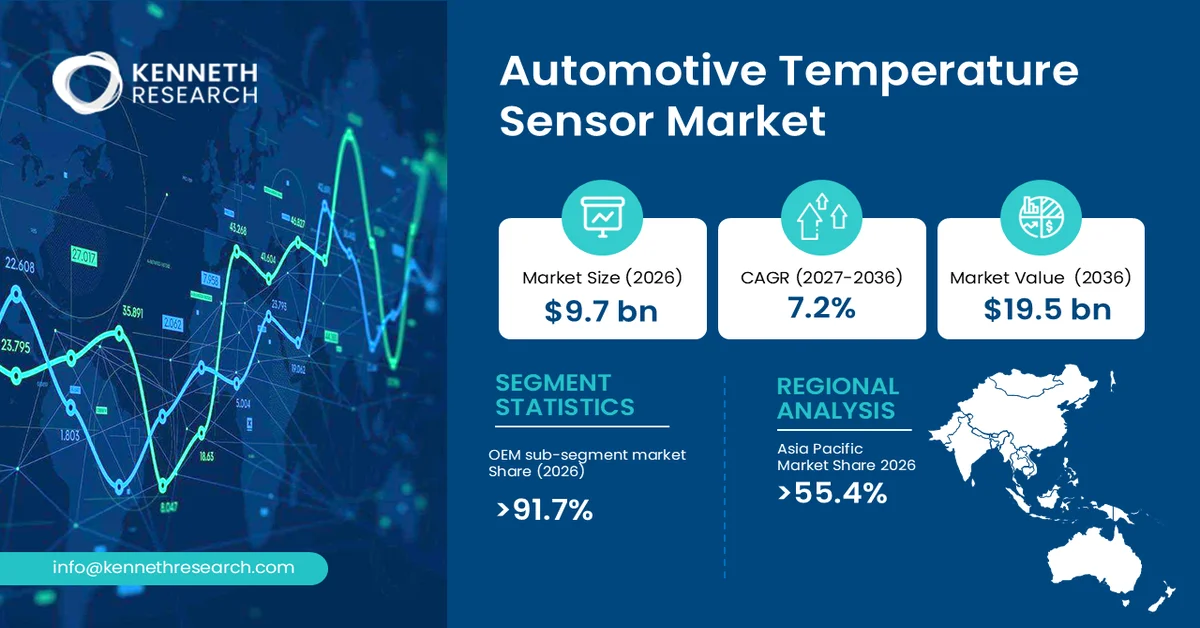
Automotive Temperature Sensor Market size was valued at USD 9.7 Billion in 2026 and is projected to reach USD 19.5 Billion by the end of 2036, rising at a CAGR of 7.2% during the forecast period, i.e., 2027–2036. In 2027, the industry size of the automotive temperature sensor is estimated at USD 10.4 Billion.
The primary growth driver is the automotive industry’s increasing emphasis on thermal efficiency, emissions control, and precise operating-temperature management. U.S. government data shows thermal-glass technology reached an 89% production share in model-year 2020 vehicles, illustrating broad adoption of technologies that manage vehicle heat and reduce energy demand across vehicle platforms.
The automotive temperature sensor market comprises sensors, sensing elements, and associated assemblies that detect and report temperature conditions within vehicle systems. These devices convert thermal changes into electrical signals used by electronic control units and thermal-management controllers. Typical monitoring points include engines, transmissions, exhaust after-treatment systems, cooling circuits, HVAC systems, batteries, power electronics, and other heat-sensitive components.
Key characteristics include accurate measurement across demanding temperature ranges, rapid response, durability under vibration and contaminants, compact packaging, and compatibility with vehicle electronic architectures. Depending on the application, temperature sensing can support closed-loop control, diagnostics, efficiency optimization, occupant comfort, and component protection.
Key Automotive Temperature Sensor Market Insights Summary:
Key Takeaways: Market Trends & Insights
- Automotive Temperature Sensor Market is valued at USD 9.7 billion in 2026 and is projected to reach USD 19.5 billion by 2036
- The market is expected to expand at a CAGR of 7.2% during 2027-2036
- OEM is the leading Sales Channel segment with a 91.7% market share in 2026
- Asia Pacific is the dominant region with a 55.4% market share in 2026
- Passenger Car is identified as the second and fastest-growing analysis segment within the Vehicle Type category
Market Drivers
- Expansion of electrified powertrains and battery thermal management
- Increasing electronic content and advanced thermal-control requirements
- Stricter vehicle-emissions and efficiency requirements
- Growth of connected diagnostics and predictive vehicle maintenance
Challenges
- Harsh operating environments and long-term sensor reliability
- Integration complexity across increasingly dense electronic architectures
Automotive Temperature Sensor Market Overview & Supply Chain
Adoption of automotive temperature sensors is increasing globally as vehicle architectures become more electronically controlled, energy-efficient, and thermally demanding. Temperature sensing is integral to monitoring and regulating engine, transmission, exhaust, battery, power-electronics, cabin, and thermal-management systems, supporting performance, reliability, emissions control, and preventive diagnostics. The transition toward electrified vehicles further expands the role of sensing technologies because battery packs and associated power electronics require continuous thermal monitoring to maintain operating efficiency and safety.
The automotive temperature sensor value chain begins with raw-material and component suppliers providing sensing elements, semiconductor materials, conductive metals, ceramics, polymers, glass, and protective substrates. Specialized sensor manufacturers then convert these inputs into thermistors, resistance temperature detectors, semiconductor-based devices, thermocouples, and integrated sensing assemblies through material processing, microelectronics fabrication, assembly, calibration, encapsulation, and quality testing. Component suppliers and Tier-1 automotive system manufacturers integrate sensors into thermal-management, powertrain, battery, HVAC, exhaust, and vehicle-control systems. Distribution occurs through direct OEM procurement, Tier-1 supply agreements, authorized distributors, and aftermarket channels. End users ultimately include passenger-vehicle manufacturers, commercial-vehicle producers, component integrators, repair networks, and vehicle owners.
Automotive Temperature Sensor Market - Growth Drivers & Challenges
Growth Drivers
- Expansion of electrified powertrains and battery thermal management: The accelerating deployment of electric and hybrid vehicles is increasing the need for accurate temperature monitoring across batteries, power electronics, electric motors, charging systems, and associated thermal-management circuits. Temperature sensors provide continuous inputs to battery-management and vehicle-control systems, enabling thermal regulation, performance optimization, fault detection, and protection against excessive heat. This requirement is particularly important because battery temperature influences operating performance, usable energy, component durability, and safety.
- Increasing electronic content and advanced thermal-control requirements: Growing electronic content in modern vehicles is creating broader requirements for temperature sensing across multiple subsystems. Conventional powertrains already depend on thermal measurements for engine, transmission, coolant, exhaust, and HVAC management, while electronically controlled vehicles add sensing requirements around power electronics, electric machines, battery systems, and cabin thermal functions. Temperature information enables control units to adjust operating conditions, protect components, identify abnormal thermal behavior, and maintain system efficiency. As automotive manufacturers pursue higher power density and increasingly compact vehicle architectures, effective thermal control becomes more important because components operate within tighter thermal envelopes.
Challenges
- Harsh operating environments and long-term sensor reliability: Automotive temperature sensors must maintain measurement accuracy despite thermal cycling, vibration, humidity, mechanical shock, corrosive exposure, and proximity to heat-generating components. The root cause is the combination of demanding vehicle operating environments with increasingly compact sensor packaging and higher electronic integration. Research published in Microelectronics Reliability identifies mechanical shock, thermo-mechanical stress, and humidity as important failure mechanisms affecting automotive sensor reliability. These conditions increase engineering requirements for protective materials, sealing, calibration stability, packaging, and validation. Commercially, suppliers face greater development and qualification burdens because sensor failures can trigger warranty exposure, vehicle-level diagnostics, component replacement, or reputational damage.
- Integration complexity across increasingly dense electronic architectures: The growing concentration of electronics within vehicles makes temperature-sensor integration more difficult because sensors increasingly operate alongside heat-generating processors, power electronics, communication hardware, and other sensing components. The root cause is limited physical space combined with competing requirements for thermal dissipation, electromagnetic compatibility, packaging protection, signal integrity, and measurement accuracy. A recent peer-reviewed study on automotive sensor thermal management highlights that compact sensor installations can create substantial thermal-management constraints, while conventional cooling approaches may be unsuitable in confined automotive environments. This complexity can increase design iterations, validation requirements, system-integration costs, and coordination between sensor suppliers and Tier-1 manufacturers.
Automotive Temperature Sensor Market Size and Forecast:
| Report Attribute | Details |
|---|---|
| Base Year |
2026 |
| Forecast Period |
2027-2036 |
| CAGR |
7.2% |
| Base Year Market Size (2026) |
USD 9.7 Billion |
| Forecast Year Market Size (2036) |
USD 19.5 Billion |
| Regional Scope |
|
Automotive Temperature Sensor Market Segmentation Analysis:
Sales Channel Segment Analysis
In the sales channel segment, the OEM sub-segment is anticipated to capture the largest market share of 91.7% by the end of 2026.
The OEM sales channel dominates the automotive temperature sensor market because temperature-sensing components are increasingly embedded during vehicle design and system integration rather than added later through replacement channels. OEM procurement enables sensor suppliers to meet vehicle-specific requirements for powertrain control, HVAC, exhaust monitoring, battery thermal management, and electronic control systems while maintaining compatibility with the vehicle’s software and diagnostics architecture. Demand is reinforced by continued vehicle production and new registrations across major automotive manufacturing economies. China’s Ministry of Public Security reported that 26.9 million automobiles were newly registered in 2024, providing a substantial flow of newly manufactured vehicles requiring factory-installed sensing components.
Vehicle Type Segment Analysis
The Passenger Car is projected to grow as the second-largest segment in the automotive temperature sensor market due to four converging demand drivers.
The passenger car segment is projected to grow as thermal sensing becomes increasingly important across conventional, hybrid, and battery-electric passenger vehicles. Demand is supported by the expanding use of electronic engine management, HVAC controls, battery systems, power electronics, and other thermally sensitive vehicle components. The shift toward electrified passenger cars further broadens sensor requirements because thermal monitoring extends beyond traditional engine applications to batteries, electric motors, inverters, and charging-related systems. On the supply side, sensor manufacturers benefit from established automotive electronics supply chains and OEM qualification processes, while increasing vehicle-electronics content encourages development of compact, durable, and responsive sensing technologies. Future growth should remain supported by electrification, greater vehicle-system integration, and increasingly sophisticated thermal-management architectures.
Our in-depth analysis of the global automotive temperature sensor market includes the following segments:
|
Segment |
Sub-segment |
|
Sensor Type |
|
|
Application |
|
|
Vehicle Type |
|
|
Sales Channel |
|
Automotive Temperature Sensor Market Regional Insights:
Asia Pacific Trends & Insights:
Asia Pacific automotive temperature sensor market is projected to hold the largest revenue share of 55.4% by the end of 2026.
It is supported by its concentration of vehicle manufacturing, component production, electronics capabilities, and expanding investment in electrified mobility. The region benefits from integrated automotive supply chains and strong manufacturing ecosystems across China, Japan, South Korea, and other production centers. Government-backed industrial policies supporting vehicle electrification, advanced manufacturing, and automotive technology further reinforce regional demand.
Within the region, China remains the principal manufacturing and consumption hub, supported by extensive vehicle production capacity, a deep domestic component ecosystem, and accelerating electrification. The country's expanding new-energy vehicle manufacturing base creates additional applications for temperature sensing across batteries, power electronics, motors, and charging systems.
Japan represents another strategically important market, supported by established automotive OEMs, sophisticated component suppliers, advanced manufacturing capabilities, and continued emphasis on vehicle efficiency and electrified powertrains. Together, these markets strengthen Asia Pacific's position as both a production center and technology-development base. Continued investment in electrification, intelligent vehicles, and localized component supply chains should sustain the region's strategic importance for temperature-sensor suppliers.
Europe Market Trends & Insights:
Europe represents an important secondary market for automotive temperature sensors because its established automotive manufacturing base is undergoing simultaneous electrification, digitalization, and regulatory transformation. Demand is supported by vehicle thermal-management requirements across conventional, hybrid, and electric platforms, while sophisticated OEM and Tier-1 ecosystems create opportunities for technically qualified sensor suppliers. The European Commission identifies automotive as a strategically important industrial sector and supports competitiveness, research and development, technical harmonization, connected mobility, and the European Battery Alliance.
Germany remains a key European automotive technology and manufacturing center, supported by major OEMs, Tier-1 suppliers, engineering capabilities, and a mature industrial ecosystem. The country's emphasis on vehicle electrification and advanced manufacturing supports demand for increasingly sophisticated thermal sensing across vehicle platforms.
France is strengthening its domestic automotive ecosystem through industrial and electrification initiatives. Its 2024–2027 strategic automotive-sector agreement prioritizes competitiveness, innovation, supply-chain resilience, and increased production of electrified vehicles, creating opportunities for component suppliers supporting next-generation vehicle architectures.
Leading Companies Operating in the Global Automotive Temperature Sensor Market:
Here is a list of upstream, downstream, and key players operating in the global automotive temperature sensor market competitive ecosystem:
- Bosch (Robert Bosch GmbH)
- Company Overview
- Business Strategy
- Key Product Offerings
- Financial Performance
- Key Performance Indicators
- Risk Analysis
- Recent Development
- Regional Presence
- SWOT Analysis
- Sensata Technologies
- TE Connectivity
- Infineon Technologies AG
- STMicroelectronics
- TDK Corporation
Recent Developments
- In July 2025, Bosch received the Best Automotive & Mobility Solution award at Sensors Converge 2025 for its SMP290 tire-pressure sensor module, the first single-chip TPMS solution with integrated Bluetooth 5.3 enabling real-time data transmission and over-the-air updates. The sensor combines high-accuracy pressure sensing, a 2-axis accelerometer, temperature monitoring, and encrypted BLE communication into a 3.5 x 4.5 mm package, with a 10-year battery life and ±5 kPa pressure accuracy.
- In October 2025, TE Connectivity introduced a new family of E-Motor Temperature Sensors for automotive and industrial applications, featuring both PT-type and NTC thermistor designs sealed and protected by fluoroplastics material. The sensors provide critical thermal feedback for electric vehicles and battery energy storage systems, with insulation resistance ≥100MΩ, dielectric strength of 3000VAC, and a temperature range of -40°C to +200°C.
Why Choose Kenneth Research ?
-
Insight with Impact : We don’t just gather data — we uncover stories, trends, and opportunities that fuel business growth.
-
Experts Who Get It : Our team speaks your industry’s language and knows what really matters to your customers and market.
-
Custom-Built for You : Forget one-size-fits-all. We craft research and consulting solutions as unique as your business vision.
-
Partners, Not Just Providers : We work with you, not for you — collaborating closely to turn insights into smart, strategic moves.
-
Results That Speak : Our work powers brands, startups, and industry leaders alike — with a track record of ideas that work in the real world.
Report ID: 1257 |
Published Date: 01 Sep 2026 |
Report Format: |
Delivery Timeline: 48-72 Business Hours

Copyright © 2025 Kenneth Research. All rights reserved. Terms of Use | Privacy Policy
