Report ID: 1261 |
Published Date: 01 Sep 2026 |
Report Format: |
Delivery Timeline: 48-72 Business Hours
Automotive Sensor Market Outlook:
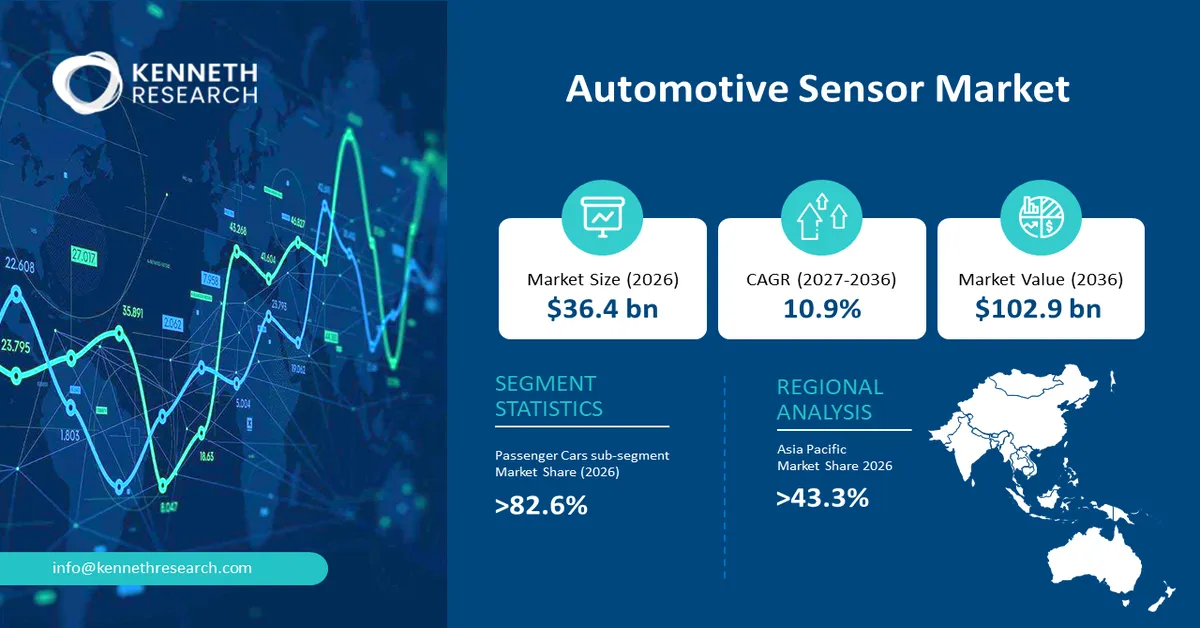
Automotive Sensor Market size was valued at USD 36.4 billion in 2026 and is projected to reach USD 102.9 billion by the end of 2036, rising at a CAGR of 10.9% during the forecast period, i.e., 2027-2036. In 2027, the industry size of the automotive sensor is estimated at USD 40.5 billion.
Rapid vehicle electrification is a primary growth driver for automotive sensors because electric powertrains require precise monitoring of battery temperature, voltage, current, charging conditions, and thermal performance. The IEA reports that global electric car sales exceeded 20 million in 2025, reinforcing the expanding deployment of sensor-intensive electric vehicle architectures.
The automotive sensor market comprises sensing devices, associated sensing technologies, and integrated sensor solutions used across passenger vehicles and other automotive platforms to detect, measure, and communicate physical or operational conditions within a vehicle. These devices convert parameters such as temperature, pressure, position, acceleration, speed, proximity, light, motion, and chemical characteristics into signals that vehicle electronic systems can process.
Automotive sensors are integral to modern vehicle architectures because they provide the real-time data required for powertrain management, chassis control, occupant protection, thermal management, body electronics, driver assistance, and vehicle connectivity. Depending on the application, sensor technologies can include pressure, temperature, inertial, ultrasonic, radar, image-based, magnetic, position, and environmental sensing.
Key Automotive Sensor Market Insights Summary:
Key Takeaways: Market Trends & Insights
- Automotive sensor market is valued at USD 36.4 Billion in 2026
- The market is projected to reach USD 102.9 Billion by 2036
- The market is expected to expand at a CAGR of 10.9% during 2027-2036
- Passenger Cars account for 82.6% market share in 2026 within the Vehicle Type segment
- Asia Pacific leads with 43.3% market share in 2026, supported by major automotive ecosystems in China and Japan
Market Drivers
- Accelerating vehicle electrification
- Expansion of advanced driver-assistance and automated vehicle functions
- Increasing integration of connected and software-defined vehicle architectures
- Stricter vehicle safety and emissions requirements driving electronic monitoring
Challenges
- Sensor Reliability and Environmental Performance
- Cybersecurity and System Integration Complexity
Automotive Sensor Market Overview & Supply Chain
Adoption of automotive sensors is increasing as vehicles become more electrified, connected, automated, and electronically controlled. Sensors provide the real-time measurements required for powertrain control, battery and thermal management, driver-assistance functions, vehicle safety, chassis systems, and connected-vehicle applications. Regulatory emphasis on intelligent-vehicle safety and the development of vehicle-road-cloud ecosystems is also increasing demand for sensing and data-acquisition capabilities.
The automotive sensor value chain begins with raw-material and component inputs, including semiconductor materials, silicon, metals, ceramics, polymers, magnets, optical components, and electronic substrates. Specialized suppliers convert these inputs into sensing elements, microelectromechanical systems, integrated circuits, packages, and electronic modules. Sensor manufacturers then undertake fabrication, assembly, calibration, testing, and quality validation before integrating products into application-specific sensing systems. Distribution typically occurs through direct relationships with vehicle manufacturers and Tier-1 suppliers, complemented by authorized component distributors and specialized electronics channels. End users primarily include passenger-vehicle and commercial-vehicle manufacturers, while downstream applications span powertrain management, safety systems, chassis control, body electronics, electrification, and advanced driver-assistance functions.
Automotive Sensor Market: Growth Drivers & Challenges
Growth Drivers:
- Accelerating vehicle electrification: The rapid transition toward electric and hybrid vehicles is strengthening demand for automotive sensors because electrified powertrains require continuous monitoring of battery condition, temperature, voltage, current, motor operation, charging performance, and thermal systems. This expands sensor content beyond conventional engine-management requirements and increases the importance of accurate, low-latency sensing for vehicle efficiency and safety. Electrification also creates opportunities for specialized battery-management, thermal, current, pressure, and position sensors. Going forward, increasingly sophisticated electric platforms should encourage suppliers to develop higher-accuracy, smaller, more integrated sensing solutions capable of operating reliably under demanding automotive conditions.
- Expansion of advanced driver-assistance and automated vehicle functions: The growing integration of advanced driver-assistance systems is another structural driver because functions such as adaptive cruise control, automated emergency braking, parking assistance, lane monitoring, and collision detection depend on continuous environmental and vehicle-state sensing. Radar, cameras, ultrasonic devices, inertial sensors, position sensors, and other technologies increasingly operate as interconnected perception systems rather than isolated components. This raises both the number and sophistication of sensing devices incorporated into vehicle architectures. Automakers and Tier-1 suppliers are consequently placing greater emphasis on sensor accuracy, redundancy, processing compatibility, functional safety, and operation across varied environmental conditions.
Challenges:
- Sensor reliability and environmental performance: Automotive sensors must maintain measurement accuracy despite vibration, temperature extremes, electromagnetic interference, contamination, moisture, mechanical shock, and rapidly changing operating conditions. The root cause is the increasing deployment of sensing technologies in demanding vehicle environments, where inaccurate or degraded signals can directly affect safety-critical functions. This creates substantial validation requirements for sensor manufacturers and Tier-1 suppliers, particularly when sensors support automated driving or advanced driver-assistance functions. Commercially, suppliers face higher engineering, qualification, testing, and warranty exposure, while automakers must manage additional system-level validation and redundancy requirements. NIST identifies automotive sensor characterization and system-level evaluation under representative real-world driving scenarios as important measurement-science needs.
- Cybersecurity and system integration complexity: The growing interconnection of sensors with electronic control units, vehicle networks, external communications, and software platforms creates a more complex security environment. Sensor data can become an attack pathway when malicious inputs, spoofed signals, or compromised interfaces influence safety-relevant vehicle functions. The root cause is the shift from relatively isolated electronic components toward interconnected, software-intensive vehicle architectures. This increases development complexity because sensor suppliers and automakers must address cybersecurity alongside functional performance, interoperability, diagnostics, and safety validation. Commercially, additional security engineering, testing, software maintenance, and compliance activities can extend development cycles and increase supplier qualification requirements.
Automotive Sensor Market Size and Forecast:
| Report Attribute | Details |
|---|---|
| Base Year |
2026 |
| Forecast Period |
2027-2036 |
| CAGR |
10.9% |
| Base Year Market Size (2026) |
USD 36.4 billion |
| Forecast Year Market Size (2036) |
USD 102.9 billion |
| Regional Scope |
|
Automotive Sensor Market Segmentation Analysis:
Vehicle Type Segment Analysis
In the vehicle type segment, the Passenger Car sub-segment is anticipated to capture the largest market share of 82.6% by the end of 2026.
Passenger cars dominate the automotive sensor market because they combine high production volumes with increasingly sophisticated electronic architectures. Consumer expectations for safety, comfort, connectivity, fuel efficiency, and automated driving are accelerating sensor integration across braking, powertrain, occupant protection, parking, climate control, and driver-assistance systems. On the supply side, passenger-vehicle platforms are increasingly designed around centralized electronic architectures, enabling manufacturers and Tier-1 suppliers to integrate multiple sensing functions into coordinated systems. This encourages demand for pressure, temperature, position, inertial, optical, radar, ultrasonic, and other sensing technologies. Electrification further expands sensing requirements through battery, motor, and thermal-management applications.
Sales Channel Segment Analysis
The OEM is projected to grow as the second-largest segment in the automotive sensor market due to four converging demand drivers.
The OEM sales channel is projected to grow as automakers increasingly embed sensors directly into vehicle platforms during original production rather than relying primarily on aftermarket replacement. Demand is being supported by electrification, advanced driver-assistance systems, centralized vehicle electronics, and greater integration of sensing functions into factory-installed systems. China’s Ministry of Industry and Information Technology reported that passenger-vehicle sales reached 27.563 million units in 2024, providing a substantial production base through which OEM-installed sensors enter new vehicles. OEM adoption is also being reinforced by closer collaboration among automakers, Tier-1 suppliers, semiconductor companies, and sensor manufacturers during vehicle-platform development. This enables sensors to be engineered around specific electronic architectures, safety requirements, software interfaces, and thermal conditions. On the supply side, standardized platforms and long-term sourcing relationships can improve component integration and production coordination.
Our in-depth analysis of the global automotive sensor market includes the following segments:
|
Segment |
Sub-segment |
|
Sensor Type |
|
|
Application |
|
|
Vehicle Type |
|
|
Sales Channel |
|
Automotive Sensor Market Regional Insights:
Asia Pacific Market Trends & Insights:
Asia Pacific automotive sensor market is projected to hold the largest revenue share of 43.3% by the end of 2026.
Asia Pacific remains the dominant regional market for automotive sensors, supported by its extensive vehicle manufacturing ecosystem, large consumer base, accelerating electrification, and expanding investment in intelligent and connected mobility. The region benefits from deep semiconductor and electronics supply chains, established automotive clusters, and government-backed initiatives supporting new-energy vehicles and advanced vehicle technologies.
China combines large-scale vehicle manufacturing with rapid deployment of electrified and intelligent vehicle technologies, creating opportunities for sensor suppliers across powertrain, battery, safety, chassis, and driver-assistance applications.
Japan contributes a technologically mature automotive ecosystem characterized by established automakers, sophisticated component suppliers, and continued investment in vehicle electronics. Its advanced manufacturing capabilities support demand for high-reliability sensing technologies and precision components. Together, China and Japan strengthen Asia Pacific’s position through complementary advantages: China provides manufacturing scale and expanding vehicle electrification, while Japan contributes engineering expertise, established supplier networks, and advanced automotive technology capabilities. These conditions should continue supporting regional sensor adoption as vehicle architectures become increasingly electronic, connected, and software-driven.
Europe Market Trends & Insights:
Europe represents a technologically advanced automotive environment where demand for sensors is supported by vehicle electrification, sophisticated safety systems, connected mobility, and the transition toward automated driving. The region combines established vehicle manufacturers, Tier-1 suppliers, semiconductor capabilities, engineering expertise, and extensive research infrastructure. Government initiatives are reinforcing this ecosystem: the European Commission’s Connected, Cooperative and Automated Mobility program supports research, innovation, standards, infrastructure pilots, and regulatory development.
Germany remains a key automotive technology center, combining major vehicle manufacturers with a dense network of component suppliers and engineering organizations. Its early deployment of automated-driving applications also supports demand for advanced sensing and perception technologies.
France is strengthening its position through national strategies for automated and connected road mobility, emphasizing integration of technologies into vehicle platforms, service operations, supervision systems, and safety validation. Together, Germany and France provide complementary opportunities: Germany offers strong vehicle engineering and industrial integration capabilities, while France provides a policy and innovation environment focused on connected and automated mobility.
Leading Companies Operating in the Global Automotive Sensor Market:
Here is a list of upstream, downstream, and key players operating in the automotive sensor market competitive ecosystem:
- Bosch (Robert Bosch GmbH) (Germany)
- Company Overview
- Business Strategy
- Key Product Offerings
- Financial Performance
- Key Performance Indicators
- Risk Analysis
- Recent Development
- Regional Presence
- SWOT Analysis
- Sensata Technologies (United States)
- TE Connectivity (Switzerland)
- Infineon Technologies AG (Germany)
- Murata Manufacturing Co., Ltd. (Japan)
Recent Developments
- In August 2025, Infineon Technologies launched the TLE480X family, its first single-chip eddy current position sensors achieving ASIL-D functional safety without requiring a second chip. The TLE4802, TLE4801, and TLE4803 serve applications including steering torque and angle, pedal travel, and wheel steering measurement. Built with ISO 26262 compliance and internal redundancy, the chips also meet ISO 11452-8:2015 stray magnetic field immunity standards—critical as electromagnetic interference increases in electrified vehicles.
- In November 2025, Murata Manufacturing expanded its NCU03 series NTC thermistors with two new 0603M size products, enabling PCB high-density mounting and miniaturization. The new products offer the same resistance and B-constant as Murata's existing 1005M size components, allowing design-in without changes, while supporting overheating detection in increasingly compact automotive electronics.
Frequently Asked Question
In 2026, the automotive sensor market exceeded USD 36.4 billion.
The automotive sensor market is projected to reach USD 102.9 billion by the end of 2036, expanding at a CAGR of 10.9% over the forecast period (2027-2036).
The major players in the market are Bosch (Robert Bosch GmbH), Sensata Technologies, TE Connectivity, Infineon Technologies AG, Murata Manufacturing Co., Ltd., and others.
In the Vehicle Type segment, the Passenger Car sub-segment is anticipated to capture the largest market share of 82.6% in 2026 and exhibit lucrative growth opportunities during 2027-2036. This growth trajectory is largely attributed to increasing vehicle electrification and the resulting demand for battery, thermal, powertrain, and safety sensing.
Asia Pacific is projected to lead the global automotive sensor market and currently holds the largest market share of 43.3% in 2026, providing more business opportunities in the future. Strong automotive manufacturing activity and accelerating vehicle electrification in China, combined with Japan’s advanced automotive technology and established supplier ecosystem, are fostering the region’s dominance.
Why Choose Kenneth Research ?
-
Insight with Impact : We don’t just gather data — we uncover stories, trends, and opportunities that fuel business growth.
-
Experts Who Get It : Our team speaks your industry’s language and knows what really matters to your customers and market.
-
Custom-Built for You : Forget one-size-fits-all. We craft research and consulting solutions as unique as your business vision.
-
Partners, Not Just Providers : We work with you, not for you — collaborating closely to turn insights into smart, strategic moves.
-
Results That Speak : Our work powers brands, startups, and industry leaders alike — with a track record of ideas that work in the real world.
Report ID: 1261 |
Published Date: 01 Sep 2026 |
Report Format: |
Delivery Timeline: 48-72 Business Hours

Copyright © 2025 Kenneth Research. All rights reserved. Terms of Use | Privacy Policy
