Report ID: 1234 |
Published Date: 14 Sep 2026 |
Report Format: |
Delivery Timeline: 48-72 Business Hours
Automotive Robotic Market Outlook:
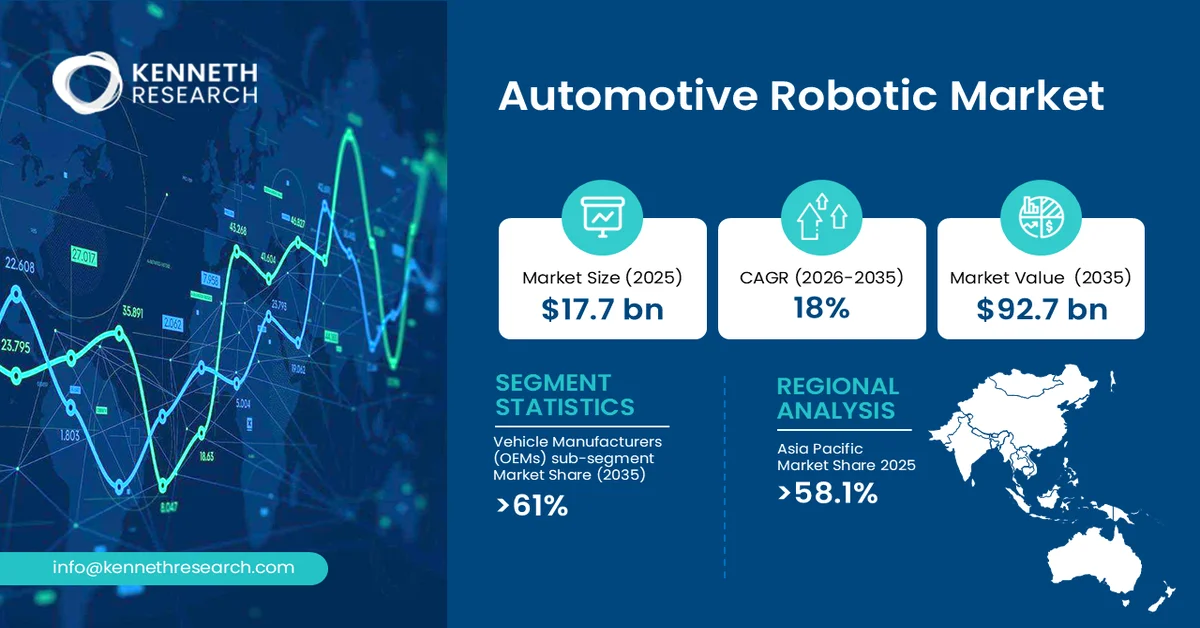
Automotive Robotic Market size was valued at USD 17.7 billion in 2025 and is projected to reach USD 92.7 billion by the end of 2035, rising at a CAGR of 18% during the forecast period, i.e., 2026-2035. In 2026, the industry size of the automotive robotic is estimated at USD 20.9 billion.
The primary growth driver of the automotive robotic market is the increasing adoption of automation across vehicle manufacturing to improve production efficiency, precision, throughput, and workplace safety.
The automotive robotic market comprises robotic systems, equipment, software, and related technologies deployed across automotive manufacturing and vehicle production environments to automate industrial processes. These systems include articulated robots, collaborative robots, SCARA robots, Cartesian robots, and other specialized robotic platforms designed to perform tasks such as welding, painting, assembly, material handling, machine tending, inspection, and quality control.
Automotive robots are characterized by high precision, repeatability, speed, programmable operation, and the ability to perform demanding or repetitive manufacturing tasks with consistent quality. Modern systems increasingly incorporate sensors, machine vision, artificial intelligence, and advanced control technologies, enabling manufacturers to optimize production workflows and respond to changing vehicle designs and manufacturing requirements.
Key Automotive Robotic Market Insights Summary:
Key Takeaways: Market Trends & Insights
- Automotive Robotic Market projected to grow from USD 17.7 billion in 2025 to USD 92.7 billion by 2035 at an 18% CAGR.
- Asia-Pacific accounted for the largest regional share at 58.1% in 2025, driven by strong automotive manufacturing activity, industrial automation, and robotics adoption across Japan and China.
- Vehicle Manufacturers (OEMs) will remain the leading End Use Type segment with a 61% market share, supported by extensive robotic deployment across welding, assembly, painting, material handling, and inspection.
- Articulated Robots are expected to maintain strong growth due to their multi-axis flexibility, precision, and suitability for complex automotive manufacturing operations.
Market Drivers
- Rising automation in automotive manufacturing
- Shift toward flexible and intelligent manufacturing
- Increasing adoption of robotics for electric vehicle production
- Growing integration of artificial intelligence, machine vision, and connected factory technologies
Challenges
- High integration complexity and implementation costs
- Skilled workforce and technical capability constraints
Automotive Robotic Market Overview & Supply Chain
The adoption of automotive robotics is increasing globally as vehicle manufacturers pursue higher production efficiency, consistent quality, workplace safety, and greater flexibility across increasingly complex manufacturing operations. Robotic systems are particularly relevant for welding, assembly, painting, material handling, inspection, and machine tending, while advances in sensing, machine vision, and intelligent control are expanding automation capabilities. Japan's Ministry of Economy, Trade and Industry reported that motor vehicles were the leading contributor to increased industrial production in January 2026, highlighting the continued importance of automotive manufacturing activity to the industrial sector and reinforcing the role of automation technologies in modern vehicle production.
The automotive robotic market value chain begins with suppliers of industrial motors, drives, controllers, sensors, actuators, robot arms, machine-vision systems, and specialized software. Robot manufacturers integrate these components into complete robotic platforms and configure systems for automotive production tasks such as welding, painting, assembly, material handling, and inspection. System integrators subsequently design production cells, program robotic workflows, install equipment, and connect robots with manufacturing execution and factory-control systems.
Automotive Robotic Market: Growth Drivers & Challenges
Growth Drivers:
- Rising automation in automotive manufacturing: The increasing automation of vehicle production is a major growth catalyst for the automotive robotic market. Automotive manufacturers are deploying robots across welding, painting, assembly, material handling, inspection, and machine-tending operations to improve precision, throughput, consistency, and workplace safety. The transition toward electric and software-defined vehicles is also encouraging manufacturers to modernize production lines and accommodate changing component architectures. According to the International Federation of Robotics, the U.S. automotive industry installed 13,700 industrial robots in 2024, reflecting continued investment in factory automation.
- Shift toward flexible and intelligent manufacturing: Automotive manufacturers are increasingly adopting flexible robotic systems as vehicle platforms become more diverse and production requirements change rapidly. Modern factories require automation that can handle multiple models, components, and manufacturing sequences without extensive equipment reconfiguration. This is increasing demand for programmable robots, collaborative systems, machine vision, advanced controllers, and software-enabled production cells. Articulated robots are particularly suited to complex multi-axis operations because they can perform varied movements within constrained production environments.
Challenges:
- High integration complexity and implementation costs: The integration of robotic systems into automotive production lines can require substantial engineering, programming, safety validation, tooling adaptation, and factory reconfiguration. This complexity becomes particularly pronounced when manufacturers attempt to connect robots with legacy machinery, machine-vision systems, manufacturing execution platforms, and other Industry 4.0 technologies. The resulting implementation burden can extend deployment timelines and increase the total cost of automation projects, particularly for manufacturers operating diverse production environments.
- Skilled workforce and technical capability constraints: The growing sophistication of automotive robotics is increasing the need for engineers and technicians capable of programming, integrating, maintaining, and optimizing automated production systems. Manufacturers must combine expertise across robotics, mechanical engineering, software, artificial intelligence, machine vision, controls, and industrial safety, creating a multidisciplinary skills requirement that can be difficult to satisfy. The challenge is particularly relevant as robotic systems transition from fixed automation toward connected and adaptive manufacturing environments.
Automotive Robotic Market Size and Forecast:
| Report Attribute | Details |
|---|---|
| Base Year |
2025 |
| Forecast Year |
2026-2035 |
| CAGR |
18% |
| Base Year Market Size (2025) |
USD 17.7 billion |
| Forecast Year Market Size (2035) |
USD 92.7 billion |
| Regional Scope |
|
Automotive Robotic Market Segmentation Analysis:
End Use Type Segment Analysis
In the End Use Type segment, the Vehicle Manufacturers (OEMs) sub-segment is anticipated to capture the largest market share of 61% by the end of 2035.
Automotive OEMs increasingly rely on robotic automation to achieve consistent quality, improve production flexibility, and support the complex manufacturing requirements associated with electric and software-intensive vehicles. China’s large automotive manufacturing base further strengthens demand for robotic systems. According to the National Bureau of Statistics of China, the country produced 31.559 million motor vehicles in 2024, with automotive manufacturing value added increasing by 9.1% year over year, demonstrating substantial industrial activity supporting automation demand. On the supply side, robotics manufacturers and system integrators are developing more flexible platforms, machine-vision capabilities, and connected automation solutions tailored to OEM production environments.
Robot Type Segment Analysis
In the Robot Type segment, the Articulated Robots sub-segment is projected to grow strongly due to their flexibility, multi-axis movement, precision, and suitability for complex automotive operations such as welding, painting, assembly, material handling, and machine tending. Automotive manufacturers increasingly favor articulated platforms because they can be integrated into automated production cells and adapted to different vehicle architectures. On the supply side, robotics manufacturers are enhancing articulated systems with improved controllers, sensors, machine vision, and intelligent software, enabling more flexible and connected manufacturing. Japan provides strong evidence of this demand trend: the International Federation of Robotics reported that the country’s automotive industry installed approximately 13,000 industrial robots in 2024, while articulated robots showed signs of recovery in Japan’s industrial robot orders.
Our in-depth analysis of the global automotive robotic market includes the following segments:
|
Segment |
Sub-segment |
|
Robot Type |
|
|
Component |
|
|
Application |
|
|
End User |
|
Automotive Robotic Market Regional Insights:
Asia Pacific Market Trends & Insights:
Asia Pacific accounted for 58.1% of the automotive robotic market in 2025, maintaining its position as the dominant regional market. The region benefits from a highly developed automotive manufacturing ecosystem, extensive industrial automation capabilities, established robotics supply chains, and continued investment in smart factories. Japan and China are particularly important because of their large vehicle production bases and strong robotics industries. Government initiatives supporting advanced manufacturing, industrial automation, electric mobility, and next-generation production technologies are further encouraging robotic deployment.
Japan remains a major center for automotive robotics because of its advanced vehicle manufacturing infrastructure, sophisticated industrial automation ecosystem, and strong domestic robotics industry. The Japanese automotive sector installed about 13,000 industrial robots in 2024, demonstrating continued investment in automated production.
China represents another major growth engine, supported by extensive vehicle manufacturing, expanding electric vehicle production, domestic robotics capabilities, and government-backed smart manufacturing initiatives. The country's large-scale manufacturing ecosystem provides substantial opportunities for robotic system manufacturers and integrators.
North America Market Trends & Insights:
North America represents a significant opportunity for the automotive robotic market, supported by established automotive manufacturing infrastructure, advanced automation capabilities, and continued investment in smart manufacturing. The region is increasingly focused on electrification, connected vehicles, factory modernization, and flexible automation, encouraging manufacturers to integrate robotics throughout production lines. Government-backed initiatives supporting advanced manufacturing and robotics are also strengthening the regional ecosystem. The U.S. Department of Commerce-supported Manufacturing USA network includes the Advanced Robotics for Manufacturing Institute, which focuses on advancing robotics and artificial intelligence in U.S. manufacturing.
The U.S. remains the principal contributor to regional demand, supported by its extensive automotive manufacturing base and strong investment in industrial automation. The automotive sector remained the country's largest industrial robot adopter in 2025, according to the International Federation of Robotics.
Canada complements regional growth through its integrated automotive supply chain, advanced manufacturing capabilities, and government support for vehicle electrification, automation, and connected technologies.
Leading Companies Operating in the Global Automotive Robotic Market:
Here is a list of upstream, downstream, and key players operating in the global automotive robotic market competitive ecosystem:
- FANUC Corporation (Japan)
- Company Overview
- Business Strategy
- Key Product Offerings
- Financial Performance
- Key Performance Indicators
- Risk Analysis
- Recent Development
- Regional Presence
- SWOT Analysis
- ABB Ltd.(Switzerland)
- Yaskawa Electric Corporation(Japan)
- KUKA AG(Germany)
Recent Developments
- July 2026 –Yaskawa announced the development of an agentic robot system integrating its MOTOMAN NEXT AI robot with Google DeepMind’s Gemini Robotics model.
- July 2026 –KUKA announced that its iiQKA.OS2 operating system and KR C5 controller platform achieved Security Level 2 certification under IEC 62443-4-2. The development strengthens cybersecurity and regulatory compliance for connected robotic production systems.
Frequently Asked Question
In 2025, the automotive robotic market exceeded USD 17.7 billion.
The automotive robotic market is projected to reach USD 92.7 billion by the end of 2035, expanding at a CAGR of 18% over the forecast period (2026-2035).
The major players in the market are FANUC Corporation, ABB Ltd., Yaskawa Electric Corporation, KUKA AG, Kawasaki Heavy Industries Ltd., and others.
In the End Use Type segment, the Vehicle Manufacturers (OEMs) sub-segment is anticipated to capture the largest market share of 61% in the future and exhibit lucrative growth opportunities during 2026–2035.
Asia-Pacific is projected to hold the largest market share of 58.1% by the end of 2035 and provide more business opportunities in the future.
Why Choose Kenneth Research ?
-
Insight with Impact : We don’t just gather data — we uncover stories, trends, and opportunities that fuel business growth.
-
Experts Who Get It : Our team speaks your industry’s language and knows what really matters to your customers and market.
-
Custom-Built for You : Forget one-size-fits-all. We craft research and consulting solutions as unique as your business vision.
-
Partners, Not Just Providers : We work with you, not for you — collaborating closely to turn insights into smart, strategic moves.
-
Results That Speak : Our work powers brands, startups, and industry leaders alike — with a track record of ideas that work in the real world.
Report ID: 1234 |
Published Date: 14 Sep 2026 |
Report Format: |
Delivery Timeline: 48-72 Business Hours

Copyright © 2025 Kenneth Research. All rights reserved. Terms of Use | Privacy Policy
