Report ID: 1258 |
Published Date: 01 Sep 2026 |
Report Format: |
Delivery Timeline: 48-72 Business Hours
Automotive RADAR Market Outlook:
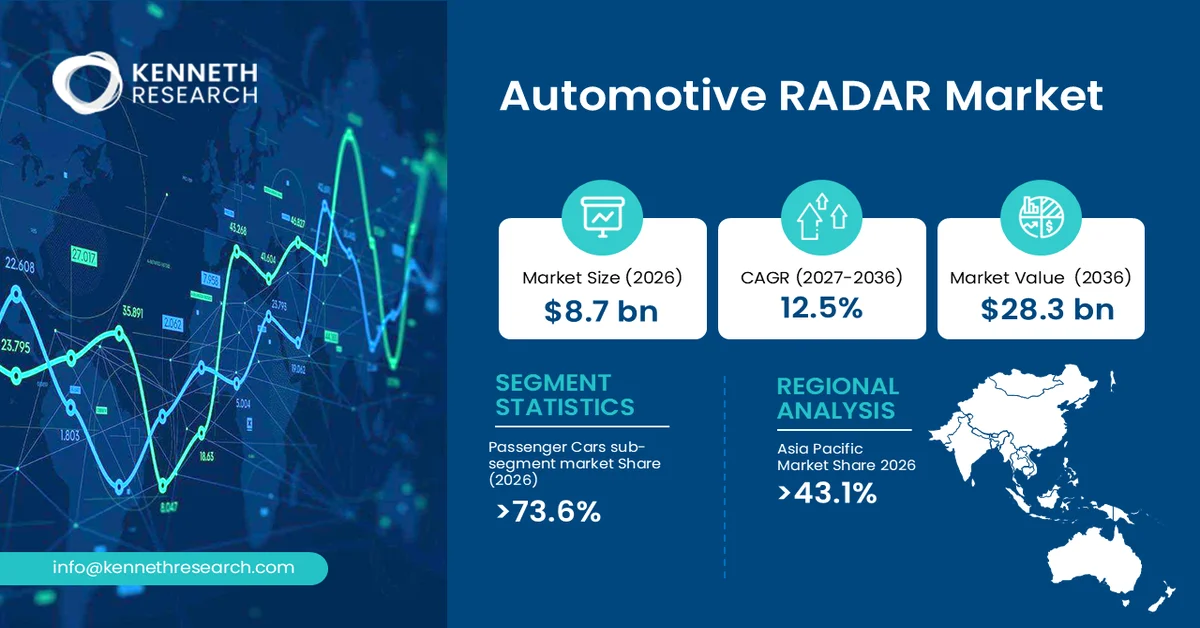
Automotive RADAR Market size was valued at USD 8.7 Billion in 2026 and is projected to reach USD 28.3 Billion by the end of 2036, rising at a CAGR of 12.5% during the forecast period, i.e., 2027–2036. In 2027, the industry size of the automotive RADAR is estimated at USD 9.8 Billion.
The primary growth driver for the automotive RADAR market is the accelerating integration of advanced driver assistance systems (ADAS) driven by vehicle-safety regulation and automaker efforts to improve collision avoidance. The European Commission’s General Safety Regulation mandates multiple driver-assistance technologies, strengthening demand for reliable environmental sensing across new vehicle platforms.
The automotive RADAR market comprises radar-based sensing hardware, software, and associated technologies designed for integration into road vehicles to detect and characterize surrounding objects and traffic conditions. Automotive radar uses radio-frequency signals to support perception of objects, including their relative position and movement, enabling vehicle systems to interpret the driving environment.
Key characteristics include sensing capability for collision-warning and avoidance functions, blind-spot monitoring, adaptive cruise control, and other advanced driver assistance systems (ADAS). Radar operates as a vehicle-based sensing technology and can complement other perception systems used for automated and assisted driving. Government safety research identifies radar-based collision-warning systems as an important category of vehicle-based crash-avoidance technology.
Key Automotive RADAR Market Insights Summary:
Key Takeaways: Market Trends & Insights
- The automotive RADAR market is valued at USD 8.7 billion in 2026 and is projected to reach USD 28.3 billion by 2036, reflecting a CAGR of 12.5% from 2027 to 2036
- Passenger Cars account for 73.6% of the automotive RADAR market in 2026, making Vehicle Type the leading segment category
- The 77 GHz frequency segment is projected to be the second and fastest-growing analysis segment, driven by increasing demand for advanced vehicle perception capabilities
- Asia Pacific holds the dominant regional position with 43.1% market share in 2026, supported by automotive manufacturing and technology development in China and Japan
- Europe represents the secondary region, with Germany and France serving as key automotive markets supporting radar adoption and advanced driver assistance development
Market Drivers
- Strengthening global ADAS regulation
- Increasing sensor integration for higher-level driving assistance
- Advancement of semiconductor and signal-processing technologies
- Expansion of radar-enabled safety and perception functions across vehicle platforms
Challenges
- Mutual radar interference and spectrum congestion
- Complex vehicle-level radar integration
Automotive RADAR Market Overview & Supply Chain
Global adoption of automotive radar is increasing as vehicle manufacturers integrate more advanced sensing capabilities into safety and driver-assistance architectures. Radar is particularly relevant to ADAS because it provides vehicle perception that can support functions such as forward collision warning, automatic emergency braking, and object detection. The technology is also gaining industrial importance as regulators and transportation agencies place greater emphasis on measurable safety performance and real-world validation of driver-assistance systems. In a 2025 study conducted through the U.S. Department of Transportation’s National Highway Traffic Safety Administration (NHTSA) Partnership for Analytics Research in Traffic Safety, automatic emergency braking was associated with a 52% reduction in front-to-rear crashes for model years 2021–2023. This evidence reinforces the safety value of the broader sensing and ADAS ecosystem in which automotive radar is deployed.
The automotive RADAR market value chain begins with specialized raw materials and electronic inputs, including semiconductor materials, radio-frequency components, antennas, substrates, packaging materials, connectors, and related electronic components. Component manufacturers and semiconductor suppliers convert these inputs into radar chipsets, transceivers, sensors, processors, and supporting circuitry. Radar-system manufacturers then integrate hardware, embedded software, signal-processing capabilities, and vehicle interfaces into complete sensing modules engineered for specific automotive applications. Distribution typically operates through direct supply agreements and automotive electronics channels connecting technology suppliers with Tier 1 automotive suppliers and vehicle manufacturers. Tier 1 suppliers integrate radar modules into broader ADAS and vehicle electronic architectures before supplying vehicle programs. End users are primarily passenger-vehicle and commercial-vehicle manufacturers, while final deployment occurs across new vehicles equipped with safety and driver-assistance functions.
Automotive RADAR Market: Growth Drivers & Challenges
Growth Drivers
- Strengthening global adas regulation: Regulatory expansion of advanced driver assistance systems is creating a structural demand driver for automotive radar because mandated safety functions require dependable environmental sensing. The European Commission states that the revised General Safety Regulation applies from 6 July 2022 and introduces mandatory advanced driver assistance systems while establishing an approval framework for automated and driverless vehicles. This regulatory direction encourages automakers to incorporate sensing technologies into vehicle platforms during initial engineering rather than treating them as optional upgrades. Radar is well positioned within this transition because it can provide information used by collision-warning, braking, lane-support, and other driver-assistance functions.
- Increasing sensor integration for higher-level driving assistance: The progression toward more capable driving-assistance architectures is increasing the technical importance of radar within vehicle perception systems. Modern ADAS platforms require continuous information about surrounding traffic and roadway conditions, encouraging manufacturers to combine complementary sensing technologies with increasingly sophisticated electronic control architectures. Radar can contribute robust object-detection and motion information while operating as part of a broader sensor-fusion framework. This creates opportunities for suppliers to improve radar resolution, signal processing, packaging, software integration, and communication with centralized vehicle computers. The industrial impact extends across semiconductor design, sensor engineering, embedded software, vehicle electronics, validation, and system integration, raising the strategic value of radar beyond an individual component.
Challenges
- Mutual radar interference and spectrum congestion: The growing density of radar-equipped vehicles creates a technically complex interference environment in which signals from neighboring vehicles or multiple sensors can disrupt target detection. The root cause is the simultaneous operation of radar systems within overlapping frequency, spatial, and temporal conditions, while differences in waveforms and sensor configurations complicate coordinated interference management. The commercial impact is significant because radar is increasingly embedded in safety-critical ADAS functions, requiring suppliers to invest in interference-resistant modulation, signal-processing algorithms, testing, and validation. This increases engineering expenditure and can lengthen development cycles for new radar platforms. It can also complicate performance guarantees across diverse traffic environments.
- Complex vehicle-level radar integration: Integrating radar into modern vehicle architectures remains a substantial engineering restraint because sensor performance can be affected by surrounding vehicle structures and electronic components. Bumpers, fascias, grilles, chassis elements, cables, and other nearby structures can influence electromagnetic propagation and alter radar behavior. The root cause is the interaction between high-frequency radar signals and the physical vehicle environment, making sensor placement, materials, packaging, and electromagnetic characteristics interdependent design considerations. Commercially, this can increase simulation, prototyping, calibration, and validation requirements and create additional coordination between radar developers, Tier 1 suppliers, and vehicle manufacturers. It may also constrain design flexibility when manufacturers seek compact or concealed sensor installations.
Automotive RADAR Market Size and Forecast:
| Report Attribute | Details |
|---|---|
| Base Year |
2026 |
| Forecast Period |
2027-2036 |
| CAGR |
12.5% |
| Base Year Market Size (2026) |
12.5% USD 8.7 Billion |
| Forecast Year Market Size (2036) |
USD 28.3 Billion |
| Regional Scope |
|
Automotive RADAR Market Segmentation Analysis:
Vehicle Type Segment Analysis
In the vehicle type segment, the Passenger Cars sub-segment is anticipated to capture the largest market share of 73.6% by the end of 2026.
Passenger cars dominate the automotive RADAR market because radar-enabled ADAS functions are increasingly embedded across high-volume consumer vehicle platforms. Demand is supported by growing emphasis on collision avoidance, adaptive cruise control, blind-spot monitoring, and automated braking, while regulatory requirements are encouraging manufacturers to integrate safety technologies into new passenger vehicles. The European Commission’s General Safety Regulation has strengthened this trend by requiring advanced safety functions, including lane-keeping and automated braking, for new cars and vans. Underlying passenger-car demand also provides a broad installation base for radar suppliers. Electrification, software-defined architectures, and increasing ADAS content are encouraging suppliers to develop compact, scalable radar modules compatible with diverse vehicle platforms.
Frequency Segment Insights
The 77 GHz is projected to grow as the second-largest segment in the automotive RADAR market due to four converging demand drivers.
The 77 GHz frequency segment is projected to expand as automakers prioritize radar architectures capable of delivering more precise environmental perception for advanced driver assistance and increasingly automated driving functions. Its growth is supported by the evolution toward higher-resolution sensing, greater object discrimination, and tighter integration with vehicle perception systems. Regulatory and spectrum-standardization activity also strengthens the supply environment: the European Union’s current ICT standardization roadmap identifies automotive radar systems operating across the 76–81 GHz band as an established ITS technology and references the corresponding ITU recommendation for automotive radar characteristics. This regulatory recognition supports ecosystem development by providing manufacturers and suppliers with a defined technical framework for radar deployment.
Our in-depth analysis of the global automotive RADAR market includes the following segments:
|
Segment |
Sub-segment |
|
Frequency |
|
|
Range |
|
|
Vehicle Type |
|
|
Application |
|
|
Technology |
|
|
Component |
|
Automotive RADAR Market Regional Insights:
Asia Pacific Market Trends & Insights:
Asia Pacific automotive RADAR market is projected to hold the largest revenue share of 43.1% by the end of 2026.
Regional leadership is supported by the concentration of vehicle manufacturing, strong domestic vehicle consumption, expanding electric-vehicle production, and sustained investment in intelligent and connected mobility technologies.
China represents the region’s principal manufacturing and consumption hub, supported by a large automotive industrial ecosystem and rapid vehicle electrification.
Japan contributes through established automotive OEMs, technology suppliers, engineering capabilities, and advanced vehicle-development programs. Together, these markets provide radar manufacturers with extensive OEM relationships, component-supply networks, testing capabilities, and opportunities to deploy sensing technologies across increasingly sophisticated vehicle architectures. Asia Pacific’s combination of manufacturing scale, technology investment, and policy support should sustain its strategic importance for automotive radar suppliers, particularly as automakers expand ADAS functionality and intelligent-vehicle platforms.
Europe Market Trends & Insights:
Europe represents a strategically important market for automotive radar, supported by mature automotive manufacturing capabilities, sophisticated vehicle-electronics ecosystems, and strong regulatory emphasis on road safety. Demand is being reinforced by the integration of ADAS into mainstream vehicle platforms and by regulatory requirements that make sensing-enabled safety functions increasingly central to vehicle development.
Germany is a major technology and manufacturing hub, with government policy explicitly focused on establishing the country as an innovation location for automated and connected driving. Its industrial base supports collaboration among automakers, suppliers, technology developers, and research institutions.
France combines a substantial automotive supply ecosystem with active government support for electrification and automated mobility. Its 2024–2027 automotive strategy emphasizes innovation and targets large-scale domestic electric-vehicle production, while national automated-driving policy supports safety validation and deployment frameworks.
Leading Companies Operating in the Global Automotive RADAR Market:
Here is a list of upstream, downstream, and key players operating in the automotive RADAR market competitive ecosystem:
- Aptiv PLC (Ireland)
- Company Overview
- Business Strategy
- Key Product Offerings
- Financial Performance
- Key Performance Indicators
- Risk Analysis
- Recent Development
- Regional Presence
- SWOT Analysis
- Texas Instruments Incorporated (United States)
- Calterah Semiconductor (China)
- smartmicro (Germany)
Recent Developments
- In September 2025, Calterah Semiconductor highlighted its Alps-Pro and Andes radar SoC series at AutoSens Europe 2025, featuring on-chip AI for real-time object detection, classification, and tracking directly within the radar. The company's advanced Radar Signal Processor 2.0 and multi-chip cascading capabilities enable longer detection ranges while maintaining accuracy.
- In 2025, Texas Instruments provided the AWR2944 radar sensor for a reference design collaboration with Provizio at CES 2025. The single-chip 77GHz 4D imaging radar system achieves sub 0.5° angular resolution by creating 48 virtual receiver channels through proprietary software-defined antenna technology.
Frequently Asked Question
In 2026, the automotive RADAR market was valued at USD 8.7 Billion.
The automotive RADAR market is projected to reach USD 28.3 Billion by the end of 2036, expanding at a CAGR of 12.5% over the forecast period (2027–2036).
The major players in the market are Aptiv PLC, Texas Instruments Incorporated, Calterah Semiconductor, smartmicro, and others.
In the Vehicle Type segment, the Passenger Cars sub-segment is anticipated to capture the largest market share of 73.6% in 2026 and exhibit lucrative growth opportunities during 2027–2036. This growth trajectory is largely attributed to increasing integration of advanced driver assistance systems across passenger-vehicle platforms.
Asia Pacific is projected to hold the largest market share of 43.1% in 2026 and provide more business opportunities in the future. Continuous automotive manufacturing activity and investment in intelligent-vehicle technologies across China and Japan are fostering the region's dominance.
Why Choose Kenneth Research ?
-
Insight with Impact : We don’t just gather data — we uncover stories, trends, and opportunities that fuel business growth.
-
Experts Who Get It : Our team speaks your industry’s language and knows what really matters to your customers and market.
-
Custom-Built for You : Forget one-size-fits-all. We craft research and consulting solutions as unique as your business vision.
-
Partners, Not Just Providers : We work with you, not for you — collaborating closely to turn insights into smart, strategic moves.
-
Results That Speak : Our work powers brands, startups, and industry leaders alike — with a track record of ideas that work in the real world.
Report ID: 1258 |
Published Date: 01 Sep 2026 |
Report Format: |
Delivery Timeline: 48-72 Business Hours

Copyright © 2025 Kenneth Research. All rights reserved. Terms of Use | Privacy Policy
