Report ID: 1262 |
Published Date: 01 Sep 2026 |
Report Format: |
Delivery Timeline: 48-72 Business Hours
Automotive Pressure Sensor Market Outlook:
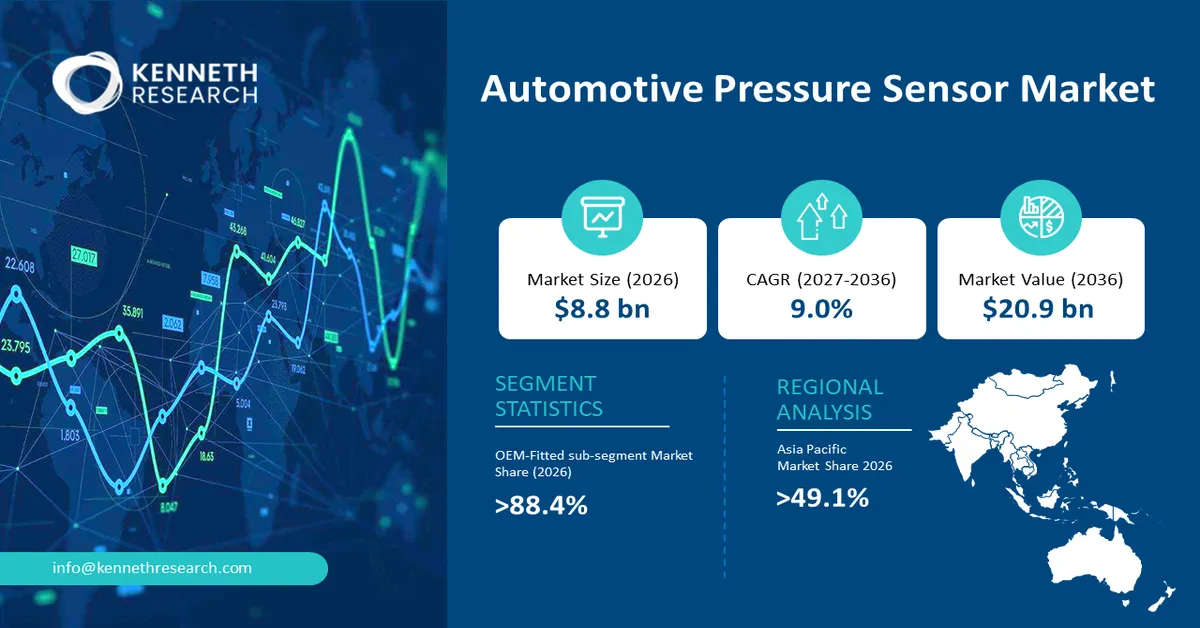
Automotive Pressure Sensor Market size was valued at USD 8.8 billion in 2026 and is projected to reach USD 20.9 billion by the end of 2036, rising at a CAGR of 9.0% during the forecast period, i.e., 2027-2036. In 2027, the industry size of the automotive pressure sensor is estimated at USD 9.6 billion.
Stricter vehicle-safety requirements and the expanding use of electronic monitoring systems are driving automotive pressure sensor demand. Regulatory emphasis on accurate tire-pressure monitoring, together with pressure measurement across braking, fuel, engine, transmission, and thermal systems, is increasing sensor integration as automakers pursue safer, more efficient, connected, and increasingly software-defined vehicles.
The automotive pressure sensor market comprises sensors and sensing assemblies that detect and convert pressure changes in vehicle systems into electrical signals for monitoring, control, warning, and diagnostic functions. These products measure pressures in applications such as tires, engine and fuel systems, braking, transmission, air conditioning, and other fluid or pneumatic circuits. Key characteristics include compact construction, fast response, measurement accuracy, resistance to temperature and vibration, and compatibility with electronic control architectures.
Technologies can include piezoresistive, capacitive, and microelectromechanical sensing approaches, with product designs tailored to the operating environment and required measurement conditions. The market is industrially relevant because pressure information supports vehicle safety, system performance, energy efficiency, emissions management, and predictive diagnostics. Government vehicle regulations also reinforce demand for reliable pressure-monitoring capabilities: European Union rules require vehicles to use accurate tire-pressure monitoring systems capable of warning drivers when tire pressure is lost, while UNECE Regulation No. 141 establishes approval provisions for tire-pressure monitoring systems.
Key Automotive Pressure Sensor Market Insights Summary:
Key Takeaways: Market Trends & Insights
- The automotive pressure sensor market is valued at USD 8.8 Billion in 2026
- The market is projected to reach USD 20.9 Billion by 2036 at a CAGR of 9.0%
- OEM-Fitted leads the Sales Channel segment with an 88.4% market share in 2026
- Asia Pacific dominates the market with a 49.1% market share in 2026
Market Drivers
- Electrification and expansion of vehicle sensing
- Increasing electronic content and vehicle-system integration
- Stringent vehicle safety and pressure-monitoring requirements
- Rising demand for advanced thermal, braking, and powertrain management systems
Challenges
- Harsh operating conditions and reliability requirements
- Cost pressure and complex automotive qualification
Automotive Pressure Sensor Market Overview & Supply Chain
Adoption of automotive pressure sensors is increasing globally as vehicles incorporate more electronically controlled systems requiring continuous measurement of operating conditions. Pressure sensing supports tire-pressure monitoring, engine management, braking, thermal management, fuel delivery, and other vehicle functions, making sensors increasingly relevant to safety, efficiency, diagnostics, and vehicle-control architectures. Electrification is also broadening sensing requirements across thermal and fluid-management systems. Regulatory attention to vehicle safety further reinforces demand for reliable pressure monitoring.
The automotive pressure sensor value chain begins with specialized inputs, including semiconductor materials, silicon wafers, sensing elements, metals, ceramics, polymers, packaging materials, and electronic components. Component manufacturers fabricate sensing structures, microelectromechanical elements, signal-conditioning circuits, housings, connectors, and protective interfaces before undertaking calibration, testing, and qualification. Sensor suppliers then integrate these components into application-specific products designed for automotive operating environments and communicate specifications through automotive qualification and engineering processes. Distribution typically operates through direct OEM relationships, automotive Tier 1 suppliers, authorized component distributors, and specialized electronics channels. End users include passenger-car and commercial-vehicle manufacturers, while replacement-market participants serve vehicle maintenance and repair requirements.
Automotive Pressure Sensor Market: Growth Drivers & Challenges
Growth Drivers:
- Electrification and expansion of vehicle sensing: Vehicle electrification is expanding the role of pressure sensing beyond conventional engine and fuel applications into battery thermal management, cooling circuits, heat pumps, braking systems, and other electronically controlled functions. As electric and hybrid platforms become more sophisticated, manufacturers require compact sensors capable of delivering reliable pressure information to electronic control systems. This creates additional sensing points per vehicle and encourages suppliers to develop products optimized for high-temperature, vibration, fluid, and electromagnetic operating environments.
- Increasing electronic content and vehicle-system integration: The increasing electronic content of modern vehicles is strengthening demand for sensors that provide continuous operating-condition data to electronic control units. Pressure measurements can be incorporated into multiple vehicle subsystems, allowing manufacturers to improve control precision, detect abnormal conditions, support diagnostics, and optimize system operation. This trend is reinforced by the migration toward connected and software-intensive vehicle architectures, where physical measurements increasingly serve as inputs for automated control and diagnostic functions. For pressure-sensor suppliers, greater system integration creates opportunities to develop application-specific devices with improved signal conditioning, communications capability, packaging, and functional reliability.
Challenges:
- Harsh operating conditions and reliability requirements: Automotive pressure sensors must maintain measurement integrity despite thermal cycling, vibration, pressure fluctuations, corrosive fluids, moisture, electromagnetic interference, and mechanical stress. The root cause is the placement of sensing components directly within demanding vehicle environments, where material properties, packaging interfaces, and electronic circuits can respond differently to changing conditions. These stresses increase engineering complexity because manufacturers must select compatible sensing materials, protective structures, bonding materials, and signal-conditioning architectures while maintaining stable performance throughout the vehicle lifecycle. Commercially, this raises development and validation burdens and can lengthen qualification cycles, particularly for sensors integrated into safety-relevant systems.
- Cost pressure and complex automotive qualification: Automotive pressure sensors face a difficult commercial balance between stringent performance expectations and aggressive component-cost targets. The root cause is the need to combine sensing elements, signal conditioning, packaging, connectors, protection, calibration, and application-specific interfaces within compact automotive assemblies. Qualification requirements further increase engineering effort because suppliers must demonstrate robustness across vehicle operating conditions and maintain consistent production quality. These demands can make design changes costly and restrict flexibility once a component has been approved for a vehicle platform. The commercial impact is particularly significant for suppliers competing for high-volume OEM programs, where modest component-price differences can affect sourcing decisions and margins. Looking ahead, manufacturers will need greater automation, process control, design standardization, and scalable architectures to reduce development and production costs while preserving reliability.
Automotive Pressure Sensor Market Size and Forecast:
| Report Attribute | Details |
|---|---|
| Base Year |
2026 |
| Forecast Period |
2027-2036 |
| CAGR |
9.0% |
| Base Year Market Size (2026) |
USD 8.8 billion |
| Forecast Year Market Size (2036) |
USD 20.9 billion |
| Regional Scope |
|
Automotive Pressure Sensor Market Segmentation Analysis:
Sales Channel Segment Analysis
In the sales channel segment, the OEM-Fittedsub-segment is anticipated to capture the largest market share of 88.4% by the end of 2026.
The OEM-fitted channel dominates because pressure sensors are increasingly designed into vehicles as integral components of factory-installed safety, powertrain, thermal-management, braking, and monitoring systems. Automakers and Tier 1 suppliers typically specify sensors during vehicle-platform development, allowing pressure measurement functions to be embedded directly into electronic control architectures rather than added after vehicle production. Demand is reinforced by expanding vehicle production and the growing electronic content of new models. China provides a strong indication of this factory-installation opportunity: according to China’s State Council Information Office, the country’s automobile industry recorded 34.531 million vehicles of total output in 2025, establishing a new production record. This large manufacturing base supports recurring OEM procurement of pressure-sensing components across new vehicle platforms.
Technology Segment Analysis
The Piezoresistive MEMS is projected to grow as the second-largest segment in the automotive pressure sensor market due to four converging demand drivers.
Piezoresistive MEMS is projected to grow as automotive manufacturers increase the integration of compact, semiconductor-based pressure sensing into powertrain, braking, tire, thermal-management, and safety systems. Its growth is supported by miniaturization, low power requirements, fast response, scalability, and the ability to integrate sensing with signal-processing electronics. On the supply side, semiconductor manufacturing capabilities and formal automotive-grade MEMS standardization can support broader commercialization. China’s current GB/T 44531-2024 standard specifically establishes technical specifications for automotive-grade MEMS pressure sensors. Future growth should benefit from greater vehicle electrification, electronic-system integration, and demand for compact, reliable sensing platforms.
Our in-depth analysis of the global automotive pressure sensor market includes the following segments:
|
Segment |
Sub-segment |
|
Technology |
|
|
Sales Channel |
|
|
PCB Type |
|
|
Vehicle Type |
|
|
Propulsion Type |
|
|
Level of Autonomy |
|
|
Substrate |
|
|
Application |
|
Automotive Pressure Sensor Market Regional Insights:
Asia Pacific Market Trends & Insights:
Asia Pacific automotive pressure sensor market is projected to hold the largest revenue share of 49.1% by the end of 2026.
Its leadership is underpinned by the region’s extensive automotive manufacturing ecosystem, strong vehicle demand, expanding electrification, and continued investment in advanced vehicle electronics. China remains a major production and consumption hub, while Japan contributes established automotive engineering capabilities and sophisticated supplier networks. Government-backed industrial policies supporting new-energy vehicles, manufacturing modernization, and automotive technology development further strengthen the regional environment for pressure-sensing technologies.
China represents a pivotal market within Asia Pacific, supported by its large automotive manufacturing base and rapidly expanding new-energy vehicle ecosystem.
Japan remains strategically important through its globally established automakers, advanced manufacturing capabilities, and emphasis on vehicle technology and component reliability. Together, China and Japan provide complementary demand and technology foundations that reinforce Asia Pacific’s position as the leading regional market for automotive pressure sensors.
Europe Market Trends & Insights:
Europe remains an important secondary market for automotive pressure sensors, supported by established vehicle manufacturing, sophisticated component supply chains, and demand for increasingly intelligent and electronically managed vehicles. Industrial activity is being reshaped by electrification, decarbonization, connected mobility, and tighter vehicle-performance requirements, creating opportunities for sensor suppliers across thermal management, braking, powertrain, battery, and safety applications. Government initiatives are also encouraging investment in cleaner mobility and more resilient automotive value chains.
Germany represents a key European automotive manufacturing center, with government policy focused on maintaining a competitive automotive and supplier base while accelerating electromobility, charging infrastructure, battery technologies, and connected and automated driving. These priorities support demand for advanced sensing solutions as vehicle architectures become more electronically integrated.
France is pursuing a similarly transformation-oriented strategy. Its automotive-sector framework emphasizes competitiveness, innovation, supply-chain resilience, electrification, workforce development, and decarbonized production. Government-backed programs targeting future vehicle technologies and components provide opportunities for sensor manufacturers and automotive suppliers able to support electrified and digitally enabled vehicle platforms.
Leading Companies Operating in the Global Automotive Pressure Sensor Market:
Here is a list of upstream, downstream, and key players operating in the automotive pressure sensor market competitive ecosystem:
- Robert Bosch GmbH (Germany)
- Company Overview
- Business Strategy
- Key Product Offerings
- Financial Performance
- Key Performance Indicators
- Risk Analysis
- Recent Development
- Regional Presence
- SWOT Analysis
- Sensata Technologies (United States)
- Infineon Technologies AG (Germany)
- TE Connectivity (Switzerland)
- TDK Corporation (Japan)
Recent Developments
- In March 2026, Bosch expanded its aftermarket air conditioning portfolio with the launch of 60 new pressure sensor part numbers across Europe, covering a majority of the European vehicle fleet for both combustion engine and electric/hybrid vehicles. Available in mechanical or electronic versions with integrated temperature measurement, the sensors undergo rigorous pressure and leakage tests before market introduction.
- In April 2026, Infineon Technologies unveiled the XENSIV™ KP497 smart barometric pressure sensor at Mouser Electronics, combining a precision pressure sensor, one-axis accelerometer, temperature sensing, and digital interface support in a single compact package. The AEC-Q100 Grade 1 qualified sensor features a pressure measurement range of 20–250 kPa with ±2 kPa accuracy, designed for demanding battery management systems to detect thermal runaway events in high-voltage battery packs.
Frequently Asked Question
In 2026, the automotive pressure sensor market exceeded USD 8.8 billion.
The automotive pressure sensor market is projected to reach USD 20.9 billion by the end of 2036, expanding at a CAGR of 9.0% over the forecast period (2027-2036).
The major players in the market are Robert Bosch GmbH, Sensata Technologies, Infineon Technologies AG, TE Connectivity, TDK Corporation, and others.
In the Sales Channel segment, the OEM-Fitted sub-segment is anticipated to capture the largest market share of 88.4% in the future and exhibit lucrative growth opportunities during 2027-2036. This growth trajectory is largely attributed to increasing vehicle production and the growing integration of electronic systems in vehicles.
Asia Pacific is projected to hold the largest market share of 49.1% and provide more business opportunities in the future. Strong automotive manufacturing activity and established technology capabilities across China and Japan are fostering the region's dominance.
Why Choose Kenneth Research ?
-
Insight with Impact : We don’t just gather data — we uncover stories, trends, and opportunities that fuel business growth.
-
Experts Who Get It : Our team speaks your industry’s language and knows what really matters to your customers and market.
-
Custom-Built for You : Forget one-size-fits-all. We craft research and consulting solutions as unique as your business vision.
-
Partners, Not Just Providers : We work with you, not for you — collaborating closely to turn insights into smart, strategic moves.
-
Results That Speak : Our work powers brands, startups, and industry leaders alike — with a track record of ideas that work in the real world.
Report ID: 1262 |
Published Date: 01 Sep 2026 |
Report Format: |
Delivery Timeline: 48-72 Business Hours

Copyright © 2025 Kenneth Research. All rights reserved. Terms of Use | Privacy Policy
