Report ID: 1276 |
Published Date: 01 Sep 2026 |
Report Format: |
Delivery Timeline: 48-72 Business Hours
Automotive PCB Market Outlook:
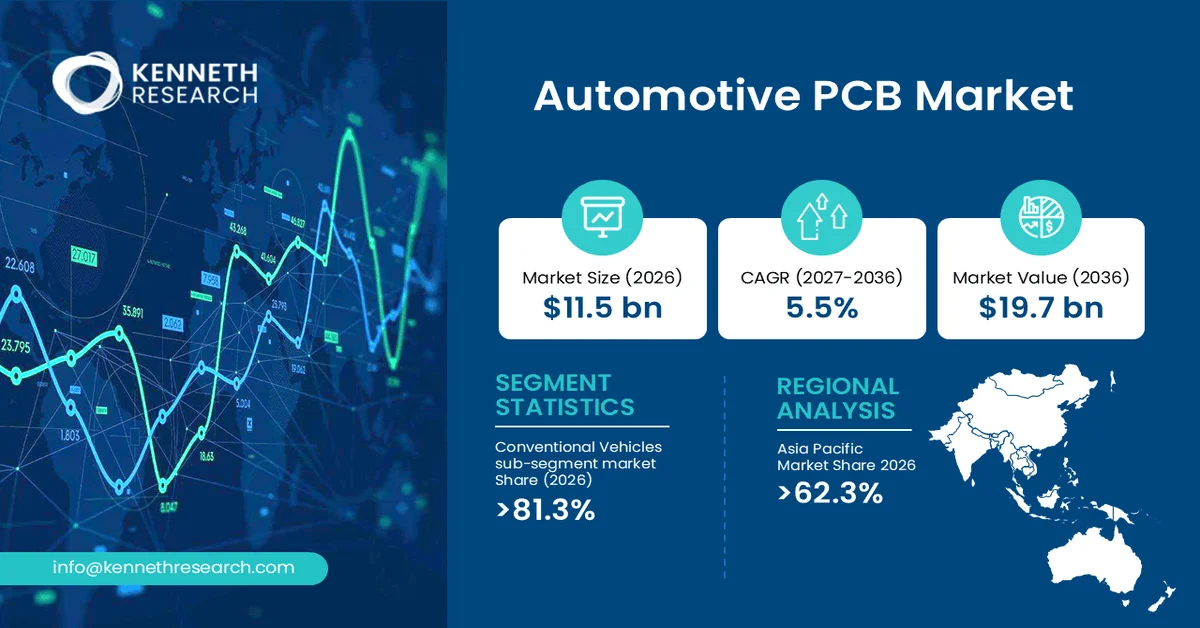
Automotive PCB Market size was valued at USD 11.5 billion in 2026 and is projected to reach USD 19.7 billion by the end of 2036, rising at a CAGR of 5.5% during the forecast period, i.e., 2027-2036. In 2027, the industry size of the automotive PCB is estimated at USD 12.2 billion.
The primary growth driver is the rapid electrification and increasing electronic content of vehicles, which expands PCB requirements across battery management, power electronics, control units, connectivity, safety, and driver-assistance systems. Global electric car sales exceeded 17 million units in 2024, demonstrating accelerating vehicle electrification and expanding demand for automotive electronic architectures.
The automotive PCB market comprises the design, manufacture, and supply of printed circuit boards used within automotive electrical and electronic systems. Automotive PCBs provide the physical and electrical foundation for mounting, interconnecting, controlling, and communicating electronic components throughout vehicles. They are incorporated into applications spanning power management, body electronics, infotainment, connectivity, safety systems, vehicle control, sensing, battery management, and advanced driver-assistance functions.
Key characteristics include requirements for high reliability, thermal resistance, mechanical durability, electrical performance, compact form factors, and compatibility with increasingly complex vehicle architectures. PCB configurations can vary according to application and substrate requirements, including rigid boards, flexible designs, and specialized constructions engineered for demanding automotive environments.
Key Automotive PCB Market Insights Summary:
Key Takeaways: Market Trends & Insights
- The automotive PCB market is valued at USD 11.5 billion in 2026 and is projected to reach USD 19.7 billion by 2036
- The automotive PCB market is expected to expand at a CAGR of 5.5% during 2027-2036
- Conventional vehicles account for 83.1% of the automotive PCB market in 2026 within the Level of Autonomy segment
- Asia Pacific dominates the automotive PCB market with a 62.3% market share in 2026
- Rigid PCBs including FR-4 and metal-core represent the second and fastest analysis segment within the Substrate category
Market Drivers
- Electrification of vehicle powertrains and expansion of battery-management electronics
- Increasing connectivity, infotainment, telematics, and vehicle networking requirements
- Growth of electronic control units and distributed vehicle architectures
- Increasing Electronic Content Across Electrified and Connected Vehicles
Challenges
- High reliability and qualification requirements
- Supply-chain complexity and material compatibility
Automotive PCB Market Overview & Supply Chain
Global adoption of automotive PCBs is increasing as vehicles incorporate more electrified powertrains, connected functions, sensing technologies, electronic control systems, and advanced driver-assistance capabilities. This transition increases the need for reliable circuit-board architectures capable of supporting higher electronic integration, power management, data processing, and vehicle control.
The automotive PCB value chain begins with raw-material inputs including copper foil, laminates, resins, glass fibre, specialty metals, soldering materials, and electronic components. Material suppliers provide the conductive, dielectric, thermal-management, and structural inputs required for automotive-grade board production. PCB manufacturers then undertake circuit imaging, etching, drilling, lamination, plating, surface finishing, inspection, and electrical testing, with process controls tailored to stringent automotive reliability requirements. Distribution typically operates through direct OEM relationships, Tier-1 and Tier-2 component suppliers, specialist electronics distributors, and contract manufacturing channels. End users include passenger-vehicle and commercial-vehicle manufacturers, while PCB assemblies are integrated into control modules, power electronics, infotainment, connectivity, safety, sensing, and electrification systems.
Automotive PCB Market: Growth Drivers & Challenges
Growth Drivers
- Expansion of advanced driver-assistance and vehicle safety electronics: The growing integration of advanced driver-assistance systems (ADAS) is increasing PCB demand because these functions require interconnected sensing, processing, control, and communication electronics. Camera, radar, braking, steering, and vehicle-control modules depend on circuit boards capable of supporting high-speed signal transmission, compact packaging, thermal management, and continuous operation under demanding automotive conditions. Regulatory intervention is reinforcing this trajectory. In 2024, the U.S. National Highway Traffic Safety Administration finalized Federal Motor Vehicle Safety Standard No. 127, requiring automatic emergency braking, including pedestrian AEB, as standard equipment on passenger cars and light trucks beginning in September 2029.
- Increasing electronic content across electrified and connected vehicles: Vehicle architectures are becoming progressively more dependent on distributed electronic control, connectivity, sensing, power conversion, and software-driven functionality. This structural shift expands PCB requirements because every additional electronic function requires dependable interconnection and control hardware. Electrified powertrains intensify the requirement further through battery-management, charging, inverter, thermal-management, and power-distribution electronics, while connected vehicles add communication and computing modules. For PCB manufacturers, this creates opportunities to supply higher-reliability boards engineered for thermal stress, vibration, electromagnetic compatibility, and compact packaging. It also encourages product development toward specialized rigid, metal-core, multilayer, and other application-specific constructions.
Challenges
- High reliability and qualification requirements: Automotive PCBs must operate reliably under thermal cycling, vibration, humidity, electromagnetic exposure, and sustained electrical loads, making material selection and manufacturing control considerably more demanding than for conventional electronics. The root cause is the safety-critical role of many automotive electronic systems, where latent defects can translate into vehicle malfunction or warranty exposure. This raises commercial costs through specialized laminates, tighter process controls, extensive validation, traceability, and customer-specific qualification requirements. It can also lengthen design-in cycles and create barriers for smaller PCB suppliers seeking automotive contracts.
- Supply-chain complexity and material compatibility: Automotive PCB production depends on coordinated availability of copper foils, laminates, resins, specialty substrates, plating chemicals, and electronic assembly inputs, while increasingly complex board designs require tighter compatibility among these materials. The root challenge is that different applications impose competing requirements for thermal performance, electrical characteristics, mechanical strength, manufacturability, and cost. Disruptions or substitutions can therefore trigger redesign, requalification, or customer approval requirements rather than straightforward component replacement. Commercially, this increases inventory-management complexity and can constrain supplier flexibility, particularly for manufacturers serving multiple vehicle programs with different specifications.
Automotive PCB Market Size and Forecast:
| Report Attribute | Details |
|---|---|
| Base Year |
2026 |
| Forecast Period |
2027-2036 |
| CAGR |
5.5% |
| Base Year Market Size (2026) |
USD 11.5 billion |
| Forecast Year Market Size (2036) |
USD 19.7 billion |
| Regional Scope |
|
Automotive PCB Market Segmentation Analysis:
Level of Autonomy Segment Analysis
In the level of autonomy segment, Conventional Vehicles sub-segment is anticipated to capture the largest market share of 83.1% by the end of 2026.
Conventional vehicles remain the leading application segment for automotive PCBs because internal-combustion powertrains continue to support extensive electronic architectures spanning engine management, transmission control, braking, body electronics, infotainment, connectivity, and safety systems. Demand is reinforced by the continued integration of electronic functions into established vehicle platforms, even as electrification expands. The U.S. Department of Energy reports that gasoline direct injection was incorporated into 73% of light-duty vehicles produced for the 2023 model year, illustrating the substantial penetration of electronically managed propulsion technologies within conventional vehicle production. From a supply perspective, PCB manufacturers benefit from mature automotive qualification processes, established Tier-1 supplier relationships, and proven board designs supporting high-volume conventional platforms.
Substrate Segment Analysis
The rigid (FR-4 and metal-core) is projected to grow as the second-largest segment in the Automotive PCB market due to four converging demand drivers.
Rigid PCBs, particularly FR-4 and metal-core constructions, are projected to expand rapidly because automotive electronic systems increasingly require mechanical stability, dependable electrical performance, and effective thermal management. Electrification is a major demand catalyst: battery-management systems, onboard chargers, inverters, power-control modules, and charging interfaces require robust circuit-board platforms capable of operating under elevated electrical and thermal stresses. PCB producers are therefore investing in higher thermal performance, multilayer integration, miniaturization, and manufacturing consistency. As electrified and electronically controlled vehicles gain adoption, rigid boards should remain strategically important, with metal-core solutions gaining particular relevance in high-power and thermally demanding applications.
Our in-depth analysis of the automotive PCB market includes the following segments:
|
Segment |
Sub-segment |
|
PCB Type |
|
|
Vehicle Type |
|
|
Propulsion Type |
|
|
Level of Autonomy |
|
|
Substrate |
|
|
Application |
|
Automotive PCB Market Regional Insights:
Asia Pacific Market Trends & Insights:
Asia Pacific automotive PCB market is projected to hold the largest revenue share of 62.3% by the end of 2026.
Its leadership is underpinned by the region’s concentration of automotive manufacturing, electronics supply chains, and vehicle-component production. Strong demand for electronic control systems, electrification technologies, and increasingly connected vehicle platforms supports PCB consumption across both established and emerging automotive programs. The region also benefits from substantial manufacturing investment and policy support for advanced automotive and semiconductor ecosystems.
China represents the region’s principal automotive manufacturing engine, supported by extensive domestic production, a large vehicle market, and rapid electrification.
Japan remains another strategically important market, supported by established automotive OEMs, sophisticated electronics capabilities, and a mature supplier network. Together, China and Japan strengthen Asia Pacific’s position across vehicle production, automotive electronics development, and PCB procurement.
North America Market Trends & Insights:
North America presents a strategically important environment for automotive PCB demand, supported by established vehicle manufacturing, expanding electrification, and increasing emphasis on localized automotive supply chains. Industrial activity is shifting toward advanced vehicle platforms, battery systems, connected technologies, and higher-value electronic components, creating opportunities for PCB suppliers with capabilities in reliability, miniaturization, thermal management, and automotive-grade qualification.
The United States remains the region’s principal automotive manufacturing and technology hub, with opportunities concentrated around advanced vehicle components, electrification, battery systems, and connected-vehicle architectures. Federal support for automotive manufacturing modernization is creating additional opportunities for PCB producers serving evolving vehicle electronics requirements.
Canada complements the regional ecosystem through automotive manufacturing, critical-mineral resources, battery development, and connected and autonomous vehicle initiatives. Its federal government has positioned EV supply-chain development as a strategic industrial priority, supporting opportunities across vehicle production and component ecosystems.
Leading Companies Operating in the Global Automotive PCB Market:
Here is a list of upstream, downstream, and key players operating in the automotive PCB competitive ecosystem:
- Meiko Electronics Co., Ltd. (Japan)
- Company Overview
- Business Strategy
- Key Product Offerings
- Financial Performance
- Key Performance Indicators
- Risk Analysis
- Recent Development
- Regional Presence
- SWOT Analysis
- Compeq Manufacturing Co., Ltd. (Taiwan)
- Daeduck Electronics Co., Ltd. (South Korea)
- Kingboard Holdings Limited (Hong Kong)
Recent Developments
- In 2025, Kingboard Holdings began expanding its PCB production capacity by 2.5 million square feet per year at its Kaiping City facility, focusing on multi-layer PCBs and HDI PCBs for high-end AI and automotive applications, with production scheduled to commence in the first half of 2027. The company is also constructing new PCB factories in Vietnam and Thailand to meet growing overseas demand for automotive and AI-related products.
- In May 2026, Meiko Electronics reported record financial results for fiscal year 2025, with revenue up 16.3% year-on-year to ¥240.6 billion. Automotive PCB revenue grew 8% to ¥97.5 billion, driven by rising vehicle electrification demand, while the company forecasts automotive PCB revenue to reach ¥100 billion in fiscal year 2026.
Frequently Asked Question
In 2026, the automotive PCB market exceeded USD 11.5 billion.
The automotive PCB market is projected to reach USD 19.7 billion by the end of 2036, expanding at a CAGR of 5.5% over the forecast period (2027-2036).
The major players in the market are Meiko Electronics Co., Ltd., Compeq Manufacturing Co., Ltd., Daeduck Electronics Co., Ltd., Kingboard Holdings Limited, and others.
In the Level of Autonomy segment, the Conventional Vehicles sub-segment is anticipated to capture the largest market share of 83.1% in the future and exhibit lucrative growth opportunities during 2027-2036. This growth trajectory is largely attributed to continued demand for electronic systems across conventional vehicle platforms.
Asia Pacific is projected to hold the largest market share of 62.3% by the end of 2036 and provide more business opportunities in the future. Continuous automotive manufacturing activity and established electronics supply chains in China and Japan are fostering the region's dominance.
Why Choose Kenneth Research ?
-
Insight with Impact : We don’t just gather data — we uncover stories, trends, and opportunities that fuel business growth.
-
Experts Who Get It : Our team speaks your industry’s language and knows what really matters to your customers and market.
-
Custom-Built for You : Forget one-size-fits-all. We craft research and consulting solutions as unique as your business vision.
-
Partners, Not Just Providers : We work with you, not for you — collaborating closely to turn insights into smart, strategic moves.
-
Results That Speak : Our work powers brands, startups, and industry leaders alike — with a track record of ideas that work in the real world.
Report ID: 1276 |
Published Date: 01 Sep 2026 |
Report Format: |
Delivery Timeline: 48-72 Business Hours

Copyright © 2025 Kenneth Research. All rights reserved. Terms of Use | Privacy Policy
