Report ID: 1260 |
Published Date: 01 Sep 2026 |
Report Format: |
Delivery Timeline: 48-72 Business Hours
Automotive LiDAR Market Outlook:
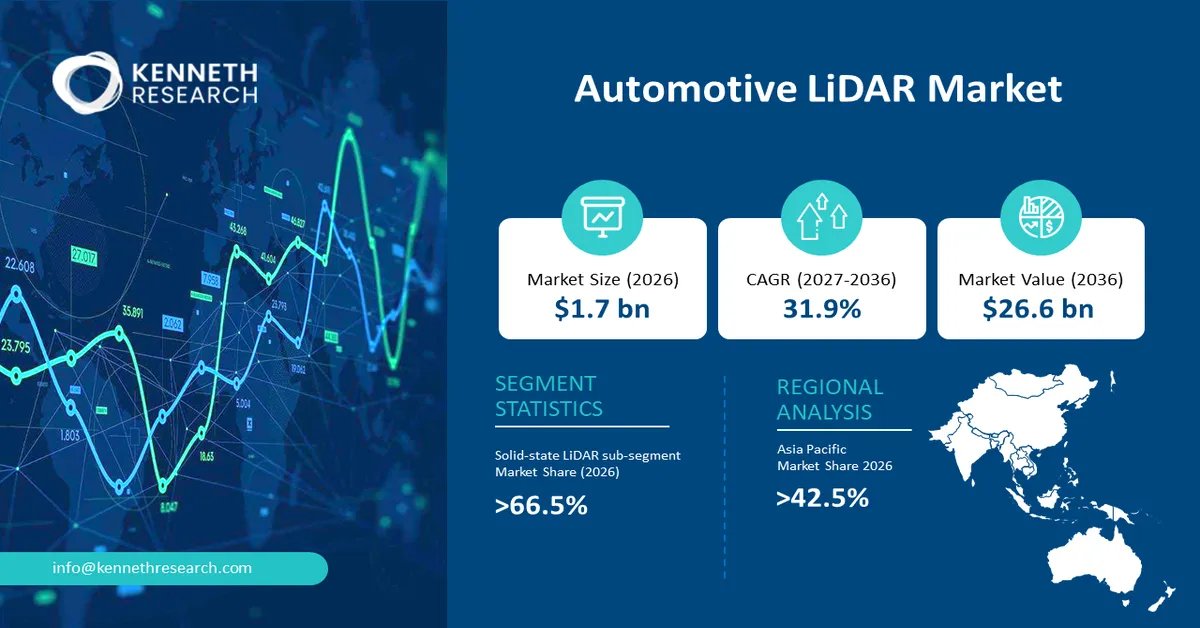
Automotive LiDAR Market size was valued at USD 1.7 billion in 2026 and is projected to reach USD 26.6 billion by the end of 2036, rising at a CAGR of 31.9% during the forecast period, i.e., 2027-2036. In 2027, the industry size of the automotive LiDAR is estimated at USD 2.2 billion.
The primary growth driver for the automotive LiDAR market is the accelerating deployment of advanced driver-assistance and automated-driving technologies. LiDAR provides high-resolution three-dimensional environmental perception, complementing cameras and radar, while advances in compact solid-state architectures are improving integration, reliability, and commercial viability for vehicle platforms.
The automotive LiDAR market comprises LiDAR sensing hardware and associated automotive-grade components used in vehicles to detect, measure, and map surrounding objects and environments. LiDAR—Light Detection and Ranging—emits infrared light pulses and measures their reflections to generate detailed three-dimensional representations of the vehicle’s surroundings. This enables perception of object position, distance, shape, and spatial relationships, supporting vehicle sensing and decision-making functions.
Key characteristics include high spatial resolution, three-dimensional environmental mapping, operation using infrared wavelengths, and increasing integration of compact, chip-scale and solid-state architectures. Government-backed technology research identifies solid-state approaches as addressing earlier LiDAR constraints involving size, integration complexity, reliability, and cost, thereby supporting greater suitability for automotive deployment.
Key Automotive LiDAR Market Insights Summary:
Key Takeaways: Market Trends & Insights
- Solid-state LiDAR leads the Technology segment with a 66.5% market share in 2026, supported by compact architecture, reliability and easier automotive integration
- ADAS is the fastest-growing Application segment as automakers increasingly integrate advanced perception and sensor-fusion capabilities into intelligent vehicle platforms
- Asia Pacific dominates the automotive LiDAR market with a 42.5% share in 2026, supported by strong automotive manufacturing ecosystems and intelligent-vehicle development across China and Japan
- China and Japan remain key regional markets, driven by expanding intelligent connected-vehicle programs, automated-driving development and established automotive technology capabilities
- The automotive LiDAR market is projected to expand from USD 2.2 billion in 2027 to USD 26.6 billion by 2036 at a 31.9% CAGR, highlighting substantial long-term opportunities for LiDAR manufacturers and automotive technology suppliers
Market Drivers
- Expansion of automated-driving testing and deployment
- Increasing integration of LiDAR with advanced ADAS architectures
- Advancement of solid-state LiDAR technology and automotive-grade integration
- Growing deployment of intelligent connected-vehicle infrastructure and vehicle-road-cloud coordination
Challenges
- Performance Degradation Under Adverse Environmental Conditions
- Interference and System-Integration Complexity
Automotive LiDAR Market Overview & Supply Chain
Adoption of automotive LiDAR is increasing globally as vehicle manufacturers and technology developers advance ADAS and automated-driving capabilities that require precise, three-dimensional environmental perception. LiDAR complements cameras and radar by supporting detailed detection and localization of surrounding road users and objects, making it relevant to automated navigation, collision avoidance, lane-level perception, and vehicle control. Its industrial importance is reinforced by the progression from controlled demonstrations toward public-road testing and commercial deployment.
The Automotive LiDAR value chain begins with raw-material and component inputs, including semiconductor devices, optical components, laser sources, photodetectors, processors, electronic circuitry, packaging materials, and precision mechanical or solid-state components. Specialized suppliers provide these inputs to LiDAR manufacturers, which engineer, assemble, calibrate, and validate sensing modules and supporting software for automotive operating environments. System suppliers then integrate LiDAR with perception software, vehicle computing platforms, cameras, radar, positioning technologies, and vehicle-control architectures. Distribution occurs primarily through direct relationships among LiDAR suppliers, Tier 1 automotive technology integrators, and vehicle manufacturers, with aftermarket and mobility-service channels representing additional routes where applicable. End users include passenger-vehicle manufacturers, commercial-vehicle producers, autonomous-mobility operators, logistics fleets, and technology developers.
Automotive LiDAR Market: Growth Drivers & Challenges
Growth Drivers:
- Expansion of automated-driving testing and deployment: The expansion of automated-driving programs is strengthening demand for automotive LiDAR by increasing the number of vehicle platforms that require high-resolution environmental sensing. LiDAR can provide detailed three-dimensional perception that supports object detection, localization, mapping, and scene interpretation, making it particularly relevant to higher levels of driving automation and sophisticated ADAS architectures. Government-led testing and deployment programs are also helping move sensing technologies from development environments toward structured commercial applications.
- Increasing integration of lidar with advanced adas architectures: The growing sophistication of ADAS is creating stronger technical requirements for complementary sensing modalities, supporting LiDAR adoption across increasingly capable vehicle platforms. Advanced systems must interpret complex traffic environments involving vehicles, pedestrians, cyclists, road boundaries, and changing roadway conditions. LiDAR contributes depth information and three-dimensional scene representation that can complement camera-based visual information and radar measurements. As automakers and technology suppliers develop more automated functions, sensor fusion becomes increasingly important because different sensing technologies provide distinct forms of environmental information.
Challenges:
- Performance degradation under adverse environmental conditions: Automotive LiDAR relies on optical signals, making its sensing performance vulnerable to environmental conditions that interfere with signal transmission or detection. Rain, fog, snow, dust, road spray, and contamination on the sensor cover can reduce effective perception and create uncertainty in object detection. This creates a significant engineering challenge because automotive systems must maintain dependable perception across diverse operating environments rather than only under favorable conditions. The U.S. Department of Transportation has identified sensor degradation, including effects from road grime and occlusion, as a system-level safety consideration for ADAS.
- Interference and system-integration complexity: As LiDAR becomes more prevalent on vehicles and within dense traffic environments, interference between sensing systems creates an additional technical constraint. Multiple LiDAR units operating simultaneously can introduce unwanted optical signals that complicate point-cloud interpretation and potentially affect perception reliability. Research presented through the Georgia Institute of Technology and Optica has specifically examined interference effects across different automotive LiDAR architectures, highlighting the need to understand and mitigate interactions between simultaneously operating systems.
Automotive LiDAR Market Size and Forecast:
| Report Attribute | Details |
|---|---|
| Base Year |
2026 |
| Forecast Period |
2027-2036 |
| CAGR |
31.9% |
| Base Year Market Size (2026) |
USD 1.7 billion |
| Forecast Year Market Size (2036) |
USD 26.6 billion |
| Regional Scope |
|
Automotive LiDAR Market Segmentation Analysis:
Technology Segment Analysis
In the technology segment, Solid-state LiDAR sub-segment is anticipated to capture the largest market share of 66.5% by the end of 2026.
Solid-state LiDAR leads the technology segment because its architecture aligns closely with automotive manufacturers’ requirements for compact packaging, improved reliability, scalable production, and integration into electronically controlled vehicle platforms. Demand is being supported by the expansion of advanced driver-assistance functions and higher levels of driving automation, where three-dimensional perception is increasingly integrated with cameras, radar, and onboard computing. Government-backed industry evidence indicates that solid-state LiDAR has progressed beyond laboratory development toward broader automotive deployment. On the supply side, manufacturers are prioritizing automotive-grade solid-state designs, semiconductor integration, and production automation to improve consistency and simplify vehicle installation.
Application Segment Analysis
The ADAS is projected to grow as the second-largest segment in the automotive LiDAR market due to four converging demand drivers.
ADAS is projected to remain a high-growth application for automotive LiDAR because vehicle manufacturers are expanding automated safety functions that require increasingly precise environmental perception. LiDAR can strengthen ADAS architectures by providing three-dimensional information for functions such as object detection, obstacle recognition, lane-level positioning, and collision avoidance, while complementing camera and radar inputs. Demand is also supported by growing regulatory and safety emphasis on advanced crash-avoidance technologies. A U.S. Department of Transportation evaluation published in 2024 found that effective forward-collision-alert technology was associated with a 16% reduction in crashes, demonstrating the safety value that can support continued investment in advanced vehicle-assistance systems.
Our in-depth analysis of the automotive LiDAR market includes the following segments:
|
Segment |
Sub-segment |
|
Technology |
|
|
Application |
|
|
Vehicle Type |
|
|
Installation |
|
Automotive LiDAR Market Regional Insights:
Asia Pacific Market Trends & Insights:
Asia Pacific automotive LiDAR market is projected to hold the largest revenue share of 42.5% by the end of 2026.
It is supported by a concentrated automotive manufacturing base, expanding intelligent-vehicle programs, and strong investment in vehicle electrification and automated-driving technologies. China, Japan, South Korea, and other regional production centers provide an extensive ecosystem spanning vehicle manufacturers, Tier 1 suppliers, semiconductor companies, sensing specialists, and technology developers.
China represents the region's principal growth engine, combining large-scale vehicle production with rapid commercialization of intelligent connected vehicles. Government-led pilot programs, infrastructure development, and automotive technology investment create favorable conditions for LiDAR suppliers and system integrators.
Japan remains strategically important through its established automotive manufacturing capabilities, engineering expertise, and sustained development of advanced safety and automated-driving technologies. Japanese automakers and technology suppliers provide an important channel for LiDAR integration into increasingly sophisticated ADAS and automated-driving platforms.
North America Market Trends & Insights:
North America represents a strategically important secondary region for automotive LiDAR, supported by sophisticated automotive manufacturing, established semiconductor and software ecosystems, advanced vehicle testing capabilities, and sustained investment in ADAS and automated-driving technologies. In the United States, federal policy is increasingly focused on creating conditions for safe testing, evaluation, and eventual deployment of automated vehicles.
The country remains the region’s principal technology and commercialization hub, combining major automakers, autonomous-vehicle developers, semiconductor companies, software specialists, and testing organizations. Federal initiatives supporting automated-vehicle evaluation and V2X deployment can facilitate ecosystem development and interoperability.
Canada provides complementary opportunities through government-supported CAV testing, safety frameworks, research programs, and technology-development initiatives. Transport Canada explicitly supports safe testing and adoption of connected and automated vehicles, while its current framework emphasizes research, trials, funding, cybersecurity, and regulatory preparedness.
Leading Companies Operating in the Global Automotive LiDAR Market:
Here is a list of upstream, downstream, and key players operating in the automotive LiDAR market competitive ecosystem:
- RoboSense (China)
- Company Overview
- Business Strategy
- Key Product Offerings
- Financial Performance
- Key Performance Indicators
- Risk Analysis
- Recent Development
- Regional Presence
- SWOT Analysis
- Seyond (Innovusion) (China)
- Luminar Technologies (United States)
- Ouster Inc. (United States)
- Innoviz Technologies Ltd. (Israel)
Recent Developments
- In February 2026, Ouster acquired StereoLabs SAS for approximately $35 million in cash and 1.8 million shares, creating a unified Physical AI sensing platform that integrates digital LiDAR, stereo cameras, AI compute, sensor fusion, and perception software for robotics, industrial automation, and smart infrastructure applications.
- In February 2026, Innoviz Technologies reported record full-year 2025 revenue of $55.1 million, more than doubling 2024's $24.3 million. The company improved gross margin to 23% from approximately -5% in the prior year and reduced operating expenses by about 20% to $80.6 million. Innoviz continues to serve key customers including Volkswagen, BMW, and Mobileye, and maintains a cash runway into 2027.
Why Choose Kenneth Research ?
-
Insight with Impact : We don’t just gather data — we uncover stories, trends, and opportunities that fuel business growth.
-
Experts Who Get It : Our team speaks your industry’s language and knows what really matters to your customers and market.
-
Custom-Built for You : Forget one-size-fits-all. We craft research and consulting solutions as unique as your business vision.
-
Partners, Not Just Providers : We work with you, not for you — collaborating closely to turn insights into smart, strategic moves.
-
Results That Speak : Our work powers brands, startups, and industry leaders alike — with a track record of ideas that work in the real world.
Report ID: 1260 |
Published Date: 01 Sep 2026 |
Report Format: |
Delivery Timeline: 48-72 Business Hours

Copyright © 2025 Kenneth Research. All rights reserved. Terms of Use | Privacy Policy
