Report ID: 1195 |
Published Date: 27 Aug 2026 |
Report Format: |
Delivery Timeline: 48-72 Business Hours
Automotive Fuel Injection Pump Market Outlook:
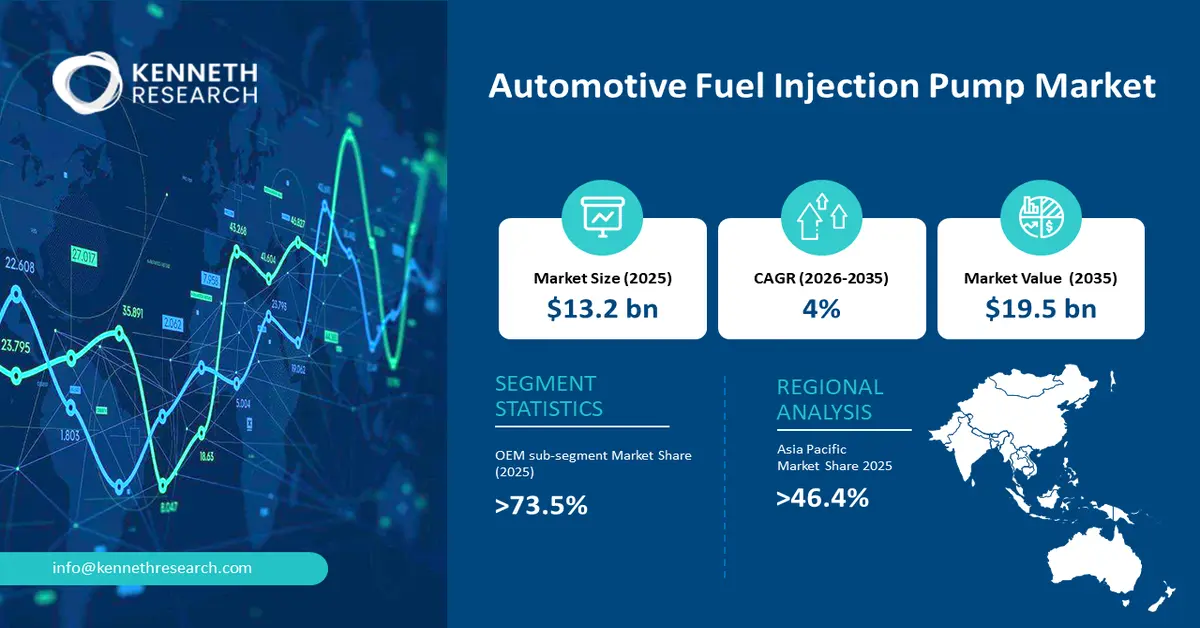
Automotive Fuel Injection Pump Market size was valued at USD 13.2 billion in 2025 and is projected to reach USD 19.5 billion by the end of 2035, rising at a CAGR of 4% during the forecast period, i.e., 2026-2035. In 2026, the industry size of the automotive fuel injection pump is estimated at USD 13.7 billion.
The growing emphasis on fuel efficiency and lower vehicle emissions is a primary growth driver for the automotive fuel injection pump market. More precise fuel delivery enables improved combustion control, supporting tighter efficiency and emissions requirements.
The automotive fuel injection pump market comprises pumps designed to deliver fuel from a vehicle’s fuel system to the engine’s injection system at controlled pressure, timing, and flow rates. These components are particularly important in internal-combustion engines, where accurate fuel delivery directly influences combustion efficiency, engine performance, emissions, and reliability. Fuel injection pumps may be integrated into different fuel-delivery architectures and are engineered according to engine type, fuel characteristics, pressure requirements, and vehicle application.
Key characteristics include precise metering, high-pressure fuel delivery, durability under demanding operating conditions, and compatibility with electronically controlled engine-management systems. In diesel engines, the injection system delivers fuel into the combustion chamber, where compression-generated heat initiates combustion.
Key Automotive Fuel Injection Pump Market Insights Summary:
Key Takeaways: Market Trends & Insights
- Automotive Fuel Injection Pump Market projected to grow from USD 13.2 billion in 2025 to USD 19.5 billion by 2035 at a 4% CAGR.
- Asia-Pacific accounted for the largest regional share at 46.4% in 2025, supported by strong automotive manufacturing ecosystems and advanced powertrain production across Japan and China.
- OEM is expected to remain the leading Sales Channel segment with a 73.5% market share in 2025, supported by direct integration between vehicle manufacturers and fuel injection pump suppliers.
- Direct Injection Systems are projected to witness strong growth as automakers increasingly adopt precise fuel-delivery technologies to improve combustion efficiency, engine performance, and emissions management.
Market Drivers
- Rising adoption of direct fuel injection technologies.
- Increasing focus on engine efficiency and emission optimization.
- Growing integration of fuel injection systems with turbocharged and downsized engines.
- Increasing demand for electronically controlled, high-precision fuel delivery systems.
Challenges
- High manufacturing complexity and precision requirements.
- Electrification reducing long-term demand for combustion-engine components.
Automotive Fuel Injection Pump Market Overview & Supply Chain
Adoption of automotive fuel injection pumps remains important as vehicle manufacturers seek tighter control over fuel delivery, combustion efficiency, engine performance, and emissions. Although electrification is reshaping the powertrain landscape, internal-combustion and hybrid vehicles continue to require increasingly precise fuel-management technologies. The International Energy Agency reported that global electric car sales exceeded 20 million in 2025, highlighting the accelerating powertrain transition while also underscoring the need for advanced efficiency technologies in remaining combustion-engine applications.
The automotive fuel injection pump market value chain begins with suppliers of metals, precision-machined components, seals, electronic elements, springs, valves, and other specialized inputs required for pump manufacturing. Component manufacturers and specialized machining companies provide parts engineered to stringent dimensional, pressure, durability, and thermal requirements. Fuel injection pump manufacturers then undertake precision machining, assembly, calibration, testing, and quality validation to produce finished systems compatible with specific engine architectures.
Automotive Fuel Injection Pump Market: Growth Drivers & Challenges
Growth Drivers:
- Rising adoption of direct fuel injection technologies: Increasing adoption of direct injection systems is strengthening demand for advanced fuel injection pumps capable of delivering fuel at precisely controlled pressures. Direct injection improves combustion control and enables automakers to optimize engine efficiency, performance, and emissions. According to the U.S. Department of Energy, gasoline direct injection was used in 73% of light-duty vehicles produced for the 2023 model year, demonstrating the continued integration of advanced injection architectures. As manufacturers increasingly combine direct injection with turbocharging, downsizing, and electronic engine management, demand is shifting toward high-pressure, electronically controlled pump technologies.
- Increasing focus on engine efficiency and emission optimization: Automakers are increasingly optimizing internal-combustion engines to achieve better fuel efficiency and lower emissions while maintaining power and drivability. Fuel injection pumps are central to this objective because accurate pressure regulation and fuel delivery enable precise control of the combustion process. Modern engine architectures increasingly integrate electronically controlled injection systems with turbocharging, variable valve technologies, and sophisticated engine-management systems.
Challenges:
- High manufacturing complexity and precision requirements: Advanced automotive fuel injection pumps require highly precise machining, pressure-control components, tight dimensional tolerances, and rigorous testing to achieve reliable fuel delivery. The increasing integration of high-pressure and electronically controlled systems further raises engineering and production complexity. Manufacturers must invest in specialized equipment, calibration capabilities, quality-control systems, and technical expertise, increasing production and development costs. These requirements can place greater pressure on margins, particularly for suppliers serving cost-sensitive vehicle programs.
- Electrification reducing long-term demand for combustion-engine components: The accelerating transition toward battery-electric vehicles represents a structural challenge because fully electric powertrains do not require conventional fuel injection pumps. As automakers redirect research, engineering resources, and capital expenditure toward batteries, electric motors, and power electronics, opportunities for new internal-combustion engine programs may gradually become more limited. This creates long-term volume uncertainty for fuel injection pump manufacturers and increases the importance of maintaining scale across existing combustion and hybrid platforms.
Automotive Fuel Injection Pump Market Size and Forecast:
| Report Attribute | Details |
|---|---|
| Base Year |
2025 |
| Forecast Period |
2026-2035 |
| CAGR |
4% |
| Base Year Market Size (2025) |
USD 13.2 billion |
| Forecast Year Market Size (2035) |
USD 19.5 billion |
| Regional Scope |
|
Automotive Fuel Injection Pump Market Segmentation Analysis:
Sales Channel Segment Analysis
In the sales channel segment, the OEM sub-segment is anticipated to capture the largest market share of 73.5% by the end of 2035.
OEM procurement enables pumps to be engineered specifically for vehicle platforms, ensuring compatibility with engine-control systems, injectors, pressure requirements, and emissions-management technologies. Demand is supported by the continued production of vehicles equipped with advanced fuel-delivery systems. According to the U.S. Department of Energy, gasoline direct injection was adopted in 73% of light-duty vehicles produced for the 2023 model year, reflecting substantial integration of sophisticated fuel-delivery technologies into new vehicles.
OEM-focused suppliers also benefit from long-term development relationships, platform qualification, stringent quality requirements, and established production programs. These factors create significant barriers to entry for aftermarket-focused competitors and support sustained OEM channel adoption.
Application Type Segment Analysis
The Direct Injection Systems application segment is projected to grow as automakers increasingly adopt fuel-delivery architectures that inject fuel directly into the combustion chamber, enabling more precise combustion control and supporting improvements in efficiency, performance, and emissions management. Adoption is reinforced by integration with turbocharging, engine downsizing, electronic controls, and hybrid powertrains.
From the supply side, pump manufacturers are developing high-pressure systems with tighter tolerances, faster response, enhanced durability, and greater compatibility with sophisticated engine-management architectures. OEM collaboration remains important because injection pumps must be calibrated to specific engine platforms and emission-control systems.
Our in-depth analysis of the global automotive fuel injection pump market includes the following segments:
|
Segment |
Sub-segment |
|
By Sales Channel |
|
|
By Type |
|
|
By Pressure |
|
|
By Fuel Type |
|
|
By Vehicle Type |
|
|
By Application |
|
Automotive Fuel Injection Pump Market Regional Insights:
Asia-Pacific Market Trends & Insights:
Asia-Pacific accounted for 46.4% of the automotive fuel injection pump market in 2025, establishing the region as the leading market.
Its dominance is supported by extensive vehicle manufacturing capacity, large automotive supply chains, strong demand for passenger and commercial vehicles, and continued investment in advanced powertrain technologies. China and Japan provide well-established ecosystems spanning vehicle OEMs, engine manufacturers, component suppliers, and precision-engineering companies. Government policies supporting automotive manufacturing, industrial modernization, fuel efficiency, and cleaner transportation further encourage investment in advanced fuel-delivery technologies.
Japan remains a technologically advanced automotive manufacturing center, supported by major vehicle manufacturers, sophisticated component suppliers, and established expertise in engine and fuel-system technologies.
China represents a particularly important growth center because of its extensive vehicle manufacturing ecosystem, expanding domestic automotive market, and large-scale production infrastructure. China's government reported that automobile production reached 31.282 million units in 2024, reinforcing the country's importance to regional automotive component demand.
North America Market Trends & Insights:
North America represents a significant market for automotive fuel injection pumps, supported by its established vehicle manufacturing base, mature automotive supply chains, and continued demand for advanced powertrain technologies. The United States benefits from extensive OEM production, component manufacturing, and engineering capabilities, while government initiatives supporting domestic automotive manufacturing and technology investment create opportunities for advanced fuel-delivery systems.
In the United States, demand is supported by major vehicle manufacturers, extensive Tier 1 and Tier 2 supplier networks, and continued development of efficient combustion and hybrid powertrains. Advanced engine-management technologies sustain requirements for precise fuel-delivery components, particularly across vehicles retaining internal-combustion engines.
Canada complements regional demand through its integrated OEM and component manufacturing infrastructure. In 2024, five major OEMs assembled more than 1.31 million light-duty vehicles at Canadian plants, supported by a broad network of parts suppliers.
Leading Companies Operating in the Global Automotive Fuel Injection Pump Market:
Here is a list of upstream, downstream, and key players operating in the global automotive fuel injection pump market competitive ecosystem:
- Bosch (Germany)
- Company Overview
- Business Strategy
- Key Product Offerings
- Financial Performance
- Key Performance Indicators
- Risk Analysis
- Recent Development
- Regional Presence
- SWOT Analysis
- DENSO (Japan)
- Continental (Germany)
- Delphi Technologies (United Kingdom)
Recent Developments
- September 2025: Bosch showcased its latest mobility technologies at IAA Mobility 2025, highlighting its broader portfolio for software-defined and electrified mobility while continuing to support advanced combustion-engine technologies.
- February 2026: Delphi expanded its fuel-management portfolio with three first-to-market fuel pump module assemblies, adding coverage for Buick and Toyota applications.
Frequently Asked Question
In 2025, the automotive fuel injection pump market exceeded USD 13.2 billion.
The automotive fuel injection pump market is projected to reach USD 19.5 billion by the end of 2035, expanding at a CAGR of 4% over the forecast period (2026–2035).
The major players in the market are Bosch, DENSO, Continental, Delphi Technologies, Stanadyne, Marelli, Hitachi Astemo, and others.
In the sales channel segment, the oem sub-segment is anticipated to capture the largest market share of 73.5% in the future and exhibit lucrative growth opportunities during 2026–2035.
Asia-Pacific is projected to hold the largest market share of 46.4% by the end of 2025 and provide more business opportunities in the future.
Why Choose Kenneth Research ?
-
Insight with Impact : We don’t just gather data — we uncover stories, trends, and opportunities that fuel business growth.
-
Experts Who Get It : Our team speaks your industry’s language and knows what really matters to your customers and market.
-
Custom-Built for You : Forget one-size-fits-all. We craft research and consulting solutions as unique as your business vision.
-
Partners, Not Just Providers : We work with you, not for you — collaborating closely to turn insights into smart, strategic moves.
-
Results That Speak : Our work powers brands, startups, and industry leaders alike — with a track record of ideas that work in the real world.
Report ID: 1195 |
Published Date: 27 Aug 2026 |
Report Format: |
Delivery Timeline: 48-72 Business Hours

Copyright © 2025 Kenneth Research. All rights reserved. Terms of Use | Privacy Policy
