Report ID: 1269 |
Published Date: 01 Sep 2026 |
Report Format: |
Delivery Timeline: 48-72 Business Hours
Automotive Electronics Market Outlook:
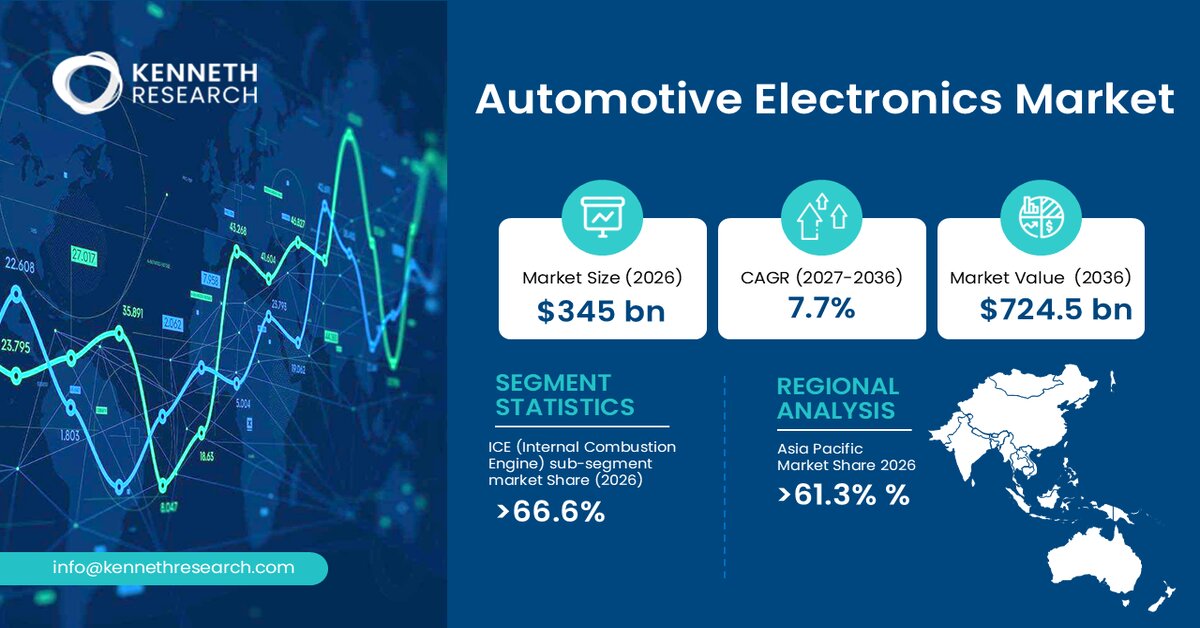
Automotive Electronics Market size was valued at USD 345 billion in 2026 and is projected to reach USD 724.5 billion by the end of 2036, rising at a CAGR of 7.7% during the forecast period, i.e., 2027–2036. In 2027, the industry size of the automotive electronics is estimated at USD 371.6 billion.
The rapid expansion of vehicle electrification, connectivity, advanced safety systems, and intelligent vehicle functions is driving demand for automotive electronics.
The automotive electronics market encompasses electronic components, systems, and control technologies integrated into vehicles to manage, monitor, and enhance vehicle functions. These systems include electronic control units, sensors, semiconductor devices, infotainment systems, advanced driver-assistance technologies, lighting controls, body electronics, connectivity solutions, and propulsion-related electronic systems. Automotive electronics are characterized by high reliability, compact designs, real-time processing capabilities, and increasing integration with software-defined vehicle architectures.
The market serves passenger vehicles, commercial vehicles, and other automotive platforms, with technologies increasingly designed to operate across connected and automated environments. Its industrial relevance is strengthened by the automotive industry's transition toward software-intensive vehicles, greater vehicle connectivity, improved safety requirements, and increasing electronic content per vehicle.
Key Automotive Electronics Market Insights Summary:
Key Takeaways: Market Trends & Insights
- automotive electronics market is projected to grow from USD 345 billion in 2026 to USD 724.5 billion by 2036, registering a CAGR of 7.7% during the forecast period.
- Asia-Pacific is projected to remain the leading regional market, accounting for 61.3% in 2026, supported by strong automotive manufacturing ecosystems, advanced electronics capabilities, and increasing adoption of intelligent and connected vehicles across Japan and China.
- ICE (Internal Combustion Engine) is expected to remain the leading Propulsion segment with a 66.6% share in 2026, supported by its extensive installed vehicle base, mature supply chains, and continued integration of electronic engine management, emissions control, and diagnostic systems.
- OEM (Original Equipment Manufacturer) is projected to remain the leading Sales Channel as factory-installed electronics become increasingly important for integrated vehicle architectures, safety systems, connectivity, infotainment, and powertrain management.
Market Drivers
- Increasing integration of connected-car technologies, infotainment systems, and vehicle-to-everything communication.
- Growing adoption of advanced electronic architectures supporting software-defined and intelligent vehicles.
- Rising demand for electronic systems that improve vehicle efficiency, diagnostics, comfort, and operational performance.
- Increasing deployment of sensors, processors, and control systems across modern automotive platforms.
Challenges
- Semiconductor Supply Chain Vulnerability
- Increasing System Complexity and Integration Requirements
Automotive Electronics Market Overview & Supply Chain
Adoption of automotive electronics is increasing globally as vehicle manufacturers integrate more sophisticated safety, connectivity, infotainment, driver-assistance, and electrification technologies. The shift toward software-defined and increasingly automated vehicles is expanding electronic content across propulsion, body control, sensing, communication, and passenger systems. Regulatory pressure for lower emissions and safer vehicles is further encouraging OEMs to deploy advanced electronic architectures. The International Energy Agency reported that global electric car sales exceeded 20 million in 2025, demonstrating the accelerating transition toward vehicle platforms that require extensive electronic control and power-management technologies.
The automotive electronics value chain begins with semiconductor devices, sensors, microcontrollers, displays, wiring systems, power-management components, connectors, and other electronic inputs supplied by specialized technology manufacturers. These inputs are integrated into electronic control units, infotainment systems, sensing modules, lighting systems, powertrain electronics, and other finished automotive electronic assemblies through design, engineering, manufacturing, testing, and validation processes. Tier-1 automotive electronics suppliers subsequently supply integrated systems and modules to vehicle manufacturers, while specialized component producers serve both Tier-1 suppliers and OEMs.
Automotive Electronics Market: Growth Drivers & Challenges
Growth Drivers
- Increasing vehicle production and electronic content: The expansion of global vehicle manufacturing is directly increasing the addressable demand for automotive electronic systems. Every vehicle platform requires electronic components for powertrain management, safety, body control, infotainment, sensing, communication, and diagnostics, while higher levels of functionality continue to increase electronic integration per vehicle. This creates opportunities for semiconductor manufacturers, electronic control-unit suppliers, sensor producers, and Tier-1 system integrators. The scale of global automotive production also supports manufacturing efficiencies and encourages suppliers to develop standardized platforms that can be deployed across multiple vehicle models.
- Rising integration of advanced safety and driver-assistance electronics: The growing integration of advanced driver-assistance and vehicle safety technologies is accelerating demand for sensors, cameras, radar systems, electronic control units, processors, and vehicle communication networks. Automakers are increasingly incorporating electronic systems capable of monitoring surroundings, warning drivers, assisting with vehicle control, and supporting automated driving functions. This trend is reinforced by regulatory and safety priorities as manufacturers seek to improve vehicle safety while differentiating models through technology-rich features.
Challenges
- Semiconductor supply chain vulnerability: The automotive electronics industry remains exposed to disruptions in semiconductor supply because modern vehicles depend on microcontrollers, processors, sensors, power-management devices, and other specialized chips. Semiconductor manufacturing is highly concentrated and involves long, technically complex production cycles, making automotive electronics suppliers vulnerable to shortages, allocation constraints, and unexpected disruptions. The resulting uncertainty can affect component availability, production scheduling, inventory planning, and delivery commitments between Tier-1 suppliers and vehicle manufacturers. Commercially, manufacturers may need to maintain additional inventories, qualify alternative suppliers, and redesign systems around available components, increasing procurement and engineering complexity.
- Increasing system complexity and integration requirements: The rapid expansion of electronic functionality is increasing the engineering complexity of automotive platforms. Vehicles now integrate numerous interconnected control units, sensors, software systems, communication networks, and safety-critical electronics, requiring rigorous validation and interoperability across multiple suppliers. This complexity increases development requirements for hardware-software integration, cybersecurity, functional safety, thermal management, and system-level testing. Smaller suppliers can face particular difficulties competing with established technology providers because access to advanced capabilities, engineering talent, and automotive-grade development infrastructure can be limited.
Automotive Electronics Market Size and Forecast:
| Report Attribute | Details |
|---|---|
| Base Year |
2026 |
| Forecast Period |
2027-2036 |
| CAGR |
7.7% |
| Base Year Market Size (2026) |
USD 345 billion |
| Forecast Year Market Size (2036) |
USD 724.5 billion |
| Regional Scope |
|
Automotive Electronics Market Segmentation Analysis:
Propulsion Type Segment Analysis
In the Propulsion segment, the ICE (Internal Combustion Engine) sub-segment is anticipated to capture the largest market share of 66.6% in 2026.
Its dominance is supported by the continued global installed base of conventional vehicles and the extensive electronic systems required for engine management, fuel injection, transmission control, emissions monitoring, thermal management, and vehicle diagnostics. OEMs and Tier-1 suppliers continue to enhance ICE platforms with increasingly sophisticated electronic controls to improve fuel efficiency, performance, safety, and compliance with emissions requirements. Supply-side capabilities are also well established, with mature manufacturing ecosystems for engine control units, sensors, actuators, and powertrain electronics. NITI Aayog notes that engine and engine components remain fundamental to both ICE and plug-in hybrid vehicles, while ongoing replacement demand continues to support the ICE component ecosystem.
Sales Channel Segment Analysis
In the Sales Channel segment, the OEM (Original Equipment Manufacturer) sub-segment is projected to grow strongly as vehicle manufacturers increasingly integrate electronic systems directly into new vehicle platforms. OEM-installed electronics provide the foundation for advanced driver assistance, infotainment, connectivity, powertrain management, body control, and vehicle diagnostics, making them integral to factory-built vehicles rather than optional aftermarket additions. Automakers are also moving toward centralized electronic architectures and software-defined vehicle platforms, increasing collaboration with Tier-1 electronics suppliers and semiconductor manufacturers. On the supply side, established OEM procurement networks, long-term supplier relationships, and platform-based component standardization support efficient deployment of electronic systems across vehicle model ranges. Government data from China illustrates the scale of OEM activity in the region: the country recorded 31.282 million vehicles produced in 2024, reinforcing the large manufacturing base through which factory-installed automotive electronics are supplied.
Our in-depth analysis of the global automotive electronics market includes the following segments:
|
Segment |
Sub-segment |
|
By Application |
|
|
Component |
|
|
Vehicle Type |
|
|
Propulsion |
|
|
By Sales |
|
Automotive Electronics Market Regional Insights:
Asia-Pacific Market Trends & Insights:
Asia-Pacific is projected to remain the dominant region in the automotive electronics market, accounting for 61.3% in 2026.
Regional leadership is supported by its extensive automotive manufacturing base, large consumer markets, established electronics supply chains, and strong investment in connected, intelligent, and increasingly electrified vehicle technologies. Japan and China host major vehicle manufacturers, Tier-1 suppliers, semiconductor ecosystems, and electronics technology companies, creating a highly integrated regional production environment. Government policies supporting automotive modernization, manufacturing, digitalization, and new-energy mobility are further strengthening regional demand for sophisticated electronic systems. China’s National Bureau of Statistics reported that automobile manufacturing value added increased by 9.1% in 2024, highlighting continued industrial momentum within one of the region’s key automotive production centers.
Japan remains a technologically advanced automotive hub with strong capabilities in vehicle electronics, sensors, powertrain control, safety systems, and automotive components. The presence of globally established OEMs and specialized suppliers supports continued development and integration of sophisticated electronic architectures.
China represents a major growth engine because of its extensive vehicle manufacturing ecosystem, expanding domestic OEM base, and rapid advancement in intelligent and connected vehicle technologies.
North America Market Trends & Insights:
North America represents an important market for automotive electronics, supported by established vehicle manufacturing capabilities, sophisticated automotive supply chains, and strong investment in connected and intelligent vehicle technologies. Demand is reinforced by OEM adoption of advanced driver-assistance systems, vehicle connectivity, infotainment, electronic control architectures, and next-generation propulsion technologies. Government initiatives supporting automotive modernization, domestic manufacturing, and the transition toward connected and lower-emission vehicles are creating additional opportunities for electronics suppliers.
The United States remains the region's principal automotive electronics hub, supported by a large OEM base, extensive manufacturing infrastructure, advanced technology development, and strong automotive R&D activity. Its established supplier ecosystem creates opportunities for electronic control, sensing, connectivity, and computing technologies.
Canada complements the regional ecosystem through established vehicle assembly operations and a broad parts-supplier network. Government initiatives focused on securing domestic automotive production and next-generation technologies are strengthening the country's role in connected and electrified vehicle manufacturing, supporting continued demand for sophisticated automotive electronic systems.
Leading Companies Operating in the Global Automotive Electronics Market:
Here is a list of upstream, downstream, and key players operating in the global automotive electronics market competitive ecosystem:
- Aptiv PLC (Ireland)
- Company Overview
- Business Strategy
- Key Product Offerings
- Financial Performance
- Key Performance Indicators
- Risk Analysis
- Recent Development
- Regional Presence
- SWOT Analysis
- DENSO Corporation (Japan)
- ZF Friedrichshafen AG (Germany)
Recent Developments
- August 2025: Aptiv opened a new Software, Advanced Safety & User Experience Technical Center in Chennai, India, designed to support software, AI/ML, ADAS, and safety-critical technology development.
- January 2025: DENSO showcased semiconductor, electrification, ADAS, radar, vision-sensor, and other next-generation automotive technologies at the Bharat Mobility Global Expo 2025.
Frequently Asked Question
In 2026, the automotive electronics market exceeded USD 345 billion.
The automotive electronics market is projected to reach USD 724.5 billion by the end of 2036, expanding at a CAGR of 7.7% over the forecast period (2027–2036).
The major players in the market are Robert Bosch GmbH, DENSO Corporation, Continental AG, ZF Friedrichshafen AG, Aptiv PLC, Panasonic Automotive Systems Co., Ltd., Hyundai Mobis Co., Ltd., and others.
In the Propulsion segment, the ICE (Internal Combustion Engine) sub-segment is anticipated to capture the largest market share of 66.6% in the future and exhibit lucrative growth opportunities during 2027–2036.
Asia-Pacific is projected to hold the largest market share of 61.3% by the end of 2036 and provide more business opportunities in the future.
Why Choose Kenneth Research ?
-
Insight with Impact : We don’t just gather data — we uncover stories, trends, and opportunities that fuel business growth.
-
Experts Who Get It : Our team speaks your industry’s language and knows what really matters to your customers and market.
-
Custom-Built for You : Forget one-size-fits-all. We craft research and consulting solutions as unique as your business vision.
-
Partners, Not Just Providers : We work with you, not for you — collaborating closely to turn insights into smart, strategic moves.
-
Results That Speak : Our work powers brands, startups, and industry leaders alike — with a track record of ideas that work in the real world.
Report ID: 1269 |
Published Date: 01 Sep 2026 |
Report Format: |
Delivery Timeline: 48-72 Business Hours

Copyright © 2025 Kenneth Research. All rights reserved. Terms of Use | Privacy Policy
