Report ID: 1264 |
Published Date: 01 Sep 2026 |
Report Format: |
Delivery Timeline: 48-72 Business Hours
Ambient Light Sensor Market Outlook:
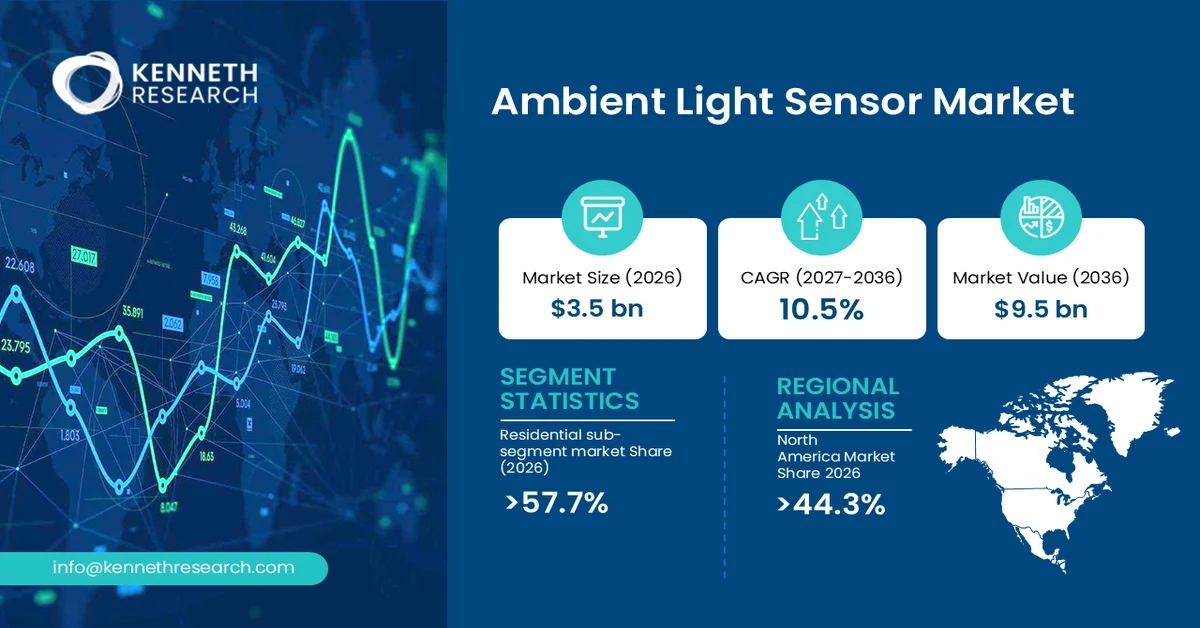
Ambient Light Sensor Market size was valued at USD 3.5 Billion in 2026 and is projected to reach USD 9.5 Billion by the end of 2036, rising at a CAGR of 10.5% during the forecast period, i.e., 2027–2036. In 2027, the industry size of the ambient light sensor is estimated at USD 3.9 Billion.
The primary growth driver for the ambient light sensor market is the increasing integration of intelligent lighting controls into buildings and electronic systems. Ambient light sensors enable devices to detect surrounding illumination and automatically adjust lighting output, supporting energy-efficient operation, responsive illumination, improved user comfort, and greater automation across residential and commercial environments.
The ambient light sensor market comprises sensors and associated components that detect the intensity of surrounding light and convert measured illumination into an electrical signal used by electronic systems for automated control. These devices are commonly based on photodiodes, phototransistors, or related optical sensing technologies and can be incorporated into lighting systems, consumer electronics, automotive electronics, smart-building equipment, and other connected products.
A key characteristic of ambient light sensors is their ability to continuously respond to changing environmental illumination. Depending on system architecture, the sensor output can support automatic display-brightness adjustment, daylight-responsive lighting, dimming, or other control functions. Their integration with digital controllers and connected systems enables more adaptive operation than conventional fixed lighting arrangements.
Key Ambient Light Sensor Market Insights Summary:
Key Takeaways: Market Trends & Insights
- 2026 market value stands at USD 3.5 billion, reflecting a substantial base for continued expansion of the Ambient Light Sensor Market
- The market is projected to reach USD 3.9 billion in 2027, establishing the starting point for the forecast period and indicating continued demand for ambient sensing technologies
- By 2036, the ambient light sensor market is projected to reach USD 9.5 billion, supported by increasing integration across lighting systems, connected electronics, and smart-building applications
- The market is projected to expand at a CAGR of 10.5% from 2027 to 2036, highlighting sustained growth potential for sensor manufacturers, component suppliers, and technology integrators
- Residential remains the leading end-use segment with a 57.7% market share in 2026, while North America leads geographically with a 44.3% share, supported by adoption across the United States and Canada
Market Drivers
- Expansion of energy-efficient and adaptive lighting systems
- Integration of sensors with connected electronics and smart systems
- Growth of smart-building and building-automation infrastructure
- Increasing adoption of automated display and illumination management
Challenges
- Optical accuracy and integration complexity
- Application-specific design and qualification requirements
Automotive Electronics Market Overview & Supply Chain
Global adoption of ambient light sensing is increasing as lighting and electronic systems shift toward automated, responsive operation. Ambient light sensors provide a key input for systems that adapt illumination to surrounding daylight conditions, supporting energy management, visual comfort, and more precise control. Their relevance is expanding alongside connected lighting, smart-building systems, and electronically managed environments. The U.S. Department of Energy reported in a 2021 study that a chromaticity sensor used in a tunable LED lighting control system showed no abrupt failure after 5,000 hours of testing, including under a relatively harsh temperature-humidity environment. This demonstrates the importance of sensor reliability as lighting systems become increasingly dependent on continuous sensing and automated control.
The ambient light sensor market value chain begins with raw-material and component suppliers providing semiconductor materials, photodiodes, phototransistors, optical elements, substrates, packaging materials, and electronic interconnects. Sensor manufacturers then undertake semiconductor processing, optical integration, packaging, calibration, testing, and quality assurance to produce discrete sensing components or integrated modules. These products move through distributors, electronic-component suppliers, original equipment manufacturers, and specialized system integrators, depending on application complexity. OEMs incorporate sensors into lighting equipment, displays, consumer electronics, building-control systems, and other electronic products, while system integrators combine sensing hardware with controllers, communication networks, software, and luminaires. Final demand comes from residential users, commercial facilities, industrial operators, electronics manufacturers, and institutional buildings.
Ambient Light Sensor Market: Growth Drivers & Challenges
Growth Drivers
- Expansion of energy-efficient and adaptive lighting systems: The transition toward energy-efficient and adaptive lighting systems is strengthening demand for ambient light sensors because these devices provide the illumination data required for automatic dimming, daylight harvesting, and responsive lighting control. As building operators move beyond conventional switching toward connected and programmable lighting, sensors become an essential interface between environmental conditions and control platforms. The U.S. Department of Energy notes that approximately two-thirds of commercial buildings still have no lighting controls beyond a light switch, indicating substantial scope for deployment of more sophisticated sensing and control technologies.
- Integration of sensors with connected electronics and smart systems: The increasing integration of sensing capabilities into connected electronic products is creating additional demand for ambient light sensors. Modern devices increasingly require automatic adjustment of displays, illumination, and operating modes according to surrounding conditions, making compact optical sensing an important functionality rather than a standalone feature. Semiconductor integration is allowing sensor components to become smaller, more power-efficient, and easier to incorporate into densely packaged electronic designs. This supports adoption across consumer electronics, connected devices, automotive interfaces, smart appliances, and intelligent building equipment. Integration with microcontrollers, wireless connectivity, and software-based control further increases the functionality that can be built around a relatively small sensing component.
Challenges
- Optical accuracy and integration complexity: Ambient light sensors must accurately reproduce perceived illumination despite interference from infrared radiation, cover glass, optical coatings, display structures, and artificial-light flicker. This creates engineering complexity because sensor performance depends not only on the sensing element but also on optical placement and the surrounding product architecture. Texas Instruments specifically identifies stray infrared reflections from cover glass as a factor that can affect ambient-light measurements, requiring specialized optical filtering and sensor design. For OEMs, these requirements can increase validation effort, calibration requirements, mechanical-design constraints, and integration risk, particularly in compact electronic products.
- Application-specific design and qualification requirements: Ambient light sensors are not universally interchangeable because different end products impose distinct requirements for sensitivity, spectral response, power consumption, package geometry, communication interfaces, and environmental operating conditions. A sensor optimized for display-brightness control may not provide the same design characteristics required for industrial lighting or advanced optical applications. Consequently, manufacturers must select and qualify components against the precise architecture of each product rather than treating ambient light sensing as a standardized plug-and-play function. This can lengthen design cycles and increase engineering resources required for testing, firmware integration, optical validation, and production qualification.
Ambient Light Sensor Market Size and Forecast:
| Report Attribute | Details |
|---|---|
| Base Year |
2026 |
| Forecast Period |
2027-2036 |
| CAGR |
10.5% |
| Base Year Market Size (2026) |
USD 3.5 Billion |
| Forecast Year Market Size (2036) |
USD 9.5 Billion |
| Regional Scope |
|
Ambient Light Sensor Market Segmentation Analysis:
End-Use Segment Analysis
In the end-use segment, Residential sub-segment is anticipated to capture the largest market share of 57.7% by the end of 2026.
The residential segment dominates demand because ambient light sensing aligns closely with the growing deployment of automated lighting, smart-home controls, and energy-conscious household electronics. Residential lighting increasingly incorporates sensors that adjust illumination according to environmental conditions, reducing manual intervention while improving convenience and visual comfort. This trend is reinforced by broader smart-home adoption: the U.S. Energy Information Administration’s 2024 Residential Energy Consumption Survey recorded 13.72 million U.S. homes with smart speakers used to control lighting, demonstrating an established residential pathway for digitally controlled illumination. From a supply perspective, sensor manufacturers benefit from compact optical components, integrated electronics, and increasingly standardized interfaces that simplify incorporation into connected lighting products.
Application Segment Analysis
The Consumer Electronics is projected to grow as the second-largest segment in the ambient light sensor market due to four converging demand drivers.
The consumer electronics segment is projected to grow rapidly as smartphones, tablets, laptops, wearables, smart displays, and other connected devices increasingly incorporate automatic brightness and illumination-management functions. Ambient light sensors enable these products to adapt display output to surrounding conditions, improving usability while supporting power-management objectives. From an industry perspective, consumer-electronics manufacturers are prioritizing compact, low-power components that can be integrated into increasingly space-constrained device architectures. Sensor suppliers are responding through higher integration, miniature packages, improved spectral matching, and digital interfaces that simplify OEM implementation. Continued development of connected personal devices and smart displays should expand opportunities for ambient sensing, while greater emphasis on device efficiency and automated user interfaces is expected to reinforce its role in next-generation consumer electronics.
Our in-depth analysis of the global ambient light sensor market includes the following segments:
|
Segment |
Sub-segment |
|
Application |
|
|
Sensor Type |
|
|
Technology |
|
|
End-Use |
|
Ambient Light Sensor Market Regional Insights:
North America Market Trends & Insights:
North America ambient light sensor market is projected to hold the largest revenue share of 44.3% by the end of 2026.
North America holds the dominant regional position in the Ambient Light Sensor Market, with the supplied 2026 share establishing its leadership. Regional strength is supported by advanced electronics manufacturing, established semiconductor and lighting ecosystems, strong adoption of connected-device technologies, and sustained investment in smart-building infrastructure.
The United States represents the region’s principal technology and demand center, supported by a large electronics industry, smart-building investment, and federal research into advanced sensing and lighting controls. Government-supported programs also encourage integration of lighting with broader building systems. Canada contributes through energy-efficiency initiatives, building modernization, and adoption of connected lighting technologies across residential, commercial, and institutional facilities. Together, the two markets provide complementary demand conditions: the United States offers scale and technology development, while Canada strengthens regional adoption through efficiency-oriented building practices.
Asia Pacific Market Trends & Insights:
Asia Pacific represents a significant opportunity for the ambient light sensor market because of its extensive electronics manufacturing base, expanding smart-building activity, modernization of lighting infrastructure, and increasing emphasis on energy-efficient equipment. Demand is supported by the region’s concentration of consumer-electronics production, semiconductor ecosystems, connected-device development, and lighting-system deployment. Government initiatives are also reinforcing the business case for intelligent and efficient lighting.
China is the region’s principal industrial opportunity, combining a large electronics manufacturing ecosystem with government-backed energy-efficiency and equipment-modernization policies. Its emphasis on intelligent, greener manufacturing can encourage adoption of integrated sensing and control technologies.
Japan offers a technologically mature market characterized by advanced electronics, energy-efficient equipment, and strong engineering capabilities. Its 2024 national technology strategy specifically promotes research, development, and dissemination of energy-efficiency technologies, creating favorable conditions for intelligent lighting and sensor-enabled applications.
Leading Companies Operating in the Global Ambient Light Sensor Market:
Here is a list of upstream, downstream, and key players operating in the ambient light sensor market competitive ecosystem:
- ams-OSRAM AG (Austria)
- Company Overview
- Business Strategy
- Key Product Offerings
- Financial Performance
- Key Performance Indicators
- Risk Analysis
- Recent Development
- Regional Presence
- SWOT Analysis
- STMicroelectronics (Switzerland)
- Vishay Intertechnology, Inc. (United States)
- ON Semiconductor (onsemi) (United States)
- Melexis NV (Belgium)
Recent Developments
- In October 2025, ams-OSRAM announced that its next-generation HDR flicker detection sensor has been integrated into the Honor Magic 8 flagship series. The sensor supports an ultra-high sampling rate of up to 20,000 Hz, enabling real-time detection of lighting and display flicker frequency and depth, and provides professional-grade ambient-light detection for personalized eye-comfort protection in mobile devices.
- In June 2026, Vishay Intertechnology expanded its optoelectronics portfolio with two AEC-Q102 qualified Automotive Grade PIN photodiode ambient light sensors—the VEMD4210FX02 and VEMD5525FX02. These sensors feature spectral sensitivity closely matched to the human eye response with no infrared (IR) bump, making them suitable for automatic light control in automotive center information displays, head-up displays, and rain light tunnel systems.
Frequently Asked Question
In 2026, the ambient light sensor market exceeded USD 3.5 billion.
The ambient light sensor market is projected to reach USD 9.5 billion by the end of 2036, expanding at a CAGR of 10.5% over the forecast period (2027-2036).
The major players in the market are ams-OSRAM AG, STMicroelectronics, Vishay Intertechnology, Inc., ON Semiconductor (onsemi), Melexis NV, and others.
In the End-Use segment, the Residential sub-segment is anticipated to capture the largest market share of 57.7% in the future and exhibit lucrative growth opportunities during 2027-2036. This growth trajectory is largely attributed to increasing adoption of automated lighting, smart-home controls, and energy-efficient residential lighting systems.
North America is projected to hold the largest market share of 44.3% by the end of 2036 and provide more business opportunities in the future. Continuous investments in smart-building infrastructure, connected electronics, and energy-efficient lighting technologies in the United States and Canada are fostering the region's dominance.
Why Choose Kenneth Research ?
-
Insight with Impact : We don’t just gather data — we uncover stories, trends, and opportunities that fuel business growth.
-
Experts Who Get It : Our team speaks your industry’s language and knows what really matters to your customers and market.
-
Custom-Built for You : Forget one-size-fits-all. We craft research and consulting solutions as unique as your business vision.
-
Partners, Not Just Providers : We work with you, not for you — collaborating closely to turn insights into smart, strategic moves.
-
Results That Speak : Our work powers brands, startups, and industry leaders alike — with a track record of ideas that work in the real world.
Report ID: 1264 |
Published Date: 01 Sep 2026 |
Report Format: |
Delivery Timeline: 48-72 Business Hours

Copyright © 2025 Kenneth Research. All rights reserved. Terms of Use | Privacy Policy
