Report ID: 1228 |
Published Date: 28 Sep 2026 |
Report Format: |
Delivery Timeline: 48-72 Business Hours
Aerospace Semiconductor Market Outlook:
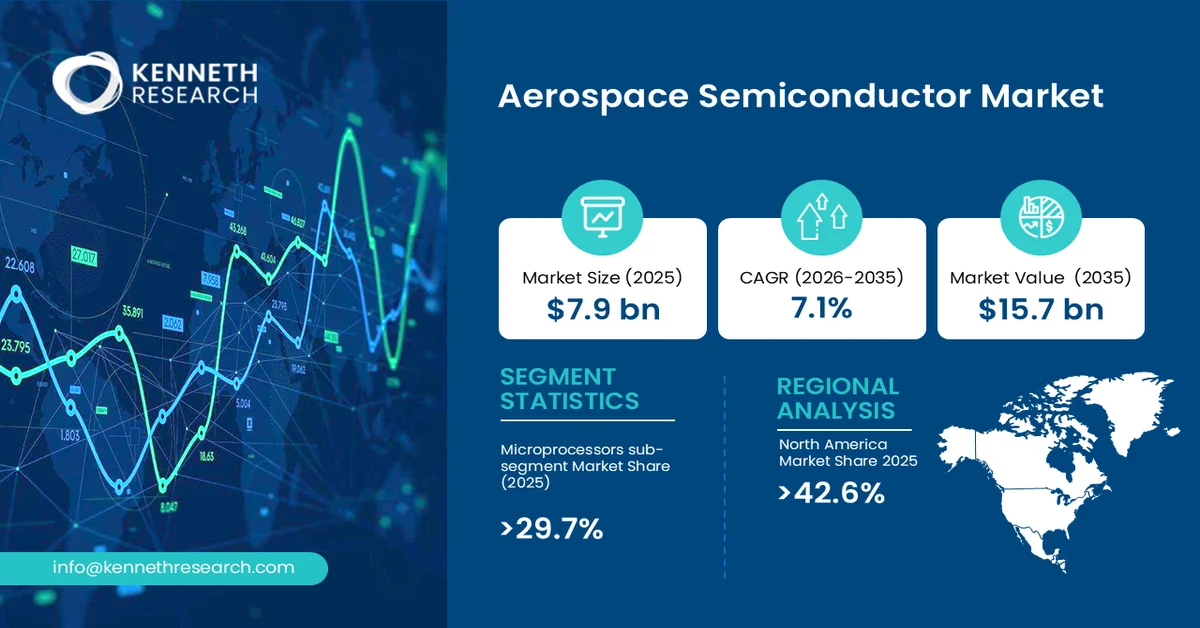
Aerospace Semiconductor Market size was valued at USD 7.9 billion in 2025 and is projected to reach USD 15.7 billion by the end of 2035, rising at a CAGR of 7.1% during the forecast period, i.e., 2026-2035. In 2026, the industry size of aerospace semiconductor is estimated at USD 8.5 billion.
The primary growth driver is the increasing need for reliable, radiation-tolerant electronics in advanced aerospace and space systems. NASA identifies advanced semiconductor process nodes, radiation-hard devices, heterogeneous integration, and radiation-hardened mixed-signal ASICs as foundational technologies for future avionics, supporting higher onboard processing capability, miniaturization, reliability, and mission resilience.
The aerospace semiconductor market comprises semiconductor devices, integrated circuits, processors, memory components, sensors, power-management devices, and specialized microelectronics designed, qualified, or adapted for aerospace applications. These components support aircraft, spacecraft, satellites, launch vehicles, avionics, navigation, communications, flight-control, sensing, and onboard computing systems.
A defining characteristic of the market is its emphasis on performance under demanding operating conditions. Aerospace semiconductor solutions must address requirements associated with radiation exposure, temperature variation, vibration, reliability, long operating lifetimes, power efficiency, and mission-critical operation. Radiation-hardened and radiation-tolerant technologies are particularly important for spaceborne electronics because semiconductor devices can experience performance degradation or functional disruption from the space radiation environment.
Key Aerospace Semiconductor Market Insights Summary:
Key Takeaways: Market Trends & Insights
- Aerospace Semiconductor Market reached USD 7.9 billion in 2025 and is projected to reach USD 15.7 billion by 2035 at a CAGR of 7.1% during 2026-2035
- Microprocessors dominated the Component Type segment with a 29.7% market share in 2025, supported by demand for onboard computing, navigation, data handling and autonomous aerospace functions
- Radiation-hardened semiconductors are projected to grow rapidly as aerospace systems require reliable electronics capable of operating under radiation exposure and demanding environmental conditions
- North America led the global aerospace semiconductor market with a 42.6% market share in 2025, supported by advanced aerospace manufacturing, semiconductor capabilities, defense programs and space activities
- Asia Pacific represents an important future opportunity, with China and India strengthening space programs, satellite infrastructure, semiconductor capabilities and indigenous aerospace electronics development
Market Drivers
- Increasing Demand for Radiation-Hardened and Extreme-Environment Electronics
- Rising Electronic Content and Advanced Onboard Computing Requirements
- Expansion of Autonomous Flight and Intelligent Avionics
- Increasing Deployment of Satellites and Space-Based Communication Infrastructure
Challenges
- Supply Chain Concentration and Component Availability
- Complex Qualification and Specialized Manufacturing Requirements
Aerospace Semiconductor Market Overview & Supply Chain
Global adoption of aerospace semiconductors is increasing as aircraft and spacecraft become more electronically intensive and require higher levels of onboard computing, sensing, communications, navigation, and autonomous control. Semiconductor reliability is particularly important in space applications, where radiation can cause cumulative degradation and transient or destructive electronic effects. NASA highlights radiation-hardness assurance as an integral consideration covering component selection, testing, spacecraft layout, radiation-tolerant design, and mission requirements. Supply-chain resilience is also strategically important: the U.S. Government Accountability Office reported that 15 of the 17 aviation manufacturers it interviewed experienced difficulty procuring raw materials or components, with shortages extending to semiconductors.
The aerospace semiconductor value chain begins with specialized inputs including silicon and compound-semiconductor materials, wafers, substrates, metals, packaging materials, and radiation-hardening technologies. Semiconductor designers and integrated-device manufacturers convert these inputs into processors, memory, sensors, power devices, analog components, and other mission-specific electronics through wafer fabrication, packaging, assembly, and testing. Qualification and reliability testing form a critical stage because aerospace components must satisfy demanding environmental and mission requirements. Distribution then moves qualified components through authorized distributors, specialist suppliers, aerospace electronics integrators, and directly contracted procurement channels. End users include aircraft manufacturers, spacecraft and satellite developers, defense organizations, space agencies, airlines, and maintenance providers.
Aerospace Semiconductor Market: Growth Drivers & Challenges
Growth Drivers:
- Increasing demand for radiation-hardened and extreme-environment electronics: A major growth driver is the expanding requirement for semiconductor devices capable of maintaining dependable operation in radiation-intensive and extreme-temperature aerospace environments. Spacecraft, satellites, exploration vehicles, and advanced avionics increasingly depend on processors, mixed-signal circuits, RF electronics, memory, and control devices that cannot rely solely on conventional commercial-grade semiconductor architectures. NASA's technology-development portfolio illustrates this direction through its completed project on radiation-hardening silicon-germanium mixed-signal and RF electronics for wide-temperature operation. The project focuses on radiation-hardened-by-design integrated circuits intended to operate without bulky shielding and heating or cooling infrastructure, while supporting lower size, weight, power, and cost requirements.
- Rising electronic content and advanced onboard computing requirements: A second growth driver is the increasing electronic complexity of aerospace platforms and the transition toward higher-performance onboard computing. Modern aircraft and spacecraft require greater processing capability for navigation, communications, sensing, flight management, autonomous functions, data handling, and real-time decision-making. These requirements favor increasingly capable microprocessors, memory, application-specific integrated circuits, FPGAs, sensors, power-management devices, and high-performance connectivity components. Semiconductor integration can also help aerospace manufacturers reduce system complexity by consolidating multiple functions into smaller and more capable electronic architectures. For space applications, higher computing capability must simultaneously satisfy stringent reliability, power, thermal, and environmental constraints, creating demand for specialized semiconductor designs rather than simple adoption of mainstream commercial devices.
Challenges:
- Supply chain concentration and component availability: A major restraint is the geographically concentrated and highly interdependent semiconductor supply chain. Aerospace manufacturers cannot readily substitute qualified semiconductor components because mission-critical devices require established specifications, qualification records, traceability, and dependable long-term supply. Consequently, disruptions affecting wafer fabrication, packaging, materials, logistics, or specialist suppliers can propagate into aerospace production schedules. The U.S. Government Accountability Office identifies geographic concentration and limited domestic capacity as important vulnerabilities in semiconductor supply. For aerospace companies, these constraints can increase procurement complexity, encourage inventory buffering, extend qualification cycles, and complicate redesign when a component becomes unavailable. Commercial implications include higher sourcing costs, greater supplier-management requirements, and potential delays in aircraft, spacecraft, and defense-electronics programs.
- Complex qualification and specialized manufacturing requirements: Aerospace semiconductors face a structural restraint arising from demanding qualification, reliability, and environmental-performance requirements. Unlike mainstream electronics, components used in mission-critical aerospace systems may need extensive validation for radiation exposure, temperature extremes, vibration, electromagnetic conditions, reliability, and long-duration operation. These requirements narrow the pool of acceptable suppliers and make replacement of established components difficult. Specialized radiation-hardened technologies can also require dedicated design capabilities, manufacturing processes, testing infrastructure, and engineering expertise that are not readily interchangeable with conventional semiconductor production. The commercial consequence is a longer path from device development to aerospace deployment, with greater engineering coordination and qualification expenditure.
Aerospace Semiconductor Market Size and Forecast:
| Report Attribute | Details |
|---|---|
| Base Year |
2025 |
| Forecast Year |
2026-2035 |
| CAGR |
7.1% |
| Base Year Market Size (2025) |
USD 7.9 billion |
| Forecast Year Market Size (2035) |
USD 15.7 billion |
| Regional Scope |
|
Aerospace Semiconductor Market Segmentation Analysis:
Component Type Segment Analysis
In the component type segment, the Microprocessors sub-segment is anticipated to capture the largest market share of 29.7% by the end of 2025.
Microprocessors dominate the component-type segment because they constitute the computational core of aerospace electronics, supporting command processing, flight management, data handling, navigation, autonomy, and onboard decision-making. Demand is being reinforced by spacecraft architectures that require greater processing capability while maintaining stringent constraints on reliability, power consumption, radiation tolerance, and physical integration. NASA identifies the processor as the foundation of onboard computing, while ESA describes microprocessors as fundamental building blocks of spacecraft electronics. The supply side is consequently moving toward more advanced, radiation-tolerant, and highly integrated processor architectures. A clear indication of institutional demand is the European Space Agency's €8 million contract with Frontgrade Gaisler for ultra-deep-submicron semiconductor technology, specifically supporting building blocks for advanced space integrated circuits including microprocessors.
Functionality Segment Analysis
The Radiation-hardened is projected to grow as the second-largest segment in the aerospace semiconductor market due to four converging demand drivers.
Radiation-hardened semiconductors are projected to grow rapidly as spacecraft operators prioritize electronics capable of maintaining functionality under radiation exposure, particularly for longer-duration missions and increasingly demanding orbital and deep-space environments. Radiation-hardened designs incorporate specialized architectures, materials, circuit techniques, and qualification procedures that reduce susceptibility to single-event effects and cumulative radiation damage. Adoption is also expanding as advanced spacecraft require greater onboard processing, communications, sensing, and autonomous functionality without compromising mission reliability. On the supply side, semiconductor developers are advancing radiation-hardening approaches across processors, FPGAs, ASICs, mixed-signal devices, and other integrated circuits, while space agencies are evaluating newer commercial semiconductor technologies for radiation performance.
Our in-depth analysis of the global aerospace semiconductor market includes the following segments:
|
Segment |
Sub-segment |
|
Component Type |
|
|
Functionality |
|
|
Platform |
|
|
Material Type |
|
|
Technology Node |
|
|
Application |
|
|
End User |
|
Aerospace Semiconductor Market Regional Insights:
North America Market Trends & Insights:
North America aerospace semiconductor market is projected to hold the largest revenue share of 42.6% by the end of 2025.
North America remains the dominant regional market, supported by a deeply established aerospace manufacturing ecosystem, substantial semiconductor investment, advanced defense programs, and strong government involvement in critical technology development. The region benefits from extensive demand for high-reliability processors, avionics electronics, radiation-hardened devices, and specialized components across commercial aviation, defense, and space applications. The U.S. semiconductor policy environment is also strengthening domestic production capabilities.
Within North America, the United States represents the principal production, consumption, and investment center because of its extensive aircraft and spacecraft manufacturing base, defense-electronics ecosystem, space programs, semiconductor R&D capabilities, and federal technology initiatives. Government-backed development of radiation-hardened electronics and advanced avionics further reinforces the country's strategic position.
Canada complements the regional ecosystem through its aerospace manufacturing capabilities, space technology activities, research institutions, and specialized suppliers. Its proximity to the U.S. market also facilitates integration into broader North American aerospace supply chains.
Asia Pacific Market Trends & Insights:
Asia Pacific is becoming an increasingly important aerospace semiconductor market as regional governments strengthen space programs, satellite infrastructure, domestic semiconductor capabilities, and advanced electronics manufacturing. Demand is supported by expanding spacecraft development, satellite communications, navigation systems, defense electronics, and commercial aerospace activity. China is promoting commercial aerospace through coordinated policies covering satellite constellations, launch services, satellite applications, and industrial infrastructure, while India is pursuing semiconductor self-reliance alongside indigenous aerospace and defense electronics development.
China has a broad aerospace ecosystem supported by government-led satellite, commercial-space, and space-application initiatives. Beijing is developing industrial clusters spanning rocket manufacturing, satellite development, constellation operations, and satellite internet applications, creating multiple downstream requirements for specialized electronics and semiconductor components.
India is strengthening its position through semiconductor ecosystem development and indigenous aerospace electronics. DRDO has developed domestic silicon-carbide wafer and GaN-based MMIC capabilities applicable to space, aerospace, radar, and satellite communications, helping build local capabilities for strategically important semiconductor technologies.
Leading Companies Operating in the Global Aerospace Semiconductor Market:
Here is a list of upstream, downstream, and key players operating in the global aerospace semiconductor market competitive ecosystem:
- Texas Instruments Incorporated (United States)
- Company Overview
- Business Strategy
- Key Product Offerings
- Financial Performance
- Key Performance Indicators
- Risk Analysis
- Recent Development
- Regional Presence
- SWOT Analysis
- Infineon Technologies AG (Germany)
- NXP Semiconductors N.V. (Netherlands)
- Intel Corporation (United States)
- Broadcom Inc. (United States)
- Wolfspeed Inc. (United States)
Recent Developments
- In May 2025, Infineon introduced a new family of radiation-hardened gallium nitride (GaN) transistors, with the first devices becoming the first in-house-manufactured GaN transistors to achieve DLA JANS certification—the highest reliability rating assigned by the U.S. Defense Logistics Agency for space flight applications. Engineered for mission-critical applications including on-orbit vehicles and deep-space probes, the 100V devices deliver best-in-class efficiency and power density for smaller, lighter space designs.
- In December 2025, Wolfspeed received $698.6 million in cash tax refunds from the U.S. IRS under the Advanced Manufacturing Investment Credit (Section 48D), strengthening its liquidity position as it advances 200mm silicon carbide manufacturing for key growing segments, including aerospace and defense in addition to EV markets. The refund represents a significant milestone in monetizing the company's approximately $1 billion in accrued AMIC benefits.
Frequently Asked Question
In 2025, the aerospace semiconductor market exceeded USD 7.9 billion.
The aerospace semiconductor market is projected to reach USD 15.7 billion by the end of 2035, expanding at a CAGR of 7.1% over the forecast period (2026-2035).
The major players in the market are Texas Instruments Incorporated, Infineon Technologies AG, NXP Semiconductors N.V., Intel Corporation, Broadcom Inc., Wolfspeed Inc., and others.
In the Component Type segment, the Microprocessors sub-segment is anticipated to capture the largest market share of 29.7% in the future and exhibit lucrative growth opportunities during 2026-2035. This growth trajectory is largely attributed to increasing demand for advanced onboard computing, navigation, data handling, and autonomous aerospace functions.
North America is projected to hold the largest market share of 42.6% by the end of 2025 and provide more business opportunities in the future. Continuous investments across the United States and Canada in aerospace manufacturing, semiconductor capabilities, space technologies, and advanced avionics are fostering the region's dominance.
Why Choose Kenneth Research ?
-
Insight with Impact : We don’t just gather data — we uncover stories, trends, and opportunities that fuel business growth.
-
Experts Who Get It : Our team speaks your industry’s language and knows what really matters to your customers and market.
-
Custom-Built for You : Forget one-size-fits-all. We craft research and consulting solutions as unique as your business vision.
-
Partners, Not Just Providers : We work with you, not for you — collaborating closely to turn insights into smart, strategic moves.
-
Results That Speak : Our work powers brands, startups, and industry leaders alike — with a track record of ideas that work in the real world.
Report ID: 1228 |
Published Date: 28 Sep 2026 |
Report Format: |
Delivery Timeline: 48-72 Business Hours

Copyright © 2025 Kenneth Research. All rights reserved. Terms of Use | Privacy Policy
