Report ID: 1240 |
Published Date: 14 Sep 2026 |
Report Format: |
Delivery Timeline: 48-72 Business Hours
Aerospace 3D Printing Materials Market Outlook:
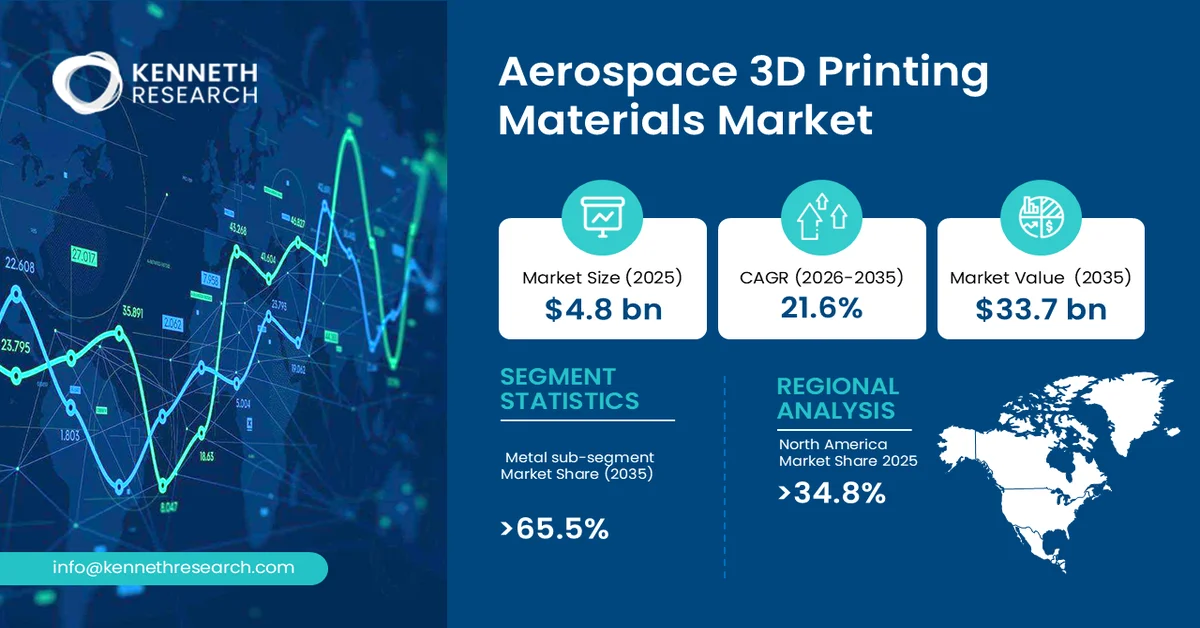
Aerospace 3D Printing Materials Market size was valued at USD 4.8 billion in 2025 and is projected to reach USD 33.7 billion by the end of 2035, rising at a CAGR of 21.6% during the forecast period, i.e., 2026–2035. In 2026, the industry size of the aerospace 3D printing materials is estimated at USD 5.8 billion.
The primary growth driver of the aerospace 3D printing materials market is the increasing adoption of additive manufacturing for lightweight, complex, and performance-critical aerospace components.
The aerospace 3D printing materials market comprises specialized materials used in additive manufacturing processes to produce components, tooling, prototypes, and other parts for aircraft, spacecraft, propulsion systems, and aerospace support applications. Major material categories include metals, polymers, ceramics, and composites, with material selection determined by mechanical strength, temperature resistance, weight, durability, corrosion performance, and manufacturing compatibility.
These materials are supplied in application-specific forms such as metal powders, polymer filaments or pellets, resin systems, and composite feedstocks. Aerospace-grade materials require stringent control over composition, processing behavior, mechanical properties, and repeatability because printed components may be exposed to demanding operational environments.
Key Aerospace 3D Printing Materials Market Insights Summary:
Key Takeaways: Market Trends & Insights
- Aerospace 3D Printing Materials Market is projected to grow from USD 4.8 billion in 2025 to USD 33.7 billion by 2035, registering a 21.6% CAGR during the forecast period.
- North America accounted for the largest regional share at 34.8% in 2025, supported by advanced aerospace manufacturing capabilities, strong additive manufacturing infrastructure, and government-backed research across the U.S. and Canada.
- Metal will remain the leading Material Type segment with a 65.5% share, driven by demand for high-strength, lightweight, and temperature-resistant materials for aerospace structures and propulsion applications.
- Aircraft is expected to remain the leading End-Product segment, supported by increasing integration of additive manufacturing into aircraft component production, maintenance, tooling, and lightweight design.
Market Drivers
- Increasing adoption of additive manufacturing for aerospace components
- Growing demand for lightweight and complex aerospace designs
- Development of high-temperature and application-specific aerospace alloys
- Increasing integration of additive manufacturing into propulsion, aircraft, and spacecraft production
Challenges
- Complex qualification and certification requirements
- Material and process variability
Aerospace 3D Printing Materials Market Overview & Supply Chain
The adoption of aerospace 3D printing materials is increasing as aircraft and spacecraft manufacturers seek lighter structures, complex geometries, consolidated components, and more efficient production methods. Additive manufacturing is particularly relevant to aerospace because it enables material development and component designs that can be difficult or costly to achieve through conventional manufacturing. NASA’s RAMPT program has demonstrated additively manufactured rocket hardware using advanced alloys and composite materials, including components with substantial weight reductions compared with conventional designs.
The aerospace 3D printing materials market value chain begins with metal alloys, polymers, ceramics, composites, and specialized chemical feedstocks used to produce aerospace-grade additive manufacturing materials. Material producers then process these inputs into powders, filaments, pellets, resins, or other feedstock formats compatible with specific additive manufacturing technologies. Specialized suppliers conduct material characterization, qualification, and quality testing before supplying aerospace manufacturers, component producers, research organizations, and additive manufacturing service providers. Distribution generally occurs through direct industrial relationships, qualified material suppliers, and specialized aerospace manufacturing channels. End users include aircraft manufacturers, spacecraft developers, engine manufacturers, defense contractors, maintenance organizations, and aerospace research institutions.
Aerospace 3D Printing Materials Market: Growth Drivers & Challenges
Growth Drivers:
- Increasing adoption of additive manufacturing for aerospace components: The increasing use of additive manufacturing for aerospace components is a major growth driver for specialized 3D printing materials. Aerospace manufacturers are adopting metal powders, advanced alloys, polymers, and composites to produce complex components while reducing part counts, material waste, and manufacturing constraints. NASA’s RAMPT program has demonstrated the maturation of advanced alloys and large-scale additive processes for rocket-engine hardware, while also supporting technology transfer to commercial aerospace and space companies. This government-backed development demonstrates the expanding technical readiness of aerospace-specific materials and processes.
- Growing demand for lightweight and complex aerospace designs: The aerospace industry's continuing focus on lightweight structures and complex component geometries is strengthening demand for advanced 3D printing materials. Additive manufacturing allows engineers to produce intricate internal channels, lattice structures, consolidated assemblies, and topology-optimized components that can be difficult to manufacture economically through conventional methods. Material selection is therefore becoming increasingly important because aerospace applications require a combination of low weight, structural integrity, temperature resistance, fatigue performance, and dimensional stability.
Challenges:
- Complex qualification and certification requirements: Qualification and certification remain a major restraint on the adoption of 3D printing materials in aerospace. Unlike conventional materials with established production histories, additively manufactured materials can exhibit process-dependent properties influenced by feedstock characteristics, equipment parameters, build orientation, defects, and post-processing. These variables require extensive validation before materials and printed components can be approved for flight-critical applications. The FAA issued AC 33.15-3 in 2023, providing an acceptable means of demonstrating compliance for aircraft-engine parts manufactured through powder-bed-fusion additive manufacturing, illustrating the specialized regulatory requirements surrounding AM materials and processes.
- Material and process variability: Material and process variability presents another significant challenge because aerospace manufacturers require highly repeatable material properties and component performance. Differences in powder characteristics, material composition, machine settings, thermal history, and post-processing can influence density, microstructure, mechanical properties, and defect formation. NASA research identifies qualification and certification as significant barriers to broader aviation adoption and notes that conventional approaches can result in high costs, lengthy development timelines, and complex design iterations.
Aerospace 3D Printing Materials Market Size and Forecast:
| Report Attribute | Details |
|---|---|
| Base Year |
2025 |
| Forecast Year |
2026-2035 |
| CAGR |
21.6% |
| Base Year Market Size (2025) |
USD 4.8 billion |
| Forecast Year Market Size (2035) |
USD 33.7 billion |
| Regional Scope |
|
Aerospace 3D Printing Materials Market Segmentation Analysis:
Material Type Segment Analysis
In the Material Type segment, the Metal sub-segment is anticipated to capture the largest market share of 65.5% by the end of 2035.
Its dominance is supported by the suitability of aerospace-grade metals for structural, propulsion, thermal, and other performance-critical applications requiring high strength and temperature resistance. Metal additive manufacturing also enables complex geometries, integrated channels, part consolidation, and customized components that can be difficult to produce conventionally. NASA has continued developing and qualifying additively manufactured aerospace alloys, including nickel-, copper-, aluminum-, titanium-, and stainless-steel-based systems, for demanding propulsion environments. On the supply side, material producers are advancing powder-based alloys and process-specific formulations while aerospace manufacturers increasingly integrate additive manufacturing into component development and production workflows.
End-Product Segment Analysis
In the End-Product segment, the Aircraft sub-segment is projected to grow strongly as aerospace manufacturers increasingly integrate additive manufacturing into aircraft component development, production, maintenance, and lightweight design. Aircraft applications benefit from 3D printing’s ability to produce complex geometries, consolidate components, and support customized parts while reducing manufacturing constraints. NASA research continues to examine additive manufacturing for aircraft materials and structures, including advanced metals, composites, and manufacturing approaches designed for demanding aviation environments. NASA’s 2024 research on sustainable aircraft manufacturing also explores advanced materials and manufacturing processes for future aircraft, reinforcing the technology’s relevance to next-generation aviation.
Our in-depth analysis of the global aerospace 3D printing materials market includes the following segments:
|
Segment |
Sub-segment |
|
Material |
|
|
Component |
|
|
Technology |
|
|
Application |
|
|
End-Product |
|
Aerospace 3D Printing Materials Market Regional Insights:
North America Market Trends & Insights:
North America accounted for 34.8% of the aerospace 3D printing materials market in 2025, supported by advanced aerospace manufacturing capabilities, strong government-backed research, and established additive manufacturing infrastructure. The region benefits from extensive collaboration among aerospace OEMs, material developers, research institutions, and government agencies. NASA has continued advancing additive manufacturing for flight hardware, while the U.S. Department of Defense has developed the Workbench for Additive Materials to share qualified additive-manufacturing material-performance data across government agencies.
The U.S. remains the principal contributor to regional demand because of its large aerospace and defense manufacturing ecosystem and substantial investment in advanced materials and additive manufacturing. NASA's additive manufacturing programs are progressing materials and processes toward flight applications, including complex metal components and propulsion hardware.
Canada complements regional growth through its aerospace-focused advanced manufacturing infrastructure. The National Research Council Canada operates an Aerospace Manufacturing Technologies Centre supporting industry in 3D additive manufacturing, repair technologies, aircraft assembly, and advanced materials processing.
Asia Pacific Market Trends & Insights:
Asia Pacific represents a significant growth opportunity for the aerospace 3D printing materials market, supported by expanding aerospace manufacturing, advanced materials development, additive manufacturing adoption, and government-backed technology programs. Japan is strengthening its additive manufacturing ecosystem through initiatives focused on expanding metal AM adoption and supporting aerospace-related manufacturing capabilities.
Japan offers strong opportunities through its sophisticated aerospace, precision engineering, materials, and manufacturing industries. Government support includes the Space Strategy Fund, which targets development of satellite components and technologies for private-sector space transportation, strengthening demand for advanced materials and manufacturing technologies.
China provides substantial long-term potential through its expanding aerospace and advanced manufacturing ecosystem. Government priorities around manufacturing modernization, supply-chain development, and next-generation production technologies are supporting wider industrial adoption of additive manufacturing.
Leading Companies Operating in the Global Aerospace 3D Printing Materials Market:
Here is a list of upstream, downstream, and key players operating in the aerospace 3D printing materials market competitive ecosystem:
- Stratasys Ltd.(United States)
- 3D Systems Corporation(United States)
- EOS GmbH(Germany)
- GE Additive(United States)
Recent Developments
- November 2025 –Stratasys announced new materials, software, and printing capabilities designed to improve additive manufacturing productivity.
- August 2025 –3D Systems received a contract from the U.S. Air Force for an advanced metal printing system. The initiative focuses on metal additive manufacturing capabilities for aerospace and defense requirements.
Frequently Asked Question
In 2025, the aerospace 3D printing materials market exceeded USD 4.8 billion.
The aerospace 3D printing materials market is projected to reach USD 33.7 billion by the end of 2035, expanding at a CAGR of 21.6% over the forecast period (2026–2035).
The major players in the market are Stratasys Ltd., 3D Systems Corporation, EOS GmbH, GE Additive, Höganäs AB, and others.
In the Material Type segment, the Metal sub-segment is anticipated to capture the largest market share of 65.5% in the future and exhibit lucrative growth opportunities during 2026–2035.
North America is projected to hold the largest market share of 34.8% by the end of 2025 and provide more business opportunities in the future.
Why Choose Kenneth Research ?
-
Insight with Impact : We don’t just gather data — we uncover stories, trends, and opportunities that fuel business growth.
-
Experts Who Get It : Our team speaks your industry’s language and knows what really matters to your customers and market.
-
Custom-Built for You : Forget one-size-fits-all. We craft research and consulting solutions as unique as your business vision.
-
Partners, Not Just Providers : We work with you, not for you — collaborating closely to turn insights into smart, strategic moves.
-
Results That Speak : Our work powers brands, startups, and industry leaders alike — with a track record of ideas that work in the real world.
Report ID: 1240 |
Published Date: 14 Sep 2026 |
Report Format: |
Delivery Timeline: 48-72 Business Hours

Copyright © 2025 Kenneth Research. All rights reserved. Terms of Use | Privacy Policy
