Report ID: 1236 |
Published Date: 14 Sep 2026 |
Report Format: |
Delivery Timeline: 48-72 Business Hours
Adhesive Additives Market Outlook:
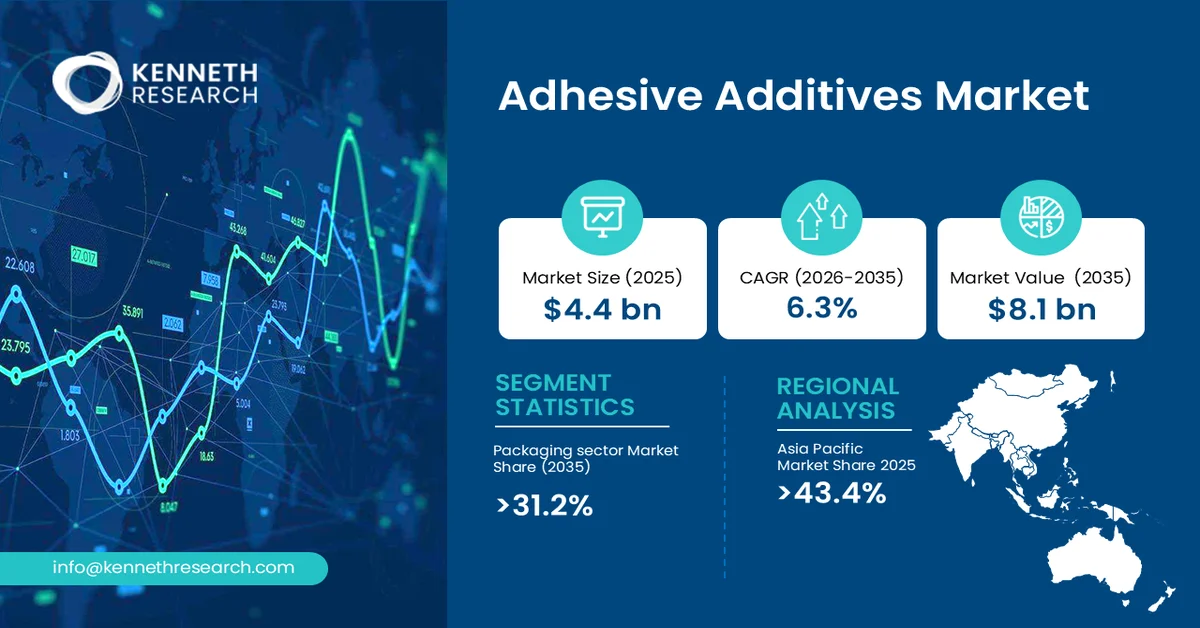
Adhesive Additives Market size was valued at USD 4.4 billion in 2025 and is projected to reach USD 8.1 billion by the end of 2035, rising at a CAGR of 6.3% during the forecast period, i.e., 2026-2035. In 2026, the industry size of the adhesive additives is estimated at USD 4.7 billion.
The primary growth driver of the adhesive additives market is the expanding use of high-performance adhesives across packaging, construction, automotive, electronics, and woodworking applications.
The adhesive additives market comprises specialty chemical additives incorporated into adhesive formulations to enhance bonding performance, processing characteristics, durability, and compatibility with different substrates. These additives include tackifiers, plasticizers, defoamers, dispersing agents, rheology modifiers, antioxidants, and other functional materials designed to optimize adhesive formulations for specific applications.
Adhesive additives influence important characteristics such as tack, viscosity, flexibility, wetting, thermal stability, moisture resistance, aging performance, and adhesion strength. Their selection depends on the adhesive chemistry, production process, substrate characteristics, and required end-use performance.
Key Adhesive Additives Market Insights Summary:
Key Takeaways: Market Trends & Insights
- Adhesive Additives Market projected to grow from USD 4.4 billion in 2025 to USD 8.1 billion by 2035 at a 6.3% CAGR.
- Asia Pacific accounted for the largest regional share at 43.4% in 2025, driven by strong manufacturing, packaging, automotive, electronics, and industrial activity across Japan and China.
- Packaging sector will remain the leading End Use Industry segment with a 31.2% market share, supported by rising demand for flexible packaging, labeling, laminates, and high-performance bonding solutions.
- Tackifiers are expected to witness strong growth within the Product Type segment due to their importance in improving tack, adhesion strength, and bonding performance across pressure-sensitive and packaging adhesive applications.
Market Drivers
- Expanding packaging and converting applications
- Increasing demand for high-performance adhesive formulations
- Growing adoption of lightweight and advanced bonding technologies
- Rising demand for sustainable and low-emission adhesive systems
Challenges
- Volatility in specialty chemical feedstock costs
- Increasing regulatory and formulation compliance requirements
Adhesive Additives Market Overview & Supply Chain
The adoption of adhesive additives is increasing globally as manufacturers demand bonding systems with improved adhesion, flexibility, durability, processing efficiency, and substrate compatibility. Packaging remains particularly important because adhesives support paper, plastic, metal, and multilayer packaging structures while enabling efficient high-speed converting processes. Japan’s Ministry of Economy, Trade and Industry maintains a dedicated annual survey covering the use and production of containers and packaging, demonstrating the importance of packaging activity within the country’s manufacturing and recycling framework.
The adhesive additives market value chain begins with chemical feedstocks and specialty intermediates used to manufacture tackifiers, plasticizers, dispersants, defoamers, rheology modifiers, antioxidants, and other functional additives. Specialty chemical producers process these inputs into application-specific additives and formulate grades compatible with water-based, solvent-based, hot-melt, reactive, and pressure-sensitive adhesive systems. Adhesive manufacturers then incorporate additives into finished formulations according to bonding, processing, and substrate requirements. Distribution is conducted through specialty chemical distributors, direct supplier relationships, and industrial sales channels.
Adhesive Additives Market: Growth Drivers & Challenges
Growth Drivers:
- Expanding packaging and converting applications: The expanding use of adhesives in packaging and converting applications is a major growth driver for the adhesive additives market. Packaging producers increasingly require formulations that provide strong bonding, controlled tack, flexibility, heat resistance, and reliable performance across paper, films, foils, and multilayer structures. Adhesive additives enable formulators to fine-tune these characteristics while supporting high-speed manufacturing and diverse packaging designs. The U.S. Census Bureau recorded 526 establishments in adhesive manufacturing in 2022, illustrating the established industrial base supporting adhesive formulation and production in the United States.
- Increasing demand for high-performance adhesive formulations: The growing need for high-performance adhesives across automotive, construction, electronics, furniture, and industrial manufacturing is supporting broader use of functional additives. Modern bonding systems must often withstand temperature variation, moisture, mechanical stress, chemicals, and prolonged service conditions while maintaining processing efficiency. Additives allow formulators to modify viscosity, flexibility, adhesion, wetting, curing behavior, and durability without fundamentally changing the underlying adhesive chemistry. This enables manufacturers to develop application-specific formulations for increasingly specialized production environments. The transition toward lightweight components, engineered surfaces, automated dispensing, and advanced composite structures is further increasing the importance of optimized adhesive systems.
Challenges:
- Volatility in specialty chemical feedstock costs: The adhesive additives market faces pressure from fluctuations in the cost and availability of petrochemical-derived feedstocks and specialty chemical intermediates. Tackifiers, plasticizers, resins, and other functional additives often depend on upstream chemical inputs whose pricing can change with energy markets, refinery operations, geopolitical conditions, and supply disruptions. This creates challenges for manufacturers attempting to maintain formulation consistency while protecting margins. Sudden changes in input costs can also complicate long-term customer contracts and pricing strategies, particularly for suppliers serving packaging and other high-volume applications.
- Increasing regulatory and formulation compliance requirements: Evolving environmental, chemical-safety, and product-performance requirements create a significant restraint for adhesive additive manufacturers. Regulations affecting VOC emissions, hazardous substances, food-contact applications, and chemical composition can require suppliers to reformulate existing additive systems and conduct additional testing before products can be commercialized. This is particularly important for packaging applications, where adhesive components must meet stringent safety and migration requirements while maintaining bonding performance.
Adhesive Additives Market Size and Forecast:
| Report Attribute | Details |
|---|---|
| Base Year |
2025 |
| Forecast Year |
2026-2035 |
| CAGR |
6.3% |
| Base Year Market Size (2025) |
USD 4.4 billion |
| Forecast Year Market Size (2035) |
USD 8.1 billion |
| Regional Scope |
|
Adhesive Additives Market Segmentation Analysis:
End-Use Industry Segment Analysis
In the End Use Industry segment, the Packaging sector is anticipated to capture the largest market share of 31.2% by the end of 2035.
Its dominance is supported by widespread adhesive use in flexible packaging, labels, cartons, films, laminates, and other multilayer structures requiring reliable bonding and processing performance. Demand is also being reinforced by continued expansion of paper and packaging manufacturing, particularly across Asia Pacific. China’s Ministry of Industry and Information Technology reported that national machine-made paper and paperboard output reached 15,846.9 ten-thousand tonnes in 2024, increasing by 8.6% year over year, demonstrating strong underlying activity in a major adhesive-consuming packaging material ecosystem. On the supply side, additive manufacturers are developing formulations that improve tack, adhesion, flexibility, heat resistance, and compatibility with increasingly complex packaging substrates.
Product Type Segment Analysis
In the Product Type segment, the Tackifiers sub-segment is projected to grow strongly because these additives improve the initial tack, adhesion strength, and bonding performance of adhesive formulations across packaging, labels, tapes, and pressure-sensitive applications. Demand is supported by the increasing need for reliable bonding across diverse substrates and high-speed converting processes. The U.S. Census Bureau classifies adhesive manufacturing as an industry covering establishments primarily engaged in producing adhesives, glues, and caulking compounds, with the 2022 Economic Census recording 358 firms in this industry. This established manufacturing base provides a broad customer ecosystem for specialty additive suppliers. On the supply side, producers are developing tackifier grades with improved compatibility, thermal stability, processing characteristics, and suitability for water-based and hot-melt adhesive systems.
Our in-depth analysis of the global adhesive additives market includes the following segments:
|
Segment |
Sub-segment |
|
Product Type |
|
|
End-Use Industry |
|
Adhesive Additives Market Regional Insights:
Asia Pacific Market Trends & Insights:
Asia Pacific accounted for 43.4% of the adhesive additives market in 2025, making it the dominant regional market. The region benefits from extensive packaging, electronics, automotive, construction, and consumer-goods manufacturing, creating broad demand for performance-enhancing adhesive additives. Japan and China provide particularly strong industrial foundations through advanced manufacturing capabilities, established chemical supply chains, and continued investment in high-performance materials. Japan’s packaging industry demonstrates the region’s substantial downstream demand: the Japan Packaging Institute reported ¥6,382 billion in 2024 shipments of packaging materials and containers, highlighting the scale of the packaging ecosystem that consumes adhesive technologies.
Japan represents a technologically advanced market characterized by sophisticated packaging, electronics, automotive, and precision manufacturing industries. Demand is increasingly oriented toward high-quality adhesive formulations offering improved durability, processing efficiency, and environmental performance.
China provides substantial growth opportunities through its extensive manufacturing base, packaging production, automotive industry, electronics ecosystem, and expanding specialty-chemical capabilities.
North America Market Trends & Insights:
North America represents a significant opportunity for the adhesive additives market, supported by established packaging, automotive, construction, electronics, and industrial manufacturing ecosystems. The region is increasingly focused on advanced manufacturing, sustainable materials, lightweight product design, and high-performance bonding technologies, creating demand for additives that improve adhesion, processing efficiency, durability, and formulation flexibility. Government initiatives supporting domestic manufacturing and supply-chain resilience are also strengthening the industrial environment.
The U.S. remains the principal contributor to regional demand, supported by its extensive manufacturing base, automotive production, packaging activity, and growing investment in advanced industrial technologies.
Canada complements regional growth through its integrated automotive and manufacturing supply chains, close trade relationship with the U.S., and increasing investment in electrification and advanced production. Canada's automotive sector includes major vehicle manufacturers and component production facilities, creating opportunities for specialty adhesive additives in vehicle assembly and component applications.
Leading Companies Operating in the Global Adhesive Additives Market:
Here is a list of upstream, downstream, and key players operating in the adhesive additives market competitive ecosystem:
- BASF SE(Germany)
- Company Overview
- Business Strategy
- Key Product Offerings
- Financial Performance
- Key Performance Indicators
- Risk Analysis
- Recent Development
- Regional Presence
- SWOT Analysis
- Eastman Chemical Company(United States)
- Arkema S.A.(France)
- Evonik Industries AG(Germany)
Recent Developments
- July 2026 –BASF expanded its certified biomass-balanced additives portfolio with new products designed to reduce the carbon footprint of formulations while maintaining established performance.
- February 2025 –Arkema reported continued development of its Adhesive Solutions activities, with its portfolio combining Bostik formulation expertise with Arkema's knowledge of polymers, additives, and coatings.
Frequently Asked Question
In 2025, the adhesive additives market exceeded USD 4.4 billion.
The adhesive additives market is projected to reach USD 8.1 billion by the end of 2035, expanding at a CAGR of 6.3% over the forecast period (2026–2035).
The major players in the market are BASF SE, Eastman Chemical Company, Arkema S.A., Evonik Industries AG, Clariant AG, and others.
In the End Use Industry segment, the Packaging sector sub-segment is anticipated to capture the largest market share of 31.2% in the future and exhibit lucrative growth opportunities during 2026–2035.
Asia Pacific is projected to hold the largest market share of 43.4% by the end of 2025 and provide more business opportunities in the future. Strong packaging, automotive, electronics, and manufacturing activity across Japan and China is fostering the region's dominance.
Why Choose Kenneth Research ?
-
Insight with Impact : We don’t just gather data — we uncover stories, trends, and opportunities that fuel business growth.
-
Experts Who Get It : Our team speaks your industry’s language and knows what really matters to your customers and market.
-
Custom-Built for You : Forget one-size-fits-all. We craft research and consulting solutions as unique as your business vision.
-
Partners, Not Just Providers : We work with you, not for you — collaborating closely to turn insights into smart, strategic moves.
-
Results That Speak : Our work powers brands, startups, and industry leaders alike — with a track record of ideas that work in the real world.
Report ID: 1236 |
Published Date: 14 Sep 2026 |
Report Format: |
Delivery Timeline: 48-72 Business Hours

Copyright © 2025 Kenneth Research. All rights reserved. Terms of Use | Privacy Policy
