Report ID: 1232 |
Published Date: 14 Sep 2026 |
Report Format: |
Delivery Timeline: 48-72 Business Hours
Address Fabric for Telecom Market Outlook:
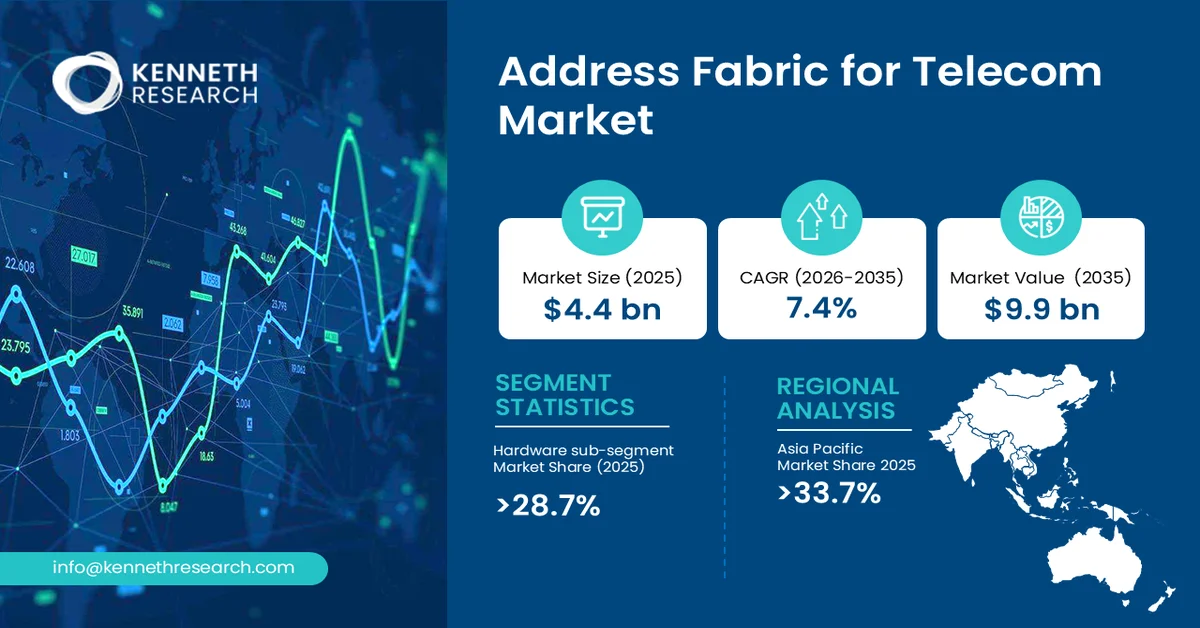
Address Fabric for Telecom Market size was valued at USD 4.4 billion in 2025 and is projected to reach USD 9.9 billion by the end of 2035, rising at a CAGR of 7.4% during the forecast period, i.e., 2026-2035. In 2026, the industry size of address fabric for telecom is estimated at USD 5.2 billion.
The primary growth driver is the rapid expansion of advanced mobile-network infrastructure, particularly 5G, which increases demand for address-fabric capabilities that enable scalable, reliable connectivity, network segmentation, automation, and efficient resource management. In Asia and the Pacific, ITU reported that 5G coverage expanded substantially through 2024, reinforcing infrastructure modernization as a key demand catalyst.
The address fabric for telecom market encompasses technologies, platforms, software, hardware, and associated services used by telecommunications organizations to manage, coordinate, automate, and optimize network addressing resources across complex communications environments. Address fabric capabilities provide a structured layer for managing network identifiers and address information across physical, virtual, cloud, data-center, access, transport, and mobile-network domains.
Key characteristics include centralized or distributed address management, policy-based allocation, automation, synchronization, visibility, scalability, and integration with network-management and orchestration systems. These capabilities become particularly relevant as telecom networks evolve toward software-defined, cloud-native, virtualized, and multi-domain architectures. Address fabric solutions can help operators maintain consistency across network resources while supporting operational efficiency and reducing manual configuration requirements.
Key Address Fabric for Telecom Market Insights Summary:
Key Takeaways: Market Trends & Insights
- Hardware held the largest share at 28.7% in 2025, supported by continued demand for physical telecom network infrastructure
- Asia Pacific dominated the market with a 33.7% share in 2025, driven by extensive telecommunications infrastructure and network modernization
- China and India represent key country markets within Asia Pacific, supported by advanced mobile network deployment and continued digitalization
- Professional Services is projected to grow as telecom operators require specialized expertise for integration, configuration, migration, and optimization
- Legacy-system integration and multi-vendor interoperability remain major challenges, while cybersecurity and operational-risk exposure can increase deployment complexity
Market Drivers
- Accelerating 5G Network Expansion
- Growing Network Virtualization and Automation
- Expansion of Cloud-Native Telecom Infrastructure
- Increasing Adoption of Edge Computing and Distributed Network Architectures
Challenges
- Legacy-system integration and multi-vendor interoperability
- Cybersecurity and operational-risk exposure
Address Fabric for Telecom Market Overview & Supply Chain
Global adoption of address-fabric capabilities is increasing as telecom operators modernize networks across fiber, mobile, cloud, data-center, and software-defined environments. Greater network complexity is increasing the need for centralized visibility, automated address allocation, policy enforcement, synchronization, and orchestration across heterogeneous infrastructure. The relevance is particularly strong as operators expand high-capacity connectivity and integrate communications infrastructure with digital services.
The Address Fabric for Telecom value chain begins with technology and infrastructure inputs, including semiconductor components, networking hardware, computing platforms, software frameworks, databases, operating systems, and cloud infrastructure. Solution developers and equipment manufacturers integrate these inputs into address-management platforms, network controllers, orchestration systems, and supporting hardware capable of operating across telecom environments. Systems integrators and technology distributors then package, configure, deploy, and maintain solutions according to operator requirements, frequently combining products with implementation and professional services. Telecommunications operators represent the principal end users, applying address-fabric capabilities across mobile, fixed-line, cloud, data-center, transport, and access networks. Enterprise communications providers, managed-service providers, network equipment vendors, cloud platforms, and infrastructure partners also participate in the ecosystem.
Address Fabric for Telecom Market: Growth Drivers & Challenges
Growth Drivers:
- Accelerating 5G network expansion: The continued rollout of 5G networks is expanding the operational complexity that telecom operators must manage across radio, transport, core, edge, and cloud environments. As network architectures become more distributed, address-fabric capabilities can provide centralized visibility, automated allocation, policy coordination, and synchronization across multiple infrastructure domains. The International Telecommunication Union reported that 5G coverage reached 51% of the world’s population in 2024, demonstrating the broadening deployment footprint of next-generation mobile infrastructure. This expansion creates additional requirements for scalable network-resource management and strengthens the business case for automation-oriented address technologies.
- Growing network virtualization and automation: Telecom operators are progressively shifting from hardware-centric architectures toward virtualized, software-defined, and cloud-native network environments. This transition increases the number of logical resources, domains, interfaces, and dynamically provisioned services that must be coordinated. Address-fabric technologies can support this transformation by providing consistent resource visibility, policy-based allocation, automated configuration, and integration with orchestration platforms. The growth mechanism is therefore linked not simply to additional network equipment, but to the increasing software complexity surrounding each infrastructure layer. Greater automation can also reduce manual provisioning, improve operational consistency, and accelerate service activation. As operators adopt multi-cloud, edge-computing, network-function virtualization, and programmable infrastructure models, address management becomes increasingly interconnected with broader network orchestration.
Challenges:
- Legacy-system integration and multi-vendor interoperability: Telecom operators typically operate heterogeneous environments accumulated through successive technology generations, acquisitions, and vendor deployments. Legacy platforms may rely on proprietary interfaces, inconsistent data structures, and limited automation capabilities, making integration with modern address-fabric architectures technically demanding. The root cause is the absence of uniform interfaces across infrastructure domains and the difficulty of coordinating physical, virtual, and cloud-native resources through a common operational model. Industry impact includes longer implementation cycles, additional middleware requirements, extensive customization, and greater testing requirements before automation can be deployed safely. Commercially, these factors can increase deployment costs and weaken the immediate return on investment for operators considering address-fabric modernization.
- Cybersecurity and operational-risk exposure: Address-fabric platforms increasingly connect network inventories, configuration systems, orchestration layers, APIs, and automated workflows, expanding the operational dependency on centralized software and data. The root challenge is that greater programmability introduces additional interfaces and control paths that must be protected against unauthorized access, configuration manipulation, data corruption, and service disruption. Industry impact can extend beyond the address-management layer because inaccurate or compromised resource information may propagate into downstream provisioning and network operations. Commercially, operators may therefore require stronger identity controls, segmentation, monitoring, audit mechanisms, resilience measures, and specialized security expertise before deploying address-fabric capabilities extensively.
Address Fabric for Telecom Market Size and Forecast:
| Report Attribute | Details |
|---|---|
| Base Year |
2025 |
| Forecast Year |
2026-2035 |
| CAGR |
7.4% |
| Base Year Market Size (2025) |
USD 4.4 billion |
| Forecast Year Market Size (2035) |
USD 9.9 billion |
| Regional Scope |
|
Address Fabric for Telecom Market Segmentation Analysis:
Component Segment Analysis
In the component segment, the Hardware sub-segment is anticipated to capture the largest market share of 28.7% by the end of 2025.
Hardware dominates the address fabric for telecom market because telecom operators require dedicated infrastructure to support address management, network connectivity, processing, routing, and resource coordination across increasingly complex networks. Demand is being reinforced by continued deployment of 5G, fiber, and high-capacity infrastructure, where physical network equipment remains fundamental to service delivery. China provides a strong indication of this underlying demand: the Ministry of Industry and Information Technology reported 4.04 million 5G base stations by the end of August 2024, highlighting the extensive physical infrastructure supporting next-generation telecommunications.
Component Segment Analysis
The Professional Services is projected to grow as the second-largest segment in the address fabric for telecom market due to four converging demand drivers.
Professional Services is projected to grow as telecom operators increasingly require specialized expertise to design, integrate, configure, migrate, and optimize address-fabric environments across complex multi-vendor networks. Demand is supported by the transition toward software-defined, cloud-native, and automated infrastructure, where implementation requires integration with existing operational systems and network-management platforms. India’s Department of Telecommunications reported that its Digital Communications Innovation Square scheme had supported 126 projects led by start-ups and MSMEs, demonstrating continued institutional activity around advanced communications technologies and the associated need for specialized technical capabilities.
Our in-depth analysis of the global address fabric for telecom market includes the following segments:
|
Segment |
Sub-segment |
|
Component |
|
|
Application |
|
|
Deployment Mode |
|
|
End-User |
|
Address Fabric for Telecom Market Regional Insights:
Asia Pacific Market Trends & Insights:
Asia Pacific address fabric for telecom market is projected to hold the largest revenue share of 33.7% by the end of 2025.
It is supported by its extensive telecommunications infrastructure, large operator base, accelerating network modernization, and sustained investment in digital connectivity. The region combines major telecom manufacturing ecosystems with substantial consumption of mobile, fixed broadband, cloud, and data-center infrastructure. Regulatory initiatives supporting digital transformation and connectivity further reinforce investment across network infrastructure and associated management technologies.
China is a principal regional market, benefiting from extensive telecom infrastructure deployment, domestic equipment capabilities, and continued investment in advanced mobile and broadband networks. Government-backed infrastructure programs and large-scale operator deployments create a substantial environment for network-resource management technologies.
India represents another important growth market, supported by rapid digitalization, expanding mobile connectivity, and continued network modernization.
North America Market Trends & Insights:
North America remains an attractive market for address-fabric solutions because telecom operators, enterprises, cloud providers, and public-sector networks are pursuing modernization, higher resilience, and greater automation across increasingly complex infrastructure. In the United States, federal broadband programs are supporting network expansion while encouraging coordinated deployment across states, territories, Tribal nations, and private-sector participants. The U.S. government is also actively shaping the next generation of wireless infrastructure through policy work around 6G, emphasizing secure, reliable, and interoperable telecommunications ecosystems. These initiatives create opportunities for address-fabric technologies that can improve network visibility, resource coordination, provisioning, and interoperability.
The country is positioned as a major adoption center because operators and infrastructure providers are modernizing broadband and wireless networks while integrating increasingly software-driven architectures. Federal initiatives supporting broadband deployment and next-generation wireless research should encourage demand for network-management and orchestration capabilities.
Canada offers opportunities through network-reliability programs, rural connectivity initiatives, and preparations for future wireless technologies. Government policy emphasizes resilient, interoperable networks and continued expansion of reliable connectivity, supporting demand for technologies that simplify infrastructure management and coordination.
Leading Companies Operating in the Global Address Fabric for Telecom Market:
Here is a list of upstream, downstream, and key players operating in the global address fabric for telecom market competitive ecosystem:
- Arista Networks (United States)
- Company Overview
- Business Strategy
- Key Product Offerings
- Financial Performance
- Key Performance Indicators
- Risk Analysis
- Recent Development
- Regional Presence
- SWOT Analysis
- Nokia Corporation (Finland)
- Ericsson (Sweden)
- Extreme Networks, Inc. (United States)
Recent Developments
- In June 2026, Arista Networks introduced the 7060XE7 Series, a new portfolio of 1.6 Terabit networking platforms designed specifically as the foundation for rack-scale AI infrastructure. The 64-port air-cooled switches support AI clusters with hundreds of thousands of XPUs. First shipments are expected in Q4 2026, with both Meta and Microsoft endorsing Arista's Etherlink AI fabric approach.
- In May 2026, Extreme Networks showcased expanded capabilities of its Platform ONE management solution at Extreme Connect 2026. Platform ONE now serves as the unified control plane for wired, Wi-Fi, fabric, and SD-WAN with deep fabric visibility and zero-touch provisioning. The company highlighted growing enterprise adoption as Platform ONE crosses a threshold from promise to proof.
Frequently Asked Question
In 2025, the address fabric for telecom market exceeded USD 4.4 billion.
The address fabric for telecom market is projected to reach USD 9.9 billion by the end of 2035, expanding at a CAGR of 7.4% over the forecast period (2026-2035).
The major players in the market are Arista Networks, Nokia Corporation, Ericsson, Extreme Networks, Inc., and others.
In the Component segment, the Hardware sub-segment is anticipated to capture the largest market share of 28.7% in the future and exhibit lucrative growth opportunities during 2026-2035. This growth trajectory is largely attributed to continued expansion of 5G network infrastructure.
Asia Pacific is projected to hold the largest market share of 33.7% by the end of 2035 and provide more business opportunities in the future. Continuous investments in telecommunications infrastructure and network modernization across China and India are fostering the region's dominance.
Why Choose Kenneth Research ?
-
Insight with Impact : We don’t just gather data — we uncover stories, trends, and opportunities that fuel business growth.
-
Experts Who Get It : Our team speaks your industry’s language and knows what really matters to your customers and market.
-
Custom-Built for You : Forget one-size-fits-all. We craft research and consulting solutions as unique as your business vision.
-
Partners, Not Just Providers : We work with you, not for you — collaborating closely to turn insights into smart, strategic moves.
-
Results That Speak : Our work powers brands, startups, and industry leaders alike — with a track record of ideas that work in the real world.
Report ID: 1232 |
Published Date: 14 Sep 2026 |
Report Format: |
Delivery Timeline: 48-72 Business Hours

Copyright © 2025 Kenneth Research. All rights reserved. Terms of Use | Privacy Policy
