Report ID: 1266 |
Published Date: 10 Sep 2026 |
Report Format: |
Delivery Timeline: 48-72 Business Hours
60GHz Radar Sensor Market Outlook:
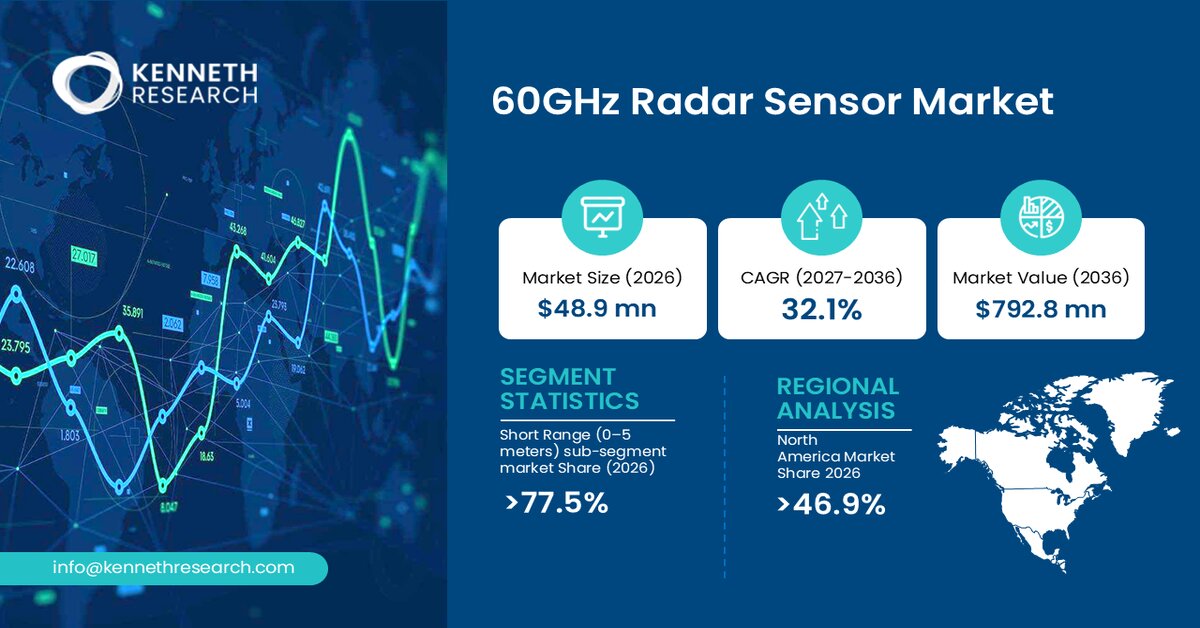
60GHz Radar Sensor Market size was valued at USD 48.9 Million in 2026 and is projected to reach USD 792.8 Million by the end of 2036, rising at a CAGR of 32.1% during the forecast period, i.e., 2027–2036. In 2027, the industry size of the 60GHz radar sensor is estimated at USD 64.7 Million.
The primary growth driver is the expanding adoption of radar-based sensing across automotive safety, autonomous systems, healthcare monitoring, home automation, and other applications requiring reliable object detection. Regulatory support for innovative 60GHz field-disturbance sensor applications is also encouraging product development and commercialization.
The 60GHz radar sensor market comprises radar sensing systems and associated hardware designed to detect, locate, and monitor objects, motion, distance, or other physical characteristics using electromagnetic signals around the 60GHz spectrum. These sensors operate as field-disturbance sensing devices, transmitting radio-frequency energy and analyzing reflected signals to derive information about targets and their movement. The technology is particularly relevant where non-contact, compact, and responsive sensing is required.
Key characteristics include millimeter-wave operation, directional sensing, electronic signal processing, and suitability for applications requiring object or motion detection. Government regulatory documentation recognizes 60GHz field-disturbance sensors and radars for uses spanning personal safety, automotive systems, home automation, environmental control, and healthcare monitoring.
Key 60GHz Radar Sensor Market Insights Summary:
Key Takeaways: Market Trends & Insights
- The 60GHz radar sensor market is valued at USD 48.9 Million in 2026, with a strong growth trajectory through 2036
- The market is projected to reach USD 792.8 Million by 2036, reflecting a CAGR of 32.1% during 2027–2036
- Short Range (0–5 meters) leads the Range segment with a 77.5% market share in 2026, supported by demand for proximity detection, automation, and safety applications
- Hardware is identified as the fastest-growing Component segment, driven by increasing integration of RF front ends, antennas, processors, and other sensing electronics
- North America dominates the global market with a 46.9% market share in 2026, supported by advanced automotive, electronics, industrial automation, and sensing technology ecosystems
Market Drivers
- Regulatory Push for Advanced Vehicle Safety
- Expansion of Intelligent, Contactless Sensing
- Growing Integration of Radar into Automated and Connected Systems
- Advances in RF Semiconductor Integration and Sensor Miniaturization
Challenges
- Mutual Interference and Signal Reliability
- High Integration Complexity and Qualification Requirements
60GHz Radar Sensor Market Overview & Supply Chain
Adoption of 60GHz radar sensors is increasing as industries seek compact, non-contact sensing for safety, automation, monitoring, and intelligent environments. Millimeter-wave radar can support detection where conventional optical sensing may be constrained by lighting or visibility, strengthening its relevance across automotive, healthcare, robotics, building automation, and industrial applications. Regulatory developments are also supporting commercialization: U.S. spectrum authorities have expanded opportunities for mobile radar operations in the 60GHz band, recognizing applications including vehicle safety, healthcare monitoring, home automation, and environmental control.
The 60GHz radar sensor value chain begins with semiconductor-grade materials, RF substrates, packaging materials, antennas, electronic components, and specialized manufacturing inputs. Component suppliers produce radio-frequency integrated circuits, transceivers, antennas, signal-processing elements, and supporting electronics, which are subsequently assembled into sensor modules or integrated sensing platforms. Manufacturers undertake wafer processing, component assembly, antenna integration, calibration, testing, and software or firmware integration before supplying finished products. Distribution typically moves through direct OEM relationships, electronics distributors, system integrators, and specialized technology partners. End users include automotive manufacturers, industrial automation companies, healthcare technology providers, robotics developers, smart-building operators, security-system providers, and consumer-electronics manufacturers.
60GHz Radar Sensor Market: Growth Drivers & Challenges
Growth Drivers
- Regulatory push for advanced vehicle safety: The strengthening of vehicle safety requirements is creating a structural demand driver for radar-based sensing technologies. Advanced driver-assistance systems rely on forward-looking sensing to identify vehicles, pedestrians, and other obstacles, making radar an important technology for collision-warning and automated-braking architectures. In 2024, the U.S. National Highway Traffic Safety Administration finalized a Federal Motor Vehicle Safety Standard requiring automatic emergency braking, including pedestrian detection, on new passenger cars and light trucks. NHTSA estimates that the requirement will prevent at least 24,000 injuries annually, reinforcing the policy importance of sensor-enabled safety systems. As automakers redesign electronic architectures to satisfy increasingly demanding safety-performance requirements, demand for compact, reliable radar modules should expand.
- Expansion of intelligent, contactless sensing: The broader transition toward intelligent automation is another important growth driver for 60GHz radar sensors. Manufacturers, building-technology providers, healthcare-equipment developers, robotics companies, and consumer-device designers increasingly require sensing systems that can operate without physical contact and provide information about movement, presence, distance, or activity. Radar is attractive because sensing performance can be maintained across environments where optical technologies may face limitations related to lighting, privacy, or visual occlusion. At the component level, improvements in RF integration, antenna design, signal processing, and embedded software are enabling increasingly compact sensor architectures. This supports integration into equipment and environments where space, power consumption, and unobtrusive operation are important design considerations.
Challenges
- Mutual interference and signal reliability: As 60GHz radar deployment expands across connected environments, the simultaneous operation of multiple radar devices can create mutual interference, particularly when sensors share spectrum and operate in close proximity. Interference can distort received signals, reduce detection reliability, generate false targets, or temporarily obscure smaller objects. The root cause is the increasing density of electronically active sensing equipment combined with the need to operate within defined frequency allocations. This creates additional engineering requirements for waveform design, interference detection, filtering, and signal-processing algorithms. Commercially, manufacturers must invest more heavily in validation and system-level testing, while integrators may face greater complexity when deploying multiple sensors within confined environments.
- High integration complexity and qualification requirements: Developing compact 60GHz radar modules requires close integration of RF front ends, antennas, digital processing, power management, embedded software, and thermal considerations. At millimeter-wave frequencies, small variations in layout, packaging, signal integrity, or component characteristics can materially affect system performance, making design and validation more demanding than for many conventional sensing technologies. This complexity can lengthen development cycles and increase engineering requirements, particularly for applications where reliability and repeatable sensing performance are commercially critical. Manufacturers must also balance technical performance with module size, power consumption, manufacturability, and integration into existing electronic architectures. For smaller technology providers, these requirements can make customer qualification and production scaling difficult.
60GHz Radar Sensor Market Size and Forecast:
| Report Attribute | Details |
|---|---|
| Base Year |
2026 |
| Forecast Period |
2027-2036 |
| CAGR |
32.1% |
| Base Year Market Size (2026) |
USD 48.9 Million |
| Forecast Year Market Size (2036) |
USD 792.8 Million |
| Regional Scope |
|
60GHz Radar Sensor Market Segmentation Analysis:
Range Segment Analysis
In the range segment, the Short Range (0–5 meters) sub-segment is anticipated to capture the largest market share of 77.5% by the end of 2026.
Short-range radar dominates because proximity sensing is central to applications requiring immediate detection of people, vehicles, objects, and movement within confined operating zones. Demand is being reinforced by automotive safety, parking assistance, occupant monitoring, robotics, industrial automation, smart-building controls, and healthcare applications where compact sensing and rapid response are valuable. From the supply side, 60GHz radar benefits from increasingly integrated RF semiconductor architectures, compact antenna designs, embedded processing, and module-level integration, allowing manufacturers to incorporate sensing into space-constrained equipment. Regulatory developments also support broader deployment of 60GHz radar applications.
Component Segment Analysis
The Hardware is projected to grow as the second-largest segment in the 60GHz radar sensor market due to four converging demand drivers.
Hardware is projected to grow rapidly because 60GHz radar systems require increasingly integrated radio-frequency front ends, antennas, transceivers, processors, memory, power-management circuitry, and packaging to deliver compact sensing platforms. Demand is being supported by the expansion of automation, robotics, automotive electronics, smart infrastructure, and industrial monitoring, where physical sensing must increasingly operate as part of connected electronic architectures. U.S. Census Bureau data provide a useful indicator of this underlying hardware demand: U.S. nonfarm employer businesses invested $12,960 million in robotic equipment in 2022, demonstrating substantial capital deployment toward automated equipment that depends on sensing and electronic control technologies. Supply-side development is also improving through greater semiconductor integration, smaller RF components, advanced packaging, and increasingly standardized radar modules.
Our in-depth analysis of the global 60GHz radar sensor market includes the following segments:
|
Segment |
Sub-segment |
|
Component |
|
|
Range |
|
|
Application |
|
|
End-User |
|
60GHz Radar Sensor Market Regional Insights:
North America Trends & Insights:
North America 60GHz radar sensor market is projected to hold the largest revenue share of 46.9% by the end of 2026.
Regional leadership is supported by a mature automotive technology ecosystem, advanced semiconductor and electronics capabilities, strong industrial automation adoption, and sustained investment in connected sensing technologies. Regulatory attention toward vehicle safety and intelligent transportation further supports radar deployment, while demand from smart buildings, healthcare monitoring, robotics, and industrial applications broadens the addressable customer base.
The United States represents the principal national market within North America, benefiting from extensive automotive electronics development, semiconductor investment, defense and aerospace capabilities, and a large installed base of industrial and connected technologies. Regulatory and commercial activity around advanced driver-assistance and automated systems further reinforces demand for sophisticated sensing components.
Canada provides a complementary market through its automotive manufacturing base, technology ecosystem, and advanced-manufacturing capabilities. Its electronics and semiconductor-related activities also support regional supply-chain development. Together, the two countries provide a combination of technology development, industrial consumption, investment capacity, and regulatory support that strengthens North America's position in 60GHz radar sensing.
Asia Pacific Trends & Insights:
Asia Pacific presents strong opportunities for 60GHz radar sensors because of its deep electronics manufacturing base, expanding automotive production, industrial automation, smart-city development, and growing deployment of connected devices. Government initiatives are reinforcing this environment, particularly through intelligent-vehicle infrastructure and automated mobility programs. In China, ministries have established a coordinated “vehicle-road-cloud integration” application program focused on intelligent roadside infrastructure, connected vehicles, cloud-control platforms, and multi-scenario autonomous applications.
China is positioned as a major regional opportunity because of its large automotive and electronics ecosystem and active government support for intelligent and connected vehicles. National initiatives are encouraging collaboration between vehicle manufacturers, infrastructure providers, technology companies, and local governments, creating broader deployment opportunities for perception technologies.
Japan offers complementary opportunities through its advanced automotive, robotics, electronics, and industrial-technology base. Government-backed development is also supporting next-generation radar and sensor research, strengthening the country's ecosystem for sophisticated sensing technologies and creating potential applications across mobility, industrial automation, and advanced equipment.
Leading Companies Operating in the Global 60GHz Radar Sensor Market:
Here is a list of upstream, downstream, and key players operating in the global 60GHz radar sensor market competitive ecosystem:
- Texas Instruments Incorporated (United States)
- Company Overview
- Business Strategy
- Key Product Offerings
- Financial Performance
- Key Performance Indicators
- Risk Analysis
- Recent Development
- Regional Presence
- SWOT Analysis
- Acconeer AB (Sweden)
- Calterah Semiconductor (China)
- Asahi Kasei Microdevices (AKM) (Japan)
- Possumic Technology (China)
Recent Developments
- In May 2025, Texas Instruments introduced the IWRL6844, a next-generation 60GHz radar sensor featuring four transmitters and four receivers, a new C66x DSP, and 2.5MB of memory for machine learning models, all while consuming under 500mW average power . The device targets building automation for presence detection and people counting up to 20m, as well as industrial automation including robotics, safety scanners, and off-highway vehicles.
- In February 2025, Acconeer signed a global franchise agreement with Future Electronics to distribute its A121 60GHz radar sensor and related products, expanding the company's global distribution network for its patented Pulsed Coherent Radar technology across automotive, IoT, and industrial automation sectors.
Frequently Asked Question
In 2026, the 60GHz radar sensor market exceeded USD 48.9 Million.
The 60GHz radar sensor market is projected to reach USD 792.8 Million by the end of 2036, expanding at a CAGR of 32.1% over the forecast period (2027-2036).
The major players in the market are Texas Instruments Incorporated, Acconeer AB, Calterah Semiconductor, Asahi Kasei Microdevices (AKM), Possumic Technology, and others.
In the Range segment, the Short Range (0–5 meters) sub-segment is anticipated to capture the largest market share of 77.5% in the future and exhibit lucrative growth opportunities during 2027-2036. This growth trajectory is largely attributed to increasing demand for proximity sensing in automotive safety, robotics, industrial automation, smart buildings, and healthcare applications.
North America is projected to hold the largest market share of 46.9% by the end of 2036 and provide more business opportunities in the future. Strong automotive technology capabilities, industrial automation, advanced electronics development, and regulatory support in the United States and Canada are fostering the region's dominance.
Why Choose Kenneth Research ?
-
Insight with Impact : We don’t just gather data — we uncover stories, trends, and opportunities that fuel business growth.
-
Experts Who Get It : Our team speaks your industry’s language and knows what really matters to your customers and market.
-
Custom-Built for You : Forget one-size-fits-all. We craft research and consulting solutions as unique as your business vision.
-
Partners, Not Just Providers : We work with you, not for you — collaborating closely to turn insights into smart, strategic moves.
-
Results That Speak : Our work powers brands, startups, and industry leaders alike — with a track record of ideas that work in the real world.
Report ID: 1266 |
Published Date: 10 Sep 2026 |
Report Format: |
Delivery Timeline: 48-72 Business Hours

Copyright © 2025 Kenneth Research. All rights reserved. Terms of Use | Privacy Policy
