Report ID: 1233 |
Published Date: 14 Sep 2026 |
Report Format: |
Delivery Timeline: 48-72 Business Hours
5G IoT Market Outlook:
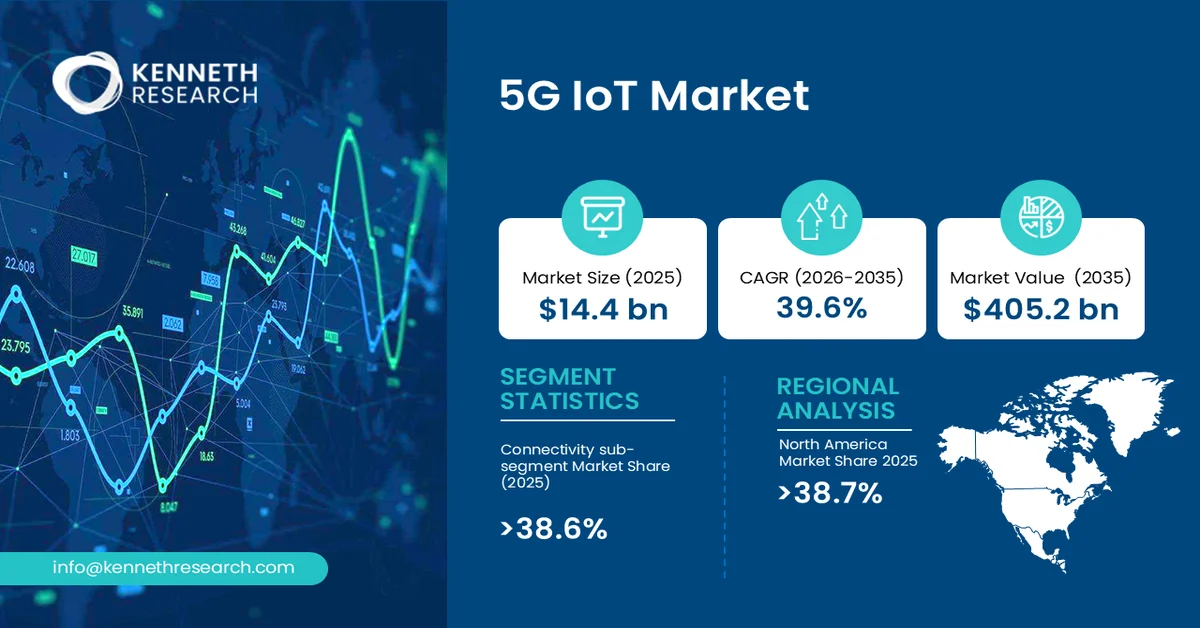
5G IoT Market size was valued at USD 14.4 billion in 2025 and is projected to reach USD 405.2 billion by the end of 2035, rising at a CAGR of 39.6% during the forecast period, i.e., 2026–2035. In 2026, the industry size of 5G IoT is estimated at USD 20.1 billion.
Industrial digitization and automation are driving 5G IoT adoption as enterprises seek reliable, low-latency wireless connectivity for connected machinery, robotics, sensors, and operational systems. ITU identifies 5G’s support for ultra-reliable, low-latency communication and massive machine-to-machine applications as important capabilities for vertical industries and industrial automation.
The 5G IoT market comprises technologies, equipment, connectivity solutions, platforms, and services that use fifth-generation mobile networks to connect, manage, monitor, and exchange data among physical and virtual devices. It encompasses connected sensors, machines, industrial equipment, vehicles, gateways, and other endpoints, together with the network and computing infrastructure required to support their communications.
A defining characteristic is the integration of 5G capabilities with IoT architectures to address demanding connectivity requirements, including high reliability, low latency, device density, mobility, and scalable data exchange. These capabilities extend IoT beyond conventional monitoring toward real-time control, automation, intelligent operations, and machine-to-machine communication.
Key 5G IoT Market Insights Summary:
Key Takeaways: Market Trends & Insights
- The 5G IoT market is valued at USD 14.4 billion in 2025 and is projected to reach USD 405.2 billion by 2035
- The market is expected to expand at a CAGR of 39.6% during 2026–2035
- Connectivity is the leading Component sub-segment, accounting for 38.6% market share in 2025
- North America is the dominant regional market, holding 38.7% market share in 2025
- Large Enterprises represent the second and fastest analysis segment, supported by increasing enterprise deployment of connected industrial and operational technologies
Market Drivers
- Expansion of industrial wireless connectivity
- Increasing demand for real-time operational intelligence
- Growth of private 5G networks for enterprise applications
- Integration of edge computing with connected industrial assets
Challenges
- Complex industrial deployment and performance validation
- Cybersecurity and privacy complexity
5G IoT Market Overview & Supply Chain
Global adoption of the 5G IoT market is increasing as enterprises and public-sector organizations pursue connected operations that require higher network reliability, device density, mobility, and responsive data exchange. 5G is particularly relevant to industrial automation because it can connect large populations of sensors, machines, vehicles, and control systems while supporting time-sensitive applications. The International Telecommunication Union identifies massive machine-to-machine communication as a core 5G capability and states that one million devices may be connected per square kilometre, supporting applications across vertical industries.
he 5G IoT market value chain begins with raw materials and technology inputs, including semiconductor materials, electronic components, sensors, antennas, radio-frequency components, processors, batteries, cables, and networking hardware. Component manufacturers convert these inputs into IoT devices, gateways, modules, routers, base-station equipment, and other connectivity infrastructure. Systems integrators and technology providers subsequently combine hardware with network management, edge-computing, cybersecurity, cloud, analytics, and IoT platform capabilities to create deployable solutions. Distribution occurs through telecommunications operators, equipment vendors, specialist distributors, systems integrators, and technology partners, with deployment frequently tailored to specific industrial environments. End users include manufacturers, logistics operators, utilities, healthcare organizations, transportation providers, public agencies, and enterprises.
5G IoT Market: Growth Drivers & Challenges
Growth Drivers:
- Expansion of industrial wireless connectivity: The transition toward connected, data-driven production environments is accelerating demand for 5G-enabled IoT because manufacturers increasingly require wireless networks capable of supporting automation, robotics, sensors, mobile equipment, and real-time control. The U.S. National Institute of Standards and Technology (NIST) established its Industrial Wireless 5G Testbed to evaluate 5G performance in industrial environments, including low-latency applications, connectivity, security, reliability, industrial IoT integration, and cyber-physical systems. The initiative demonstrates how 5G is moving from telecommunications infrastructure toward an industrial technology layer. Greater availability of validated industrial use cases can reduce technology-adoption uncertainty and encourage manufacturers to replace fragmented wired and legacy wireless architectures with more flexible connectivity.
- Increasing demand for real-time operational intelligence: Enterprises are increasingly connecting physical assets to digital systems to improve visibility, automate decisions, and respond faster to changing operating conditions. 5G IoT supports this transition by combining pervasive device connectivity with the processing capabilities of edge and cloud environments. In manufacturing, connected sensors can continuously capture equipment, process, and environmental information, while low-latency communications can enable faster interaction between machines, software, and operators. The resulting architecture supports predictive maintenance, production monitoring, asset tracking, quality management, and increasingly autonomous workflows. This creates a broader role for 5G IoT beyond connectivity alone: network infrastructure becomes an enabler of operational intelligence.
Challenges:
- Complex industrial deployment and performance validation: A major restraint is the technical complexity of deploying 5G IoT reliably inside industrial environments. Factories contain metal structures, moving machinery, physical obstructions, electromagnetic interference, and heterogeneous communications systems that can affect radio propagation and deterministic data delivery. NIST identifies reliable and deterministic wireless communication as a key adoption challenge for industrial control applications, particularly where network performance must remain predictable. This creates commercial friction because enterprises cannot evaluate 5G IoT solely through conventional telecommunications benchmarks; deployments require site-specific engineering, testing, integration with operational technology, and ongoing network management. The result can be longer implementation cycles, higher integration effort, and greater dependence on specialized engineering expertise.
- Cybersecurity and privacy complexity: 5G IoT expands the number of connected endpoints and introduces a more distributed architecture spanning devices, radio access networks, cloud platforms, edge computing, and enterprise operational systems. This broad attack surface makes cybersecurity a structural challenge rather than an isolated device-level concern. NIST notes that 5G introduces security capabilities focused on interoperable interfaces while leaving additional cybersecurity and privacy considerations outside the core standards, complicating how organizations assess, deploy, and supplement protections. Commercially, enterprises therefore need coordinated security controls across telecommunications and IT/OT environments, increasing governance, integration, monitoring, and compliance requirements. These demands can slow deployments where operational technology has strict availability and safety requirements.
5G IoT Market Size and Forecast:
| Report Attribute | Details |
|---|---|
| Base Year |
2025 |
| Forecast Year |
2026-2035 |
| CAGR |
39.6% |
| Base Year Market Size (2025) |
USD 14.4 billion |
| Forecast Year Market Size (2035) |
USD 405.2 billion |
| Regional Scope |
|
5G IoT Market Segmentation Analysis
Component Segment Analysis
In the component segment, the Connectivity sub-segment is anticipated to capture the largest market share of 38.6% by the end of 2025.
Connectivity dominates the 5G IoT market because reliable network access is the foundational layer connecting sensors, machines, vehicles, gateways, and industrial applications to edge and cloud environments. Demand is strengthened by enterprise digitization, smart infrastructure, industrial automation, and the expansion of connected-device deployments requiring higher capacity, mobility, and responsiveness. Government-backed infrastructure development is also broadening the addressable deployment base. The European Commission reported that 94.3% of EU households had 5G coverage at the end of 2024, demonstrating the substantial expansion of the underlying network infrastructure required for 5G-enabled IoT services. From the supply side, operators are expanding 5G networks while equipment vendors, module suppliers, and systems integrators develop connectivity products tailored to industrial requirements.
Organization Size Segment Analysis
The Large Enterprises is projected to grow as the second-largest segment in the 5G IoT market due to four converging demand drivers.
Large enterprises are projected to remain the fastest-growing organization-size segment in the 5G IoT market because they possess the capital, technical resources, and operational scale required to deploy connected infrastructure across multiple facilities and business functions. Demand is supported by digital transformation initiatives involving smart manufacturing, asset monitoring, logistics, private wireless networks, and real-time operational systems. Their established IT and operational technology environments also make integration with 5G-enabled IoT platforms more commercially valuable, particularly where connectivity can support automation and centralized data management. From the supply side, telecommunications operators, network-equipment vendors, cloud providers, and systems integrators are increasingly able to package connectivity with enterprise-grade IoT, security, analytics, and edge capabilities.
Our in-depth analysis of the global 5G IoT market includes the following segments:
|
Segment |
Sub-segment |
|
Component |
|
|
Organization Size |
|
|
Network Type |
|
|
Type |
|
|
End User |
|
5G IoT Market Regional Insights:
North America Market Trends & Insights:
North America 5G IoT market is projected to hold the largest revenue share of 38.7% by the end of 2025.
It is supported by advanced telecommunications infrastructure, strong enterprise technology spending, early industrial digitization, and a mature ecosystem of network operators, equipment suppliers, cloud providers, and systems integrators. The region benefits from significant private-wireless and industrial connectivity activity, alongside regulatory initiatives designed to make spectrum available for enterprise networks.
The U.S. remains the principal regional technology and investment center, supported by extensive 5G infrastructure, industrial automation activity, hyperscale cloud capabilities, and enterprise adoption of private wireless networks. CBRS availability is particularly relevant for manufacturing, logistics, utilities, healthcare, and other organizations seeking localized connectivity and greater control over operational networks.
Canada complements U.S. strength through continued enterprise digitalization and expanding IoT adoption. Statistics Canada reported that 26% of Canadian businesses used internet-connected smart devices or IoT in 2023, demonstrating a broadening commercial foundation for connected operations.
Europe Market Trends & Insights:
Europe is emerging as a significant market for 5G IoT as enterprises modernize manufacturing, logistics, transportation, energy, healthcare, and public infrastructure. Demand is supported by the region’s established industrial base and the growing need for secure, high-performance connectivity across operational environments. The European Commission positions 5G as an enabler of industrial transformation, IoT, connected mobility, eHealth, energy management, and smart-city applications. Government policy is also reinforcing deployment through the Digital Decade framework, coordinated spectrum policies, public funding, and initiatives supporting advanced connectivity and new industrial use cases. The region’s future opportunity lies in moving beyond basic 5G coverage toward standalone networks, private industrial networks, edge computing, and integrated IoT applications.
Germany represents a particularly important European market because of its manufacturing intensity and Industry 4.0 ecosystem. The government-backed Manufacturing-X initiative is designed to establish secure, sovereign, and interoperable industrial data ecosystems, supporting more connected and resilient production and supply chains. This provides a strong foundation for 5G IoT applications requiring real-time connectivity and data exchange across industrial value chains.
France is strengthening its position through explicit government support for industrial 5G. Initiatives include industrial 5G experimentation, dedicated spectrum-access measures, France 2030 support for 5G industrial campuses, and cooperation with Germany on private 5G networks.
Leading Companies Operating in the Global 5G IoT Market:
Here is a list of upstream, downstream, and key players operating in the global 5G IoT market competitive ecosystem:
- Quectel Wireless Solutions (China)
- Company Overview
- Business Strategy
- Key Product Offerings
- Financial Performance
- Key Performance Indicators
- Risk Analysis
- Recent Development
- Regional Presence
- SWOT Analysis
- Ericsson AB (Sweden)
- Huawei Technologies Co., Ltd. (China)
- Sierra Wireless (Semtech) (Canada/United States)
- Fibocom Wireless Inc. (China)
Recent Developments
- In March 2026, Quectel expanded its small cell antennas portfolio with five new products at MWC Barcelona, including the YECJ095JPAM 5G ceiling mount omnidirectional antenna for indoor wireless infrastructure deployments.
- In March 2026, Sierra Wireless (Semtech) participated in the GSMA IoT Summit at MWC Barcelona, where the GSMA celebrated 1 billion cellular Low Power Wide Area Network (LPWAN) connections globally, underscoring the maturity of the IoT ecosystem.
Frequently Asked Question
In 2025, the 5G IoT market exceeded USD 14.4 billion.
The 5G IoT market is projected to reach USD 405.2 billion by the end of 2035, expanding at a CAGR of 39.6% over the forecast period (2026-2035).
The major players in the market are Quectel Wireless Solutions, Ericsson AB, Huawei Technologies Co., Ltd., Sierra Wireless (Semtech), Fibocom Wireless Inc., and others.
In the Component segment, the Connectivity sub-segment is anticipated to capture the largest market share of 38.6% in the future and exhibit lucrative growth opportunities during 2026-2035. This growth trajectory is largely attributed to increasing demand for reliable network access across connected sensors, machines, vehicles, gateways, and industrial applications.
North America is projected to hold the largest market share of 38.7% by the end of 2035 and provide more business opportunities in the future. Continuous investments and enterprise adoption across the United States and Canada are fostering the region's dominance.
Why Choose Kenneth Research ?
-
Insight with Impact : We don’t just gather data — we uncover stories, trends, and opportunities that fuel business growth.
-
Experts Who Get It : Our team speaks your industry’s language and knows what really matters to your customers and market.
-
Custom-Built for You : Forget one-size-fits-all. We craft research and consulting solutions as unique as your business vision.
-
Partners, Not Just Providers : We work with you, not for you — collaborating closely to turn insights into smart, strategic moves.
-
Results That Speak : Our work powers brands, startups, and industry leaders alike — with a track record of ideas that work in the real world.
Report ID: 1233 |
Published Date: 14 Sep 2026 |
Report Format: |
Delivery Timeline: 48-72 Business Hours

Copyright © 2025 Kenneth Research. All rights reserved. Terms of Use | Privacy Policy
