Report ID: 1235 |
Published Date: 14 Sep 2026 |
Report Format: |
Delivery Timeline: 48-72 Business Hours
5G for Banking Applications Market Outlook:
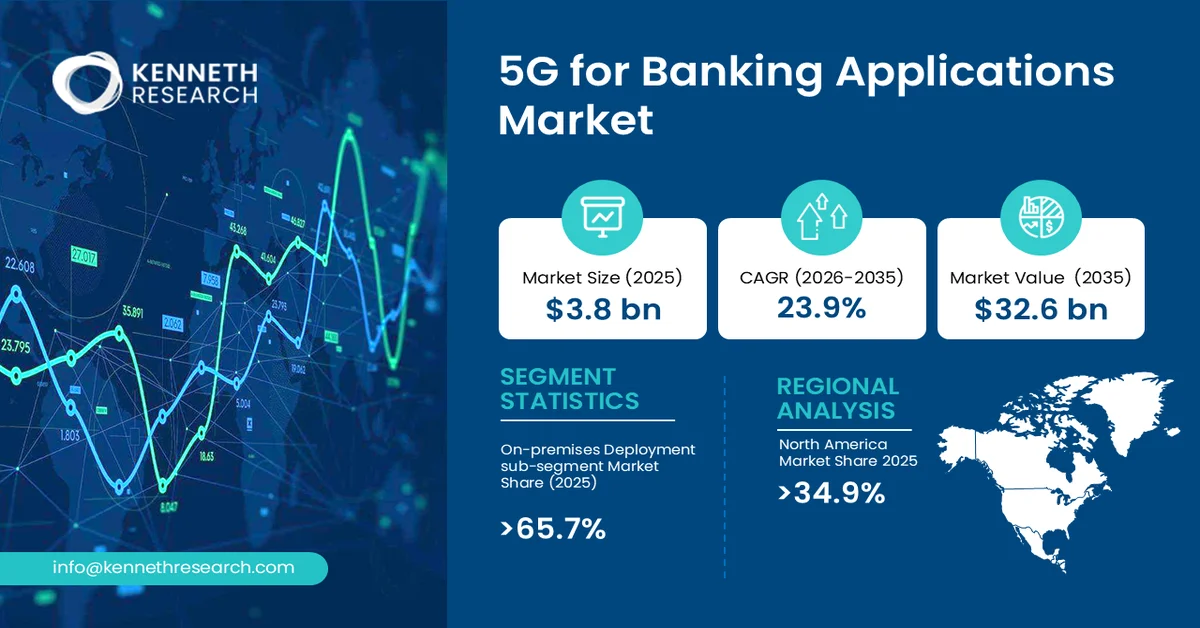
5G for Banking Applications Market size was valued at USD 3.8 billion in 2025 and is projected to reach USD 32.6 billion by the end of 2035, rising at a CAGR of 23.9% during the forecast period, i.e., 2026-2035. In 2026, the industry size of 5G for banking applications is estimated at USD 4.7 billion.
The primary growth driver is accelerating digital financial-service adoption, which increases demand for faster, more reliable, secure connectivity across mobile banking, digital payments, remote advisory, connected branches, and real-time financial applications. The World Bank reports that two-thirds of adults worldwide make or receive digital payments, reinforcing banks’ need for advanced connectivity infrastructure.
The 5G for banking applications market comprises 5G-enabled connectivity, infrastructure, network capabilities, software, and associated services deployed by banking institutions to support digital banking operations and customer-facing financial applications. It encompasses the use of fifth-generation wireless networks across mobile and branch banking, digital payments, connected devices, remote customer engagement, security systems, data-intensive applications, and emerging financial technologies.
A defining characteristic is the combination of high-capacity wireless connectivity with low-latency communications, network flexibility, virtualization, edge computing, and network-slicing capabilities. These attributes allow banks to support applications requiring responsive connectivity while enabling more adaptable network architectures. U.S. government telecommunications research identifies 5G as supporting high capacity, low latency, enhanced broadband, and services extending across industries and applications.
Key 5G for Banking Applications Market Insights Summary:
Key Takeaways: Market Trends & Insights
- 5G for Banking Applications Market reached USD 3.8 billion in 2025, reflecting expanding demand for advanced connectivity across banking operations
- The market is projected to reach USD 32.6 billion by 2035, supported by sustained adoption of 5G-enabled banking applications
- The market is expected to expand at a 23.9% CAGR from 2026 to 2035, indicating strong long-term growth momentum
- On-premises Deployment accounted for 65.7% market share in 2025, making it the leading segment within Deployment Mode
- North America held a 34.9% market share in 2025, with the United States and Canada supporting its leadership through advanced telecommunications and digital banking ecosystems
Market Drivers
- Accelerating digital-payment ecosystems
- Growing adoption of connected and automated banking infrastructure
- Increasing demand for low-latency financial applications
- Expansion of private and enterprise 5G networks
Challenges
- Cybersecurity exposure across distributed 5G banking architectures
- Complex integration with legacy banking technology and third-party systems
5G for Banking Applications Market Overview & Supply Chain
Global adoption of 5G for banking applications is increasing as financial institutions accelerate digital-channel deployment, expand mobile and contactless services, and require connectivity capable of supporting data-intensive, low-latency applications. The broader shift toward digital financial services strengthens the need for resilient communications infrastructure across banking ecosystems. The World Bank reports that 57% of adults in developing economies made or received a digital payment in 2021, demonstrating the expanding digital-service environment in which advanced connectivity technologies can support financial institutions. 5G is particularly relevant because its high capacity, low latency, and support for private or localized networks can facilitate connected branches, mobile banking infrastructure, real-time customer interactions, IoT-enabled security, and other digitally intensive banking operations.
The industry value chain begins with raw materials and technology inputs, including semiconductor components, radio-frequency equipment, antennas, optical components, servers, networking hardware, and specialized software. Manufacturing and production involve telecommunications equipment manufacturers, semiconductor suppliers, network-system integrators, and software developers that design and assemble 5G infrastructure and application-enablement technologies. Distribution occurs through telecommunications operators, technology vendors, value-added distributors, systems integrators, and managed-service providers that deliver connectivity, equipment, platforms, and implementation support to banking institutions. End users include retail banks, commercial banks, investment institutions, and other financial organizations deploying 5G-enabled applications.
5G for Banking Applications Market: Growth Drivers & Challenges
Growth Drivers:
- Expansion of secure, interoperable 5g network infrastructure: he increasing availability of secure and interoperable 5G infrastructure is strengthening the foundation for banking applications that require reliable, high-performance connectivity. Banks can use these capabilities to connect branches, mobile operations, security systems, digital-service environments, and edge-computing resources while reducing dependence on fragmented network architectures. Government-backed technology programs are also accelerating ecosystem maturity. In 2023, the U.S. National Telecommunications and Information Administration and Department of Defense selected seven contestants for the 5G Challenge from 23 white-paper applications, focusing on secure networks, open interfaces, interoperable subsystems, and modular multi-vendor solutions.
- Increasing demand for real-time digital banking experiences: The growing expectation for immediate, always-available financial services is encouraging banks to strengthen the connectivity supporting digital transactions and customer interactions. Instant payments, mobile banking, real-time fraud monitoring, digital identity services, and connected financial platforms all place greater emphasis on responsive communications infrastructure. 5G can complement these developments by providing high-capacity wireless connectivity with low latency and greater flexibility for distributed banking environments. Its potential extends beyond customer-facing applications: banks can use advanced connectivity to link branches, connected devices, security infrastructure, analytics platforms, and edge resources. As financial institutions increasingly compete on speed, availability, personalization, and digital convenience, network performance becomes an important component of service delivery.
Challenges:
- Cybersecurity exposure across 5g-enabled banking architectures: The principal restraint is the expansion of the banking attack surface as 5G introduces network slicing, virtualization, edge computing, connected devices, and greater dependence on distributed technology infrastructure. These capabilities create additional security dependencies that banks must govern alongside conventional core-banking and digital-channel controls. The commercial impact is significant because financial institutions cannot treat connectivity as a standalone telecommunications layer; security architecture, monitoring, incident response, vendor oversight, and operational resilience must be incorporated into deployment decisions. This can lengthen implementation cycles and increase integration complexity, particularly where critical banking workloads interact with external network or technology providers.
- Complexity of integrating 5g with existing banking technology: Integration complexity is another major restraint because banks operate heterogeneous environments comprising legacy core-banking platforms, private data centres, cloud services, branch systems, payment infrastructure, cybersecurity tools, and third-party technology platforms. Introducing 5G does not automatically modernize these underlying systems; instead, connectivity improvements must be coordinated with application interfaces, data architectures, security policies, operational processes, and vendor ecosystems. This creates commercial friction through longer implementation timelines, specialized integration requirements, migration risks, and the need for skilled technical resources. It can also make business cases more difficult where existing networks already satisfy basic connectivity requirements. The challenge is particularly relevant for institutions seeking to connect advanced 5G capabilities with mission-critical systems without disrupting established banking operations.
5G for Banking Applications Market Size and Forecast:
| Report Attribute | Details |
|---|---|
| Base Year |
2025 |
| Forecast Year |
2026-2035 |
| CAGR |
23.9% |
| Base Year Market Size (2025) |
USD 3.8 billion |
| Forecast Year Market Size (2035) |
USD 32.6 billion |
| Regional Scope |
|
5G for Banking Applications Market Segmentation Analysis:
Deployment Mode Segment Analysis
In the deployment mode segment, the On-premises Deployment sub-segment is anticipated to capture the largest market share of 65.7% by the end of 2025.
On-premises deployment dominates because banks prioritize direct control over sensitive workloads, network security, data governance, and integration with established core-banking infrastructure. Demand is reinforced by the continued expansion of digital banking, where institutions require reliable connectivity within controlled operational environments. The supply side is also becoming more capable as telecom equipment vendors, systems integrators, and enterprise-network providers develop private 5G architectures suited to mission-critical organizations. The International Telecommunication Union reported that 40% of the world’s population was covered by a 5G network in 2023, indicating that the underlying connectivity ecosystem is becoming increasingly available for enterprise applications. This expanding infrastructure base supports banks’ ability to deploy localized 5G networks while maintaining greater control over traffic, access, and security policies.
End-User Segment Analysis
The Retail Banks is projected to grow as the second-largest segment in the 5G for banking applications market due to four converging demand drivers.
Retail banks are projected to experience strong growth in 5G adoption because their customer-facing operations increasingly depend on mobile applications, digital payments, real-time transaction processing, connected branches, and personalized financial services. These institutions require connectivity that can support high volumes of simultaneous interactions while maintaining responsive service delivery. As retail banks expand digital services, 5G can provide an enabling communications layer for low-latency applications, branch connectivity, intelligent security systems, and emerging edge-based banking services. On the supply side, telecommunications operators and enterprise technology providers are developing private and managed 5G solutions that can be integrated with banking environments. Future adoption should strengthen as retail banks compete on digital experience, operational responsiveness, and connected service delivery.
Our in-depth analysis of the global 5G for banking applications market includes the following segments:
|
Segment |
Sub-segment |
|
Component |
|
|
Application |
|
|
Deployment Mode |
|
|
End User |
|
5G for Banking Applications Market Regional Insights:
North America Market Trends & Insights:
North America 5G for banking applications market is projected to hold the largest revenue share of 34.9% by the end of 2025.
It is supported by advanced telecommunications infrastructure, strong banking-sector digitization, substantial enterprise technology investment, and a mature ecosystem of network operators, cloud providers, cybersecurity vendors, and systems integrators. Regulatory initiatives supporting 5G deployment and open network architectures further strengthen the region’s investment environment.
Within North America, the United States represents the principal technology and investment hub, supported by major wireless operators, technology suppliers, financial institutions, and ongoing development of open and interoperable 5G architectures.
Canada complements regional strength through high digital-banking engagement and continued telecommunications modernization. Together, the two countries provide a favorable ecosystem for 5G-enabled banking applications, combining sophisticated financial markets with established connectivity infrastructure. The regional outlook remains positive as banks prioritize network resilience, digital service performance, cybersecurity, and integration of emerging technologies.
Asia Pacific Market Trends & Insights:
Asia Pacific presents strong opportunities for 5G-enabled banking applications as financial institutions accelerate digital transformation, mobile banking, digital payments, cloud adoption, and technology-led customer services. Industrial activity is supported by expanding telecommunications infrastructure, financial-technology ecosystems, and collaboration between banks, network operators, technology vendors, and regulators. Government initiatives are increasingly linking telecommunications modernization with financial-sector digitalization. In China, the People’s Bank of China and six other government agencies issued an action plan in 2024 to accelerate financial-institution digital transformation, strengthen digital-finance infrastructure, improve data capabilities, and expand digital financial services.
China represents a major regional opportunity because its banking sector is supported by coordinated government-led digital-finance development and substantial telecommunications capabilities. Policy emphasis on digital transformation, data governance, emerging infrastructure, and secure payments provides a favorable environment for advanced connectivity applications.
India is another important growth market, supported by rapid nationwide 5G deployment and continued banking-sector digitalization. The Indian government reported that 5G services had been rolled out across all states and union territories by October 2024, creating a broad connectivity foundation for enterprise applications.
5G for Banking Applications Market Competitive Landscape
Here is a list of upstream, downstream, and key players operating in the global 5G for banking applications market competitive ecosystem:
- Ericsson AB (Sweden)
- Company Overview
- Business Strategy
- Key Product Offerings
- Financial Performance
- Key Performance Indicators
- Risk Analysis
- Recent Development
- Regional Presence
- SWOT Analysis
- Huawei Technologies Co., Ltd. (China)
- Deutsche Telekom (Germany)
- Tata Consultancy Services (TCS) (India)
Recent Developments
- In October 2025, Deutsche Telekom, Ericsson (Vonage), Aduna, and mBank collaborated at the World Banking Forum to showcase how 5G and Network APIs can transform banking security. Aduna aggregates telecom network capabilities, Vonage makes these accessible to developers via APIs, and mBank integrates them into fraud prevention workflows to provide real-time identity verification and frictionless customer experiences.
- In February 2026, Huawei signed a strategic cooperation agreement with Vietnamese lender SHB to support the bank in designing technology architectures and building data platforms. The partnership focuses on digital transformation, security, data analytics, and cloud computing, with Huawei also expanding its role in Vietnam's 5G network infrastructure.
Frequently Asked Question
In 2025, the 5G for banking applications market exceeded USD 3.8 billion.
The 5G for banking applications market is projected to reach USD 32.6 billion by the end of 2035, expanding at a CAGR of 23.9% over the forecast period (2026-2035).
The major players in the market are Ericsson AB, Huawei Technologies Co., Ltd., Deutsche Telekom, Tata Consultancy Services (TCS), and others.
In the Deployment Mode segment, the On-premises Deployment sub-segment is anticipated to capture the largest market share of 65.7% in the future and exhibit lucrative growth opportunities during 2026-2035. This growth trajectory is largely attributed to banks’ preference for greater control over sensitive workloads, network security, data governance, and integration with established banking infrastructure.
North America is projected to hold the largest market share of 34.9% by the end of 205 and provide more business opportunities in the future. Continuous investments in advanced telecommunications infrastructure, digital banking, cybersecurity, and enterprise 5G capabilities across the United States and Canada are fostering the region’s dominance.
Why Choose Kenneth Research ?
-
Insight with Impact : We don’t just gather data — we uncover stories, trends, and opportunities that fuel business growth.
-
Experts Who Get It : Our team speaks your industry’s language and knows what really matters to your customers and market.
-
Custom-Built for You : Forget one-size-fits-all. We craft research and consulting solutions as unique as your business vision.
-
Partners, Not Just Providers : We work with you, not for you — collaborating closely to turn insights into smart, strategic moves.
-
Results That Speak : Our work powers brands, startups, and industry leaders alike — with a track record of ideas that work in the real world.
Report ID: 1235 |
Published Date: 14 Sep 2026 |
Report Format: |
Delivery Timeline: 48-72 Business Hours

Copyright © 2025 Kenneth Research. All rights reserved. Terms of Use | Privacy Policy
