Report ID: 1277 |
Published Date: 14 Sep 2026 |
Report Format: |
Delivery Timeline: 48-72 Business Hours
3D Sensor Market Outlook:
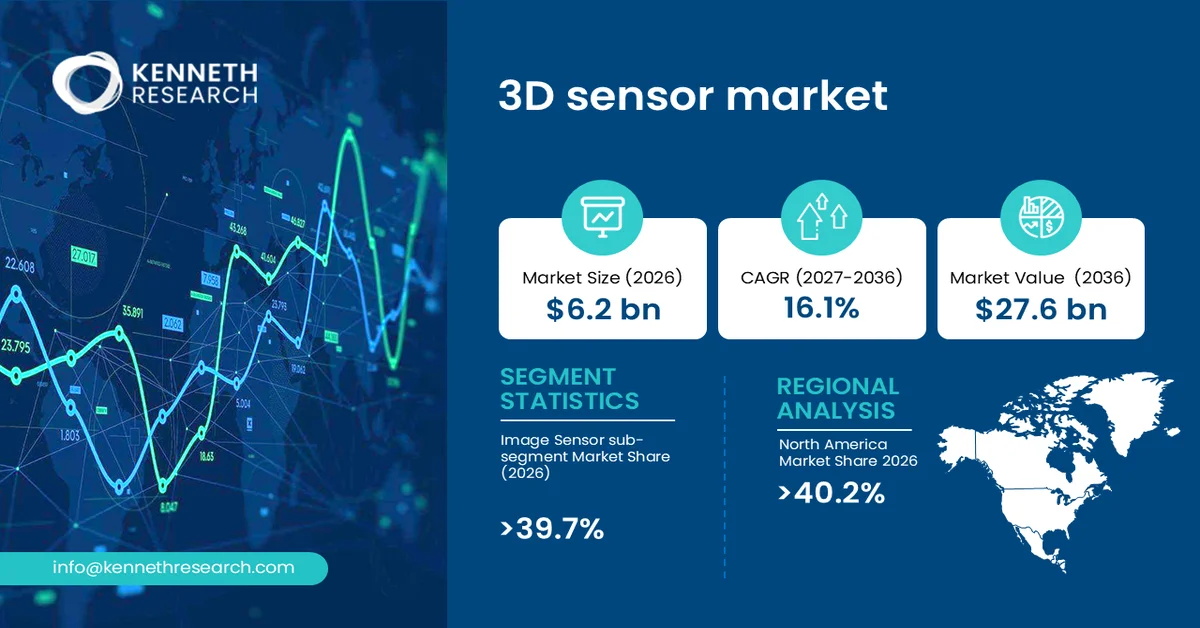
3D sensor market size was valued at USD 6.2 billion in 2026 and is projected to reach USD 27.6 billion by the end of 2036, rising at a CAGR of 16.1% during the forecast period, i.e., 2027–2036. In 2027, the industry size of the 3D sensor market is estimated at USD 7.2 billion.
The primary growth driver is the expanding deployment of automation and machine vision across manufacturing. As factories pursue more adaptive, accurate, and flexible robotic operations, 3D sensors provide spatial information that supports object recognition, positioning, inspection, assembly, bin picking, and other perception-intensive tasks, strengthening demand for industrial sensing solutions globally.
The 3D sensor market comprises hardware and associated sensing solutions that capture spatial information about objects, people, or environments, enabling machines and digital systems to perceive depth, shape, position, and three-dimensional geometry. The market encompasses sensor technologies used to generate or interpret depth information through approaches such as structured light, stereo vision, time-of-flight, and related imaging techniques.
Key characteristics include non-contact measurement, spatial awareness, depth perception, and integration with cameras, processors, robotics, machine-vision platforms, and software. Depending on the application, 3D sensors can support object localization, dimensional assessment, surface inspection, navigation, gesture or human detection, and robotic perception.
Key 3D Sensor Market Insights Summary:
Key Takeaways: Market Trends & Insights
- The 3D sensor market is projected to reach USD 27.6 billion by 2036 with a CAGR of 16.1% during 2027-2036
- Image Sensor is the leading Type segment with a 39.7% market share in 2026, driven by demand across industrial automation, robotics, automotive systems, and electronic devices
- Time of Flight is projected to grow rapidly due to increasing demand for real-time depth perception in robotics, machine vision, autonomous navigation, and human-machine interaction
- North America holds the dominant regional position with a 40.2% market share in 2026, supported by advanced semiconductor capabilities, industrial automation, research infrastructure, and technology investment
- Asia Pacific offers strong growth opportunities due to its extensive electronics manufacturing base, expanding automotive production, industrial automation, robotics adoption, and government-backed intelligent manufacturing initiatives
Market Drivers
- Growth of autonomous vehicles and advanced driver-assistance systems
- Expansion of smart manufacturing and machine-vision applications
- Rising adoption of 3D-enabled healthcare and medical imaging systems
- Increasing Demand for Real-Time Depth Perception
Challenges
- Measurement Reliability and Calibration Complexity
- Integration Complexity Across Industrial Systems
3D Sensor Market Overview & Supply Chain
Global adoption of 3D sensors is increasing as manufacturers, robotics developers, healthcare providers, and technology integrators seek more accurate spatial perception, object recognition, automation, and real-time environmental awareness. Unlike conventional imaging technologies that primarily capture surface appearance, 3D sensing provides depth and geometric information that can support machine vision, robotic manipulation, inspection, autonomous navigation, and precision measurement. Its relevance is therefore expanding alongside smart manufacturing, collaborative robotics, automated quality control, and digitally enabled production environments. Regulatory and standards activity is also strengthening the technology’s industrial foundation.
The 3D sensor market value chain begins with suppliers of semiconductor materials, optical components, light sources, photodetectors, lenses, substrates, packaging materials, and electronic components required to construct sensing modules. Component manufacturers and specialized technology developers then integrate these inputs into image sensors, depth-sensing modules, cameras, processors, and complete 3D sensing systems using technologies such as structured light, stereo vision, and time-of-flight. System manufacturers combine hardware with firmware, signal-processing capabilities, calibration, and software algorithms to deliver application-specific solutions. Distribution typically occurs through direct enterprise sales, technology integrators, electronics distributors, and specialized automation channels. End users span automotive manufacturers, industrial automation companies, consumer electronics producers, healthcare organizations, logistics operators, construction firms, and robotics developers.
3D Sensor Market - Growth Drivers & Challenges
Growth Drivers
- Expansion of Robotics and Automated Perception: The rapid deployment of robotics across manufacturing and logistics is strengthening demand for 3D sensing because autonomous machines require reliable spatial information to identify objects, measure distances, navigate workspaces, and perform collision avoidance. 3D sensors provide the depth information needed for robotic picking, inspection, autonomous mobile robots, and automated material handling, making them an important perception layer within increasingly intelligent production environments. The International Federation of Robotics reported that 4,281,585 industrial robots were operating in factories worldwide in 2023, demonstrating the substantial installed base of automated equipment that can benefit from advanced sensing and perception capabilities.
- Increasing Demand for Real-Time Depth Perception: The growing requirement for machines and devices to understand physical environments in real time is supporting adoption of 3D sensing across industrial automation, transportation, healthcare, security, consumer electronics, and smart infrastructure. Conventional two-dimensional imaging can identify visual characteristics but cannot independently provide the same depth information required for accurate spatial interpretation. 3D sensors address this limitation by combining image information with distance or depth measurements, enabling applications such as object recognition, dimensional inspection, navigation, gesture interpretation, and safety monitoring. This capability is particularly valuable where systems must respond dynamically to changing surroundings rather than simply record images.
Challenges
- Measurement Reliability and Calibration Complexity: A major restraint is the difficulty of maintaining consistent measurement performance across different 3D sensing technologies and operating environments. Optical systems can respond differently to surface reflectivity, ambient illumination, object geometry, occlusion, and sensor configuration, creating application-specific accuracy challenges. This complicates equipment selection because specifications supplied by different manufacturers may not be directly comparable, while calibration and validation can require specialized expertise. For industrial buyers, the consequence is greater integration effort, longer commissioning cycles, and increased risk when sensors are deployed in demanding production environments. NIST’s recent work highlights the continuing need for standardized performance evaluation covering factors such as resolution, operating conditions, reliability, robustness, and calibration.
- Integration Complexity Across Industrial Systems: Integration complexity can constrain adoption when 3D sensors must operate as part of larger automation architectures rather than as standalone devices. Industrial deployments commonly require synchronization between sensing hardware, robotic equipment, controllers, machine-vision software, communications interfaces, and application algorithms. Differences in data formats, sensor characteristics, environmental conditions, and system architectures can increase engineering requirements and make deployment dependent on specialized systems integrators. The commercial impact extends beyond the sensor itself because buyers may need additional engineering, software configuration, validation, and ongoing maintenance before achieving reliable production performance. This is particularly significant for manufacturers seeking flexible automation across multiple workcells or product variants, where changes in equipment or operating conditions can affect perception performance.
3D Sensor Market Size and Forecast:
| Report Attribute | Details |
|---|---|
| Base Year |
2026 |
| Forecast Year |
2027-2036 |
| CAGR |
16.1% |
| Base Year Market Size (2026) |
USD 6.2 billion |
| Forecast Year Market Size (2036) |
USD 27.6 billion |
| Regional Scope |
|
3D Sensor Market - Segment Analysis
Type Segment Analysis
In the type segment, Image Sensor sub-segment is anticipated to capture the largest market share of 39.7% by the end of 2026.
Image sensors represent the leading segment by type because they provide the core optical data required for converting physical scenes into machine-readable information, forming an essential sensing layer for 3D perception systems. Demand is supported by expanding use across smartphones, automotive systems, industrial vision, robotics, medical imaging, and other electronic devices where visual information must be captured and processed. The U.S. Department of Commerce specifically identifies image sensors among semiconductor applications in its 2024 review of critical semiconductor supply chains, alongside microcontrollers, display drivers, automobiles, satellites, and other applications. This breadth of use reinforces the segment’s strategic relevance within the wider semiconductor ecosystem. Supply-side development is also benefiting from continued semiconductor manufacturing investment, while sensor producers are pursuing higher sensitivity, smaller form factors, improved resolution, and greater integration with processing capabilities.
Technology Segment Insights
The Time of Flight is projected to grow as the second-largest segment in the 3D sensor market due to four converging demand drivers.
Time-of-Flight (ToF) is projected to grow rapidly because its direct depth-measurement approach provides real-time distance information that is well suited to robotics, machine vision, autonomous navigation, gesture recognition, and human-machine interaction. Demand is supported by applications requiring fast spatial perception, particularly where conventional two-dimensional cameras cannot independently determine object distance. NIST’s manufacturing-robotics research identifies three-dimensional geometry obtained through time-of-flight, structured-light, or stereo-camera systems as important for applications including assembly, inspection, and mobile robot navigation. Adoption is also benefiting from compact solid-state components and improving integration with semiconductor-based imaging and processing architectures, enabling ToF capabilities to be incorporated into increasingly smaller devices and robotic platforms.
Our in-depth analysis of the global 3D sensor market includes the following segments:
|
Segment |
Sub-segment |
|
Type |
|
|
Technology |
|
|
End-Use |
|
3D Sensor Market - Regional Analysis
North America Market Trends & Insights:
North America 3D sensor market is projected to hold the largest revenue share of 40.2% by the end of 2026.
It is supported by a mature semiconductor and electronics ecosystem, advanced industrial automation, strong research capabilities, and high adoption of machine vision and robotics. The United States anchors regional production, technology development, and investment, while government initiatives supporting domestic semiconductor manufacturing and advanced technology development strengthen the underlying supply base. Demand is reinforced by automotive, aerospace, defense, healthcare, logistics, and industrial applications that increasingly require precise spatial perception. U.S. Census Bureau data show that semiconductor and related device manufacturing establishments increased to 2,545 in the first quarter of 2024, illustrating expansion in the manufacturing ecosystem supporting sensor-intensive technologies.
The United States remains the principal regional technology and investment center, benefiting from semiconductor manufacturing expansion, extensive R&D capabilities, and strong industrial automation demand. Its regulatory environment increasingly emphasizes domestic technology resilience and advanced manufacturing capacity.
Canada provides complementary capabilities through electronics, semiconductor research, engineering expertise, and specialized manufacturing clusters. Government-backed efforts to strengthen technology supply chains further support its role within the regional ecosystem. Collectively, U.S. technological scale and Canadian research and manufacturing capabilities create a supportive environment for 3D sensor development, integration, and commercialization across North American end-use industries.
Asia Pacific Market Trends & Insights:
Asia Pacific represents a strong secondary growth region for 3D sensors because of its extensive electronics manufacturing base, accelerating industrial automation, expanding automotive production, and increasing deployment of robotics and intelligent factory technologies. Demand is particularly relevant to machine vision, automated inspection, logistics, consumer electronics, and advanced manufacturing, where depth perception supports more autonomous and precise operations. Government initiatives are reinforcing this environment.
China is a major demand and production center, supported by a broad electronics ecosystem and government-led intelligent-manufacturing programs. The policy emphasis on intelligent equipment, industrial robots, sensing, and digital transformation creates multiple application pathways for 3D sensing technologies.
Japan offers a complementary opportunity through its established robotics and precision-manufacturing capabilities. Government programs supporting robot research, commercialization, safety, and public implementation can encourage adoption of sophisticated perception technologies. Together, China’s manufacturing scale and Japan’s robotics expertise provide a strong platform for regional 3D sensor deployment and technology development.
3D Sensor Market Competitive Landscape
Here is a list of upstream, downstream, and key players operating in the global 3D sensor competitive ecosystem:
- Infineon Technologies AG (Germany)
- Company Overview
- Business Strategy
- Key Product Offerings
- Financial Performance
- Key Performance Indicators
- Risk Analysis
- Recent Development
- Regional Presence
- SWOT Analysis
- STMicroelectronics N.V. (Switzerland)
- ams-OSRAM AG (Austria)
- Microchip Technology Inc. (United States)
- OmniVision Technologies, Inc. (United States)
Recent Developments
- In June 2026, STMicroelectronics introduced the VL53L9, a compact direct Time-of-Flight 3D LiDAR all-in-one module delivering 2,268 zones (54×42) resolution at up to 100 frames per second. The sensor features dual-scan flood illumination to reduce motion artifacts, measure only 12.8 × 6.1 × 4.6 mm, and outputs AI-ready data for edge-AI systems on small microcontrollers. Key applications include robotics, industrial automation, AR/VR, and healthcare monitoring.
- In March 2025, OmniVision partnered with Biotech Dental to develop Scan4All 3D intraoral scanners using multiple medical-grade OmniVision CameraCubeChip® modules (OCH2B30, OCHSA10, and OVM9724). The collaboration enables highly accurate, high-speed 3D digital dental models, replacing traditional putty impressions and significantly improving patient care. OmniVision's camera modules undergo extensive biocompatibility, sterilization, and medical testing for dental applications.
Frequently Asked Question
In 2026, the 3D sensor market market exceeded USD 6.2 billion.
The 3D sensor market market is projected to reach USD 27.6 billion by the end of 2036, expanding at a CAGR of 16.1% over the forecast period (2027-2036).
The major players in the market are Infineon Technologies AG (Germany), STMicroelectronics N.V. (Switzerland), ams-OSRAM AG (Austria), Microchip Technology Inc. (United States), OmniVision Technologies, Inc. (United States), and others.
In the Type segment, the Image Sensor sub-segment is anticipated to capture the largest market share of 39.7% in the future and exhibit lucrative growth opportunities during 2027-2036. This growth trajectory is largely attributed to expanding demand for visual data capture across industrial automation, robotics, automotive systems, and electronic devices.
North America is projected to hold the largest market share of 40.2% by the end of 2026 and provide more business opportunities in the future. Continuous investments in semiconductor manufacturing, advanced industrial automation, research and development, and technology infrastructure across the United States and Canada are fostering the region's dominance.
Why Choose Kenneth Research ?
-
Insight with Impact : We don’t just gather data — we uncover stories, trends, and opportunities that fuel business growth.
-
Experts Who Get It : Our team speaks your industry’s language and knows what really matters to your customers and market.
-
Custom-Built for You : Forget one-size-fits-all. We craft research and consulting solutions as unique as your business vision.
-
Partners, Not Just Providers : We work with you, not for you — collaborating closely to turn insights into smart, strategic moves.
-
Results That Speak : Our work powers brands, startups, and industry leaders alike — with a track record of ideas that work in the real world.
Report ID: 1277 |
Published Date: 14 Sep 2026 |
Report Format: |
Delivery Timeline: 48-72 Business Hours

Copyright © 2025 Kenneth Research. All rights reserved. Terms of Use | Privacy Policy
