Report ID: 1192 |
Published Date: 27 Aug 2026 |
Report Format: |
Delivery Timeline: 48-72 Business Hours
3D Printing Photopolymers Market Outlook:
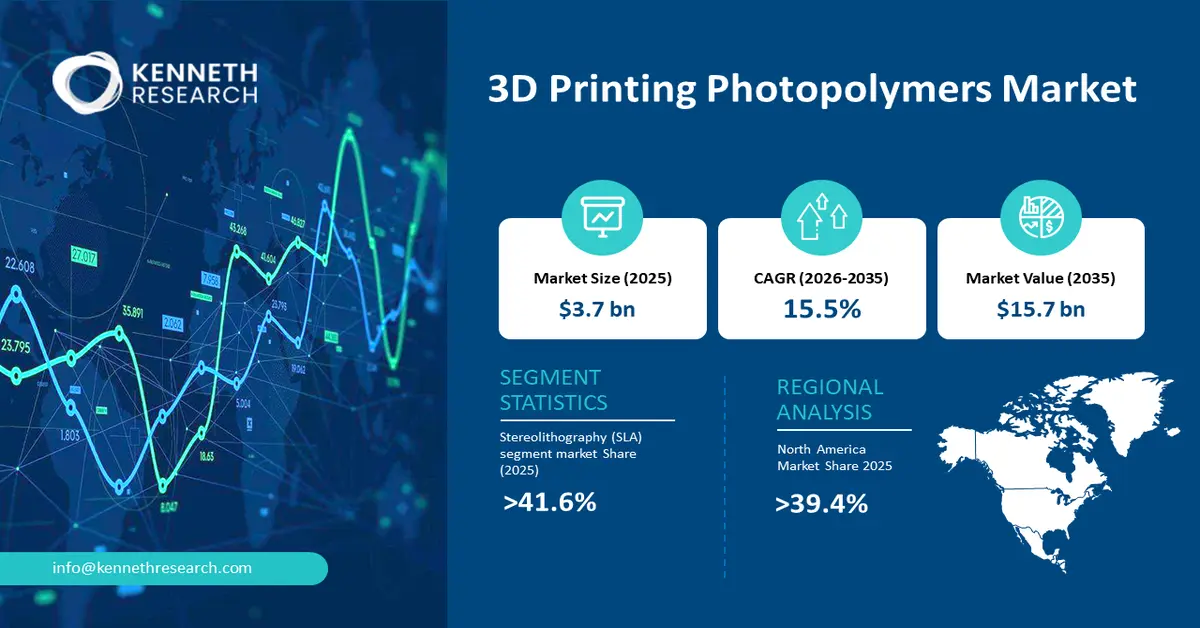
3D Printing Photopolymers Market size was valued at USD 3.7 billion in 2025 and is projected to reach USD 15.7 billion by the end of 2035, rising at a CAGR of 15.5% during the forecast period, i.e., 2026-2035. In 2026, the industry size of the 3D printing photopolymers is estimated at USD 4.3 billion.
The primary growth driver of the 3D printing photopolymers market is increasing adoption of high-resolution vat photopolymerization for applications requiring precise geometries, fine surface finishes, and customized components.
The 3D printing photopolymers market comprises photopolymer-based materials, technologies, and associated solutions used to manufacture three-dimensional parts through light-induced polymerization. Liquid photopolymer resins are selectively exposed to ultraviolet or other suitable light sources, causing controlled curing and solidification according to a digital model. Major technology approaches include Stereolithography (SLA), Digital Light Processing (DLP), and other vat photopolymerization techniques.
Photopolymer materials can be engineered to provide specific characteristics such as rigidity, flexibility, transparency, heat resistance, durability, biocompatibility, and improved surface quality. These characteristics support applications across prototyping, healthcare, dental manufacturing, electronics, automotive, aerospace, consumer products, and industrial production.
Key 3D Printing Photopolymers Market Insights Summary:
Key Takeaways: Market Trends & Insights
- The 3D printing photopolymers market is projected to grow from USD 3.7 billion in 2025 to USD 15.7 billion by 2035, registering a 15.5% CAGR during the forecast period.
- North America accounted for the largest regional share at 39.4% in 2025, supported by advanced additive manufacturing capabilities and increasing use of photopolymer technologies in precision manufacturing, healthcare, aerospace, and industrial applications.
- Stereolithography (SLA) remained the leading Technology segment with a 41.6% share in 2025, supported by its high precision, smooth surface finish, and compatibility with liquid photopolymer materials.
- High Performance is the key Performance Type segment analyzed, supported by increasing demand for photopolymers offering enhanced mechanical strength, thermal stability, and chemical resistance for demanding industrial applications.
Market Drivers
- Increasing demand for high-resolution additive manufacturing
- Development of advanced and application-specific photopolymer materials
- Growing adoption of vat photopolymerization across specialized manufacturing
- Increasing integration of advanced optical, software, and process-control technologies
Challenges
- Lack of standardized testing and measurement procedures
- Process variability and inconsistent part quality
3D Printing Photopolymers Market Overview & Supply Chain
The 3D printing photopolymers market is developing alongside advances in vat photopolymerization, materials engineering, high-resolution printing, and process-control technologies. Photopolymer systems use light to selectively cure liquid resin, enabling manufacturers to produce complex geometries with high dimensional precision and detailed surface characteristics. The U.S. National Institute of Standards and Technology (NIST) identifies vat photopolymerization as an important additive manufacturing technology and is conducting research to improve high-resolution, mechanically precise printing through advanced material and voxel-scale characterization.
The supply chain begins with chemical and polymer producers supplying monomers, oligomers, photoinitiators, photoabsorbers, reactive diluents, and specialty additives. These inputs are formulated into application-specific photopolymer resins with controlled curing behavior, viscosity, mechanical characteristics, and optical properties. Resin suppliers then work with printer manufacturers to ensure material compatibility with specific wavelengths, exposure conditions, and curing systems. The next stage comprises 3D printer and hardware manufacturers, which provide SLA, DLP, and other vat photopolymerization platforms. Hardware is increasingly integrated with optical systems, software, sensors, process monitoring, and automated curing controls.
3D Printing Photopolymers Market: Growth Drivers & Challenges
Growth Drivers:
- Increasing demand for high-resolution additive manufacturing: The growing requirement for precise, detailed, and mechanically controlled parts is a major growth driver for the 3D printing photopolymers market. Vat photopolymerization can produce intricate structures by selectively curing liquid resin with light, making it suitable for applications where dimensional accuracy and surface quality are important. NIST identifies high-resolution and mechanically precise vat photopolymerization as a key research direction, with work focused on understanding material behavior at voxel and sub-voxel scales.
- Development of advanced photopolymer materials: Continuous development of photopolymer formulations is creating new opportunities for market expansion. Material developers are increasingly targeting specific mechanical, thermal, chemical, optical, and environmental characteristics rather than relying solely on general-purpose resins. NIST research has demonstrated that modifying printable photopolymer formulations with reactive diluents can significantly influence thermomechanical properties and water resistance, illustrating the potential to tailor materials for specialized applications.
Challenges:
- Lack of standardized testing and measurement procedures: The absence of fully harmonized testing and measurement procedures remains a significant challenge for the 3D printing photopolymers market. Photopolymer printing performance depends on resin formulation, light exposure, optical characteristics, printer configuration, and process parameters, making comparisons between materials and machines difficult. NIST's 2024 interlaboratory study found substantial variation in working-curve measurements across participating laboratories and highlighted the need for standardized procedures and improved hardware characterization.
- Process variability and part quality: Maintaining consistent part quality across photopolymer printing systems is another important restraint. Variations in light intensity, spectral characteristics, exposure conditions, resin behavior, and printer hardware can influence polymerization and ultimately affect dimensional accuracy, surface texture, and part fidelity. NIST research has demonstrated that spatial variation in LCD-based light engines can influence polymerization and surface characteristics, highlighting the importance of improved optical performance.
3D Printing Photopolymers Market Size and Forecast:
| Report Attribute | Details |
|---|---|
| Base Year |
2025 |
| Forecast Period |
2026-2035 |
| CAGR |
15.5% |
| Base Year Market Size (2025) |
USD 3.7 billion |
| Forecast Year Market Size (2035) |
USD 15.7 billion |
| Regional Scope |
|
3D Printing Photopolymers Market Segmentation Analysis:
Technology Type Segment Analysis
In the technology segment, stereolithography (sla) accounted for the largest market share of 41.6% in 2025.
SLA is a vat photopolymerization process in which liquid photopolymer resin is selectively cured using light to construct parts layer by layer. Its ability to produce detailed geometries, smooth surfaces, and precise components makes it particularly relevant for applications requiring high dimensional accuracy and complex designs. NIST identifies SLA as a key photopolymer additive manufacturing technology and is conducting research aimed at improving high-resolution and mechanically precise vat photopolymerization. Demand for SLA-based photopolymers is supported by applications requiring detailed prototypes, customized components, specialized manufacturing parts, and increasingly sophisticated functional materials. Material development is also expanding the technology's capabilities.
Performance Type Segment Analysis
In the performance type segment, the high performance sub-segment is positioned for strong growth as manufacturers increasingly seek photopolymer materials with enhanced mechanical, thermal, chemical, and environmental characteristics. High-performance photopolymers are particularly relevant where standard resins cannot provide the required durability or functional performance.
NIST research is focused on developing advanced photopolymer materials and establishing relationships between feedstock composition, processing conditions, and final material properties. Its work on photopolymer additive manufacturing specifically targets high-resolution, mechanically precise vat photopolymerization and improved understanding of material behavior at the voxel and sub-voxel scales.
Our in-depth analysis of the global 3D printing photopolymers market includes the following segments:
|
Segment |
Sub-segment |
|
Technology |
|
|
Application |
|
|
Performance Type |
|
3D Printing Photopolymers Market Regional Insights:
North America Market Trends & Insights:
North America accounted for 39.4% of the 3D printing photopolymers market in 2025, supported by advanced additive manufacturing capabilities, strong materials research, and established adoption of photopolymer-based technologies across specialized applications. The U.S. has a particularly strong ecosystem involving government research institutions, technology developers, materials companies, and manufacturers.
The U.S. remains the primary contributor to regional demand, supported by sophisticated additive manufacturing research and applications spanning industrial production, healthcare, aerospace, electronics, and prototyping. Government-backed research is also addressing standardization and measurement challenges, which are important for improving repeatability and qualification of photopolymer printing processes.
Canada provides additional opportunities through its advanced manufacturing and research ecosystem. Increasing interest in digital manufacturing and additive technologies is supporting demand for specialized materials and printing systems.
Europe Market Trends & Insights:
Asia-Pacific represents a strong growth opportunity for the 3D printing photopolymers market, supported by expanding additive manufacturing capabilities, advanced electronics and automotive production, and increasing investment in high-technology manufacturing. Japan and China are particularly important markets because of their established industrial bases and growing adoption of additive manufacturing for specialized production.
Japan is strengthening its additive manufacturing ecosystem through government-supported technology development and commercialization. Japan’s Ministry of Economy, Trade and Industry (METI) notes that additive manufacturing is already being commercially used in areas including aerospace, medical devices, prototyping, and energy, while its initiatives emphasize broader utilization, workforce development, and strengthening manufacturing competitiveness.
China offers substantial potential because of its large manufacturing ecosystem and rapid development of additive manufacturing. Government-backed initiatives are also supporting advanced polymer and additive manufacturing research, including development of specialized polymer components and related engineering capabilities.
Leading Companies Operating in the Global 3D Printing Photopolymers Market:
- Stratasys Ltd. (United States)
- Company Overview
- Business Strategy
- Key Product Offerings
- Financial Performance
- Key Performance Indicators
- Risk Analysis
- Recent Development
- Regional Presence
- SWOT Analysis
- 3D Systems Corporation (United States)
- Formlabs Inc. (United States)
Recent Developments
- April 2026 –3D Systems introduced the SLA 825 Dual, a next-generation stereolithography production system, alongside its AddiTrak factory-floor software.
- January 2026 –Formlabs introduced new Tough Resins, along with Form Cure L V2 and software advancements. The resin developments are intended to expand material capabilities for functional applications requiring improved toughness and durability.
Frequently Asked Question
In 2025, the 3D printing photopolymers market was valued at USD 3.7 billion.
The 3D printing photopolymers market is projected to reach USD 15.7 billion by the end of 2035, expanding at a CAGR of 15.5% over the forecast period (2026-2035).
The major players in the market are Stratasys Ltd., 3D Systems Corporation, Formlabs Inc., Carbon, Inc., EOS GmbH, and others.
in the technology segment, stereolithography (sla) is anticipated to maintain the largest market share of 41.6% in 2025 and provide significant growth opportunities during 2026–2035.
North America is projected to maintain its leading position, accounting for 39.4% of the market in 2025.
Why Choose Kenneth Research ?
-
Insight with Impact : We don’t just gather data — we uncover stories, trends, and opportunities that fuel business growth.
-
Experts Who Get It : Our team speaks your industry’s language and knows what really matters to your customers and market.
-
Custom-Built for You : Forget one-size-fits-all. We craft research and consulting solutions as unique as your business vision.
-
Partners, Not Just Providers : We work with you, not for you — collaborating closely to turn insights into smart, strategic moves.
-
Results That Speak : Our work powers brands, startups, and industry leaders alike — with a track record of ideas that work in the real world.
Report ID: 1192 |
Published Date: 27 Aug 2026 |
Report Format: |
Delivery Timeline: 48-72 Business Hours

Copyright © 2025 Kenneth Research. All rights reserved. Terms of Use | Privacy Policy
