Report ID: 1238 |
Published Date: 14 Sep 2026 |
Report Format: |
Delivery Timeline: 48-72 Business Hours
3D Printing Materials Market Outlook:
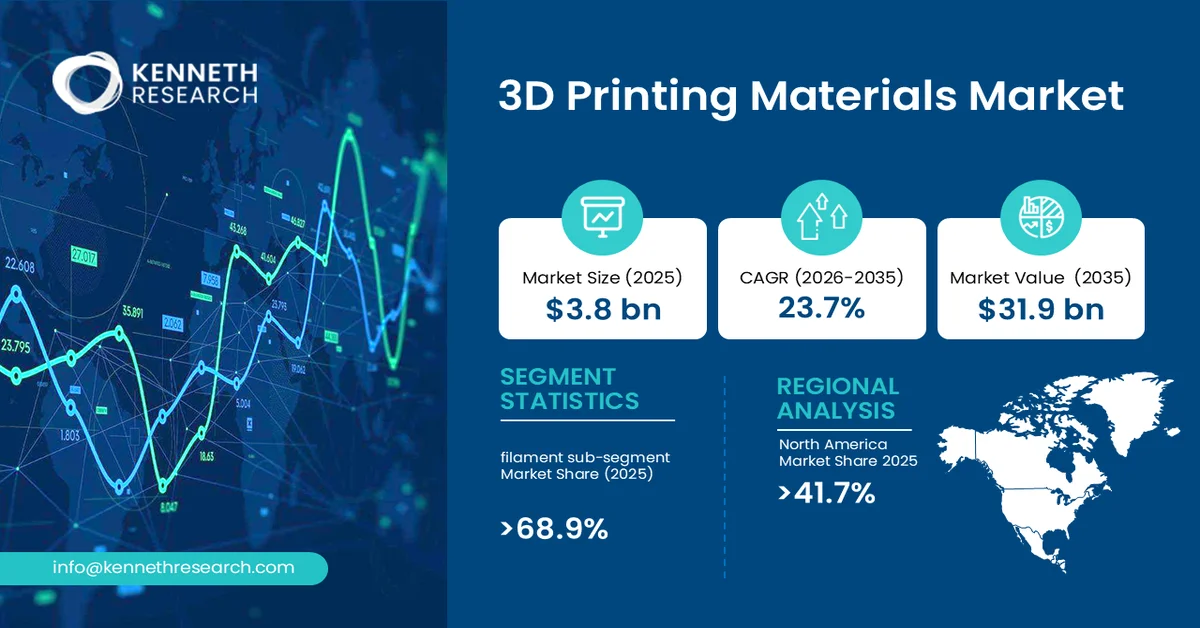
3D Printing Materials Market size was valued at USD 3.8 billion in 2025 and is projected to reach USD 31.9 billion by the end of 2035, rising at a CAGR of 23.7% during the forecast period, i.e., 2026-2035. In 2026, the industry size of 3D printing materials is estimated at USD 4.7 billion.
The primary growth driver for the c is the expanding industrial adoption of additive manufacturing for complex, customized, lightweight, and low-volume components. Government-backed research highlights its ability to accelerate design iteration, reduce tooling requirements, support on-demand production, and enable geometries that are difficult to manufacture through conventional processes.
The 3D printing materials market comprises materials used as feedstock in additive manufacturing systems to fabricate three-dimensional objects directly from digital designs. These materials are engineered to meet the processing, mechanical, thermal, chemical, dimensional, and application-specific requirements of different 3D printing technologies. Material forms can include polymers, metals, ceramics, composites, and other advanced material systems, with feedstocks commonly supplied as filaments, powders, wires, or other printable forms.
A defining characteristic of the market is its close relationship with the additive manufacturing process: material is deposited, fused, cured, or otherwise consolidated layer by layer according to a digital model. Consequently, material properties influence printability, dimensional accuracy, surface quality, strength, durability, and the reliability of finished parts. NIST identifies polymers, ceramics, metals, and advanced materials—including biomaterials, composites, and metamaterials—as important areas of additive-manufacturing materials research.
Key 3D Printing Materials Market Insights Summary:
Key Takeaways: Market Trends & Insights
- 3D Printing Materials Market is projected to expand from USD 3.8 billion in 2025 to USD 31.9 billion by 2035
- The market is expected to expand at a CAGR of 23.7% during 2026–2035
- Filament dominated the Form segment with a 68.9% market share in 2025
- North America led the regional landscape with a 41.7% market share in 2025
- Plastic is identified as the second and fastest-growing segment by Type due to increasing demand for lightweight, customized and application-specific materials
Market Drivers
- Expansion of application-specific and multifunctional material development
- Increasing use of additive manufacturing for distributed, on-demand productiong
- Expansion of Sustainable and Resource-Efficient Manufacturing
- Growth of Digital Manufacturing and Process Optimization
Challenges
- Limited standardization of material specifications
- Limited transparency across material–machine system
3D Printing Materials Market Overview & Supply Chain
Global adoption of 3D printing materials is increasing as additive manufacturing moves from prototyping toward production-oriented applications requiring customization, complex geometries, rapid design iteration, and localized manufacturing. The technology is gaining relevance across aerospace, automotive, medical, defense, and industrial production because material selection directly influences part performance, process reliability, and qualification. Government-backed research also highlights additive manufacturing’s role in reducing material waste, supporting lower-volume production, and strengthening manufacturing flexibility. NIST’s 2024 U.S. manufacturing analysis reports that additive manufacturing accounted for 0.49% of shipments in the medical/dental industry in 2021, illustrating its measurable penetration within an application area where customized components and production flexibility are strategically important.
The 3D printing materials market value chain begins with raw material and feedstock inputs, including polymers, metals, ceramics, resins, composites, and specialty additives sourced from chemical, petrochemical, metallurgical, and advanced-material suppliers. These inputs undergo material formulation, purification, compounding, alloying, particle engineering, or other processing before being converted into printer-compatible feedstock such as filament, powder, resin, or wire. Material manufacturers and specialized processors then perform quality control, characterization, packaging, and certification to meet process-specific requirements. Distribution occurs through direct industrial sales, specialized distributors, printer manufacturers, technology integrators, and digital procurement channels. End users include aerospace and defense manufacturers, automotive companies, healthcare providers, industrial equipment producers, electronics companies, research institutions, and service bureaus.
3D Printing Materials Market: Growth Drivers & Challenges
Growth Drivers:
- Advancement of high-performance materials for critical applications: The development of higher-performance 3D printing materials is expanding additive manufacturing beyond conventional prototyping into demanding aerospace, energy, defense, and industrial applications. Material innovations that improve temperature resistance, strength, durability, and weight efficiency allow manufacturers to consider additive production for components previously dependent on established manufacturing routes. A notable government-backed example is NASA’s development of the GRX-810 alloy using additive manufacturing and material modeling. NASA reports that the alloy can withstand temperatures above 2,000°F and provides substantially enhanced mechanical performance compared with conventional state-of-the-art alloys. Such developments demonstrate how materials engineering can unlock new application classes rather than merely improve existing printing processes.
- Increasing demand for complex and customized manufacturing: Growing demand for customized components, complex geometries, lightweight structures, and flexible production is supporting consumption of 3D printing materials across industrial manufacturing. Additive processes allow manufacturers to translate digital designs into physical components without relying on conventional tooling architectures, making material choice increasingly central to application economics and performance. This is particularly relevant where production requirements involve intricate structures, rapid design changes, specialized components, or distributed manufacturing. As manufacturers move toward more application-specific production, demand is shifting from generic feedstocks toward materials engineered for particular thermal, mechanical, chemical, and processing requirements.
Challenges:
- Lack of standardized material specifications: Fragmented material specifications and testing practices create difficulty in comparing feedstocks across suppliers, machines, and printing processes. Differences in characterization methods can make nominally similar materials difficult to evaluate on a consistent basis, increasing technical due diligence for buyers and development costs for suppliers. This is particularly consequential for industrial customers seeking repeatable production outcomes because material qualification must account for interactions between feedstock properties and process conditions. NIST’s recent standards work identifies materials research as an important requirement for developing technical standards in additive manufacturing. Commercially, limited standardization can slow supplier qualification, complicate procurement decisions, and favor closed ecosystems where material and equipment compatibility is tightly controlled.
- Limited transparency across material–machine systems: Closed material and equipment ecosystems can restrict transparency around processing parameters and material behavior, making optimization more difficult for industrial users. When suppliers tightly control feedstock formulations, machine settings, software, or process data, customers may have limited ability to transfer materials between platforms or independently optimize production. This can increase dependence on specific vendors and raise switching costs when manufacturers expand their additive operations. NIST research identifies the interaction of numerous material and process variables, alongside limited transparency in some supplier systems, as a barrier to optimizing polymer-based additive manufacturing. Commercially, this can constrain interoperability, slow scale-up, and discourage buyers seeking multi-vendor supply strategies.
3D Printing Materials Market Size and Forecast:
| Report Attribute | Details |
|---|---|
| Base Year |
2025 |
| Forecast Year |
2026-2035 |
| CAGR |
23.7% |
| Base Year Market Size (2025) |
USD 3.8 billion |
| Forecast Year Market Size (2035) |
USD 31.9 billion |
| Regional Scope |
|
3D Printing Materials Market Segmentation Analysis:
Form Segment Analysis
In the form segment, the filament sub-segment is anticipated to capture the largest market share of 68.9% by the end of 2025.
Filament dominates the Form segment because material extrusion systems provide an accessible and versatile route for converting polymer feedstock into functional parts, prototypes, tooling, and customized components. Demand is supported by the broad availability of thermoplastic materials, relatively straightforward handling, and compatibility with established fused filament fabrication workflows. Government research reinforces the importance of filament-based extrusion: the U.S. Department of Energy selected projects specifically focused on developing coal-enhanced PEEK filament, waste-enhanced filaments for high-temperature plastics and ceramic composites, and graphene-particle bonded filaments for additive manufacturing. This demonstrates active public-sector support for expanding filament formulations into higher-performance applications. On the supply side, filament producers can differentiate through reinforced polymers, thermal performance, conductivity, recyclability, and application-specific formulations.
Type Segment Analysis
The plastic is projected to grow as the second-largest segment in the 3D printing materials market due to four converging demand drivers.
Plastic is projected to remain the fastest-growing Type segment as manufacturers increasingly use polymer-based additive manufacturing for lightweight structures, tooling, prototypes, functional components, and large-format applications. Demand is supported by the processing flexibility of thermoplastics and the ability to formulate materials with targeted mechanical, thermal, chemical, and sustainability characteristics. Adoption is also expanding into energy applications: in 2023, the U.S. Department of Energy announced $30 million in funding to advance composite materials and additive manufacturing for large wind turbines, including projects specifically focused on polymer-based additive manufacturing for large wind blades. This government-backed initiative signals increasing industrial attention toward polymer AM in energy infrastructure.
Our in-depth analysis of the global 3D printing materials market includes the following segments:
|
Segment |
Sub-segment |
|
Form |
|
|
Type |
|
|
End-User |
|
3D Printing Materials Market Regional Insights:
North America Market Trends & Insights:
North America 3D printing materials market is projected to hold the largest revenue share of 41.7% by the end of 2025.
It is supported by a mature additive manufacturing ecosystem, advanced industrial capabilities, established material suppliers, and sustained investment in manufacturing innovation. The region benefits from strong demand across aerospace, defense, automotive, healthcare, and industrial applications, where material performance and production reliability are critical. The United States provides the region’s principal manufacturing and technology base, while regulatory and standards activity supports commercialization and qualification of additive processes.
The United States remains the regional anchor through extensive industrial adoption, federal research programs, advanced manufacturing initiatives, and a strong ecosystem connecting material developers, printer manufacturers, research institutions, and end users.
Canada complements this ecosystem through its advanced manufacturing base, research capabilities, and growing application of additive technologies across aerospace, healthcare, energy, and industrial production. Together, the two countries provide North America with strong capabilities spanning material development, equipment, process engineering, qualification, and end-use manufacturing, supporting continued regional leadership as additive manufacturing shifts toward higher-value production applications.
Asia Pacific Market Trends & Insights:
Asia Pacific is emerging as a high-potential region for 3D printing materials as manufacturers pursue localized production, advanced manufacturing capabilities, shorter development cycles, and greater design flexibility. Government initiatives are strengthening the regional ecosystem by connecting research institutions, equipment developers, material suppliers, and industrial users. China is supporting additive manufacturing as part of broader industrial modernization, including the use of additive manufacturing in equipment remanufacturing and advanced industrial applications. India is likewise developing domestic capabilities through its National Strategy for Additive Manufacturing and dedicated centers supporting machines, materials, software, and applications.
China represents a major manufacturing base for additive manufacturing, supported by extensive industrial production capabilities and government-led modernization initiatives. Its ecosystem spans equipment manufacturing, material development, industrial applications, and increasingly specialized technologies such as additive manufacturing for high-value and regulated applications. This creates a substantial addressable environment for domestic and international material developers.
India is building an indigenous additive manufacturing ecosystem through government-backed strategy, research centers, skills development, and industry collaboration. The Ministry of Electronics and Information Technology’s National Strategy for Additive Manufacturing is designed to strengthen domestic capabilities across machines, materials, software, and products. Continued development of these capabilities should create opportunities for material suppliers serving electronics, medical devices, renewable energy, defense, and advanced industrial manufacturing.
Leading Companies Operating in the Global 3D Printing Materials Market:
Here is a list of upstream, downstream, and key players operating in the global 3D printing materials market competitive ecosystem:
- 3D Systems, Inc. (United States)
- Company Overview
- Business Strategy
- Key Product Offerings
- Financial Performance
- Key Performance Indicators
- Risk Analysis
- Recent Development
- Regional Presence
- SWOT Analysis
- Stratasys Ltd. (United States/Israel)
- EOS GmbH (Germany)
- Materialise NV (Belgium)
Recent Developments
- In April 2026, 3D Systems introduced the SLA 825 Dual stereolithography system, featuring a 22% larger build volume and up to 25% faster print speeds than its predecessor, alongside the AddiTrak™ factory software platform for real-time fleet monitoring and process control.
- In February 2026, Stratasys launched a qualification program for its SAF™ PA12 production-ready nylon material, collaborating with Boeing, General Atomics, Northrop Grumman, Raytheon, and others through the NCAMP process to validate the material for repeatable, production-grade manufacturing across aerospace and industrial use cases.
Frequently Asked Question
The 3D printing materials market market size is as stated in the persistent INPUT.
The 3D printing materials market is projected to reach the forecast value stated in the persistent INPUT, expanding at the stated CAGR over the forecast period.
The major players in the market are 3D Systems, Inc., Stratasys Ltd., EOS GmbH, Materialise NV, and others.
In the Form segment, the Filament sub-segment is anticipated to capture the largest market share stated in the persistent INPUT and exhibit lucrative growth opportunities during the forecast period. This growth trajectory is largely attributed to increasing demand for customized components, complex geometries, lightweight structures, and flexible production.
North America is projected to hold the largest market share stated in the persistent INPUT by the end of the forecast year and provide more business opportunities in the future. Continuous investments and advanced manufacturing activity across the United States and Canada are fostering the region's dominance.
Why Choose Kenneth Research ?
-
Insight with Impact : We don’t just gather data — we uncover stories, trends, and opportunities that fuel business growth.
-
Experts Who Get It : Our team speaks your industry’s language and knows what really matters to your customers and market.
-
Custom-Built for You : Forget one-size-fits-all. We craft research and consulting solutions as unique as your business vision.
-
Partners, Not Just Providers : We work with you, not for you — collaborating closely to turn insights into smart, strategic moves.
-
Results That Speak : Our work powers brands, startups, and industry leaders alike — with a track record of ideas that work in the real world.
Report ID: 1238 |
Published Date: 14 Sep 2026 |
Report Format: |
Delivery Timeline: 48-72 Business Hours

Copyright © 2025 Kenneth Research. All rights reserved. Terms of Use | Privacy Policy
